
- 5 leading manufacturers
- 27 additional suppliers
- 17 states and provinces
- 20 related categories
- 3 guide sections
Robotic System Integrator Manufacturers and Companies
IQS Directory provides a detailed list of robotic system integrator companies. Find robotic system integrator companies that can design, engineer, and manufacture automated robotic system integrators to your specifications. Peruse our website to review and discover top robotic system integrator companies with roll over ads and complete product descriptions. Connect with the robotic system integrator companies through our hassle-free and efficient request for quote form. You are provided company profiles, website links, locations, phone numbers, product videos, and product information. Read reviews and stay informed with product news articles. Whether you are looking for manufacturers of assembly machinery, custom machinery, or robotic automation of every type, IQS is the premier source for you.
Suppliers located in MI, CA, IL +14 more states
Contents (5 sections)
Leading Robotic System Integrator Manufacturers
Showing all 5
| Placement No. | Manufacturer | Location | Contact | Actions | |
|---|---|---|---|---|---|
| 1 | InvioAt Invio Automation, we design and deliver automation equipment that helps manufacturers improve efficiency, consistency, and control across their production operations. We develop automated systems that streamline complex processes, reduce manual intervention, and support repeatable performance in demanding manufacturing environments. Our solutions are engineered with a focus on reliability and integration, allowing automation to fit naturally within existing workflows while supporting higher throughput and improved process stability. | New Baltimore, MI | |||
| 2 | Advent Design CorporationAdvent Design’s Manufacturing Automation group has a proven track record in the design and assembly of custom equipment for manufacturing. Company experience ranges from single workstation semi-automated equipment to fully integrated production lines. Additionally, we offer machine safety integration services to assist you in making your machine compliant with current safeguarding standards. Our diverse team members work together with your company to achieve the best solution for your particular needs. | Bristol, PA | |||
| 3 | Isotech, Inc.Since 1982, Isotech has been a leader in the automation equipment industry. You can trust the accuracy of our solutions. Our experts at Isotech are always available to assist you with your needs. Feel free to contact us today to learn more information! | Hatfield, PA | |||
| 4 | Del-Tron Precision, Inc.Del-Tron Precision is your one-stop shop for ball & crossed roller slides, multi-axis positioning and motor-ready lead screw stages, air actuators, recirculating slide guides and crossed roller rail sets. Custom linear slides are available. Visit our website to find life/load calculators. Our greatest strength is to offer components which provide a reliable mechanical interface for equipment. | Bethel, CT | |||
| 5 | Adaptek SystemsAt Adaptek Systems, we design and build automation equipment that helps manufacturers improve productivity, consistency, and process control. Our company develops custom automated systems for production environments where repeatability, accuracy, and reliable operation are essential. | Fort Wayne, IN |
Claim your Page One Spot
Leading robotic system integrator manufacturers are listed first on this page, each with a website preview and a Request a Quote button on its row.
Additional Robotic System Integrator Companies
The category’s other robotic system integrator companies are listed on their own page, with location, phone and website where each supplier provides them.
View 27 Additional Robotic System Integrator CompaniesDo not see your company listed in Robotic System Integrator?
Engineers and buyers use this page to find robotic system integrator suppliers. Add your company to the Robotic System Integrator listings so they can find you too.
List Your Company- Listed in the Robotic System Integrator directory
- A profile page for your company
- Buyers contact you directly
Robotic System Integrator Industrial Manufacturing Guides
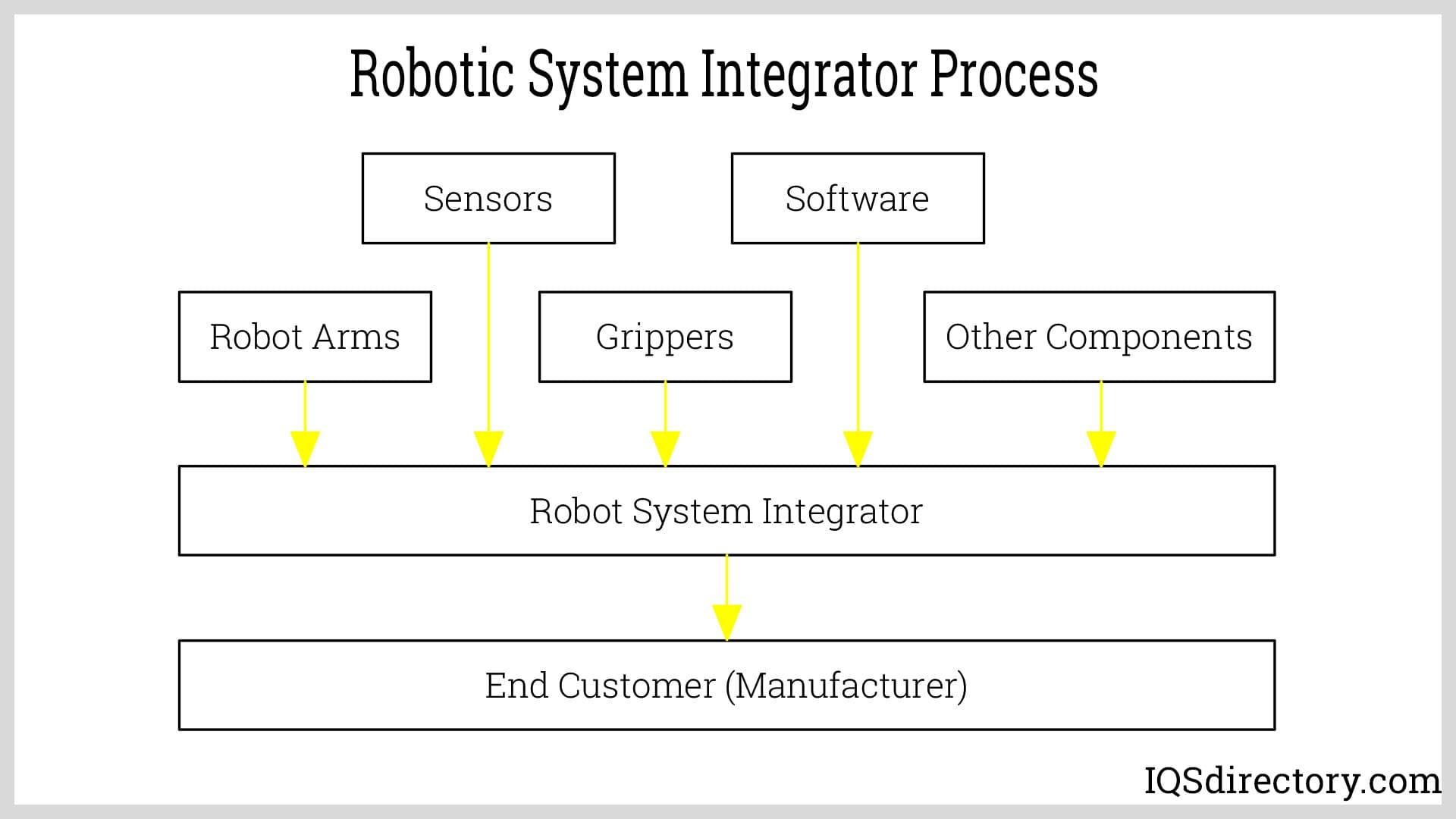
Robotic System Integrators: Types & Benefits
This article contains everything you need to know about robotic system integration and its use. You will learn What is Robotic System Integration? The Process…
5 chapters
Quick Answers
- How many robotic system integrator manufacturers are listed on IQS Directory?
- 5 leading manufacturers and 27 additional suppliers.
- Where are robotic system integrator manufacturers located?
- The listed suppliers are in 17 states and provinces: Michigan (6), California (3), Illinois (3), Indiana (3), Ohio (3), Pennsylvania (3), Colorado (1), Connecticut (1), and 9 more.
- How do I get quotes from robotic system integrator suppliers?
- Select suppliers in the table and choose Request Quotes. IQS reviews your request and forwards it to every supplier you select.
Robotic System Integrator
The rapid evolution of robotics and automation technologies has revolutionized the manufacturing landscape, introducing new possibilities for efficiency, precision, and innovation. Amidst this transformation, Robotic System Integrators (RSIs) emerge as key enablers, orchestrating the seamless integration of robotics into manufacturing processes. Robotic System Integrators are specialized professionals or firms that bridge the gap between manufacturers and robotics technology.
Key Functions of Robotic System Integrators
RSIs bring together a combination of expertise in robotics, automation, engineering, programming, and project management. The primary objective of a robotic system integrator is to bridge the gap between manufacturers seeking operational enhancements and the cutting-edge capabilities of robotic systems.
Systems Thinking and Assessment
At the core of an RSI's engagement lies a comprehensive assessment of the manufacturing ecosystem. The RSI collaborates with manufacturers to dissect the intricacies of the production process, from raw materials to end products. This involves a holistic understanding of workflows, material flows, kinematics, and the interplay of machinery.
During this phase, the RSI evaluates opportunities for automation, analyzing processes that could benefit from robotic intervention. Factors such as cycle time reduction, precision improvement, and human-robot collaboration feasibility are meticulously scrutinized. This process demands an acute awareness of the manufacturer's operational objectives and industry-specific challenges.
Customized Design and Engineering
Following the assessment, RSIs embark on a design and engineering journey that fuses creativity with technical rigor. This phase involves a profound selection process for robotic components, including arms, grippers, sensors, and controllers. The RSI tailors these choices to align with the unique requirements of the manufacturing process.
Advanced computer-aided design (CAD) tools are harnessed to create digital representations of the proposed robotic systems. The integration of kinematic models, simulation, and virtual prototyping enables the RSI to visualize the interactions between robots, humans, and other machinery. This iterative design process ensures optimal spatial utilization and task allocation.
Integration and Programming
The heart of the RSI's role culminates in the integration and programming of robotic systems. This phase necessitates expertise in robotics programming languages, motion planning algorithms, and real-time control systems. The RSI orchestrates the harmonious synchronization of multiple robots and peripheral devices, orchestrating a symphony of motion.
Collaborative robots (cobots) add an extra layer of complexity to this phase, as the RSI must program the robots to work alongside human operators safely and efficiently. This entails defining force and torque limits, implementing collision avoidance strategies, and establishing intuitive human-robot interfaces.
Rigorous Testing and Validation
Prior to deployment, RSIs engage in rigorous testing and validation procedures. Simulations, driven by accurate physics engines, emulate real-world scenarios to anticipate challenges and rectify potential pitfalls. Through iterative testing, the RSI fine-tunes control algorithms, refines trajectories, and ensures error recovery mechanisms are in place.
Validation also encompasses physical testing in controlled environments. This involves monitoring the robot's performance across various operational conditions, stress-testing the system's responsiveness, and validating safety mechanisms. The goal is to guarantee that the integrated solution adheres to predetermined performance metrics.
Training, Maintenance, and Continuous Improvement
RSIs assume the mantle of educators, training manufacturers' personnel to interact with and oversee the robotic systems. Comprehensive training programs cover robot operation, troubleshooting, and maintenance, enabling the manufacturer to independently manage the system's day-to-day operations.
The RSI's involvement extends beyond implementation. They offer ongoing support, maintenance, and continuous improvement services. This includes updating software, fine-tuning algorithms for optimal performance, and integrating emerging technologies to keep the system at the forefront of efficiency and innovation.
Benefits of Collaborating with Robotic System Integrators
The symbiotic relationship between manufacturers and Robotic System Integrators (RSIs) yields a multitude of benefits that reverberate across industries. The decision to collaborate with RSIs transcends simple automation—it represents a strategic investment in efficiency, innovation, and long-term competitiveness. Here, we delve deeper into the profound benefits that emanate from such partnerships:
Expertise and Innovation
Robotic System Integrators are domain experts with an intricate understanding of robotics, automation technologies, and industry-specific challenges. By tapping into their expertise, manufacturers gain access to a treasure trove of innovative solutions that can reshape their operational landscape. RSIs continuously track technological advancements, ensuring that their solutions incorporate the latest breakthroughs, from AI-powered vision systems to collaborative robotic interfaces.
Customization and Tailored Solutions
Each manufacturing environment is distinct, replete with unique processes, layouts, and requirements. The hallmark of RSIs lies in their ability to engineer tailor-made solutions that seamlessly integrate with existing workflows. RSIs dissect the manufacturing ecosystem, analyzing pain points, optimizing processes, and designing robotic systems that align with the manufacturer's precise needs. This customization enhances efficiency, reduces waste, and drives a surge in productivity.
Accelerated Return on Investment (ROI)
The collaborative integration of robotics through RSIs often yields a rapid return on investment. By optimizing processes, reducing cycle times, and curbing error rates, robotic systems swiftly manifest their economic benefits. Manufacturers witness tangible improvements in product output, operational cost savings, and overall production throughput. This accelerated ROI not only validates the decision to collaborate with RSIs but also provides a compelling business case for future endeavors.
Enhanced Quality and Consistency
Robotic precision translates into consistent product quality, thereby minimizing variations and defects. RSIs engineer robotic systems with meticulous attention to detail, ensuring that each task is executed with unparalleled accuracy. The elimination of human errors, fatigue, and variability results in products that meet or exceed stringent quality standards. Manufacturers can confidently deliver products that consistently adhere to customer expectations, building trust and reputation.
Scalability and Flexibility
Manufacturing environments are rarely static; they evolve to accommodate market fluctuations and changing demands. RSIs design systems with inherent scalability and flexibility, enabling manufacturers to adapt to varying production volumes without major overhauls. Robotic systems can be modified, reprogrammed, or expanded with relative ease, facilitating agile responses to market dynamics and strategic business shifts.
Safety and Workforce Empowerment
Robotic systems, when designed and integrated with safety as a top priority, enhance workplace safety by relegating hazardous tasks to machines. RSIs engineer solutions that employ safety sensors, collision avoidance algorithms, and fail-safes to protect both human operators and robots. Moreover, collaborative robots enable human-robot teamwork, allowing workers to focus on higher-value tasks that demand creativity, decision-making, and critical thinking.
Competitive Edge and Industry Leadership
Collaborating with RSIs propels manufacturers into the vanguard of industrial innovation. The ability to leverage cutting-edge robotics and automation technologies positions manufacturers as pioneers within their sectors. This technological leadership can result in market differentiation, increased customer loyalty, and a competitive edge that facilitates sustained growth in a rapidly evolving business landscape.
Continuous Improvement and Future-Readiness
RSIs remain steadfast partners beyond initial implementation. They proactively monitor system performance, analyze data, and fine-tune algorithms to optimize efficiency over time. Moreover, RSIs guide manufacturers in embracing emerging technologies, such as machine learning and the Internet of Things (IoT), ensuring that robotic systems remain at the forefront of innovation and future-readiness.
In a world defined by relentless innovation and ever-increasing competition, manufacturers find formidable allies in Robotic System Integrators. Through collaboration, they access a reservoir of expertise, innovation, and strategic guidance that culminate in a harmonious blend of human ingenuity and robotic precision. The decision to partner with RSIs transcends mere automation—it represents a decisive step towards a future where efficiency, quality, and sustainable growth converge.
Selecting the Right Robotic System Integrator
- Expertise and Portfolio: Review the RSI's expertise, previous projects, and success stories in similar industries.
- Collaborative Approach: Choose an RSI that values collaboration and works closely with your team throughout the project.
- Technical Proficiency: Evaluate the RSI's technical capabilities, including programming expertise and knowledge of cutting-edge technologies.
- Project Management: A skilled RSI should demonstrate strong project management skills to ensure timely completion and smooth execution.
- After-Sales Support: Consider an RSI that offers comprehensive after-sales support, including maintenance and troubleshooting services.