
- 4 leading manufacturers
- 27 additional suppliers
- 16 states and provinces
- 20 related categories
- 9 guide sections
Industrial Robot Integrators and Parts Suppliers
IQS Directory provides a comprehensive list of industrial robot manufacturers and suppliers. Use our website to review and source top industrial robot manufacturers with roll over ads and detailed product descriptions. Find industrial robot companies that can design, engineer, and manufacture industrial robots to your companies specifications. Then contact the industrial robot companies through our quick and easy request for quote form. Website links, company profile, locations, phone, product videos and product information is provided for each company. Whether you are looking for manufacturers of Automation Systems, Custom Machinery, Factory Automation or Used Robots of every type, this is the resource for you.
Suppliers located in MI, CA, IL +13 more states
Contents (5 sections)
Leading Industrial Robot Integrators and Parts Manufacturers
Showing all 4
| Placement No. | Manufacturer | Location | Contact | Actions | |
|---|---|---|---|---|---|
| 1 | InvioAt Invio Automation, we design and deliver automation equipment that helps manufacturers improve efficiency, consistency, and control across their production operations. We develop automated systems that streamline complex processes, reduce manual intervention, and support repeatable performance in demanding manufacturing environments. Our solutions are engineered with a focus on reliability and integration, allowing automation to fit naturally within existing workflows while supporting higher throughput and improved process stability. | New Baltimore, MI | |||
| 2 | Advent Design CorporationAdvent Design’s Manufacturing Automation group has a proven track record in the design and assembly of custom equipment for manufacturing. Company experience ranges from single workstation semi-automated equipment to fully integrated production lines. Additionally, we offer machine safety integration services to assist you in making your machine compliant with current safeguarding standards. Our diverse team members work together with your company to achieve the best solution for your particular needs. | Bristol, PA | |||
| 3 | Isotech, Inc.Since 1982, Isotech has been a leader in the automation equipment industry. You can trust the accuracy of our solutions. Our experts at Isotech are always available to assist you with your needs. Feel free to contact us today to learn more information! | Hatfield, PA | |||
| 4 | Adaptek SystemsAt Adaptek Systems, we design and build automation equipment that helps manufacturers improve productivity, consistency, and process control. Our company develops custom automated systems for production environments where repeatability, accuracy, and reliable operation are essential. | Fort Wayne, IN |
Claim your Page One Spot
Leading industrial robot integrators and parts manufacturers are listed first on this page, each with a website preview and a Request a Quote button on its row.
Additional Industrial Robot Integrators and Parts Companies
The category’s other industrial robot integrators and parts companies are listed on their own page, with location, phone and website where each supplier provides them.
View 27 Additional Industrial Robot Integrators and Parts CompaniesDo not see your company listed in Industrial Robots?
Engineers and buyers use this page to find industrial robot integrators and parts suppliers. Add your company to the Industrial Robots listings so they can find you too.
List Your Company- Listed in the Industrial Robots directory
- A profile page for your company
- Buyers contact you directly
Industrial Robot Integrators and Parts Industrial Manufacturing Guides
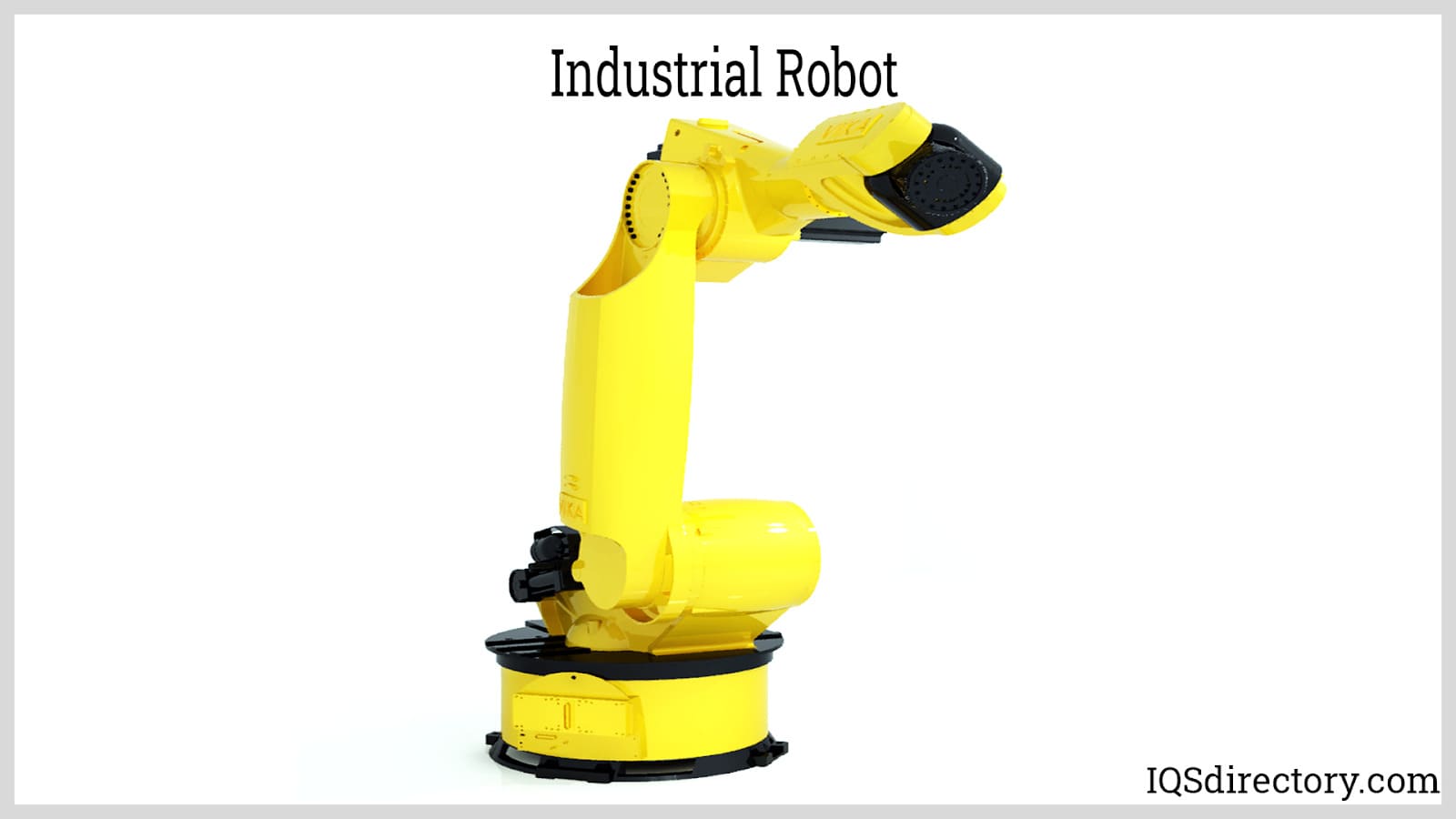
Industrial Robots: Everything You Need to Know about Types & Uses
This article takes an in-depth look at industrial robots. Read further to learn more about topics such as: What are Industrial Robots? Advantages of Industrial…
5 chapters
Quick Answers
- How many industrial robot integrators and parts manufacturers are listed on IQS Directory?
- 4 leading manufacturers and 27 additional suppliers.
- Where are industrial robot integrators and parts manufacturers located?
- The listed suppliers are in 16 states and provinces: Michigan (6), California (3), Illinois (3), Indiana (3), Ohio (3), Pennsylvania (3), Colorado (1), Florida (1), and 8 more.
- How do I get quotes from industrial robot integrators and parts suppliers?
- Select suppliers in the table and choose Request Quotes. IQS reviews your request and forwards it to every supplier you select.
Industrial Robots
People often think of robots as technology of the future. In actuality, industrial robots have a very dynamic and clear presence in today’s manufacturing and assembly operations. Once programmed to complete simple and repetitive tasks, modern day robots, through the use of sensors, are able to assess their environment and make decisions regarding how to approach an application.
Since their inception in the early 1960s, robots have rapidly developed into the go to device of the 21st Century. They have advanced from welding and completing simple industrial chores to assembling and shipping products.
What Are Industrial Robots
The term “industrial robots” covers a wide range of machines that are capable of completing complicated and complex tasks in minimal time. The range of devices under the name industrial robots includes computer numerical controlled (CNC) machines, material handling robots, palletizing robots, and painting and assembly robots.
The types of industrial robots are ever expanding and are difficult to boil down to a single concise definition. The general and acceptable definition is a robot system for manufacturing using robots that are automated, programmable, and capable of moving on three or more axes.
When robots are incorporated into a production application, they are designed and programmed for a specific task. They are being implemented more often as a means of increasing efficiency and lowering production costs.
Classification of Industrial Robots
Industrial robots are divided according to their function by the International Organization for Standardization (ISO). The organization developed their system of identification because of the confusion associated with the various types of robots. The four classifications are A, B, C and D.
A and B Classification
The A classification is for simple robots that complete repetitive tasks, while the B classification is for robots that are programmable and able to complete tasks that require precision and accuracy.
C and D Classification
Type C is a more advanced form of robot, usually CNC, that is programmable with greater strength and able to complete demanding tasks. The type D is the elite of robots that has sensors to read their environment and the ability to adapt and change according to the surrounding conditions.
Industrial Robot Configurations
Though there are many varieties and types of robots, there are six main types that are used when discussing them; these are cartesian, selectively compliant arm for robotic assembly (SCARA), cylindrical, delta, polar, and vertically articulated. These six configurations are the general types with several configurations that fall outside these six.
Engineers refer to the joints in the arm of a robot as axes, since the movement of the arm can be on several axes depending on its design. Axes can be very simple at two joints or very complex with ten axes. More axes of movement adds more freedom to the robot and its range of motion.
Common Industrial Robot Applications
Common industrial applications for robots include arc welding, spot welding, material handling, machine tending, assembly, and laser vision. Operations that are completed on a CNC machine include grinding, cutting, deburring, sanding, polishing, and routing to name a few.
The age of robotics is not something of the distant future but is something that has been growing for thirty years and continues to be implemented to improve production and enhance efficiency.
Autonomous Mobile Robots
An element that has significantly impacted the supply chain has been the rise and use of autonomous mobile robots (AMRs), a mobile device capable of moving through an environment without the need of an operator. Initially known as automated guided vehicles (AGVs), AMRs were introduced to the world in the early 1950s as material handling devices that followed a track of wires embedded in the floor of a factory or warehouse to move goods, inventory, and supplies in a set pattern.
From its initial beginning as a robotic device that required a set of wires to navigate its environment, AMRs have made giant leaps forward with the addition of sensors that allow them to navigate, learn, and evaluate their surroundings. As smarter robots, AMRs are capable of selecting the most efficient and productive route to complete their tasks.
Autonomous Mobile Robot (AMR) Definition
The generally accepted definition of an autonomous mobile robot (AMR) is a device that navigates, moves, traverses, or progresses through its surroundings without the need of any form of hardware, such as guide rails, wires, tape, or reflectors. It identifies its environment, assesses possible obstacles, and plans a safe path to its destination.
All robotic systems depend on software to determine their function and direct their operation. This is especially true of the technology that runs AMRS. After the initial introduction of automated guided vehicles in the 1950s, engineers and researchers worked diligently to develop a software program that could guide a device in an unknown and strange location without the need for tethers or guidelines.
In the late 1980s, an Australian engineer, Hugh Francis Durant-Whyte, did the initial research and programming that led to the development of simultaneous localization and mapping (SLAM) software that is used by AMRs to move through their environment and develop the most efficient route. SLAM allows AMRs to build a map of a location while simultaneously using the map to determine its location.
With SLAM, an AMR can calculate its trajectory and locate all possible obstacles and landmarks in its surroundings. Initially developed for humanoid looking robots, SLAM has been incorporated into AMRs such that they use auditory and visual sensors to estimate the position and location of human landmarks.
Why AMRs Are Necessary
Over the last several decades, there has been a great deal of stress placed on material handling and order fulfillment applications. Increasing labor costs, lack of trained personnel, and the need for immediate delivery has forced the industry to seek alternate methods for providing their services.
An essential element to supply chain and distribution operations has been the search for new technologies, methods, processes, and systems to meet the need to modernize and adapt to the realities of competition and profitability. The implementation of robotics in warehousing has been a significant step forward in the improvement of inventory locating, productivity, and efficiency.
The answer to the increasing problems of the system has been the implementation of AMRs as an assist and augmentation for existing warehousing and fulfillment methods. The use of AMRs has made age-old processes and workflow methods more efficient and productive. With the insertion of AMRs into the fulfillment plan, transport, pick up, and drop off of supplies, goods, and inventory can be easily completed leaving laborers free to do other valuable, essential, and necessary functions.
Uses for Autonomous Mobile Robots
In many ways, AMRs are the equipment of the future since they have seen limited use over the last forty years. Regardless of their futuristic identity, AMRs are finding a home as an innovative method for improving warehousing services and taking advantage of the available talent pool. Even though AMRs are a new and growing part of the supply chain, they have been divided into different types to meet the needs of specific applications.
There are a set of standard functions that have been part of warehousing since the first container was placed in a room for later use. Inventory movement, picking, and sorting are procedures that require the greatest accuracy and careful completion. Though they are necessities, these tasks are monotonous and repetitive, which makes them difficult to be performed by labor.
The three tedious and time consuming tasks of warehousing have been distributed to AMRs, which can complete the work more efficiently and precisely than humans. Provided with the map of the location, the storage slots, and potential hazards, AMRs are capable of transporting inventory, placing it, and providing data on the specific identity of the location of inventory. In an instant, materials are moved and placed with little effort but exceptional accuracy.
The Future of AMRs
It is uncertain as to how AMRs will be integrated into the future of material handling, order fulfillment, and the supply chain. Initially, their implementation has proven to be an innovative development in the progression of proof of concept (POC) designs since they can lend so much to the improvement of stagnant and antiquated processes.
What is undeniable, when examining AMRs and their future in business and manufacturing operations, is that AMRs are a part of the ever growing need to improve and streamline how work is done and processes are performed. Eventually, every business, regardless of its goals, will make use of AMRs.