
- 4 leading manufacturers
- 27 additional suppliers
- 17 states and provinces
- 20 related categories
- 5 guide sections
Automatic Screwdriver Manufacturers and Suppliers
IQS Directory provides a comprehensive list of automatic screwdrivers manufacturers and suppliers. Use our website to review and source top automatic screwdrivers manufacturers with roll over ads and detailed product descriptions. Find automatic screwdrivers companies that can design, engineer, and manufacture automatic screwdrivers to your companies specifications. Then contact the automatic screwdrivers companies through our quick and easy request for quote form. Website links, company profile, locations, phone, product videos and product information is provided for each company. Whether you are looking for manufacturers of robotic automation, assembly machines, or customized assembly machinery of every type, this is the resource for you.
Suppliers located in MI, CA, IL +14 more states
Contents (5 sections)
Leading Automatic Screwdriver Manufacturers
Showing all 4
| Placement No. | Manufacturer | Location | Contact | Actions | |
|---|---|---|---|---|---|
| 1 | InvioAt Invio Automation, we design and deliver automation equipment that helps manufacturers improve efficiency, consistency, and control across their production operations. We develop automated systems that streamline complex processes, reduce manual intervention, and support repeatable performance in demanding manufacturing environments. Our solutions are engineered with a focus on reliability and integration, allowing automation to fit naturally within existing workflows while supporting higher throughput and improved process stability. | New Baltimore, MI | |||
| 2 | Isotech, Inc.Since 1982, Isotech has been a leader in the automation equipment industry. You can trust the accuracy of our solutions. Our experts at Isotech are always available to assist you with your needs. Feel free to contact us today to learn more information! | Hatfield, PA | |||
| 3 | Del-Tron Precision, Inc.Del-Tron Precision is your one-stop shop for ball & crossed roller slides, multi-axis positioning and motor-ready lead screw stages, air actuators, recirculating slide guides and crossed roller rail sets. Custom linear slides are available. Visit our website to find life/load calculators. Our greatest strength is to offer components which provide a reliable mechanical interface for equipment. | Bethel, CT | |||
| 4 | Adaptek SystemsAt Adaptek Systems, we design and build automation equipment that helps manufacturers improve productivity, consistency, and process control. Our company develops custom automated systems for production environments where repeatability, accuracy, and reliable operation are essential. | Fort Wayne, IN |
Claim your Page One Spot
Leading automatic screwdriver manufacturers are listed first on this page, each with a website preview and a Request a Quote button on its row.
Additional Automatic Screwdriver Companies
The category’s other automatic screwdriver companies are listed on their own page, with location, phone and website where each supplier provides them.
View 27 Additional Automatic Screwdriver CompaniesDo not see your company listed in Automatic Screwdrivers?
Engineers and buyers use this page to find automatic screwdriver suppliers. Add your company to the Automatic Screwdrivers listings so they can find you too.
List Your Company- Listed in the Automatic Screwdrivers directory
- A profile page for your company
- Buyers contact you directly
Automatic Screwdriver Industrial Manufacturing Guides
Automatic Screwdrivers: Everything You Need to Know about Types & Uses
This article contains everything you will need to know about automatic screwdrivers and their use. You will learn: What is an Automatic Screwdriver? How…
6 chapters
Quick Answers
- How many automatic screwdriver manufacturers are listed on IQS Directory?
- 4 leading manufacturers and 27 additional suppliers.
- Where are automatic screwdriver manufacturers located?
- The listed suppliers are in 17 states and provinces: Michigan (6), California (3), Illinois (3), Indiana (3), Ohio (3), Pennsylvania (2), Colorado (1), Connecticut (1), and 9 more.
- How do I get quotes from automatic screwdriver suppliers?
- Select suppliers in the table and choose Request Quotes. IQS reviews your request and forwards it to every supplier you select.
Automatic Screwdrivers
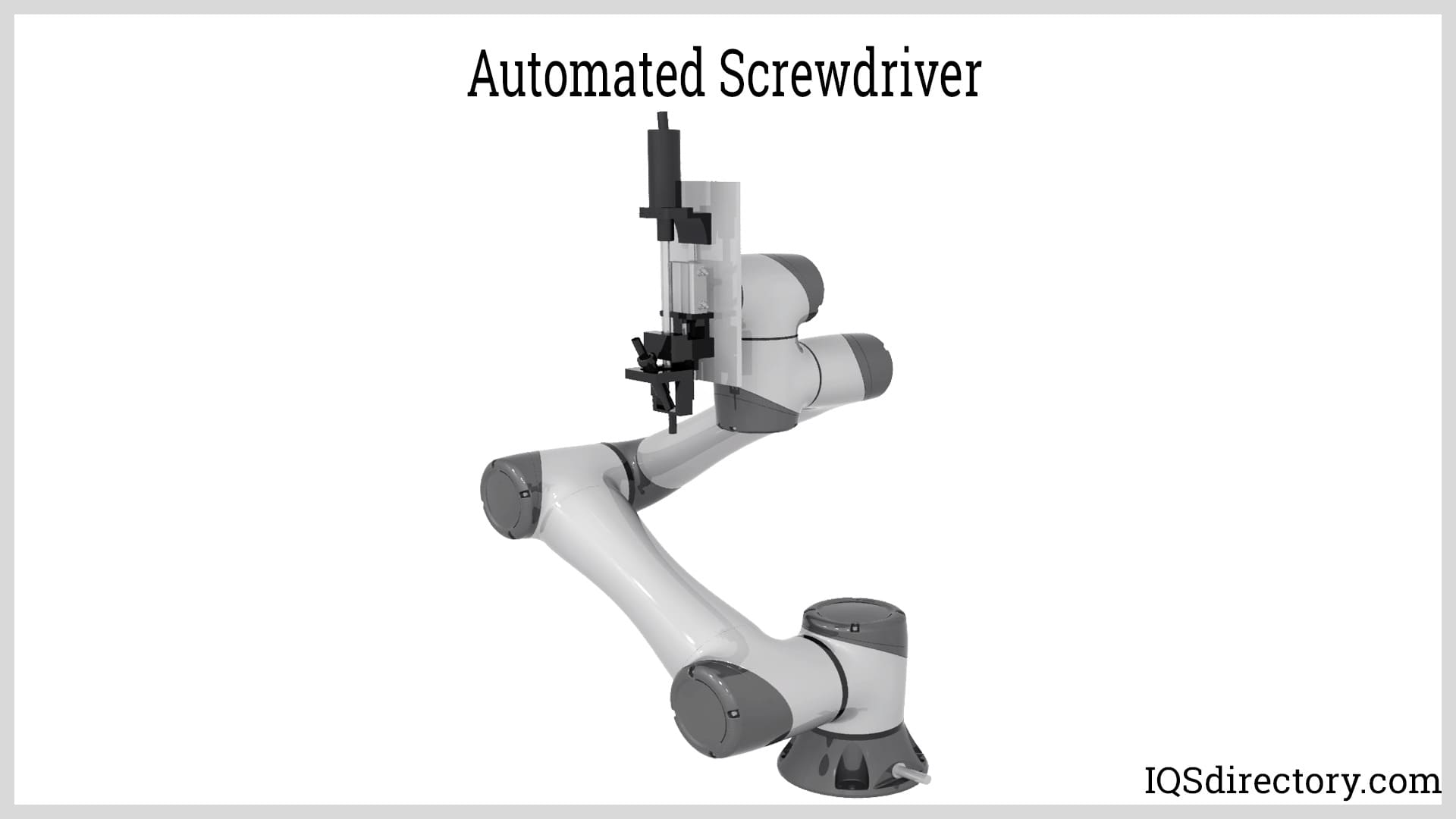
Automatic screwdrivers are designed to complete the repetitive task of connecting surfaces using robotic automation. Depending on the design of an automatic screwdriver, they can have their torque, speed, position, and method adjusted to provide precision screwing and joining. There are many types of automatic screwdrivers, and they vary by their programming, the number of screwdrivers, the number of axes, and the types of screws.
Types of Automatic Screwdrivers
The basic difference between automatic screwdrivers is their level of autonomy. Some types of automatic screwdrivers work independently, while others work with a person. In general, all automatic screwdrivers are designed to position themselves over the head of a screw and supply sufficient force to make a connection or joining. The process becomes more complex as features are added to the automatic screwdriver such that it completes the connection process on its own.
A common tool in robotic and automated processes is a gantry, which moves and positions a tool to complete an application or operation. For automatic screwdrivers, the screwdriver or screwdrivers are positioned on an arm above a sliding work table that is moved along the X and Y axes by a servo motor. Gantry-type automatic screwdrivers are programmable with a torque monitor to ensure proper fastening. The process for gantry types of automatic screwdrivers requires a workpiece to be placed on the sliding platform by a worker. Screws are fed automatically to the screw head using a form of screw presenter.
A fully automatic screwdriver robot has the workpiece placed in its mechanism. They have a robotic arm that holds the screwdriver unit, a vision sensor system, and a control system with a user interface. Once programmed, the screwing and connecting process is completed automatically with the robotic arm properly positioning the screwdriver, which is monitored by the vision sensor system. Part of the flexibility of fully automatic screwdriver robots is their ability to change the heads on the screwdriver using the vision sensor and user input.
A special form of automatic screwdriver is a collaborative automatic screwdriver where a worker or production application and robotic arm work together to complete the connecting and joining process. Collaborative automatic screwdrivers are similar to complex robotic systems in that they complete the joining process independently but are smaller and more compact such that they fit into a small workspace. The key to collaborative automatic screwdrivers is their effector, which is part of a robotic arm that holds a tool. The effector operates at the commands of the human and its software. It is the major part of a robotic arm and is designed to complete the connecting process.
A major innovation in automatic screwdrivers is the multiple spindle version that is designed to hold several screwdrivers to fasten multiple screws. They are a fully automated version of an automatic screwdriver and can be part of an assembly process. In addition, multiple spindle automatic screwdrivers can have screw heads of different shapes, sizes, and lengths. Their programming prevents them from over or under screwing.
Effectors
Effectors are part of a robotic arm and are the component of the mechanism that holds the screwdriver. Although effectors are critical for automatic screwdrivers, they are used with all forms of robotic arms to hold a wide range of tools. The programming of an effector ensures the quality and precision of the screwing process. They are programmed for error detection and can handle multiple screwdrivers.
Using the head of the screwdriver, the effector grabs the screw, positions it on the workpiece, and drives it into the workpiece with the appropriate force and power. The grasping of the screw for an effector takes several forms and includes two finger-like structures that hold the screw. The joint on the effector moves in various directions to proper placement of the screw. Its driving mechanism is located above the gripper and has rigid and flexible links with the rigid links controlling the motion of the flexible link.
Power for Automatic Screwdrivers
The effectiveness of its power system determines the speed, accuracy, timing, and torque of an automatic screwdriver. The two basic power systems are electric and pneumatic, each of which is capable of powering an automatic screwdriver and other forms of tools. Although electric and pneumatic are widely used, small operations, with low volume, prefer to use manual operated screwdrivers, while large corporations, with high volume production, rely on the two major power sources.
Electric Automated Screwdrivers
Electric automatic screw drivers are different from pneumatic automatic screwdrivers in that they can have aspects of their function adjusted during operation. It is for this reason that electric automatic screwdrivers are more widely used than pneumatic automatic screwdrivers. The two types of electric automatic screwdrivers are clutch and transducer automatic screwdrivers. The transducer type is more flexible and adaptable. They allow users to set torque according to the needs of the application.
Pneumatic Automatic Screwdrivers
Pneumatic automatic screwdrivers are powered by compressed air. The clutch in a pneumatic automatic screwdriver turns off the screwdriver when it reaches its programmed torque. Pneumatic automatic screwdrivers depend on the clutch for accuracy and precision. Although electric automatic screwdrivers are more popular, pneumatic automatic screwdrivers tend to be more accurate and have a better power-to-weight ratio. They are more affordable than electric automatic screwdrivers and work faster.
Automatic Screwdriver Feeding Methods
A critical part of the automatic screwdriver process is their feeding mechanism, which has to be accurate and precise. There are several different feeding methods with a basic five being the most common, which are bowl feeders, hopper feeders, vacuum feeders, screw presenters, and step screw feeders.
Bowl feeders have been used as feeding mechanisms for many years and use a vibratory bowl to present the screws to the screwdriver. Hoppers are a simple type of feeder and consist of a hopper or large container and a rail. Vacuum feeders use the power of negative pressure to pull screws from a container to be presented to the screwdriver. Screw presenters place one screw at a time at their opening for an automatic screwdriver to pick up. The step screw feeder method includes moving screws automatically up a series of steps where they are placed on a rail and fed to the screwdriver.
Conclusion
The development of automatic screwdrivers has made it possible to convert laborious and monotonous operations into rapid, efficient, and precise functions that enhance product quality. They are a perfect match for modern automation, alleviating workers so they can perform more intricate and demanding processes.