
- 8 leading manufacturers
- 37 additional suppliers
- 20 states and provinces
- 19 related categories
- 13 guide sections
Plastic Extrusions Manufacturers and Companies
IQS Directory provides a comprehensive list of plastic extrusion manufacturers and suppliers. Use our website to review and source top plastic extrusion manufacturers with roll over ads and detailed product descriptions. Find plastic extrusion companies that can design, engineer, and manufacture plastic extrusion to your companies specifications. Then contact the plastic extrusion companies through our quick and easy request for quote form. Website links, company profile, locations, phone, product videos and product information is provided for each company. Whether you are looking for manufacturers of coextrusions, plastic h channels, plastic extruded plates, or customized plastic extrusion of every type, this is the resource for you.
Suppliers located in WI, OH, PA +17 more states
Contents (6 sections)
Leading Plastic Extrusions Manufacturers
Showing all 8
| Placement No. | Manufacturer | Location | Contact | Actions | |
|---|---|---|---|---|---|
| 1 | Preferred Plastics, Inc.Preferred Plastics is an ISO 9001:2000-certified custom plastic extruder, specializing in rigid, flexible & co-extruded products, including extruded tubing. Preferred offers a wide range of secondary & in-line services, including cutting, drilling, punching, routing, stamping and more. By choosing preferred plastics as your custom extrusion manufacturer you will be relying on someone you can trust! | Plainwell, MI | |||
| 2 | FABEXCOAt FABEXCO, we specialize in precision plastic extrusions engineered to meet demanding industrial and commercial performance requirements. Our company works closely with customers to transform product concepts into durable, dimensionally accurate profiles that support structural, protective, and aesthetic functions. By combining technical expertise with advanced extrusion processes, we deliver consistent, high-quality components designed to integrate seamlessly into a wide range of assemblies. | Modesto, CA | |||
| 3 | Absolute Custom ExtrusionsWe have a long history of providing plastic extrusions. We will proudly serve you and we are committed to quality customer service. Our plastic extrusions are used in industries ranging from automotive to medical. These units are optimized for design, performance and quality. From pre-prototype to post production, we do it all. Please visit our website for more information! | Milwaukee, WI | |||
| 4 | Crafted Plastics Inc.Crafted Plastics has provided custom plastic extrusions & tubing to manufacturers and distributors worldwide since 1982. We can extrude basic to complex single and dual durometer profiles, co-extrusions, and tubing from a wide array of thermoplastics to meet your plastic extrusion needs. Whether you need products made from Acrylic, ABS, Polycarbonate, Polyethylene, Polypropylene, Polystyrene, PVC, Polyurethane, or Rigid PVC, we’re your source for extruded plastic profiles and tubing. | Sheboygan, WI | |||
| 5 | Northland Plastics, Inc.At Northland Plastics, we are the experts in unique custom plastic extrusions. We specialize in single and dual durometer profile extrusions, vacuum calibration, automated inline fabrication, custom fabrication, and more. Custom colors and various additives are also available. As an ISO 9001:2015 company, we value product quality, timely delivery, competitive pricing, and excellent customer service above all else. Contact Northland Plastics today for all your extrusion needs! | Sheboygan, WI | |||
| 6 | Petro Extrusion Technologies, Inc.Petro specializes in plastic extrusions, offering our customers many capabilities, such as customized shapes & extruded tubing, along with tape application, coiling & angle cutting. We have a full staff of engineers who can assist you & ship out stock products within 24 hours of your order. At Petro, we take extreme pride in our service & quality. We will deliver a product on time – every time. | Middlesex, NJ | |||
| 7 | Polytec Plastics, Inc.We develop the most affordable and long lasting plastic extrusions. These extruded materials come in a variety of options and are Polytec Q-1 certified. We offer fast delivery and our customer service team is willing to design a perfect solution for your industry. If you are concerned about your budget then rest assured that our products are affordable. Please visit our website for more information! | St. Charles, IL | |||
| 8 | GSH Industries, Inc.At GSH we know plastic, rubber and aluminum extrusions. We do tubing, injection, plastic, aluminum and rubber fabrication. We serve a variety of industries with our products, including automotive, consumer, electrical and marine. We know plastic extrusions! Come to us for superior customer service, product knowledge, on-time delivery and competitive pricing! | Strongsville, OH |
Claim your Page One Spot
Leading plastic extrusions manufacturers are listed first on this page, each with a website preview and a Request a Quote button on its row.
Additional Plastic Extrusions Companies
The category’s other plastic extrusions companies are listed on their own page, with location, phone and website where each supplier provides them.
View 37 Additional Plastic Extrusions CompaniesDo not see your company listed in Plastic Extrusions?
Engineers and buyers use this page to find plastic extrusions suppliers. Add your company to the Plastic Extrusions listings so they can find you too.
List Your Company- Listed in the Plastic Extrusions directory
- A profile page for your company
- Buyers contact you directly
Plastic Extrusions Industrial Manufacturing Guides
Plastic Extrusion: Machines, Uses and Processes
This page provides you with all the basic information about plastic extrusion. As you go through the article, you will learn more about: Overview of Plastic…
7 chapters, the longest in this category
Quick Answers
- How many plastic extrusions manufacturers are listed on IQS Directory?
- 8 leading manufacturers and 37 additional suppliers.
- Where are plastic extrusions manufacturers located?
- The listed suppliers are in 20 states and provinces: Wisconsin (8), Ohio (7), Pennsylvania (4), California (3), Georgia (2), Illinois (2), Massachusetts (2), Michigan (2), and 12 more.
- How do I get quotes from plastic extrusions suppliers?
- Select suppliers in the table and choose Request Quotes. IQS reviews your request and forwards it to every supplier you select.
Plastic Extrusions
Plastic extrusion is a continuous manufacturing method used to produce a wide range of plastic shapes and products for industrial, commercial, and consumer applications. Because the process runs continuously, manufacturers can produce long lengths of consistent plastic profiles, tubing, pipe, film, sheet, trim, and custom shapes with strong dimensional repeatability and cost control.
While the term polymer extrusion is often used as a near synonym for plastic extrusion, but the phrase can be too broad. In technical use, a polymer is a large molecule composed of many similar smaller molecules called monomers. However, when "polymer" and "extrusion" are used together, they usually refer to elastomers, rubber, and plastic processing rather than the full polymer category.
Applications of Plastic Extrusion
Plastic extrusion supports a broad range of plastic product development needs, from commodity profiles to engineered components with demanding tolerance targets. Buyers often turn to extruded plastics when they need long continuous parts, lightweight substitutes for metal, custom channels, multi-lumen tubing, protective trim, or weather-resistant shapes for outdoor service. The process is widely used in automotive manufacturing, building products, HVAC systems, plumbing, chemical processing, appliances, food and beverage operations, retail displays, and electronics.
Plastic Extrusion Products
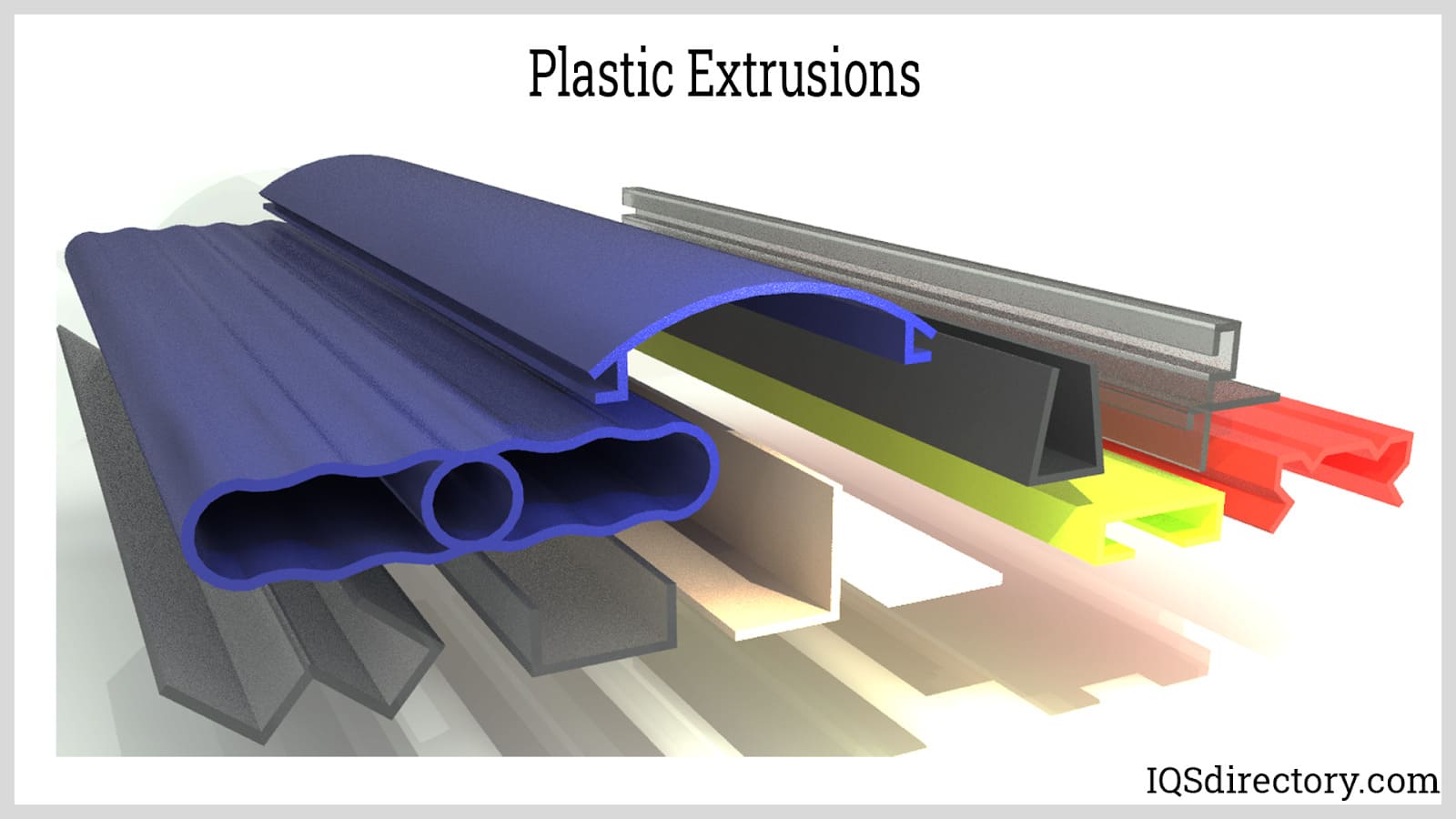
The plastic extrusion process is used to produce a wide array of plastic components, from cable guides and glazing accessories to fluid transfer parts and electronic housings. Other examples of products created through plastic extrusion include PVC channels, plastic strips, profiles, PVC pipes, all-purpose tubing, medical tubing, weather stripping, decorative and functional trim, fencing, deck railings, window frames, plastic films and sheeting, thermoplastic coatings, and wire insulation.
History of Plastic Extrusion
Early extrusion-related equipment appeared in the 1800s, when inventors began developing ways to reclaim, soften, and shape rubber compounds more efficiently. Those early machines laid the groundwork for modern extrusion by showing how heat, pressure, and mechanical force could turn raw material into repeatable continuous forms.
Modern thermoplastic extrusion expanded rapidly in the 1900s as improved screws, dies, and process controls made it easier to produce higher-quality plastic pipe, tubing, film, and custom profiles. Developments in twin-screw technology, resin formulation, and downstream cooling systems helped move extrusion from a niche method into a high-output manufacturing platform.
Today, the market continues to grow as manufacturers look for faster throughput, tighter tolerances, lighter assemblies, and materials tailored for weatherability, impact resistance, sanitation, and regulatory requirements. That shift has pushed many extrusion companies to invest in better line speed control, in-line inspection, coextrusion capability, and more refined die design.
Materials Used in Plastic Extrusion
Plastic Extrusion Process
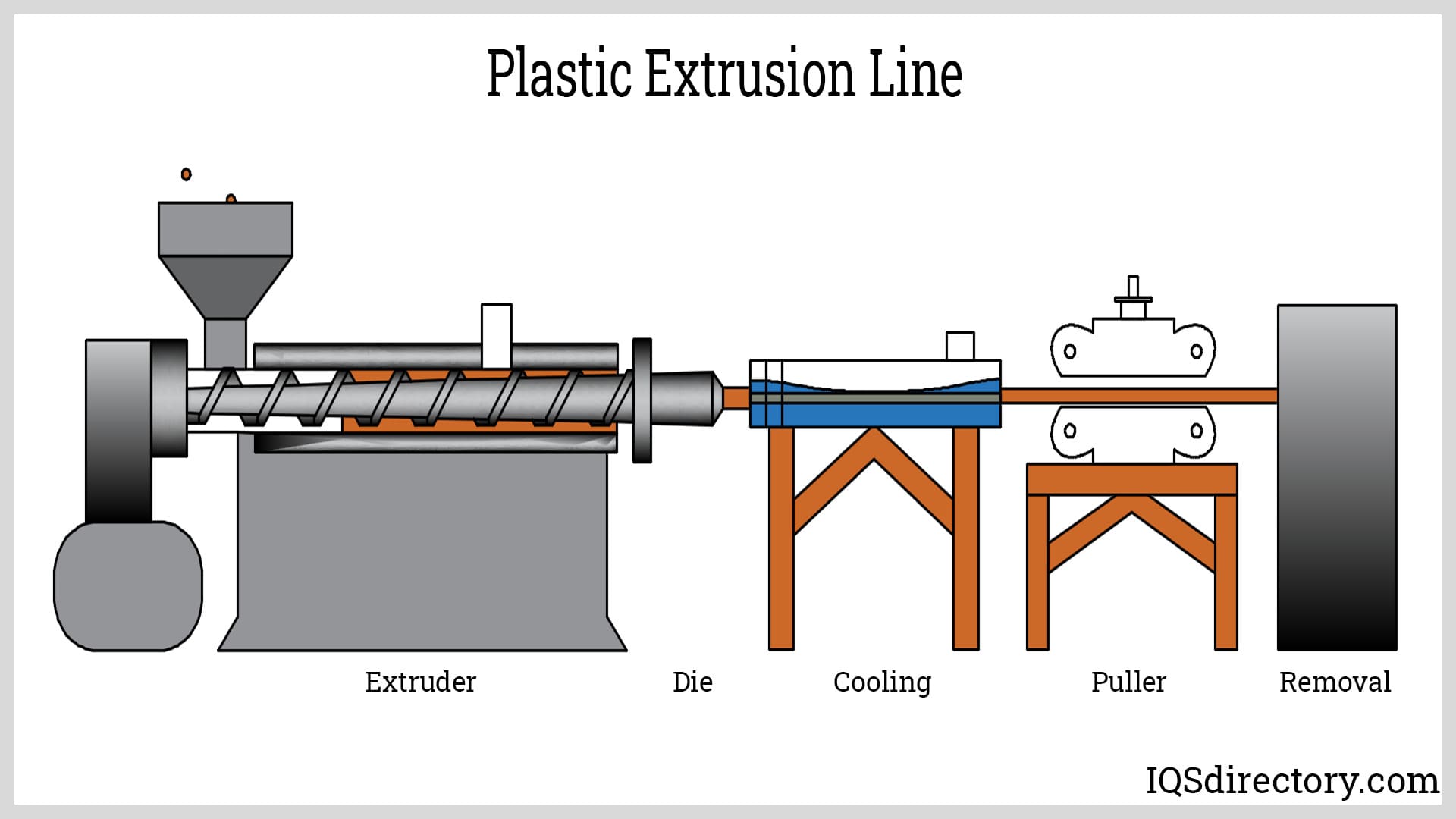
The plastic extrusion process follows the same general sequence across many product lines, although temperatures, screw designs, cooling methods, and puller speeds change with the resin, profile geometry, tolerance target, and required finish.
Typical plastic extrusion steps include the following:
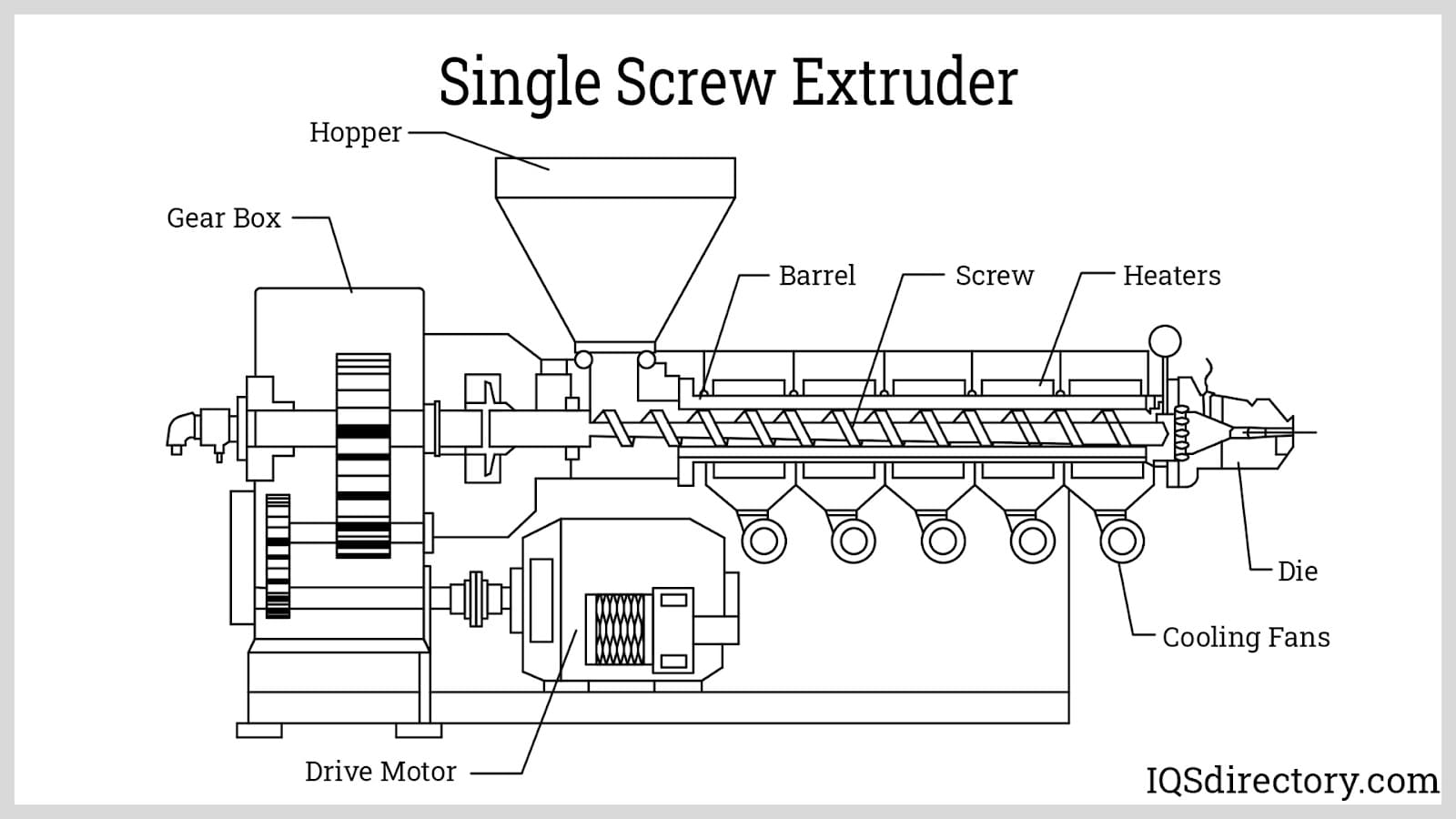
The line begins with resin pellets, powder, or a custom compound loaded into a hopper above the barrel. Depending on the job, the feedstock may include virgin resin, colorant, UV package, filler, flame-retardant additive, or approved regrind.
Gravity drops the material into the barrel, where the screw starts moving it forward at a controlled rate.
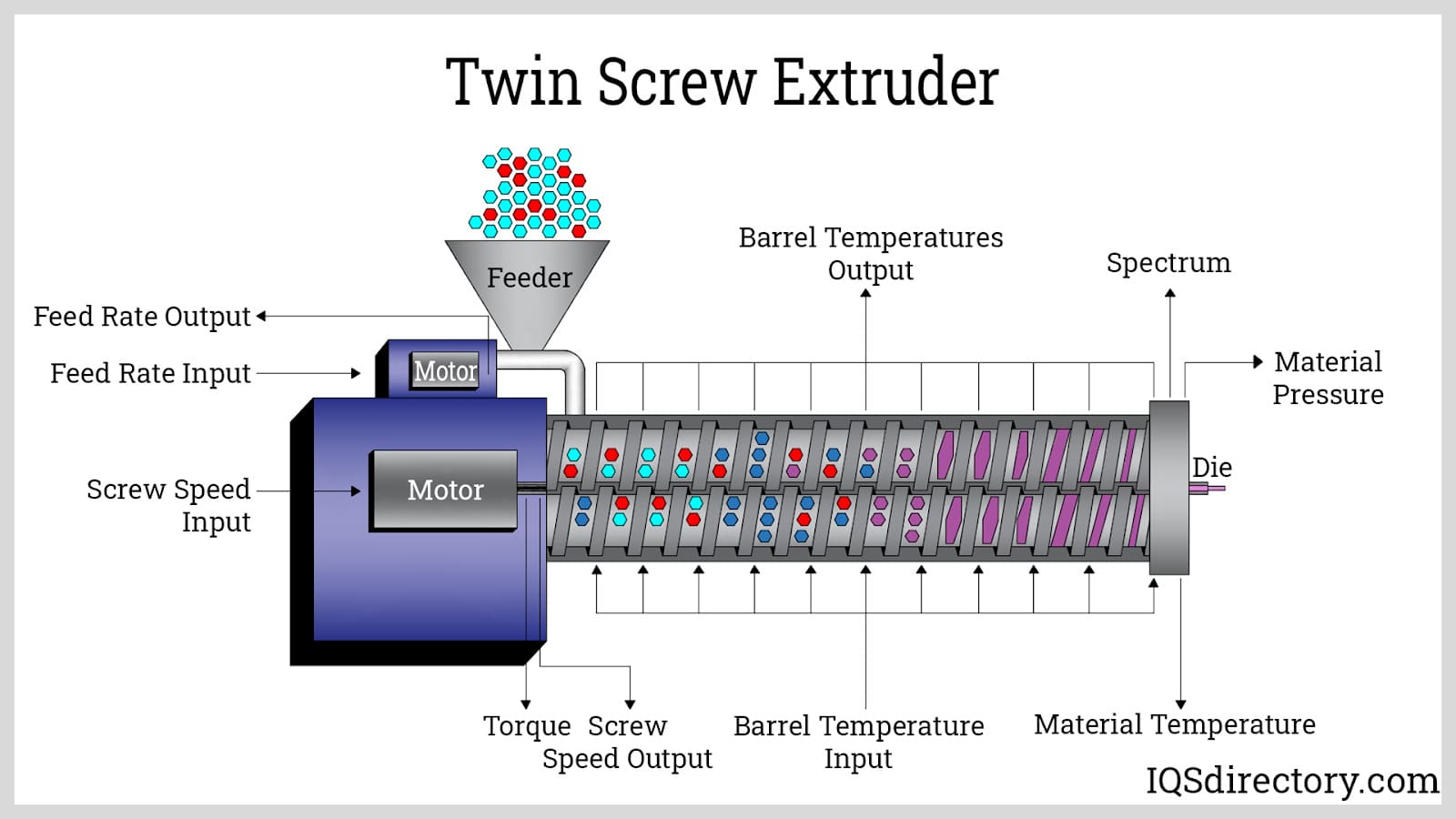
Inside the channel, a long, rotating screw moves the plastic forward. The friction generated by the screw’s rotation causes the plastic to melt. In some extruders, additional electrical heating elements help bring the resin to a stable melt. By the end of the barrel, the material should be fully mixed, pressurized, and ready for shaping.
The melt is then forced through the extrusion die, which sets the final profile geometry. The plastic exits the die as a newly extruded product.
After leaving the die, the material is cooled and sized so it holds the intended dimensions and surface finish.
Finally, the extruded plastic is cut, wound, or coiled and then prepared for shipment or sent for secondary work such as labeling, printing, punching, drilling, anti-static treatment, or other finishing steps.
Plastic Extrusion Design and Customization
When designing standard or custom plastic extrusion products, manufacturers compare material performance, line capability, die geometry, wall thickness, tolerance range, and downstream finishing needs. Material selection should match the application’s service temperature, chemical exposure, impact load, appearance target, and regulatory demands. The chosen manufacturing method—whether hot, cold, or warm extrusion—is selected around part geometry, tolerance needs, stress levels, and production volume.
Manufacturers may also offer custom extrusion options such as custom profile extrusion, custom tubing extrusion, custom plastic pipe extrusion, coextruded seals, and extrusion coating lamination to support product development, OEM sourcing, and replacement part programs.
Machinery Used in Plastic Extrusion
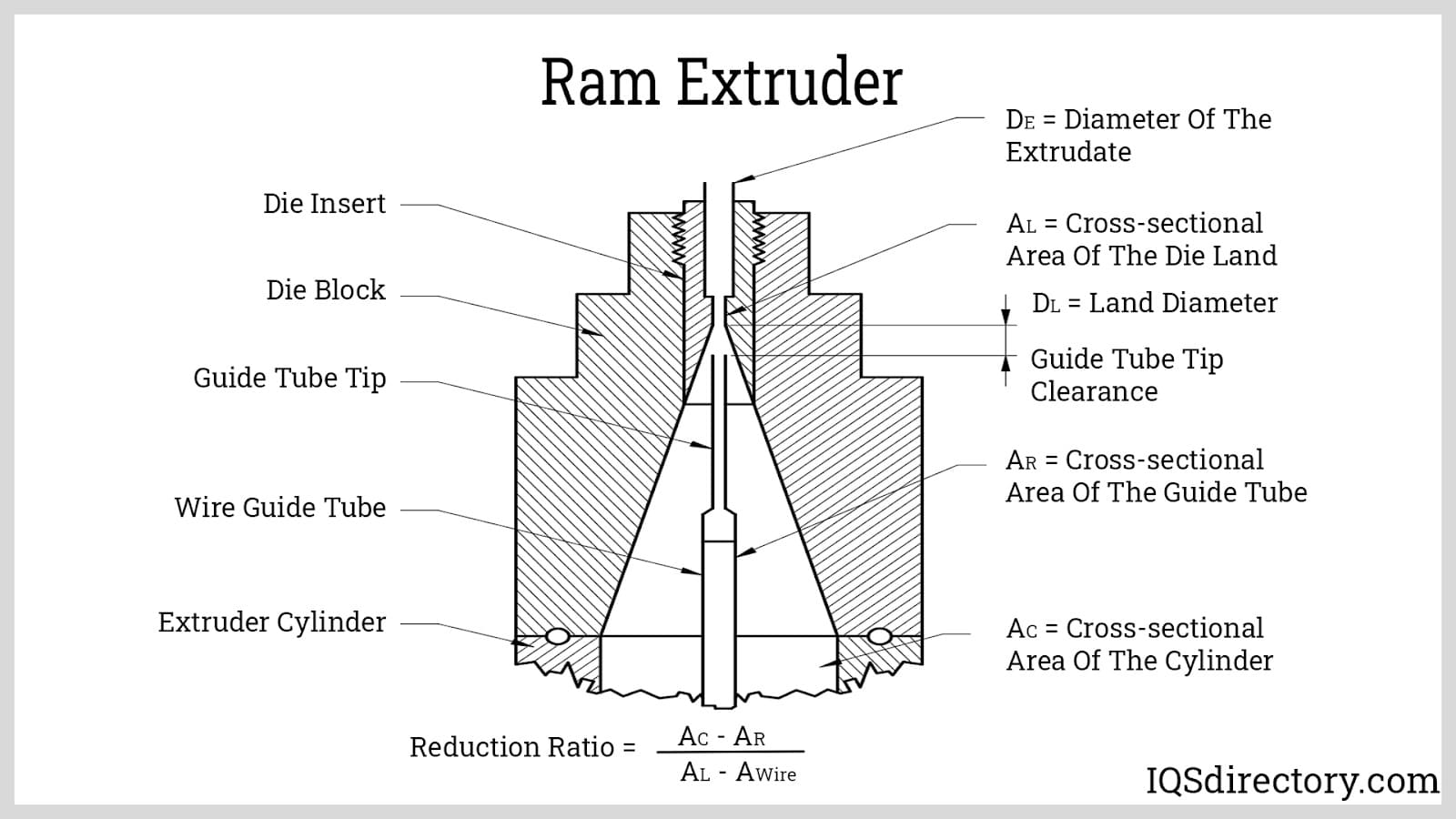
At the end of the barrel is the die, the shaping tool that gives the extrudate its final cross section. In plastic extrusion, the die directs molten resin through a carefully engineered opening that matches the intended profile.
Every die is designed around the target part. Simple dies produce basic shapes—for example, a circular die forms a plastic rod, while a square die creates a continuous square profile. Hollow products use mandrels or pins, and flat dies can create textured sheet used in mats, liners, or protective surfaces.Plastic Extrusion Images, Diagrams and Visual Concepts
Plastic Extrusion Variations and Similar Processes
Benefits of Using Plastic Extrusion
Points to Consider When Using Plastic Extrusion
To support stable output, processors watch head pressure, heating-zone temperature, screw speed, and melt uniformity closely. Many quality issues trace back to variation in those areas, so line setup and process control play a large role in finished-part consistency.
Variations in Concentration of Raw Materials Finished-part quality depends on steady raw material composition and a uniform melt. Thin-gauge extrusion is especially sensitive to pressure variation, so processors pay close attention to blending, moisture control, and the ratio of virgin resin to approved regrind. Melt-bank Uniformity Uneven melt-bank conditions can lead to visual defects, inconsistent gloss, or polishing marks. Processors manage this by balancing die-to-roll distance, roll temperature, and die design so the material stays stable through cooling and pull-off. Design of Rolls Thin-gauge work often demands roll systems that can hold load without distorting the sheet or profile. That may call for upgraded rollers, shafts, and bearing support depending on the width and output rate. Roll DeflectionRoll deflection can affect thickness control and surface quality. Common responses include:
- Crowned Rolls – Pre-ground camber can offset deflection, though it limits flexibility when jobs change.
- Counter-bending Rolls – Counter-bending can help, but it also narrows the operating window.
- Roll Skewing – Roll skewing is often favored when wider operating flexibility is needed.
Choosing the Right Plastic Extrusion Manufacturer
If you are comparing plastic extrusion companies, start by reviewing material options, tooling experience, tolerance capability, secondary services, lead times, and willingness to quote custom work. Buyers often search by profile type, resin family, end use, or industry standard, so it helps to ask whether a supplier handles custom tubing, coextrusion, color matching, fabrication, packaging, and repeat production support. A strong extrusion partner should be able to discuss your specifications clearly and recommend a process that fits performance and budget goals.
Plastic Extrusion Terms
More Plastic Extrusions Information
Common Questions
7 questions
What Is Plastic Extrusion?
Plastic extrusion is a continuous plastics manufacturing process in which thermoplastic resin is melted, pressurized, and pushed through a die to create a uniform cross section such as tubing, pipe, profiles, channels, film, sheet, or insulated wire coating.
Which Industries Use Plastic Extrusions?
Plastic extrusions serve automotive, construction, HVAC, plumbing, appliances, electrical, medical, food processing, and chemical handling markets because they offer repeatable dimensions, durable performance, low weight, corrosion resistance, and practical production economics.
What Products Are Commonly Made through Plastic Extrusion?
Common extruded products include PVC channels, plastic strips, tubing, medical tubing, window frames, fencing, decking, films, sheeting, laminated coatings, edge trim, weather seals, and wire insulation used in both standard and custom applications.
What Materials Are Used in Plastic Extrusion?
Common extrusion materials include PVC, HDPE, LDPE, PETG, polypropylene, acrylic, polystyrene, butyrate, ABS, nylon, and other thermoplastics selected for stiffness, flexibility, clarity, heat tolerance, chemical resistance, impact strength, or outdoor durability.
How Does the Plastic Extrusion Process Work?
Plastic pellets or resin enter a hopper, move through a heated barrel by way of a rotating screw, and are forced through a die that forms the profile. The extrusion is then cooled, sized, pulled, and cut to length for packaging or secondary operations.
What Are the Advantages of Plastic Extrusion?
Benefits include high-volume output, low scrap rates, strong material flexibility, competitive part pricing, process efficiency, and the ability to add finishing, sizing, embossing, punching, or other post-extrusion adjustments while the material is still workable.
What Is Coextrusion in Plastics?
Coextrusion combines two or more plastics into a layered profile by feeding separate materials into one die. This lets manufacturers blend properties such as rigidity, softness, color, barrier performance, UV resistance, or chemical resistance in one extrusion.