



Collaborative Robots: Everything you need to know about Types & Uses
IQS Directory EditorialUpdated 3 chapters
5 leading suppliers listed with this guide
Browse collaborative robot integrators suppliersContents (3 chapters)
This article will give an in-depth discussion about collaborative robots.
The article will bring more understanding about:
- Principle of Collaborative Robots
- Types of Collaborative Robots
- Applications and Benefits of Collaborative Robots
- And Much More…

Chapter 1: Understanding the Core Principles of Collaborative Robots
In this chapter, we explore the world of collaborative robots, or cobots, and the key considerations for choosing the right collaborative robot for your specific automation application. Whether your goal is to improve production efficiency, reduce repetitive labor, or increase workplace safety, understanding cobot capabilities, integrations, and return on investment is essential.
Defining Collaborative Robots
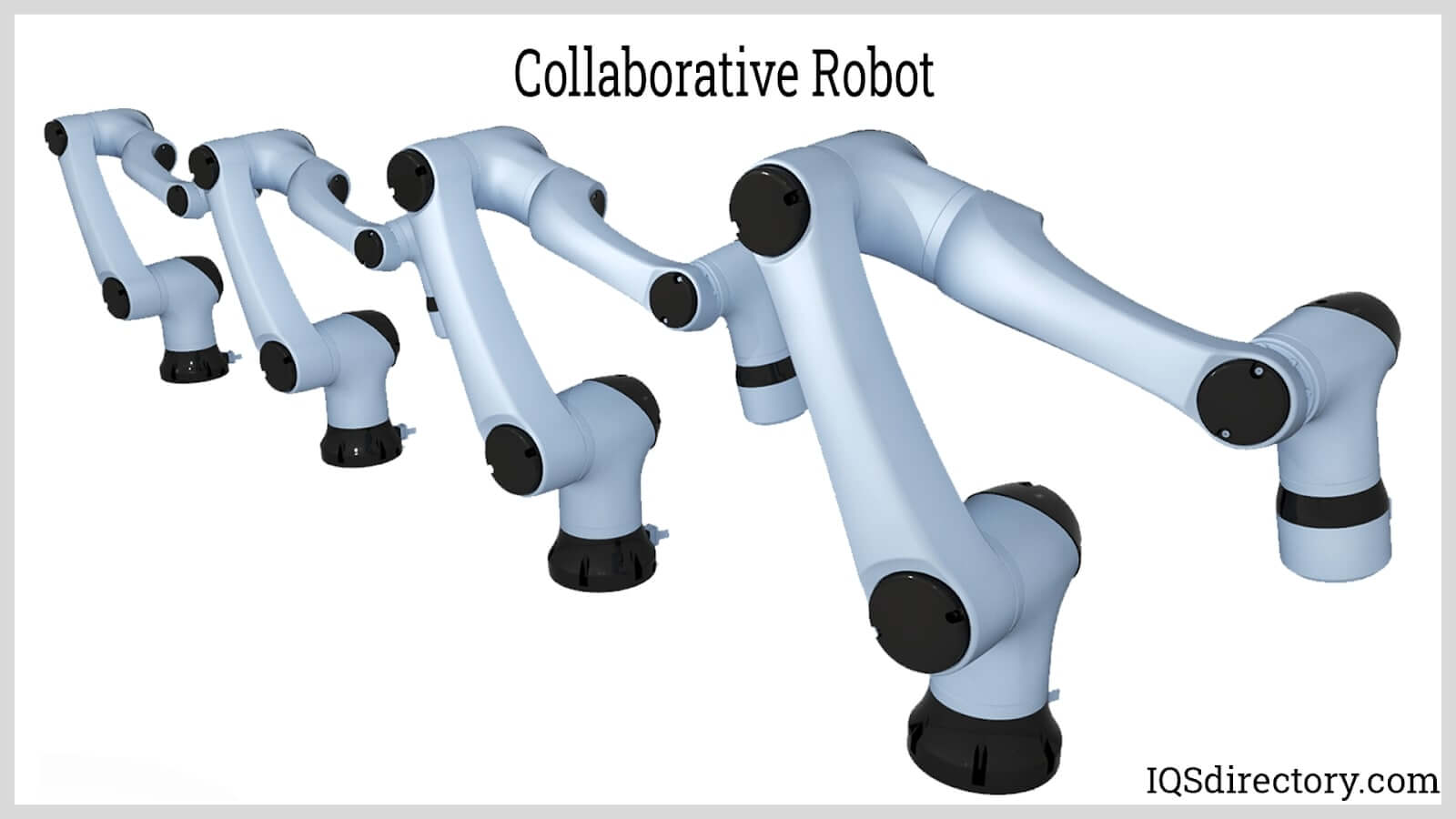
Collaborative robots, commonly known as cobots, symbolize a breakthrough in robotics and industrial automation, redefining how human-robot collaboration works on the factory floor. Unlike conventional industrial robots, cobots are equipped with advanced sensors, force limiting technology, and environmental awareness that allow them to operate safely alongside human workers. This makes them ideal for flexible manufacturing, assembly automation, machine tending, quality inspection, and other repetitive tasks. When a disturbance or safety threat is detected, the cobot can slow, stop, or transition into a protective mode, helping minimize risk while maintaining productivity.
Automation Equipment
Collaborative robots are a specialized category within automation equipment, a broad range of machinery used to streamline automated production processes. This category also includes automation cells, conveyors, industrial robots, machine tending systems, and niche equipment like turn-over machines and lifters. For manufacturers evaluating cobot integration, it is often helpful to compare payload, reach, cycle time, and footprint to determine the best fit for existing production lines.
Various Tools for Collaborative Robots
Cobots utilize end-effector tools similar to those used by traditional robots, but they are often designed for easier deployment, faster changeovers, and greater versatility across different applications. Manufacturers worldwide continue investing in specialized cobot accessories and collaborative robot tooling to expand task learning, improve accuracy, and increase throughput. These tools include vision systems, End of Arm Tooling (EOAT), grippers, software, range extenders, supply components, and safety systems.
Cobot Vision Systems
Vision systems give collaborative robots the ability to perceive, identify, and interpret their environment. Using 2D or 3D cameras, cobots can detect and locate objects, recognize patterns, scan barcodes, and support robotic inspection tasks. This flexibility is especially valuable in unstructured environments, where product placement may vary and traditional automation would require precise part presentation. Vision-enabled cobots can also support machine vision inspection, pick and place applications, bin picking, and AI-assisted defect detection for higher quality control and consistent output.

In the realm of vision systems for collaborative robots, different options exist based on application needs, cost-effectiveness, accuracy, and ease of use. Key choices include 3D and 2D camera setups, selected according to the automation task, part complexity, and the level of depth perception required.
2D Vision Systems
While more economical than 3D cameras, 2D cameras have limited functionality. They can measure an object's width and length but not its height, making them a practical option for flat parts, barcode reading, and basic inspection tasks.
3D Vision Systems
3D cameras offer the ability to measure an object's width, height, and length, making them highly versatile, although at a higher cost. Their ability to measure height is ideal for handling objects of varying elevations, stacked items, and irregular part geometries, proving especially useful in packing, palletizing, and depalletizing operations.
End of Arm Tooling (EOAT)
End of Arm Tooling (EOAT) includes a wide range of tools attachable to collaborative robots, such as sanders, screwdrivers, sensors, tool changers, glue dispensers, welding apparatus, and soldering tools. Recent advancements in these robot end effectors have greatly expanded their capabilities, allowing cobots to support more demanding production automation needs, improve repeatability, and help manufacturers scale output without sacrificing quality.

Varieties of EOAT
EOAT presents strong opportunities for training cobots on new tasks and optimizing cycle time across different workflows. As collaborative robotics continues to evolve, these tools will allow cobots to address a wider range of applications in assembly, finishing, fastening, and material handling. Below are some examples of the diverse EOAT tools available:
EOAT Glue Dispensers
A dispenser is used to attach a glue or sealant syringe to a cobot’s end, allowing precise path-following and consistent adhesive application. This improves accuracy, reduces material waste, and supports clean, repeatable dispensing for sealing, bonding, and gasketing applications.

EOAT Screwing Machines
Screwing machines enable cobots to execute fastening tasks independently or alongside human operators. Because screwdriving is repetitive and ergonomically challenging, it is well suited for automation, helping improve torque consistency, reduce fatigue, and maintain production speed over long operating periods.

EOAT Sanders
Armed with a sander, a cobot can proficiently sand, polish, or deburr surfaces. Integrated sensors help maintain consistent pressure for uniform results, while user-friendly programming makes it easier to define exact paths for finishing, surface preparation, and material removal.

Cobot Sensors
Collaborative robots come with integrated sensors that enhance their ability to work safely with humans and respond to changes in force, position, and proximity. For tasks demanding extra precision, additional components such as an external force torque sensor can improve sensitivity, support compliant motion, and increase process control in delicate applications.

Cobot Soldering and Welding Tools
Soldering and welding demand a high level of precision, making cobots an excellent match due to their repeatability and controlled motion. Equipping a cobot with a soldering iron or welding torch allows manufacturers to automate joining tasks, improve consistency, and support safer operation in production environments where quality and throughput are priorities.

Cobot Grippers
Grippers enable collaborative robots to manipulate items by lifting, holding, and positioning them in different locations. A variety of grippers exist, including vacuum, magnetic, and finger grippers, designed for specific use cases such as box handling, part transfer, and delicate pick-and-place operations. Specifications such as gripping width, force, payload capacity, and part geometry are crucial for selection when comparing cobot grippers for manufacturing automation.

Different Types of Cobot Grippers
Grippers vary according to material and task type. Selection should consider the weight, surface, and fragility of items to be handled, as well as the required cycle time and repeatability.
Electric Grippers
Electric grippers suit complex tasks with their ability to fine-tune parameters like finger positioning, gripping force, and part handling precision.
Pneumatic Grippers
Pneumatic grippers, driven by compressed air, handle simpler tasks. They're lightweight, cost-effective, and offer strong grip force, making them useful for a wide range of general automation applications.
Finger Grippers
For high-precision work, three- or two-finger grippers are optimal, adapting to an object's shape to ensure secure handling and reliable placement.
Cobot Software
Numerous resources exist for programming and designing applications for cobots, with each robot coming with intuitive software to match its function. Simulation tools, offline programming, and teach pendant interfaces help accelerate deployment before the system goes live on the production floor.
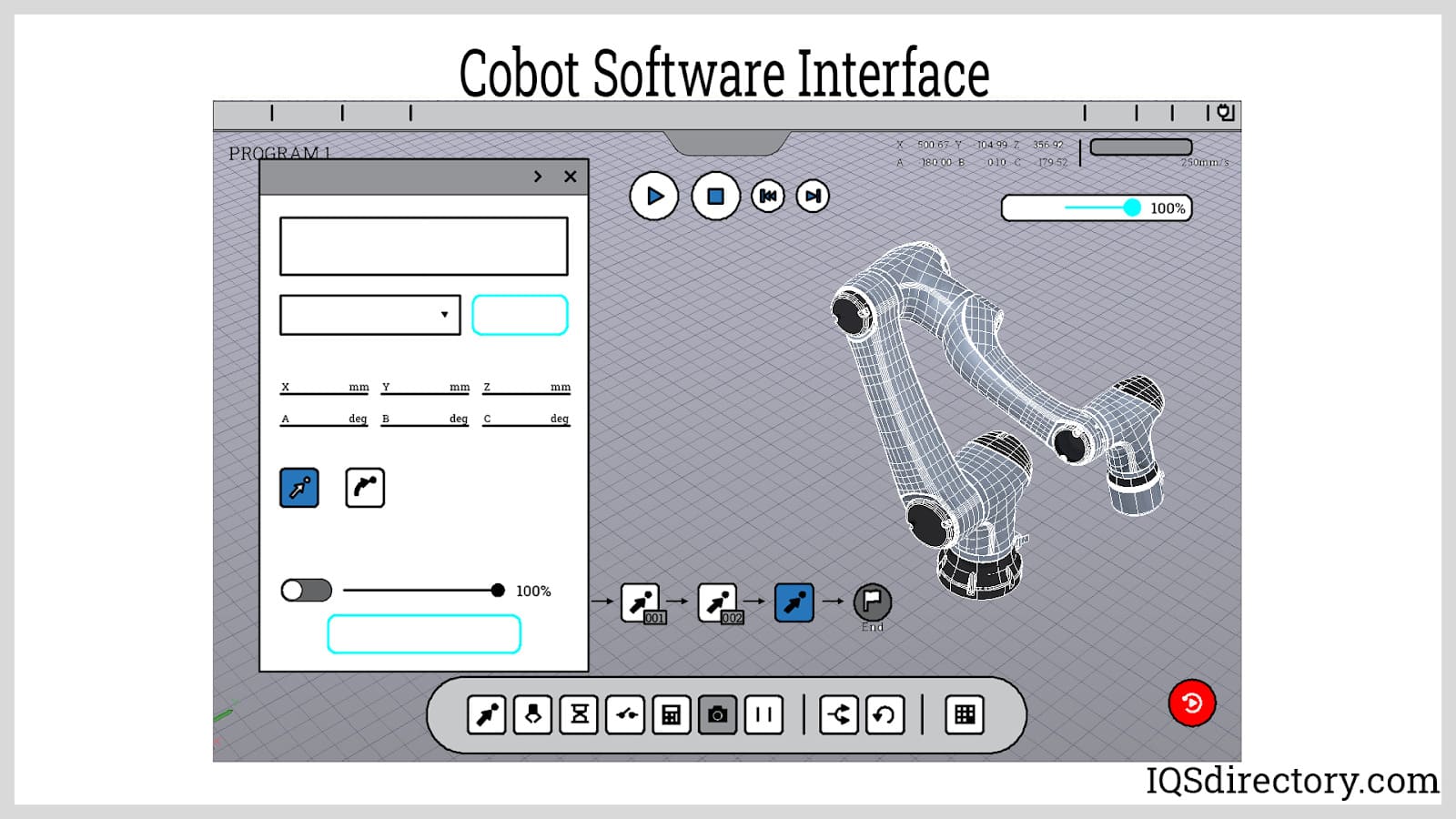
Traditional robots typically require extensive programming time and expertise, often performing only predefined actions. Cobots, however, are designed for ease of programming, learning new tasks quickly with intuitive software, mobile apps, and drag-and-drop controls. This simplicity supports fast implementation, operator adoption, and greater flexibility for companies seeking scalable automation.
RoboDK
RoboDK is an affordable, robust robot simulation tool, featuring over 500 robot arms in its library. Its user-friendly interface requires no programming experience, allowing rapid setup for simulations. Supporting offline programming, RoboDK facilitates cobot program development and testing outside production settings, suitable for machine tending, pick-and-place, welding, packaging, and palletizing applications.
Cobot Range Extenders
Range extenders augment cobots' potential by expanding their horizontal and vertical operational reach, thereby enhancing automation capabilities. Typically constrained to their base axis, cobots gain increased mobility with range extenders, which also improve productivity and workspace coverage. For instance, in palletizing, robots can handle higher box stacking and navigate in front of large machinery, executing complex workflows with fewer repositioning steps.

Collaborative robots are praised for their ease of application and swift installation. With range extenders, they become even simpler to integrate, aided by user-friendly software for seamless cobot communication setup and more flexible cell design.
Cobot Safety
Safety measures include tools and procedures that ensure safe human-robot interaction, such as barriers, light curtains, emergency stop devices, and proximity sensors that detect human presence near the robot. A strong cobot safety strategy should also include proper risk assessment, speed and separation monitoring, and operator training to support compliant, reliable deployment.
Cobot Supply Systems
Supply systems comprise tools that provide cobots with materials for manipulation. For instance, a tool can place screws in specific positions for cobot access, while screw-feeding systems collect and deliver them for assembly processes. Vibrating plates assist in sorting, orienting, and organizing mixed items, helping improve part presentation and reduce downtime caused by manual loading.

Cobot Tool Changers
Enhanced cobot versatility arises from various automatic tool changers available on the market. These allow autonomous switching between tools, enabling multiple operation performance. In assembly tasks, a cobot might use a gripper to position components before switching to a screwdriver for final assembly, boosting productivity, reducing setup time, and improving return on investment.

Key Factors in Choosing a Collaborative Robot
Several points should be assessed when selecting a collaborative robot, especially if your goal is to improve throughput, reduce labor bottlenecks, and achieve a faster automation payback period:
Collaborative Robot Applications
Cobots are ideally suited for tasks that are perceived as dirty, boring, dangerous, or physically exhausting. Typical uses include assembly, material handling, inspection, packaging, machine tending, and light-duty manufacturing automation. These robots are engineered with qualities like reach, precision, payload capability, and repeatability for efficient human collaboration. While not as fast or powerful as traditional industrial robots, cobots excel in safety, adaptability, and rapid redeployment, helping fill workforce gaps and allowing employees to focus on higher-value tasks.
The ISO 10218-1 and ISO 10218-2 outline four crucial cobot features: stops, hand guiding, speed and separation monitoring, and force and power limitations. These characteristics ensure safe, efficient operation across various applications. Speed and separation monitoring support tasks involving close human-robot interaction, while force and power limits are crucial for delicate operations. These standards facilitate safe, effective cobot integration in diverse settings, especially when combined with a documented risk assessment and proper safeguards.
Systems Integrator
Implementing a cobot demands ample expertise. Evaluate whether your team can manage the process or if a systems integrator is needed. Systems integrators offer valuable insights from varied client experiences, providing customized solutions, application engineering support, and troubleshooting guidance that help avoid the hurdles of starting from scratch. Their expertise can often ensure cost-effective and smoother cobot integration.
Expert Robotic Integrators
Significant expertise is crucial when integrating a cobot. Determine if your internal team possesses the required skills and time or if you should consult a robotic integrator. These integrators, also called systems integrators, analyze your operations and advise on what would work best based on their extensive experience. They bring cost-effective solutions by preventing the need to build the automation process from scratch and can help with ROI analysis, safety validation, and employee training.
Conducting Risk Assessment
Risk assessment is a vital component when deciding on cobot usage. Despite built-in sensors designed to stop motion and avert injuries, cobots still pose potential risks depending on payload, speed, tooling, and human proximity. Ensuring full safeguarding is essential to secure safe, effective operation for staff protection and compliance with collaborative robot safety standards.
Addressing Collaborative Robot Queries
Open communication is critical for successful cobot implementation. It's essential to engage all involved parties, from top-level executives to employees interacting with the cobot. Ensuring all stakeholders are knowledgeable and aligned can significantly streamline the integration process, improve adoption, and reduce resistance to change.
- What are the benefits of this automation type?
- What investment levels and ROI projections are expected?
- How might employee roles change, or can cobots free them for more intellectual tasks?
- What training and learning opportunities exist, and who manages them? (Systems integrators often include staff training in their packages.)
- After installation, what support is available?
- Can cobots help address workforce shortages?
- What are the company’s future automation plans?
Frequently Asked Questions
What Makes Collaborative Robots (Cobots) Different from Traditional Industrial Robots?
Cobots are equipped with safety sensors and user-friendly software, allowing them to work side-by-side with humans without protective barriers. They prioritize safety, flexibility, and easy programming, unlike traditional robots that usually require isolation and more complex integration.
What Are the Main Types of Collaborative Robots?
The primary types are Power and Force Limiting, Safety Monitored Stop, Speed and Separation, and Hand Guiding cobots. Each type offers unique safety features and is suited for different levels of human-robot collaboration.
Which Tasks and Industries Benefit Most from Cobot Integration?
Cobots excel in repetitive, dangerous, or precision tasks such as assembly, packaging, palletizing, soldering, inspection, and machine tending. Key industries include food processing, plastics, electronics, pharmaceuticals, automotive, metal fabrication, and packaging.
How Do Vision Systems Enhance Collaborative Robot Performance?
Vision systems with 2D or 3D cameras enable cobots to recognize and locate objects, inspect products, and adapt to unstructured environments. This flexibility boosts automation efficiency, improves quality inspection, and reduces the need for organized layouts.
What Are the Main Benefits and Drawbacks of Using Cobots?
Cobots are compact, flexible, easy to program, and enhance workplace safety. They reduce labor costs, improve consistency, and support faster deployment. Drawbacks include initial setup expenses, the need for safety measures, and occasional workflow slowdowns for safety monitoring.
Do Cobots Comply with Safety Standards for Human-Robot Interaction?
Yes, cobots follow ISO 10218 and ISO/TS 15066 standards, which outline requirements for speed, force, monitoring, and risk assessment to ensure safe, efficient operation alongside human workers.
Chapter 2: What Are the Types of Collaborative Robots?
Collaborative robots, also known as cobots, represent a groundbreaking advancement in industrial robotics and smart manufacturing. These innovative automation solutions are engineered to work safely and efficiently alongside human workers in a shared workspace. The main types of collaborative robots differ in their design, safety mechanisms, and levels of required human-robot interaction, making them adaptable to a wide range of industrial automation and assembly applications. By understanding the differences between these cobot types and the technology driving their development, manufacturers and businesses can make informed decisions on selecting the optimal solution for improved productivity, safety, and return on investment.
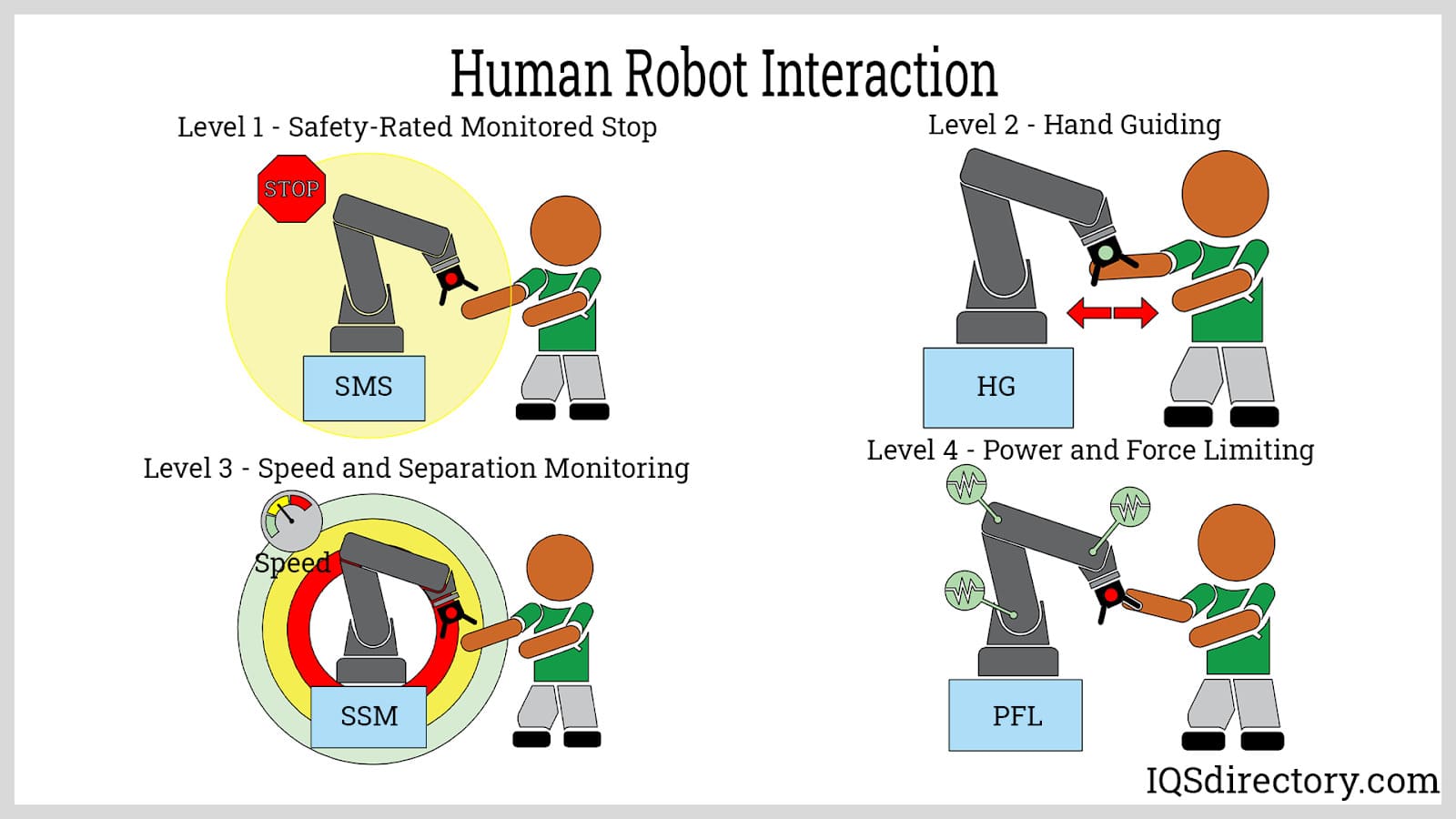
Power and Force Limiting Cobots
In most conversations about collaborative robots, Power and Force Limiting (PFL) cobots are the primary focus. These collaborative robots are engineered with advanced safety features, including torque sensors, soft materials, and rounded edges, all contributing to direct human-robot collaboration without the need for traditional safety fences, external light curtains, or complex guarding systems.

To further advance operator safety, these force and power limiting cobots utilize collision detection sensors and safety-rated monitored stop functions that instantly halt operation upon making contact with a human. Due to these robust safety protocols, they are excellent for light payload tasks such as electronic assembly, machine tending, laboratory automation, precision inspection, and packaging in industries demanding flexible automation and human-machine interaction.
Although PFL collaborative robots are typically intended for lighter-duty applications, ongoing advancements in robotics technology are rapidly expanding their capabilities, enabling more diverse use cases across manufacturing, logistics, healthcare, and research environments.
Safety Monitored Stop Cobots
Safety Monitored Stop collaborative robots integrate conventional industrial robot arms with safety monitoring systems such as presence detection devices, interlock gates, and emergency stop sensors. These cobots are ideal for manufacturing processes that require occasional human intervention for quality checks, tool changes, or equipment maintenance.

When a human worker enters the robot’s workspace, the cobot immediately suspends all motion, ensuring compliance with ISO/TS 15066 and other relevant industrial safety standards. Restarting the process is quick and user-friendly, allowing for minimal downtime and improved workflow continuity on automated production lines.
This type of collaborative robotics solution is frequently used in applications such as automotive manufacturing, CNC machine tending, material removal, and applications where a balance of throughput, safety, and periodic manual intervention is essential.
Speed and Separation Cobots
Speed and Separation collaborative robots—often described as “fenceless automation solutions”—are designed for environments with fluctuating human presence and a need for unrestricted access to equipment. These cobots employ safety laser scanners, intelligent vision systems, and virtual safety zones to dynamically adjust the robot’s operating speed based on a person’s proximity.

When an operator enters the defined safety zone, the cobot slows operation, switching to safe-mode or stopping entirely as required. Once the area is clear, the cobot resumes its programmed speed, maximizing both workplace safety and operational efficiency. This technology is particularly promising for warehousing, logistics automation, and large-scale material handling systems where flexible interaction and adaptive safety are vital.
Because speed and separation cobots offer exceptional adaptability, they can often replace traditional industrial robots in scenarios where safety, efficiency, and collaboration are equally important.
Hand Guiding Cobots
Hand guiding, or “lead-through teach,” collaborative robots feature safety-rated handles or end effectors that allow human operators to guide the robot arm manually for intuitive programming of complex paths, workflows, or pick-and-place operations. This user-friendly programming interface eliminates the need for advanced coding skills, enabling rapid deployment and task reconfiguration even by non-technical staff.
Hand-guided cobots are instrumental for applications that require frequent reprogramming, variation in production, or custom assembly operations—such as prototyping, low-volume manufacturing, or mobile workstations within dynamic environments.

Each of these four categories of collaborative robots offers unique benefits and levels of direct interaction between humans and robots. Cobots are designed to minimize the risk of accidents and injuries, leveraging the latest in robotics safety standards and smart automation features. As the rapidly evolving robotic automation industry continues to innovate, new types and advanced models of cobots will emerge, further shaping the future of smart factories, Industry 4.0, and intelligent manufacturing.
Choosing the Right Collaborative Robot for Your Application
Selecting the best collaborative robot for your unique operation involves evaluating several key factors, including workplace safety requirements, payload demands, integration with existing automation systems, and the degree of required human-robot collaboration. Modern cobot manufacturers and leading robotics suppliers offer expert consultation, risk assessments, and customized automation solutions tailored to your needs. Investing in the right cobot technology can help streamline production, lower costs, improve workplace safety, and increase overall equipment effectiveness (OEE).
For organizations seeking to implement robotics in manufacturing, assembly, material handling, or laboratory environments, understanding the latest innovations in collaborative robotics is essential to maximizing ROI, productivity, and workforce satisfaction.
Chapter 3: What Are the Applications and Benefits of Collaborative Robots (Cobots)?
This chapter will explore the various applications and advantages of collaborative robots.
Impact of Collaborative Robots on Workers
Tasks such as packing goods, restocking inventory, and assembly line work are often repetitive and monotonous. These types of tasks can lead to Repetitive Strain Injury (RSI), a condition resulting from the repeated performance of the same movements.

When robots take over repetitive tasks, human workers can focus on more complex and creative responsibilities, such as quality control or maintenance.
Assigning workers to solution-oriented and creative tasks not only enhances their job satisfaction but also fosters personal growth. This approach encourages flexibility and diversity, contributing to a more positive work environment. Such factors help workers find greater meaning in their roles, leading to increased engagement and productivity.
Applications of Collaborative Robots
Collaborative robots, equipped with various tools and intuitive software, are capable of handling a wide range of tasks. Their versatility allows them to integrate multiple functions into a single automated process. While theoretically, a cobot can be trained for numerous applications, certain tasks are commonly automated, as outlined below.
Sanding and Polishing
Tasks like sanding, polishing, or deburring require precise control. Thanks to built-in sensors, a collaborative robot can follow designated paths while applying a consistent force on the surface, ensuring uniform quality. This makes them ideal for processing wooden, stainless steel, or metal surfaces.
Screwing Jobs
Repetitive screwing tasks are well-suited for cobots. With the right tools and software, a cobot can be programmed to align objects with precision, apply consistent force, and maintain accuracy over long periods. This is challenging for humans but manageable for a cobot operating continuously throughout a workweek.
Pick-and-Place
Pick-and-place tasks involve picking up objects from bins and arranging them on conveyors. While this application is straightforward, it can become more complex with additional tools, such as double grippers or adjustable grippers for different materials and sizes.
Bin Picking
Bin picking is similar to pick-and-place but involves retrieving items from a non-standardized arrangement. Using vision systems and intelligent software, cobots can identify and pick items from bins one by one, and can also supply items to conveyor belts.
Machine Tending
Machine tending involves placing parts into machines like CNC lathes or bending equipment. By automating this task, operators are freed up to focus on more complex activities, enhancing safety and productivity while allowing for extended operational hours and increased output.
Cobots and Palletizing
Collaborative robots can significantly streamline the palletizing process. Using an electric vacuum gripper, a cobot can efficiently pick up boxes and place them onto pallets. Advances in technology have eliminated the need for external air supplies and hoses, simplifying integration and reducing costs.
Quality Testing and Inspection
Cobots are highly effective in performing quality control and inspection across various industries. They can handle tasks like placing items in testing equipment and sorting them based on visual inspections, thanks to advanced vision technology.
Gluing and Sealing
Gluing and sealing are ideal tasks for collaborative robots. By attaching a glue or sealant syringe to the cobot, it can follow a specified path and apply the adhesive consistently, ensuring uniform application.
Soldering and Welding
Soldering and welding require high precision, making collaborative robots an excellent choice for these tasks. Cobots offer consistent quality and precision in welding and soldering applications, surpassing human capabilities.
Different Industries for Collaborative Robots
Collaborative robots are highly adaptable and can be utilized across various industries. Their versatility allows them to be effectively integrated into many sectors, each with its unique requirements and challenges.
Food Industry
Automation in the food industry has increased due to factors such as higher demand and stricter safety regulations. While automating food handling presents challenges, advances in cobots and gripper technology have addressed these issues, enabling effective integration.
Plastics Industry
The plastics industry is characterized by low-volume, high-mix production, which presents challenges for automation due to frequent changes in production processes. Collaborative robots, with their flexibility and ease of reprogramming, have adapted well to these requirements.
Packaging Industry
As the demand for customized packaging solutions grows, collaborative robots are increasingly used for tasks like packing products into boxes and stacking them on pallets. Cobots can handle physically repetitive tasks, improving both production efficiency and worker satisfaction.
Electronics Industry
In the electronics industry, where precision and careful handling of small components are crucial, collaborative robots equipped with advanced sensors are well-suited for tasks like quality control and testing. Their sensitivity and accuracy make them ideal for these applications.
Pharmaceutical Industry
The pharmaceutical industry benefits from automation due to its need for high accuracy and low error margins in large-scale production. Collaborative robots excel in maintaining consistent performance, reducing errors, and improving overall efficiency.
Automotive Industry
The automotive industry has long utilized industrial robots for assembly. With increasing demands for customization and small production runs, collaborative robots are now becoming valuable for various automotive applications.
Metal Industry
In the metal industry, where low-volume, high-mix production is common, collaborative robots are advantageous due to their adaptability. They can perform tasks such as soldering, welding, and loading CNC machines efficiently, meeting diverse production needs.
Benefits of Collaborative Robots
Collaborative robots offer several advantages, including:
Compact – Cobots are compact and can be integrated into production environments without occupying significant space.
Installing and Programming – Cobots are easy to install and program. With user-friendly software for both desktops and smartphones, they can be up and running quickly.
Flexible – Cobots can be easily programmed to perform new tasks, making them versatile for various stages of the production process.
Mobile – Lightweight and easily movable, cobots can be placed on mobile workstations to perform different tasks in various locations within a facility.
Consistent and Precise – Cobots deliver consistent actions with precise force, ensuring uniform quality and accurate component placement.
Positive Impact on Employees – By handling dangerous or monotonous tasks, cobots allow employees to focus on more creative and meaningful work, enhancing job satisfaction.
Reduction of Costs of Production – The efficiency and increased production capabilities provided by cobots contribute to cost savings and improved profitability.
Drawbacks of Collaborative Robots
Collaborative robots may require a restricted working area to ensure worker safety. Initial setup costs can be high, and safety measures might slow down operations. Cobots may need to stop when a person enters their workspace, impacting workflow. Additionally, some cobots are designed to slow down or shut down completely in the presence of humans, which could necessitate costly safety measures. Since they rely on human supervision, they cannot operate entirely independently.
To achieve effective integration, significant investment in safety and operational measures may be required. Collaborative robots' dependence on human oversight means they cannot function without continuous human support.
Safety Standards of Collaborative Robots
The RIA ISO/TS 15066 technical specifications and ISO 10218 safety standards provide guidelines on the safety performance and functionality of collaborative robots. Published in 2016, the RIA TR15.606-2016 Cobots document outlines safety requirements for robot systems and collaborative robots, reflecting the U.S. adoption of ISO/TS 15066. Under TS 15066, collaborative robots' speed and force limits are configured based on human contact areas, application data, and workspace hazards.
The RIA TR15.806-2018 Guidance on Testing Force and Pressure in Collaborative Robot Applications offers guidelines for measuring device conditions, test measurements, and testing methods. It includes metrics and methods for evaluating forces and pressures associated with both transient and quasi-static contact in collaborative applications.
Conclusion
Cobots have leveled the playing ground for small to medium-sized industries. For years, large industries have had the benefits of automation by utilizing traditional industrial robots. But these expensive, complex and large robots were made for high volumes, low volume, and constant production operations, opposed to the high-mix production typical of smaller manufacturers.
Collaborative automation has turned into an adaptive, affordable, and user-friendly technology which allows companies of just about any size (and any level of technical capability) to improve productivity, better quality, and respond more rapidly to varying customer demands.