




AGV Forklifts: Types and Uses
IQS Directory EditorialUpdated 5 chapters
6 leading suppliers listed with this guide
Browse AGV forklift suppliersContents (5 chapters)
This article contains an in depth look at AGV forklifts and their use.
You will learn more about topics such as:
- What is an AGV Forklift
- Types of AGV Forklift Guidance Systems
- Types of AGV Forklifts
- Uses for AGV Forklifts
- And Much More …
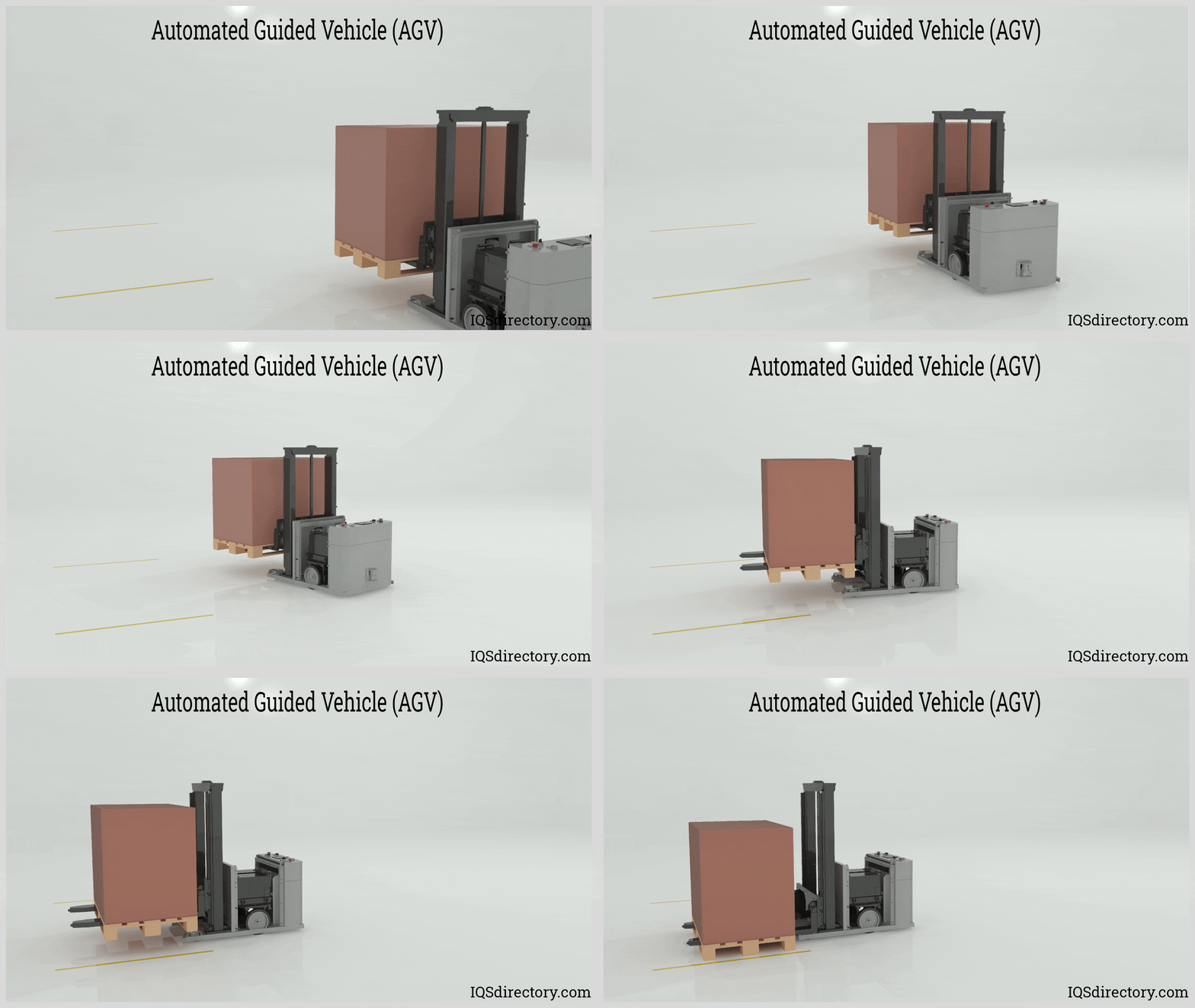
What Is an AGV Forklift?
An AGV forklift is a robotic machine that operates autonomously without a driver, capable of moving, lifting, retrieving, and positioning loads to ensure seamless transportation between points. Managed by an advanced computer system, this automated guided vehicle (AGV) functions independently, integrating computer programming, robotics, and material handling automation within a sophisticated technical framework. In modern warehouses, distribution centers, manufacturing plants, and fulfillment operations, AGV forklifts are often used to reduce labor costs, improve throughput, and support safer, more consistent pallet handling.

AGV forklifts adeptly manage a variety of load dimensions, supporting pickup and delivery from floor and elevated surfaces like conveyor belts and storage racks. Available in counterbalance and outrigger configurations, they can handle loads up to and exceeding 10,000 lbs. Different guidance technologies are utilized in AGV forklifts, such as laser-guided vehicle (LGV) systems, magnetic tape, natural navigation, and magnetic markers. Choosing the right navigation system is vital for the optimal performance of an AGV forklift, customized to the unique demands of the task at hand. Buyers evaluating an AGV solution often compare payload capacity, travel speed, battery life, route flexibility, safety sensors, and integration with warehouse management systems (WMS) or enterprise resource planning (ERP) software. This makes AGV forklifts a practical option for companies seeking scalable warehouse automation, improved inventory flow, and reliable automated pallet transport.
What Are the Different Types of AGV Forklift Navigation Systems?
Automated Guided Vehicle (AGV) forklifts are advanced robotic transport machines designed to autonomously move loads throughout modern warehouses, distribution centers, and manufacturing facilities. By leveraging sophisticated AGV forklift navigation systems, these self-driving forklifts execute programmed maneuvers, ensuring smooth, accurate, and repeatable material handling processes. While to the naked eye these automated forklifts seem to navigate independently, each movement is dictated by specialized automated guided vehicle (AGV) navigation technology—providing safety, efficiency, and route precision. Understanding the different navigation systems is critical for businesses evaluating AGV forklift solutions to improve logistics automation, operational throughput, and workplace safety.
Unlike basic guided strip or light methods, today’s AGV forklift navigation technologies utilize a range of intelligent solutions—from magnetic guidance to laser-based and vision-driven mapping approaches. Selecting the right system is essential for optimal performance in applications such as pallet transport, order picking, stock replenishment, and just-in-time delivery. Modern navigation systems for autonomous forklifts ensure route adherence, obstacle avoidance, and compliance with stringent safety regulations, all while maximizing uptime and reducing manual labor costs in automated material handling environments.
AGV Forklift Navigation Systems
Laser Guided (LGV) Navigation
The Laser Guided Vehicle (LGV) navigation system is among the most advanced and widely adopted solutions in AGV forklift automation. Utilizing laser positioning technology, an LGV features a navigation laser mounted on a pole atop the forklift. This laser interacts with reflective targets—such as reflector tape or cylindrical reflectors—strategically installed on walls, columns, or poles throughout the material handling facility.
The laser scanner emits rotating beams in a 360-degree pattern to continuously detect these reference points. Intelligent laser sensors receive data feedback from the reflectors and, using complex algorithms, accurately calculate and adjust the AGV forklift’s position 30 to 40 times per second. This process ensures precise path following, collision avoidance, and smooth navigation around obstacles, making LGV systems ideal for high-density warehouses and dynamic production floors.
Laser-guided navigation offers significant advantages including rapid installation, flexible route programming, and scalability for evolving layouts. Because this system does not require floor modifications—unlike wire-guided or magnetic-tape AGVs—deployment and rerouting are highly cost-effective and do not disrupt ongoing facility operations. LGV-based forklift systems can also integrate with warehouse management systems (WMS), enabling seamless logistics automation and real-time inventory tracking. For businesses seeking future-proof AGV forklift navigation, laser guidance provides leading accuracy and adaptability.

Magnetic Tape
Magnetic tape guidance remains a popular, cost-effective navigation method for AGV forklifts, especially in environments where fixed pathway operation is acceptable. In this system, robust magnetic tape (typically 1 mm thick, 5 cm wide) is affixed to the facility floor in the desired travel paths. AGV forklifts utilize magnetometers and magnetic sensors to detect the tape and autonomously follow the pre-defined route with consistent accuracy.
To facilitate automated decision-making at intersections or junctions, radio frequency identification (RFID) tags are often embedded along the magnetic track. AGVs equipped with RFID readers use these tags to execute navigation logic—such as turning, stopping, docking, or engaging in load transfer tasks—based on tag location and programmed route maps.
While magnetic tape navigation is relatively straightforward to install and maintain, it limits AGV forklifts to established routes, thus reducing operational flexibility. Changes in workflow or facility layout necessitate physical tape repositioning. Nonetheless, this method delivers excellent positional tolerance (±2 mm) and requires no invasive facility modifications, making it an optimal choice for repetitive transport lanes, lean manufacturing lines, and reliable point-to-point logistics automation.

Natural Navigation Systems (Vision and SLAM)
Natural navigation methods represent the forefront of autonomous guided vehicle (AGV) technology, especially in adaptive environments requiring dynamic path planning and real-time localization. Unlike fixed-path approaches, these systems “see” and interpret their surroundings, enabling AGV forklifts to adapt their routes as facility layouts or workflows change. The most prevalent technique is Simultaneous Localization and Mapping (SLAM), a process by which AGVs create and update a digital map of their environment while simultaneously estimating their position on the map.
SLAM navigation uses advanced sensor fusion—combining vision cameras, lidar scanners, 3D depth sensors, and lasers—processed by an onboard Inertial Measurement Unit (IMU) and powerful algorithms. During initial setup, AGV forklifts perform scanning runs, generating high-fidelity environment maps that serve as baseline references for subsequent autonomous operations. Map data can be supplemented or imported from facility CAD layouts, further streamlining deployment in diverse industrial applications.
After mapping, AGV forklifts continuously compare real-time sensor input with previously acquired map data, ensuring localization accuracy and safe travel even in dynamic or congested areas. This capability allows for seamless integration with Automated Storage and Retrieval Systems (AS/RS), warehouse automation platforms, and flexible manufacturing systems. Natural navigation and SLAM AGVs are highly suitable for facilities prioritizing scalability, layout changes, and integration with Industry 4.0 initiatives.

Magnetic Spots
Magnetic spot guidance represents another highly accurate form of automated forklift navigation, often preferred in environments demanding pinpoint positioning. In this system, durable magnetic cylinders (typically 20 mm by 10 mm) are embedded in the facility floor at regular intervals. AGV forklifts equipped with magnetic sensors, encoders, and gyroscopes move sequentially “spot to spot,” correcting steering and minimizing route deviation.
For optimal navigation, a facility CAD map is loaded into the AGV’s control system, which uses combined spot detection and odometric feedback to maintain tolerances of around 2.5 mm. This level of accuracy exceeds many vision-based or lidar solutions. Installation does require drilling, making magnetic spots a semi-permanent navigation infrastructure. Key benefits include very low wear and tear, minimal maintenance, and reliable route control, making it well-suited to high-value inventory areas, automotive lines, or pharmaceutical logistics requiring secure, repeatable movement.
Wire Guided Technology
Wire-guided navigation is the classic, robust solution for automated guided forklifts, particularly those operating in fixed and high-precision industrial settings. This technology requires a conductive wire to be installed beneath the facility floor along the desired AGV travel path. The wire emits a continuous radio frequency signal, detected by coil antennas mounted on the AGV forklift. Onboard electronics interpret the signal, enabling automatic, fine-tuned steering to follow the route with superior precision—even when approaching the path at sharp angles up to 70 degrees.
Wire-guided AGV systems provide extremely low-maintenance operation, as the embedded wire experiences virtually no wear over time. While highly reliable, adaptability is limited; modifying pathways requires costly floor work and operational downtime. Despite this, wire-guided navigation is still favored in heavy manufacturing, cold storage, and facilities with long, high-traffic aisles where uptime and accuracy are top priorities. First introduced in 1953, wire guidance remains a proven choice for automated material handling and continues to support legacy AGV fleets as well as new automated forklift installations.

Choosing the Optimal AGV Forklift Navigation System
Selecting the best AGV forklift navigation system requires careful consideration of application requirements, facility layout, environment dynamics, and integration goals. Buyers should evaluate factors such as:
- Facility Environment: Static or dynamic layouts, potential for workflow changes, and space constraints.
- Required Precision: Tolerance requirements for pallet alignment, load handling, and docking operations.
- Installation Impact: Ability to modify existing infrastructure versus desire for rapid, non-invasive deployment.
- Integration with Automation Software: Needs for compatibility with warehouse management systems (WMS), enterprise resource planning (ERP), and robotics workflow orchestration.
- Cost Considerations: Budget for AGV investment, installation, long-term maintenance, and system scalability.
- Operational Flexibility: Need for easy route reconfiguration and layout expansion.
By aligning navigation technology with user intent—whether optimizing for fixed-path efficiency, future layout flexibility, real-time mapping, or Industry 4.0 digital transformation—buyers and facility managers can invest in the automated forklift solution that maximizes productivity, safety, and operational ROI.
What Are the Different Types of AGV Forklifts?
Automated guided vehicle (AGV) forklifts are a cornerstone of modern warehouse automation, offering an array of advanced lifting and transporting mechanisms to streamline material handling operations. AGV forklifts are engineered to accommodate diverse warehouse settings, logistics centers, and distribution facilities by efficiently handling pallets, containers, and specialized loads. The choice of AGV forklift model primarily depends on key factors like required weight capacity, load dimensions, racking configurations, and navigation demands, as each variant supports specific industrial needs. The primary function of AGV forklifts is to optimize the internal transport of goods, reducing labor costs, minimizing errors, and delivering consistent throughput by automating repetitive and potentially hazardous manual material handling tasks.
Industrial operations favor AGV forklifts for their repeatable, precise, and error-free performance. While manual picking processes can lead to mistakes such as incorrect product selection, missed inventory slots, or damage to sensitive goods, AGV forklifts leverage advanced navigation technologies, such as laser guidance, RFID, and vision systems, to eliminate these issues. The result is a more reliable, accurate, and safe material flow, reducing costly bottlenecks or downtime caused by human error and improving inventory tracking for warehouse management systems (WMS).
Since their inception over sixty years ago, AGV forklifts have revolutionized supply chain logistics, ensuring seamless integration into existing workflows and promoting efficient just-in-time (JIT) delivery. As automated material handling solutions, AGV forklifts continue to advance warehouse productivity, reduce operational expenses, and support scalable growth for manufacturers and e-commerce fulfillment centers.
AGV Forklift Types
AGV Forklift Pallet Stacker
AGV forklift pallet stackers are essential for automated storage and retrieval (AS/RS) systems, combining the horizontal mobility of pallet movers with vertical lifting capability and enhanced weight handling. These robotic forklifts can lift loads exceeding a ton to several feet high, efficiently placing them onto high-bay pallet racks or shelving. Although AGV stackers perform similarly to traditional lift trucks, they set themselves apart by integrating programmable automation, obstacle detection sensors, and adaptable lifting algorithms. This makes them ideal for dense racking environments, finished goods staging, and dynamic staging areas in production lines, where space optimization and labor reduction are critical.

Clamp AGV Forklift
A clamp-type AGV forklift uses a specialized gripping mechanism rather than standard forks, making it indispensable for industries that handle heavy, cylindrical, or fragile loads—such as rolls of paper, steel coils, textile reels, or cable drums. By leveraging precision laser positioning, clamp AGV forklifts ensure secure, damage-free load handling, critical for sectors like printing, metalworking, and converting. These automated forklifts excel in applications requiring gentle yet firm load manipulation, reducing risks of crushing or surface damage often associated with manual handling. With capabilities like lifting up to 84-inch diameter and 3,000 lbs loads at heights above 250 inches, clamp AGV forklifts combine robust load capacity with sophisticated mobility, supported by durable polyurethane wheels for long service life.

Counterbalanced AGV Forklift
The counterbalanced AGV forklift is the workhorse of automated fleet solutions, featuring integral counterweights or battery packs positioned at the rear to stabilize heavier loads during lifting. This advanced design enables greater vertical reach compared to AGV pallet stackers, making it a popular choice for loading and unloading goods in inbound/outbound docks, cross-docking, and high-density storage systems. Counterbalanced AGV forklifts excel at handling a wide range of palletized and non-palletized goods, providing flexible automation options across various sectors, including manufacturing logistics, retail distribution, and food and beverage warehouses. Their larger chassis and extended turning radius make them optimal for spacious warehouse aisles or environments where versatile lift heights are essential.

Pallet Mover
The AGV pallet mover—also known as a fork-over AGV or automated pallet jack—is specifically engineered for low-level, horizontal pallet transport. Replacing manual pallet trucks and reducing operator fatigue, these robots seamlessly transfer loaded pallets from staging to shipping or between production zones, supporting uninterrupted material flow. Compact stabilizers below the forks minimize the footprint for navigating congested areas and tight corridors, yet limit compatibility with only single-faced pallets. For warehouses relying on high-throughput, repetitive pallet movement or where automated end-to-end material flow is key, AGV pallet movers deliver substantial labor savings and operational efficiency. However, for operations using double-faced pallets or requiring higher vertical reach, alternative designs like counterbalanced or straddle-type AGV forklifts are recommended.

Reach Truck
AGV reach forklifts are vital for high-density, narrow-aisle warehouse applications, optimizing cubic storage capacity by enabling access to tall racks while operating in tight spaces. These driverless reach trucks utilize outer stabilizing legs—similar to straddle AGV forklifts—and an extending mast that deploys the forks beyond the chassis, facilitating precise pallet retrieval and placement. Their unique design allows efficient handling of double-deep, multi-tier pallet arrangements, making them popular in warehouses prioritizing space utilization, automated order picking, and efficient inventory management. Modern AGV reach trucks often leverage fleet management software and real-time tracking solutions to maximize warehouse throughput and minimize product damage.

Straddle AGV Forklifts
Straddle AGV forklifts, also known as outrigger AGVs, are engineered for environments demanding both heavy-duty lifting and exceptional maneuverability in constricted spaces. Featuring wide, parallel stabilizing legs positioned outside the lifting forks, these units provide increased load stability, permitting higher stacking and bulkier material transport without risk of tipping. Their agile footprint makes them suitable for narrow aisles, compact warehouse layouts, or distribution centers handling an array of load types and sizes. Equipped with advanced laser navigation and automatic guidance systems, straddle AGV forklifts facilitate safe, reliable movement for operations such as conveyor loading, racking system supply, and truck loading/unloading. Their adaptability also ensures efficient integration with smart warehouse solutions and warehouse management systems.

Very Narrow Aisle (VNA) Forklifts
Very Narrow Aisle (VNA) AGV forklifts are specifically designed for ultra-high-density warehouses where storage capacity and picking speed are paramount. By incorporating side-mounted, extendable forks and multi-directional drive systems, these automated lifting solutions navigate aisles narrower than 78 inches and raise loads up to 36 feet, significantly increasing vertical storage potential. VNA AGV forklifts excel in complex environments such as mega-distribution hubs, cold storage, or high-turnover retail fulfillment centers. Their advanced automation enables a range of motions—forward, backward, lateral, rotational, and drifting—improving operational flexibility and minimizing aisle congestion. Although associated with higher upfront costs, VNA AGVs rapidly offset investment through labor savings, reduced product damage, and maximized inventory density, making them a strategic asset for businesses scaling automated warehousing or 24/7 logistics operations.

Key Considerations for Selecting an AGV Forklift
When evaluating which automated forklift best suits your facility, consider factors such as load type and weight, aisle width, storage height, safety requirements, preferred guidance technology (laser, magnetic tape, vision), and integration with existing warehouse management systems. Investing in the right AGV solution can help future-proof your supply chain, enhance efficiency, and drive consistent ROI. For a comprehensive assessment of your automation needs, consult with AGV system integrators or automation solution providers.
Frequently Asked Questions
What Is an AGV Forklift and How Does It Function?
An AGV forklift is a driverless robotic machine that autonomously moves, lifts, and positions loads using advanced computer programming and robotics to ensure efficient material transport within facilities.
Which AGV Forklift Navigation Systems Offer Flexibility for Changing Warehouse Layouts?
Natural navigation systems such as vision-based or SLAM technologies allow AGV forklifts to adapt routes as layouts change, eliminating the need for fixed-path infrastructure and enabling real-time localization in dynamic environments.
How Do AGV Forklifts Enhance Safety and Reduce Labor Costs in Warehouses?
AGV forklifts use precise navigation technologies to ensure route adherence and obstacle avoidance. This automates repetitive material handling, reduces errors, minimizes manual labor, and supports compliance with stringent safety standards.
What Are Key Factors to Consider When Selecting an AGV Forklift for My Facility?
Consider load type, weight, aisle width, storage height, preferred navigation technology, integration with warehouse management systems, operational flexibility, and budget to ensure optimal performance and ROI.
Which AGV Forklift Types Are Best for High-Density or Narrow-Aisle Warehouse Settings?
AGV reach trucks and Very Narrow Aisle (VNA) forklifts are engineered for high-density and narrow-aisle warehouses, offering extended reach for tall racks and efficient navigation in tight spaces.
How Do AGV Forklifts Integrate with Local Warehouse Management Systems?
Modern AGV forklifts integrate with warehouse management systems (WMS) to support real-time inventory tracking, automated storage and retrieval, and seamless logistics automation in local facilities.
What Are the Uses for AGV Forklifts?
The ability of AGV forklifts to consistently and reliably deliver raw materials and supplies without human intervention is a major factor in their increasing use. Implementing an AGV forklift system allows workers to focus on their core tasks without the need to manually operate a forklift or pallet jack for supply movement.
In addition to handling supplies, AGV forklifts are versatile enough to be used for work-in-progress applications and for storing completed products. They can function as a conveyor system, moving unfinished components between workstations, which enhances operational efficiency and timing.
AGV Forklift Applications
Automotive Production
The efficiency and versatility of AGV forklifts have made them an invaluable asset in automotive production. They primarily function to provide just-in-time parts for chassis production, engine and gearbox assemblies, and pre-production staging.
Handling Food and Beverage
Handling raw materials for food production requires exceptionally sensitive processing equipment to avoid contamination. Human contact with these materials can negatively affect their quality. AGV forklifts offer an ideal solution by ensuring that raw materials remain untouched by human hands.
AGV forklifts are versatile in their applications, including moving baking trays between ovens and production lines, transporting containers to and from storage, and placing raw and finished products on shelving systems at various heights in warehouses.
As the demand for freshness and convenience grows, AGV forklifts have become crucial in enhancing supply chain efficiency to meet retailer needs. Their versatility and agility facilitate quick and smooth adjustments to production requirements, minimizing the need for extensive logistical planning.
Printing Applications
The movement of paper rolls for printing is a complex and hazardous task that requires precision and careful handling. The large rolls used in the production of pamphlets, advertisements, and other literature must be perfectly aligned with the printing press’s feeding mechanism. Previously, this task was managed by a team of workers using various lifting devices.
With the introduction of AGV forklifts, the process of handling paper rolls has become faster, more efficient, and more precise, eliminating the need for human intervention. The rolls are selected from storage, picked up using V blocks, and transported to the pressroom where they are accurately positioned for loading and use. The integration of these automated forklifts has significantly reduced the risks associated with handling paper rolls.

Assembly Line Usage
Henry Ford's introduction of the assembly line revolutionized manufacturing by using a straight line with stations that added one component at a time. While this method was groundbreaking, modern assembly operations have advanced beyond the single-line design due to the increasing complexity of each process step.
Today, AGV forklifts have replaced outdated chain drives, mats, and conveyors, providing a more efficient and versatile method for moving in-process items. Implementing AGV forklifts in assembly operations unlocks a range of new possibilities for product assembly.
AGV forklifts eliminate the need for physical structures such as floor chains, moving mats, conveyors, and overhead cranes, which require significant installation, facility adjustments, and space. AGV systems can be deployed more swiftly and operate more effectively, addressing issues like supply delays and inefficient movement of unfinished products.
Using AGV forklifts in assembly lines offers several advantages, including the ability to easily alter and change paths, scale output as needed, and quickly adjust routes, locations, or add additional stages to the process.
Warehousing Applications
Among the various applications of AGV forklifts, warehousing benefits the most. AGV forklifts streamline the processes of picking, loading, placing, and cataloging materials, drastically reducing unnecessary steps. This efficiency minimizes misplacement and enhances inventory control by reducing human errors and handling, ensuring accurate racking and material location.
Inventory control errors often stem from human mistakes. A product may be misfiled due to incorrect aisle selection or placement in the wrong bin. AGV forklifts, however, follow precise programming, eliminating such misjudgments and ensuring correct item placement.
AGV forklifts enable workers to complete tasks more quickly, easily, and accurately. They reduce the time spent searching for materials and moving around, leading to increased productivity. Additionally, AGV forklifts enhance workplace safety and ergonomics, contributing to improved worker retention and effectiveness.

AGV Forklifts and Packaging
AGV forklifts are crucial in the packaging industry, from manufacturing packaging materials to their application in product production. They handle a wide range of packaging types, including pallets, cans, bottles, labels, slip sheets, cardboard products, lids, and wrappers. These materials often come in bulk sizes ranging from several hundred to several thousand units, making AGV forklifts an ideal solution for managing such weights and quantities.
AGV forklifts perform essential functions, such as delivering materials to production lines and removing finished products for storage or shipping. When it comes to shipping, AGV forklifts can safely and efficiently load trucks, streamlining the entire process.
Deep Freeze Storage
The increasing demand for frozen products has led to a rise in the need for deep freeze warehousing. While deep freeze warehousing is not uncommon, it presents several challenges due to temperatures typically falling below -18°F. This exposes both workers and equipment to extreme and hazardous conditions, creating risks and safety concerns.
Statistics show that manually operated sub-zero warehouses experience higher rates of product damage, improper product rotation, and poor fulfillment times, which negatively impact productivity and profits. Additionally, forklifts used in deep freeze environments require more frequent maintenance due to the low temperatures, contributing to higher personnel turnover.
AGV forklifts offer a solution to these challenges by enhancing product identification and rotation. Unlike traditional forklifts, AGV forklifts are more energy-efficient because they eliminate the need for workers to frequently open and close freezer doors.
Although the initial installation of an AGV forklift system is costly, it results in significant cost savings through reduced energy consumption and lower turnover and sick time among workers.
What Are the Advantages of Using AGV Forklifts?
The rapid advancement of AGV forklifts is closely linked to the growth in technology and the use of computers. These forklifts rely on sophisticated algorithms that map their routes and ensure optimal performance. As research and innovation continue to drive more efficient and cost-effective solutions, it is highly likely that AGV forklifts will further influence production, warehousing, assembly, and manufacturing processes.
AGV Forklift Use Advantages
Material Flow Advantage
The efficiency of an AGV forklift system ensures a consistent and smooth flow of materials to and from locations, eliminating concerns about production stoppages or shortages of raw materials. The programming and control of AGV forklifts allow them to operate continuously with minimal maintenance requirements.
Improved flow is partly due to the AGV forklifts' ability to perform complex and repetitive tasks autonomously and precisely. Tasks such as palletizing, loading, and transportation are completed quickly and efficiently.
Forklift Traceability
Each AGV forklift is monitored by an advanced computer system that tracks its path and coordinates its workload. This system allows for real-time identification of an AGV forklift's location and its current or upcoming load.
Safety and Security
Safety and security are key reasons for adopting AGV forklifts. They follow a predetermined path, significantly reducing the risk of collisions with workers, damage to walls, or interference with other operations. Unlike human-operated systems, AGV forklifts eliminate the potential for errors and accidents caused by human factors.
Response Time
AGV forklifts offer improved response times because they are programmed to complete tasks within specified durations. Their programming ensures consistent movement and task completion times, without deviations.
Business Growth
In a dynamic business environment, continual growth and adaptation are essential. As market demands shift, processes and operations must evolve. AGV forklifts are versatile and adaptable, easily reprogrammable and repositionable to meet the changing needs of a growing business.
Cost Effectiveness
AGV forklifts reduce operational costs by eliminating the need for multiple forklift drivers, which is especially beneficial for companies with 24-hour operations. They also consume less energy compared to manually driven forklifts. The installation of an AGV forklift system is straightforward and minimally disruptive to normal business operations.
Logistical and Inventory Management
One of the more frustrating aspects of running a business is controlling logistics and inventory, which often results in resource losses. Human error is a significant factor in this problem, leading to miscounted, misplaced, lost, or overlooked products. Variances between system records and physical inventory are common, depending on how frequently inventory counts are conducted.
Implementing an AGV forklift system greatly reduces or eliminates these errors. AGV forklifts are programmed to avoid incorrect placement or misplacement of products. With a direct link between the AGV system and the company's inventory system, product counts are accurately tracked and monitored electronically, minimizing human interference.
Conclusion
- An AGV forklift is a driverless self-operating robotic device that has the ability to carry, lift, retrieve, and place loads for easy transfer from one location to another.
- AGV forklifts are capable of handling a variety of load sizes for pickup and drop off from the floor and elevations such as conveyor systems and storage racks. They include counterbalance and outrigger designs with load capacities as high as 10,000 lbs. or higher.
- As robotic devices, AGV forklifts move freely and unhampered from location to location in a series of programmed maneuvers. Though it may seem that they are moving independently, for every AGV forklift, there is a guiding navigation system that determines their path from which they are unable to vary.
- The work of an automated guided forklift requires different types of lifting mechanisms to fit the needs of a warehouse or supply center. A major factor in determining the type of AGV forklift is the weight of the loads since each model of AGV has a different capacity.
- The rapid development of AGV forklifts is directly in line with the technological expansion and use of computers. AGV forklifts operate on sophisticated and complex algorithms that map their routes and ensure their proper performance.