
- 5 leading manufacturers
- 26 additional suppliers
- 14 states and provinces
- 20 related categories
- 4 guide sections
Rubber Trim Manufacturers and Companies

IQS Directory is a top industrial directory listing of leading industrial rubber trim manufacturers and suppliers. Access our comprehensive index to review and source rubber trim manufacturers with preview ads and detailed product descriptions. These rubber trim companies can design, engineer and manufacture rubber trim to your specifications and application need. A quick and easy to use request for quote form is provided for you to contact these rubber trim manufacturers and suppliers. Each company has detailed profile information, locations, phone number, website links, product videos and product information defined. We are the right resource for your information requirement whether its for a manufacturer of rubber strips, rubber edge trim, rubber angle drip trim.
Suppliers located in IL, IN, OH +11 more states
Contents (5 sections)
Leading Rubber Trim Manufacturers
Showing all 5
| Placement No. | Manufacturer | Location | Contact | Actions | |
|---|---|---|---|---|---|
| 1 | Aero Rubber Company, Inc.Aero Rubber Co. offers exceptional quality and competitive pricing on all of our extruded rubber products. Aero Rubber Co. uses high quality rubber compounds such as, Neoprene, Viton, Silicone, EPDM, Polyurethane, Natural Rubber, and Thermoplastic Rubber. For post-fabrication services we offer cut & coil/spool, pressure sensitive adhesive, and splicing. We offer various rubber extrusion profiles like D shaped, half-round, T shaped, U channel profiles, round cord, square, triangle, and custom extrusions. | Tinley Park, IL | |||
| 2 | Kent Rubber Supply Co.We work closely with our customers to ensure our rubber extrusions meet their specific requirements, whether it involves unique dimensions, materials, or performance characteristics. As a trusted supplier, we are committed to delivering exceptional service, quick turnaround times, and competitive pricing. At Kent Rubber Supply Co., your success drives our innovation. | Grand Rapids, MI | |||
| 3 | National Rubber Corp.National Rubber values quality, consistency, and fast delivery of our products. Our components are made from a variety of elastomers such as neoprene and silicone, and our team members are capable of turning your drawing into the part you need. Contact us today to tell us about your next project! | Canonsburg, PA | |||
| 4 | GSH Industries, Inc.Since GSH Industries began in 1986, we have been providing rubber parts to a wide variety of industries. We make sure that each part you order will work just right for its future application. Be sure to contact us for quotes on your weatherstripping project for the best products and service at the lowest prices. For full service design and engineering, call GSH. | Strongsville, OH | |||
| 5 | Dynamic Rubber, Inc.At Dynamic Rubber, we are a trusted manufacturer of custom rubber extrusions, delivering durable, high-quality solutions for customers across a wide range of industries. Our company specializes in producing precision rubber profiles that are engineered to meet unique application requirements, whether for sealing, cushioning, vibration control, insulation, or environmental protection. | Mt. Prospect, IL |
Claim your Page One Spot
Leading rubber trim manufacturers are listed first on this page, each with a website preview and a Request a Quote button on its row.
Additional Rubber Trim Companies
The category’s other rubber trim companies are listed on their own page, with location, phone and website where each supplier provides them.
View 26 Additional Rubber Trim CompaniesDo not see your company listed in Rubber Trim?
Engineers and buyers use this page to find rubber trim suppliers. Add your company to the Rubber Trim listings so they can find you too.
List Your Company- Listed in the Rubber Trim directory
- A profile page for your company
- Buyers contact you directly
Rubber Trim Industrial Manufacturing Guides
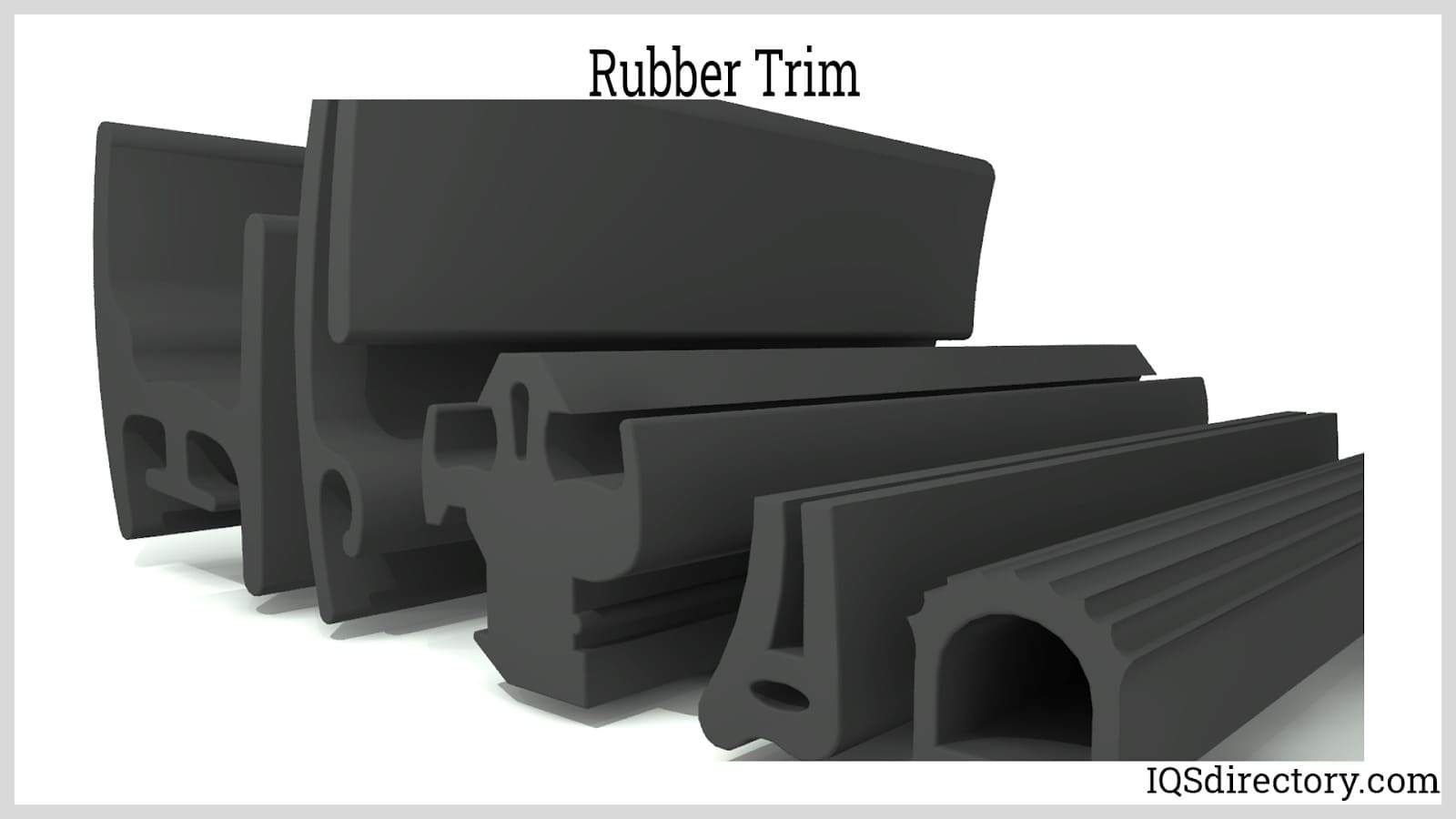
Rubber Trim: Everything You Need to Know about Types & Process
This article provides comprehensive information about rubber trims and their production process. Read further to learn more about: What is Rubber Trim?…
3 chapters
Quick Answers
- How many rubber trim manufacturers are listed on IQS Directory?
- 5 leading manufacturers and 26 additional suppliers.
- Where are rubber trim manufacturers located?
- The listed suppliers are in 14 states and provinces: Illinois (5), Indiana (4), Ohio (4), California (3), Michigan (3), Pennsylvania (3), Minnesota (2), Massachusetts (1), and 6 more.
- How do I get quotes from rubber trim suppliers?
- Select suppliers in the table and choose Request Quotes. IQS reviews your request and forwards it to every supplier you select.
Rubber Trim
Rubber trim is a type of extruded rubber that is inexpensive and easy to make. Typically long and often thin, it has countless applications, both functional and aesthetic, in the retail/consumer, commercial and industrial markets. It is especially popular in the aerospace and automotive industries, where it is used to line aircraft aisles and insulate vehicles from the outside air. To insulate vehicles, rubber trim is lined around windows and doors, where it provides an extra seal. It is additionally used for weatherstripping and building insulation, protecting and finishing metal edges, softening sharp corners, covering wall baseboards, sealing refrigerator and cooler doors, lining movie theater and auditorium aisles and more.
Design of Rubber Trim
Rubber trim is created from raw natural or synthetic rubbers, such as EPDM rubber or silicone. EPDM (ethylene propylene monomer (M-class)) is an elastomer that is valued for its highly superior temperature resistance, ozone resistance and weather resistance. It is also exceptionally resistant to ultraviolet (UV) light and exhibits good resistance to steam, water, acids, alkalis and oxygenated solvents. EPDM also displays a good amount of electrical insulation properties and maintains flexibility at low temperatures.
Rubber Extrusion Process
Regardless of its exact composition, rubber trim is processed in a rubber extruder, a machine that forms the raw material, or stock, into workable material using heat and pressure. Typically, rubber extruders consist of a hopper, a conveyance channel, a long screw and a die. To begin the process, manufacturers first dump a stockpile of raw material into the hopper. From the hopper, the stock is directed into the conveyance channel, where a long screw helps move it toward the die. As the temperature increases, the screw also helps pressurize the churning stock until it is malleable and nearly molten. Once it reaches this state, the stock moves into the die, a preformed metal mold, and takes on its shape. After it passes through the die, the newly formed trim is allowed to both cool and harden. Dies used in rubber extrusion can be made into virtually any shape, creating an almost endless field of possibilities for trim design. Going beyond simple geometry, they can even allow for the adornment of the trim with patterns or special designs. After rubber trim has been extruded, it typically undergoes some sort of finishing. The simplest finishing touches would be cutting the trim down into different lengths and then shipping it. However, many other options are available as well, such as putting the trim through vulcanization, a strengthening process that makes the trim better able to withstand harsh conditions and outdoor exposure. Rubber trim can additionally be modified to be more chemical and temperature resistant and it is typically available in an array of different colors.
Applications of Rubber Trim
It is good for car doors, machinery and outdoor applications in general. Silicone can be any number of synthetic rubbers in the silicone family. Generally, it displays thermal stability over a wide chemical range, low toxicity and low chemical reactivity. In addition, it can be made specially with specific properties that benefit certain applications. Most often silicone rubber trim is used in the food and beverage, sanitation and hygiene, pharmaceutical and medical industries. Sometimes, rubber trim is manufactured with a flexible or rigid metal core, which adds strength and helps the trim absorb shock and impact. Typically, the metal core is either steel wire or segmented steel. For outdoor applications, steel wire makes the best core, because it is able to tolerate impact even in cold temperatures. Segmented steel cores, on the other hand, which contain cold-rolled steel, are known for their good elongation properties. In other words, they are known to be able to extend or stretch well while under stress.
Things to Consider When Purchasing Rubber Trim
Rubber trim is an endlessly useful product with applications all year round, whether an application is in the kitchen, in the car, around a window or on an airplane. With the help of the right manufacturer, you can enjoy all the benefits of wellmade rubber trim, no matter your requirements. To keep your trim effective and healthy, you can both clean it and treat it from time to time. To clean rubber trim, simply wash it with soap and water. In some cases, this need only be done twice a year, while other trim, such as automotive trim, requires regular cleaning to stay looking fresh. To extend their working life, you can treat rubber trim products with a protectant six to eight times a year. Among the most common protectants are water-based vinyl and rubber dressing, a gel product that you can rub on using a cloth. If the trim is regularly exposed to sunlight, which is typically the case with exterior trim, then you should select a protectant that also contains ultraviolet (UV) protection, to keep the trim from fading. Be careful to not allow the treatment to dry, however, or it may stain the trim.