
- 4 leading manufacturers
- 23 additional suppliers
- 19 states and provinces
- 16 related categories
- 12 guide sections
Rubber Roller Manufacturers and Companies

IQS Directory provides a detailed list of urethane rubber roller manufacturers and suppliers. Find rubber roller companies that can design, engineer, and manufacture rubber rollers to your specifications. Peruse our website to review and discover top urethane rubber roller manufacturers with roll over ads and complete product descriptions. Connect with the rubber roller companies through our hassle-free and efficient request for quote form. You are provided company profiles, website links, locations, phone numbers, product videos, and product information. Read reviews and stay informed with product new articles. Whether you are looking for manufacturers of rubber roller suppliers and rollers of every type, IQS is the premier source for you.
Suppliers located in PA, AZ, CA +16 more states
Contents (5 sections)
Leading Rubber Roller Manufacturers
Showing all 4
| Placement No. | Manufacturer | Location | Contact | Actions | |
|---|---|---|---|---|---|
| 1 | Coreline RollersWe take care of all your custom roller needs. Coreline Rollers specializes in replacing, repairing, and fabricating new rollers. Roll size up to 48 in. diameter, 20 ft. length and 6,000 lbs and custom options. No minimums or set up charges! We pride ourselves on being able to manufacture the most reliable and cost effective solutions. | Cuyahoga Falls, OH | |||
| 2 | Weaver Industries, Inc.Our guide rollers are made from the highest quality materials in the industry. We take pride in adhering to our company values, like integrity and honesty. As a family owned and operated company, we like to treat customers like our own family. We will always look for the best prices and the prefect solution. Give us a call today to see how we can help you meet your goals! | Denver, PA | |||
| 3 | REDCO Rubber Engineering & Development CompanyREDCO Rubber Engineering & Development is made up of a dedicated team of designers and engineers. We have nearly 70 years of experience serving industries including paper handling and computers. Our rollers are made in-house, and customization is available upon request. Contact REDCO today! | Carson City, NV | |||
| 4 | TPC, Inc.TPC, Inc. is a dedicated and trusted manufacturer of rollers. We manufacture rollers in all shapes, sizes, designs, and colors to meet the needs of our customers and keep their process moving. Our team of experts is dedicated to the production and innovation of our products. As a result, TPC, Inc.’s custom-fit solutions are perfected for customers of all industries. | Fontana, CA |
Claim your Page One Spot
Leading rubber roller manufacturers are listed first on this page, each with a website preview and a Request a Quote button on its row.
Additional Rubber Roller Companies
The category’s other rubber roller companies are listed on their own page, with location, phone and website where each supplier provides them.
View 23 Additional Rubber Roller CompaniesDo not see your company listed in Rubber Roller Manufacturers?
Engineers and buyers use this page to find rubber roller suppliers. Add your company to the Rubber Roller Manufacturers listings so they can find you too.
List Your Company- Listed in the Rubber Roller Manufacturers directory
- A profile page for your company
- Buyers contact you directly
Rubber Roller Industrial Manufacturing Guides
Rubber Rollers: Production Process and Application
This article offers industry insights about rubber rollers. Read further to learn more about: What is a Rubber Roller? Advantages of Rubber Rollers…
6 chapters
Quick Answers
- How many rubber roller manufacturers are listed on IQS Directory?
- 4 leading manufacturers and 23 additional suppliers.
- Where are rubber roller manufacturers located?
- The listed suppliers are in 19 states: Pennsylvania (4), Arizona (2), California (2), Minnesota (2), North Carolina (2), Ohio (2), Delaware (1), Georgia (1), and 11 more.
- How do I get quotes from rubber roller suppliers?
- Select suppliers in the table and choose Request Quotes. IQS reviews your request and forwards it to every supplier you select.
Rubber Rollers
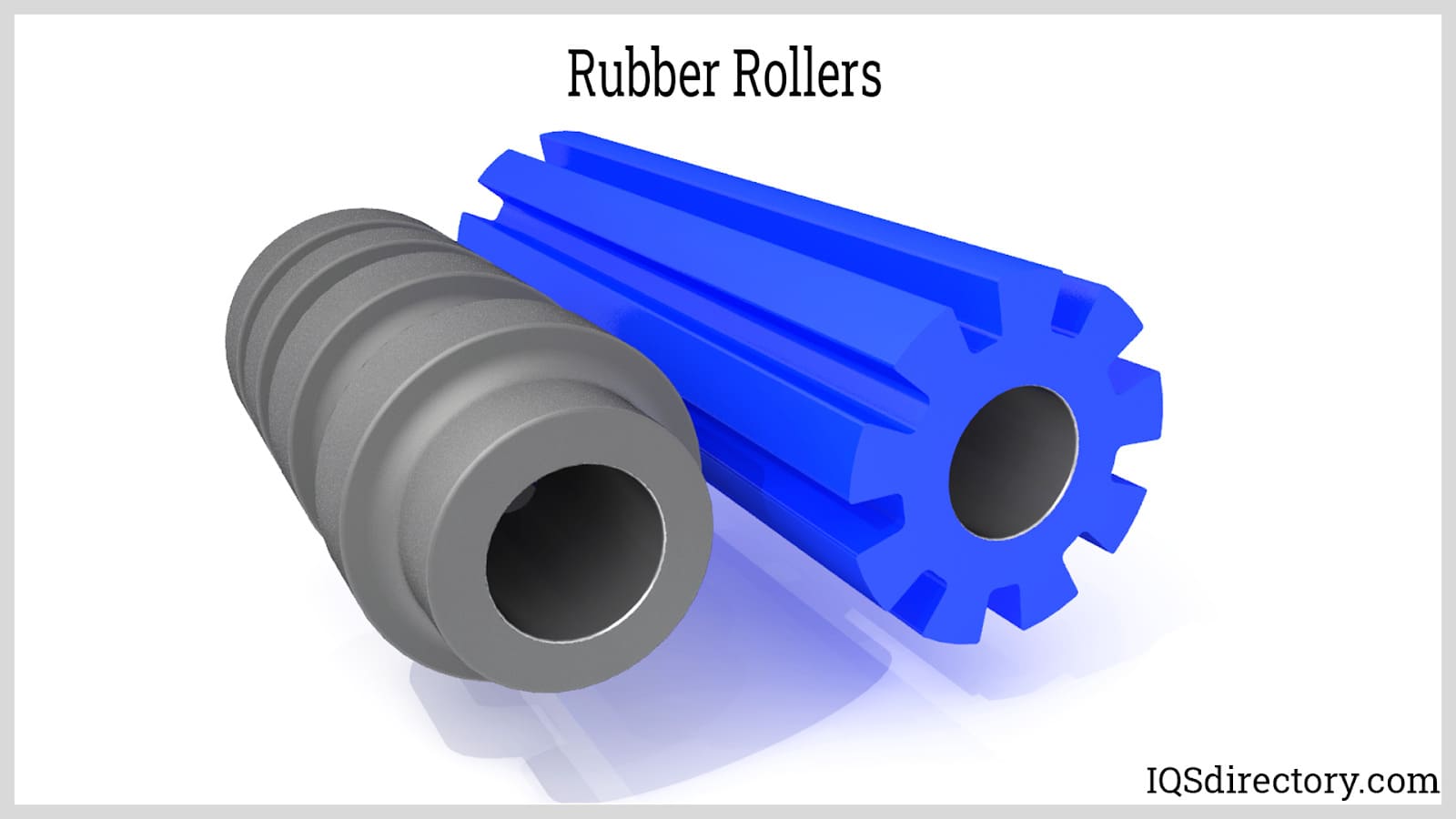
Rubber rollers, also known as rubber rolls, are cylindrical tubes that are composed of natural rubber or synthetic rubber cover bonded to a metal core. They are not to be confused with rubber roll flooring.
In their most basic form, rubber rollers press materials, substances or qualities onto another surface. They serve as basic and essential components of many different machines, systems and processes.
The History of Rubber Rollers
The first rollers, sans rubber, were used as far back as Ancient Egyptian society. There, they used wooden log rollers to perform tasks like moving building stones.
Rubber rollers came to be during the Industrial Revolution, after manufacturers learned how to cure and use rubber. Once they knew how to do this, they began coating steel shafts with rubber in order to perform tasks that were too delicate or generally unsuitable for hard steel surfaces. Before rubber rollers, manufacturers used steel shafts wrapped in rope or animal skins.
Since the 1920’s, rubber rollers have been used heavily in printing because they are the most efficient tools for applying inks to plates, spreading glue and applying thin coatings. The structure of rubber rollers have not changed much since then, but they have become more durable, strong and long lasting. They are also now made with many types of elastomers, which they make usable through curing and grinding of raw materials. That’s why, today, you may also see them with names like "urethane roller," "polyurethane roller" and "silicone roller."
Advantages of Rubber Rollers
There are many reasons to love rubber rollers. First, they’re excellent performers. For example, after they’re distorted, they return quickly to their original shape. They also handle pressure very well. In addition, the rubber layer is resistant to harsh chemicals and protects the metal component from scratching, bumping, corrosion, abrasion and general wear and tear. Finally, rubber rollers are versatile, durable, long-lasting and effective.
Design of Rubber Rollers
Manufacturers typically make the roll cover of rubber rollers using molding or casting processes. For example, to make solid rubber rollers, manufacturers usually turn to molding processes such as injection or compression molding. To make an industrial rubber roller using injection molding, manufacturers heat the elastomeric material and then inject it into the cavity of a split die chamber or mold. After that, they clamp it shut and, eventually, let it cool to form the part. During compression molding, they place the rubber compound into a mold, where, in order to achieve the desired shape, they apply heat and pressure. Thus, the industrial roller is made.
Manufacturers can also make rollers using extrusion processes. If they want to extrude the rubber rollers, they take elastomeric materials, heat them until they’re molten and then squeeze them through a die that has a pin attached to the center, which creates the hollow part of the tube.
When making rubber rollers with metallic cores, manufacturers typically form cores via a metal machining process such as stamping.
In order to form a rubber coating over the metal core, manufacturers use a rubber-to-metal bonding process. During a process such as this, they adhere rubber to a metal substrate with a bonding agent. Usually, this bonding agent consists of polymer-solvent solutions, a primer coat based on phenolic-style resins, and a top layer that is a mix of polymers and other materials.
Fabricated using a wide variety of elastomeric materials, rubber rollers can be composed of virtually any rubber product. This includes silicone, EPDM, nitrile rubber, butyl rubber, polyurethane (sometimes referred to as urethane), neoprene, silicone rubber, hard rubber and many other elastomer compounds. Rubber rollers are often manufactured with metal cores. Typical roller core materials include aluminum, steel and stainless steel.
There are many ways that you can customize your rubber roller to suit your purposes. For example, you can have it cut to length, you can get speciality coatings and finishes, or you can select customized grooving patterns, tapers, contours and materials.
Rubber Roller Features
How a rubber roll works depends on its application. However, in general, it works by rolling over a substrate or material like paper. When it does so, it may apply ink, it may smooth wrinkles or it may help convey items down a line.
Rollers are powered by the mechanisms of the system of which they are a part. This includes mechanical, electrical, inertial and automated mechanisms.
One of the features that make rubber rollers most unique is their ability to quickly return to their original shape after they’ve been depressed or deformed.
Rubber Rollers Types
Applications of Rubber Rollers
Rollers have a broad range of uses, such as the application of one material onto another material. They can also be used to facilitate movement of various machine parts, as is the case with drive rollers. Another very common use of rollers is as tools that provide support and transportation to materials moving through process equipment.
Rubber rollers are also used in circuit board printing, laser printing, photographic imaging, medical chart recording, newspaper printing, bulk material handling, packaging, metal processing, commercial printing and paper converting. Other rubber roller applications include coating, heat treating, drying, annealing, calendaring and embossing.
Rubber Roller Installation
Because rubber rollers and their applications are so diverse, the processes for installing them are also diverse. Some you can do on your own, but others require the assistance of your supplier. To find out just exactly what it will take to install your rollers, talk to your roller manufacturer.
Standards and Specifications for Rubber Rollers
Many rubber rollers must be kept up to standards that are specific to their industry, whether that be food, medicine or packaging.
To make sure your roller is of the highest quality, though, we recommend that, in addition to industry standards, you stick to both ASTM and ISO standards. Also, if you have workers involved, also research any and all OSHA requirements.
Things to Consider When Purchasing Rubber Rollers
When getting ready to make a rubber roller purchase, you have a number of factors to consider.
These include: the nature of your application (pressure, frequency of use, materials conveyed, heat, environment, etc), industry standards and the size of your operation. Considering these will help you pick the right roller type and design.
To find the best manufacturer for you, you need to think about your needs. Do they provide value-adding services like in-house packing? Are they willing to work within your budget and timeframe? Do they do their best to meet all of your specifications and requirements? All of these considerations are just as important as whether or not they’re skilled and experienced.
Find a manufacturer that has what it takes by browsing the sites of and speaking with the companies listed towards the top of this page.
Proper Care for Rubber Rollers
Care for rubber rollers involves more than cleaning, although that is certainly part of it. Rather, to maintain quality, there are a few common pitfalls you must avoid or correct. These are: dynamic balancing, glaze, piling and wrinkling.
Dynamic balancing is a state of imbalance that leads to an unintended degree of rotation. To return your rubber roll to a rotation-free state of balance (static balancing), simply use a balancing machine.
Glaze is the name for build-up on an ink rubber roll or the blanket of a printing press. Buildup like this will negatively affect the uniformity of ink distribution. Similarly, "piling" refers to the buildup of ink on the rollers, blankets and/or plates of a printing press. Avoid these states by, one, regularly cleaning your machine, and two, considering an accessory like a doctor.
Finally, the term "wrinkling" refers to the appearance of folds, creases and other deformations of the surface of a roll. Avoid wrinkling by making sure that you don’t put more stress on your rubber roll than it is designed to handle. Also make sure that it is properly supported.
Improve your rubber rollers by focusing on quality control during design and manufacturing. Opt for high performance rubber compounds, uniform hardness and sufficient bonding. Insist upon these things, and your rollers will serve you well.
Rubber Roller Accessories
Depending on the application of your rubber roll, there are many accessories out there in which you may want to invest. Some of these include bearings, solid trackings, flange gaskets, balls, ball retainers, doctors and web.
Bearings, for example, are rotary support mechanisms. In other words, they provide your rubber roll with stability and abrasion resistance. In addition, they help your roller move more easily and smoothly. They are a great accessory to have for virtually any application.
A flange gasket is a type of gasket that is designed to fit between two pipe sections and provide a greater surface area. You can use flange gaskets with rollers in order to help join assemblies.
Doctors are a blade-like accessory that, when installed, remove buildup from your roller at a near constant pace. They’re great to have when you are working with materials that, if allowed to dry or accumulate, would be hard to remove.
Web is a paper type used in printing. Purchase this accessory for high-speed, high volume printing applications like print media.
Rubber Rollers Terms