
- 5 leading manufacturers
- 38 additional suppliers
- 19 states and provinces
- 15 related categories
- 6 guide sections
Plastic Enclosures Manufacturers and Suppliers
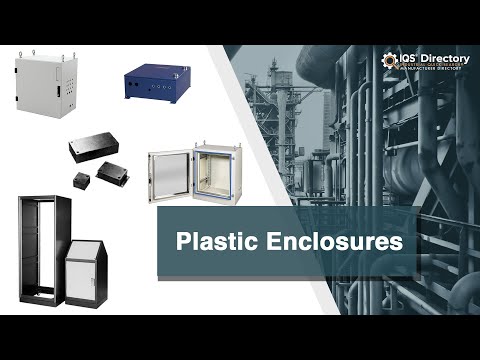
IQS Directory provides a useful tool for finding leading plastic enclosure manufacturers and suppliers. Find plastic enclosure companies that can design, engineer, and manufacture plastic enclosures to your specifications. Peruse our website to review and discover top plastic enclosure manufacturers with roll over ads and complete product descriptions. Connect with the plastic enclosure companies through our hassle-free and efficient request for quote form. You are provided company profiles, website links, locations, phone numbers, product videos, and product information. Read reviews and stay informed with product new articles. Whether you are looking for manufacturers of plastic electronic enclosures, small plastic enclosures, and plastic enclosures boxes of every type, IQS is the premier source for you.
Suppliers located in PA, IL, TX +16 more states
Contents (4 sections)
Leading Plastic Enclosures Manufacturers
Showing all 5
| Placement No. | Manufacturer | Location | Contact | Actions | |
|---|---|---|---|---|---|
| 1 | Industrial Enclosure CorporationAt Industrial Enclosure Corporation, we manufacture durable electronic enclosures designed to protect sensitive components in industrial environments. Our company produces precision-built enclosures for electrical systems, instrumentation, automation controls, communication equipment, and custom electronic assemblies. | Aurora, IL | |||
| 2 | Enclosure IndustriesAt Enclosure Industries, we provide electronic enclosures and metal fabrication solutions designed to protect components, support reliable equipment operation, and meet demanding industrial requirements. Our company works with customers who need fabricated products that combine durability, precision, and practical design, and we focus on delivering solutions that help systems perform with confidence. | Ashippun, WI | |||
| 3 | AMCO Enclosures-an IMS Engineered Products BrandAt AMCO Enclosures, we provide electronic enclosures built to protect sensitive components, organize complex systems, and support reliable performance in industrial, commercial, and technical environments. Our company focuses on solutions that house controls, power distribution equipment, communications hardware, instruments, and electronic assemblies with strength, accessibility, and long-term serviceability in mind, helping customers create secure spaces for essential electrical equipment. | Des Plaines, IL | |||
| 4 | Accurate Metal FabricatingAt Accurate Metal Fabricating, we specialize in crafting precision-engineered electronic enclosures that meet the unique demands of modern industries. With a relentless commitment to quality, we pride ourselves on providing cutting-edge enclosures that safeguard electronic components with unparalleled accuracy. At the heart of our success is a passion for innovation, driving us to create enclosures that exceed expectations and empower industries to thrive in the digital age. | Cicero, IL | |||
| 5 | A & J Manufacturing Co.At A & J Manufacturing Co, we specialize in the design and production of high-quality electronic enclosures built to protect sensitive equipment in demanding commercial and industrial environments. We manufacture durable enclosure solutions for a wide range of electrical and electronic applications, delivering products that support reliability, organization, and long-term system performance. | Foothill Ranch, CA |
Claim your Page One Spot
Leading plastic enclosures manufacturers are listed first on this page, each with a website preview and a Request a Quote button on its row.
Additional Plastic Enclosures Companies
The category’s other plastic enclosures companies are listed on their own page, with location, phone and website where each supplier provides them.
View 38 Additional Plastic Enclosures CompaniesDo not see your company listed in Plastic Enclosures?
Engineers and buyers use this page to find plastic enclosures suppliers. Add your company to the Plastic Enclosures listings so they can find you too.
List Your Company- Listed in the Plastic Enclosures directory
- A profile page for your company
- Buyers contact you directly
Quick Answers
- How many plastic enclosures manufacturers are listed on IQS Directory?
- 5 leading manufacturers and 38 additional suppliers.
- Where are plastic enclosures manufacturers located?
- The listed suppliers are in 19 states and provinces: Pennsylvania (11), Illinois (4), Texas (4), California (3), Colorado (2), Florida (2), Michigan (2), Minnesota (2), and 11 more.
- How do I get quotes from plastic enclosures suppliers?
- Select suppliers in the table and choose Request Quotes. IQS reviews your request and forwards it to every supplier you select.
Plastic Enclosures
The term “plastic enclosure” refers to a container that is designed to house, protect, or accommodate objects in any other way.
Applications of Plastic Enclosures
Most often, plastic enclosures are used to enclose electronics of some sort to hold them together, keep them away from dust and dirt, and shield them from impact damage. They may encase consumer, commercial, or industrial products. Examples of everyday objects that are housed in plastic enclosures include calculators, coolers, desktop computers, laptop computers, remote controls, televisions, video game controllers, and wireless internet controllers.
Materials Used in Manufacturing Plastic Enclosures
Plastic enclosures may be fabricated from a variety of different plastic materials, the choice of which depends on the needs of an application. Enclosures designed for heavier duty or more intensive applications, for example, are typically made out of high-density polyethylene (HDPE). HDPE is a strong thermoplastic made from petroleum. It is known for extreme heat and cold resistance, longevity, liquid and corrosion resistance, and low production costs.
Other common plastic materials used for plastic enclosure fabrication include polyvinyl chloride (PVC), acrylonitrile butadiene styrene (ABS), acrylic, and polypropylene. PVC, which is good for insulation applications, is a common and popular thermoplastic. It is lightweight and exhibits qualities of toughness, flexibility, as well as acid, base, and water resistance. ABS, valued for its mechanical toughness and impact resistance, is a terpolymer synthesized from styrene and acrylonitrile in the presence of polybutadiene. It is lightweight and does not pose a threat to human health, provided it is handled properly.
Acrylic, known more precisely as poly(methyl methacrylate) or PMMA, is known for being incredibly strong and sturdy, capable of withstanding incredible amounts of pressure. In addition to plastic enclosures, it is used to make bone cement, aircraft windows, aquarium windows, submarine viewing ports, and motorcycle helmet visors. Polypropylene, abbreviated to PP, is both strong and uncommonly resistant to bases, acids, and chemical solvents. Polypropylene enclosures may be welded.
Manufacturing Process of Plastic Enclosures
Regardless of the exact material chosen, most plastic enclosures (if they are being made from a thermoplastic) are fabricated via molding. All molding methods begin with the collection of raw plastic material, which manufacturers subsequently heat until liquified or molten. How manufacturers proceed after this depends on whether they are following the steps of the blow molding process or the injection molding process.
If they proceed with blow molding, the manufacturers will carry on by either injecting or squeezing the molten plastic into a preform or mold cavity. After this, manufacturers will blow compressed air into the cavity, rendering the plastic shape hollow. Once the shaping process has finished, the plastic will be allowed to cool and harden.
Following this step, the newly created plastic enclosure will be ejected from the mold. Similarly, if manufacturers choose injection molding, they will proceed by injecting the molten plastic into a mold cavity, the shape of which it will adapt. Manufacturers will then end the injection molding process in the same way that they end the blow molding process: by allowing the plastic to cool and harden, then ejecting it. Both methods create strong, long-lasting plastic enclosures.
Benefits of Using Plastic Enclosures
Not confined to the angles of rectangles or squares, plastic enclosures may be molded into virtually any shape. The high level of flexibility achievable by plastic enclosures stands in stark contrast with metal enclosures, which are not nearly so customizable. Another advantage they have over metal enclosures is their light weight, which lends them to applications in portable electronics. They are also better insulators and less electrically conductive than their metal counterparts.
Potential Disadvantages of Using Plastic Enclosures
Plastic enclosures are practical, customizable, easy to make, and durable. Better insulators and less likely to undesirably conduct electricity than similar metal enclosures, they are a great investment. They protect what is important to you and your application and make sure everything runs smoothly. They do, however, vary in levels of thermal stability, general strength, as well as chemical, heat, and impact resistance. In addition, they are, of course, available in different shapes, sizes, and colors.
What’s more, they are built to fit any number of regional and/or industry standard regulations, including NEMA (National Electrical Manufacturing Association) standards, EPA (Environmental Protection Agency) standards, and ISO (International Standards Organization) standards. Variety is the spice of life but sometimes this variety can make confusion and uncertainty. The best way to combat these byproducts of shopping is to consult with one or more of the many excellent enclosure manufacturers listed on our website. They will be able to provide you with advice and exact information on material choices, color options, configurations, prices, and industry standard adherences.
Types of Plastic Used in Manufacturing Electronic Enclosures