


Precision Turned Products: Process & Uses | IQS Directory
IQS Directory EditorialUpdated 5 chapters
6 leading suppliers listed with this guide
Browse precision turned parts suppliersContents (5 chapters)
This article contains everything you will need to know about precision turned products and their use.
You will learn:
- What are Precision Turned Products?
- Types of Precision Turned Products
- Uses for Precision Turned Products
- How Precision Turned Products are Made
- Materials that are Used to Produce Precision Turned Parts
- And much more …
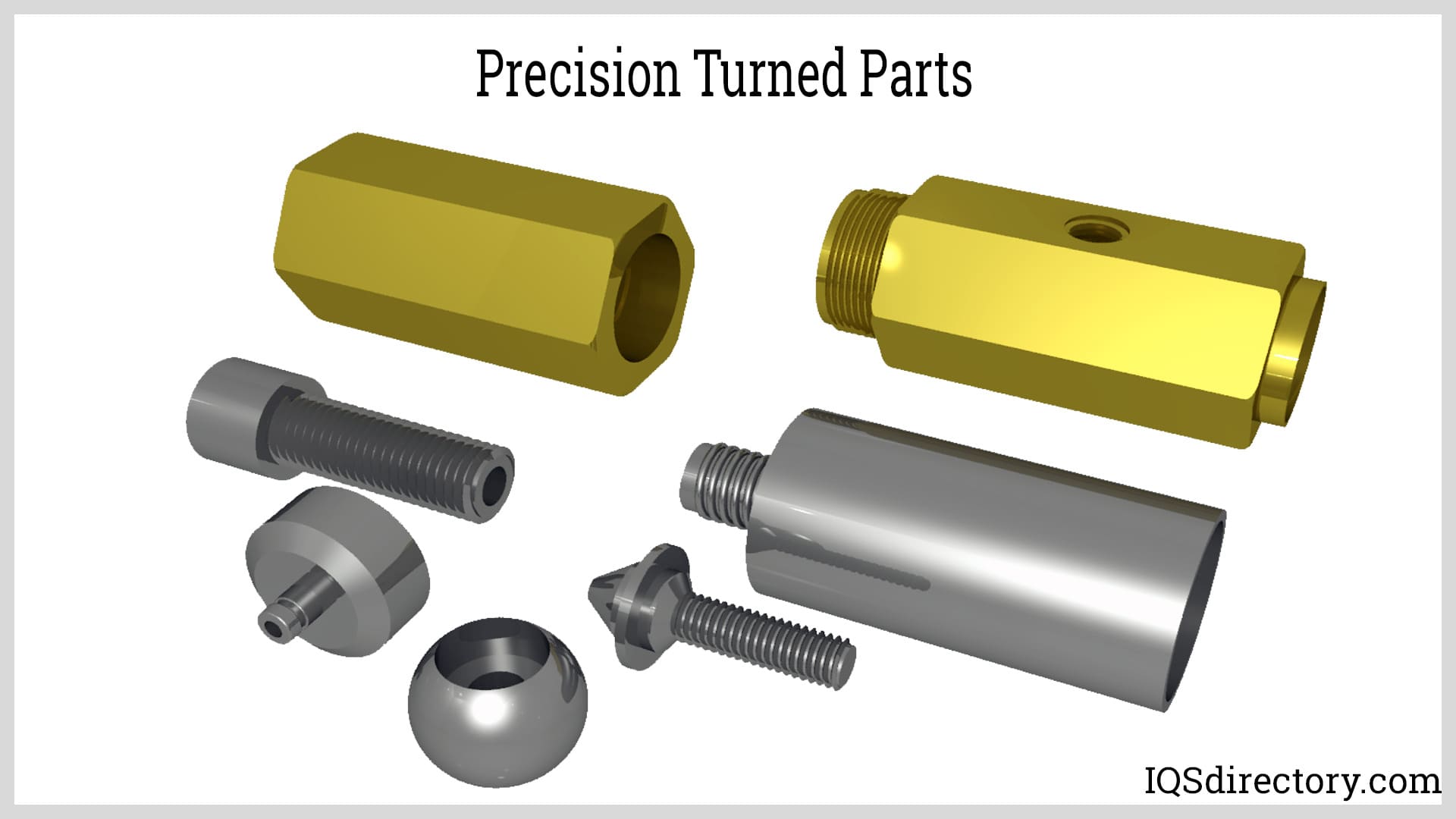
Chapter 1: Understanding Precision Turned Parts
Precision turned components are crafted with utmost precision to meet extremely tight tolerances, leveraging advanced Swiss machining and CNC turning techniques. This intricate precision machining process includes a variety of operations such as facing, chamfering, threading, tapping, drilling, deburring, and knurling. Each method is specifically chosen to carefully alter the workpiece to satisfy particular design criteria. During turning, the workpiece rotates while a cutting tool gradually removes excess material, sculpting it into the desired shape, surface finish, and dimensions required for the final product.

Precision turning yields components with unparalleled accuracy, repeatability, and strict tolerances, resulting in superior parts ideal for high-performance applications. These custom machined parts are essential in enhancing machinery and equipment functions, playing a vital role in achieving intricate processes across industries such as medical devices, aerospace, automotive, electronics, hydraulics, and industrial automation. Their extensive use is due to their resilience and effectiveness, which enhance equipment longevity, minimize waste, support cost-efficient production, and promote energy efficiency.
Choosing the right manufacturer for precision turned components is vital to the overall success and assembly of the final product. Established manufacturers with certifications from organizations like the International Organization for Standardization (ISO), Europäische Norm (EN), and the American National Standards Institute (ANSI) are preferred. These certifications are important as they guarantee compliance with stringent quality standards in manufacturing practices, including quality control, dimensional inspection, and process consistency. Buyers evaluating a precision turned parts supplier should also consider material capabilities, production volume, secondary operations, lead times, and the ability to deliver prototype-to-production support for both low-volume and high-volume machining projects.
Chapter 2: How Precision Turned Parts Are Made?
Precision turned parts play a critical role in numerous industries, including aerospace, automotive, medical device manufacturing, electronics, and telecommunications. These highly precise mechanical components are produced using advanced machining technologies such as Computer Numerical Control (CNC) machines, Swiss screw machines, and CNC automatic lathes. Modern CNC machines offer the advantage of executing multiple machining operations—such as turning, drilling, and milling—in a single cycle, resulting in improved accuracy, repeatability, and production efficiency. Meanwhile, advanced Swiss screw machines and CNC lathes excel at fabricating intricate, high-tolerance, and complex geometries essential for mission-critical parts in precision engineering.
Precision turned parts are typically manufactured from a diverse selection of materials, including stainless steel, carbon steel, titanium, brass, bronze, copper, aluminum, silver, gold, and an array of specialty alloys. The chosen raw material is often determined by factors such as corrosion resistance, strength-to-weight ratio, machinability, and specific industry requirements and standards (such as ISO, ASTM, or ASME specifications). This adaptability allows precision turning processes to serve a wide range of end-use applications where micro-tolerances and surface quality are paramount. Precision turning not only ensures consistent dimensional accuracy but also supports high-volume production with reduced cycle times and cost-effectiveness, making it the go-to process for custom component manufacturing and rapid prototyping of OEM parts.
Swiss Screw Machining
Swiss screw machining, also referred to as Swiss-type turning or Swiss lathe machining, was initially developed to fabricate watch components with exceptional accuracy—a level of micro-machining not achievable with manual processes. Today, the integration of CNC technology with Swiss screw machines has revolutionized the production of precision turned parts by delivering micron-level tolerances and consistent quality required in sectors like aerospace, electronics, and precision optics. This technology is widely adopted for manufacturing intricate medical components, miniature fasteners, spacers, bushings, threaded inserts, and custom pins.
Modern Swiss screw machines feature core elements such as the workpiece bar stock holder, chuck collet, guide bushing, and sliding headstock. Working in unison under CNC control systems, these components ensure each part is cut, drilled, shaped, or threaded exactly to the design’s tightest specifications. Swiss-style machining minimizes material waste, achieves smooth surface finishes, and supports concurrent multi-axis machining operations, making it a benchmark for fine-feature component manufacturing.
Holder
Precision in Swiss screw machining starts with the secure clamping of bar stock using specialized holders to minimize vibration, runout, and movement during high-speed rotation. Accurate stabilization is crucial for protecting both the cutting spindle and high-performance carbide tools while maintaining ultra-tight machining tolerances. The two principal types of bar feeder holders—hydrodynamic and hydrostatic—each ensure optimal workpiece support across different bar lengths and diameters.
Hydrodynamic part holders, or breech-loading bar feeders, submerge bar stock in an oil-filled liner for self-centering. This method ensures exceptionally quiet, stable operations with minimized vibration and noise levels—ideal for high-speed precision turning and mass production. In Swiss turning centers, bars are loaded individually, with feed tube changes required for each bar diameter variation to optimize positioning and accuracy.
Hydrostatic bar feeders utilize pressurized oil films within guide channels or bushings to clamp and guide the bar stock as it advances towards the cutting zone. Designed as magazine bar loaders, these systems efficiently handle longer bar stock—up to 24 feet (7.315 meters)—while automatically accommodating multiple diameters. This dramatically enhances productivity and reduces operator intervention, a key factor for lights-out manufacturing and automated CNC turning processes.

Chucking Collet
The bar stock feeder advances the workpiece into the robust chucking collet, which securely grips the bar using a combination of mechanical force and hydraulic pressure. The chucking collet assembly, featuring a three-jaw chuck, a hydraulic cylinder, and a drawtube, ensures the workpiece is centered and held tight during all stages of CNC turning. By integrating hydraulic control and precise drawtube actuation, Swiss lathes can machine parts with extremely fine tolerances even at high rotational speeds.
The selection of chucking collets is based on the spindle nose configuration, which must match international standards (such as A2-6, A2-8, or 140 mm interfaces) for compatibility with automated tool changers and quick-change spindle setups. The drawtube’s bore size further influences the chuck selection, allowing operators and engineers to optimize workholding and streamline setup times for different projects. Tailoring the collet choice to specific job requirements is key for maximizing throughput and minimizing downtime in CNC Swiss machining environments.

Guide Bushing
The guide bushing is a defining feature of Swiss screw machines and Swiss-type CNC lathes—fundamental to achieving exceptional length-to-diameter ratios and superior straightness. By providing continuous support to the bar stock immediately adjacent to the cutting tool, the guide bushing virtually eliminates workpiece deflection, resulting in high repeatability and surface finish quality. This critical component enables turning tools to complete complex cuts and features in a single pass, reducing wear on tools and shortening total machining cycle times.
Guide bushings are available in three principal configurations—rotary, fixed, and precision. Rotary guide bushings turn in unison with the bar stock and are suitable for handling larger or heavier workpieces that require additional support. Fixed bushings remain stationary while the bar rotates within, making them indispensable for producing ultra-precise parts and tight tolerances, such as those required in medical and aerospace applications. Precision bushings, often custom-engineered, enable the manufacture of miniature, detailed parts for high-tech and scientific instrumentation. Selecting the correct guide bushing is a key consideration in process planning for Swiss machining projects.

Headstock
The headstock is integral to the Swiss-style CNC machine architecture, responsible for moving the workpiece bar stock linearly along the Z-axis through the guide bushing. In contrast to conventional lathes, where the workpiece is stationary and tools move, the sliding headstock in a Swiss lathe advances or retracts the bar, positioning it with extreme precision near the cutting tools. This motion system drastically reduces chatter and enhances dimensional accuracy by minimizing unsupported workpiece length during the turning process.
With both the guide bushing and chucking collet locking the bar in place, the headstock ensures that each machining operation—from deep-hole drilling to external profiling—can be performed in close proximity to the guide bushing. This not only extends tooling life but also supports simultaneous multi-tool operations for faster cycle times and superior throughput in custom part fabrication and high-volume manufacturing.

Spindle
The spindle of a Swiss screw machine or CNC lathe is the powerhouse that delivers rotational energy and precision to cutting tools, directly influencing attainable surface finish, tolerance, and productivity in turned parts manufacturing. Among modern spindle types, direct drive, belt drive, and integrated spindles are most prevalent, each offering unique performance characteristics tailored to machining requirements. For example, belt-driven spindles use variable pulley systems for adjustable torque and achieve speeds up to 8,000 rpm, well-suited for tough alloys and medium-volume production.
Direct drive spindles, which connect the motor directly to the spindle shaft, deliver higher speed (up to 12,000 rpm) with low vibration, making them optimal for micromachining, ultra-fine features, and essential for industries like electronics or dental device manufacturing. Multi-spindle configurations have transformed Swiss turning by enabling multiple cutting heads to process several workpieces simultaneously, optimizing large-scale automated production and reducing per-part lead times for OEM suppliers and contract manufacturers.
CNC Swiss screw machines with advanced spindle technology can achieve high precision and repeatability over long production runs, meeting demanding criteria for surface roughness, concentricity, and part geometry in modern production machining.

Computer Numeric Control or CNC Machining
CNC machining is the cornerstone of modern subtractive manufacturing, revolutionizing how precision parts and components are fabricated. Utilizing preprogrammed computer codes (G-code and M-code), CNC lathes, turning centers, and Swiss machines can execute complex operations such as contour turning, facing, threading, grooving, and knurling with minimal human intervention. Automation provided by CNC technology delivers unmatched repeatability, scalability, and quality control, making it ideal for industries requiring tight geometric tolerances and rapid custom prototyping.
Key advantages of CNC precision machining include reduced setup time, consistent quality over large production volumes, and rapid changeover capability for low- to mid-volume custom part runs. With industry demands for traceability, quality assurance, and ISO 9001 certification, CNC turning centers offer statistical process control (SPC) integration and real-time quality monitoring throughout the manufacturing process. These capabilities are essential for industries like aerospace, medical device manufacturing, and advanced automotive engineering, where product safety and compliance drive supplier selection.
CNC Programming
The programming and setup phase determine the outcome of CNC turned part manufacturing. CNC turning centers are typically programmed in G-code, which defines tool paths, feed rates, spindle speeds, coolant settings, and more. Computer-Aided Manufacturing (CAM) software is utilized to translate 3D Computer-Aided Design (CAD) models into precise machine instructions, supporting the design-for-manufacturability (DFM) process and reducing time-to-market for new precision components. CAM soon allows engineers to simulate the entire machining sequence, identify collisions, and optimize cutting parameters for tool life and productivity before running a physical prototype.
Following CAD-to-G-code conversion, a dry run or verification is performed to confirm program accuracy. N-codes within G-code scripts are used to label, organize, and troubleshoot specific program segments, providing superior control and quality assurance over the complete CNC machining workflow. This programming discipline is indispensable for delivering defect-free, ready-to-assemble components to OEM customers and high-tech industries.

Open and Closed Loops
CNC systems utilize either open loop or closed loop control architectures for tool positioning accuracy. Open loop systems, which operate without feedback, are primarily deployed in basic or entry-level CNC applications where cost efficiency and simplicity are a priority and the machining forces are minimal. These systems suit light-duty operations or less complex part geometries, as they do not actively compensate for errors during cutting.
Closed loop systems, on the other hand, incorporate real-time feedback devices such as encoders and linear scales to continuously monitor and regulate the position of tools and workpieces. This ensures that the CNC lathe or Swiss turning center consistently achieves micron-precise placements, compensates for tool wear, and delivers high-quality, repeatable results. Advanced closed loop systems are vital for high-precision, multi-axis turning operations in critical industries—reducing part rejections, enhancing throughput, and meeting stringent ISO and AS9100 quality standards.
CNC Turning Tools
Swiss screw machines and CNC turning centers rely on an extensive array of specialized cutting tools—each meticulously engineered for specific turning operations, surface finishes, and geometries required in precision parts manufacturing. Cutting tools are secured into tool holders or the main spindle, enabling the manufacture of features such as external threading, deep bores, undercuts, grooves, and knurled patterns with exceptional accuracy. The integration of advanced carbide, ceramic, and diamond tool materials is essential for achieving required tool life, heat resistance, and surface finish in demanding applications like aerospace, automotive precision parts, and surgical implants.
CNC Swiss screw machines utilize indexable turning tools to quickly reduce the diameter of the bar stock, performing both roughing and finishing passes with minimal tool change, driving productivity and cost savings. The modular setup typically consists of a holder, clamp, locking screw, precision insert, and support seat—each designed for stability and optimal force distribution. Cutting inserts follow ANSI codes that specify their geometry, clearance, grade, and edge preparation, ensuring interchangeability and process consistency across different production runs.
| C | N | M | G | - | 4 | 3 | 2 |
|---|---|---|---|---|---|---|---|
| 1 | 2 | 3 | 4 | 5 | 6 | 7 | |
| Shape | Clearance | Tolerance | Type | I.C. Size | Thickness | Nose Radius |
Turning inserts are manufactured from robust materials such as tungsten carbide, ceramic, cermet, or industrial diamond. To extend tool longevity and enhance cutting speed, many are coated with advanced wear-resistant layers like TiN or TiAlN, providing excellent heat dissipation for continuous production runs. Correct insert selection is critical to achieving the required part finish, longevity, and chip control—even as high-speed CNC machining places significant demands on cutting edge stability. Inserts are firmly seated in tool holders using support seats and locking screws, ensuring rigidity and vibration-free operation at high spindle speeds. While tool holders are typically produced from high-strength forged steel, insert engineering focuses on maintaining strict tolerances, maximizing coolant delivery, and achieving repeatable, high-precision results for each part and production batch.

- Boring Tool – The boring tool enlarges pre-existing holes to precise diameters, offering improved roundness and surface finish. These are essential in applications where deep, accurate bores and fine internal features are required, such as hydraulic fittings, manifolds, and custom bushings.
- Facing Tool – Facing tools are equipped with robust side cutting edges, ideal for machining perfectly flat surfaces perpendicular to the rotational axis of a workpiece. This process ensures component interfaces are smooth and ready for assembly or sealing.
-
Chamfering Tool – Chamfering tools create beveled edges to remove sharp or burr-prone corners from turned parts. This finishing process not only enhances strength and part aesthetics but also reduces handling risks and prepares parts for secondary assembly processes.

-
Knurling Tool – Knurling tools generate textured patterns—straight, angled, or crosshatched—on cylindrical surfaces. This increases grip and enhances mechanical fit in knobs, handles, and fastener manufacturing. Precision knurling improves component functionality in both industrial and consumer products.

- Parting Tool – Parting (or cutoff) tools use a specially designed cutting blade to separate finished components from the bar stock, often in high-volume production runs. Accurate parting is vital for minimizing material waste and ensuring each finished part meets strict length tolerances and surface requirements.
When evaluating suppliers or choosing a manufacturing partner for custom precision turned parts, consider the vendor’s capability in advanced CNC Swiss machining, in-house design support, material traceability, and quality control certifications (such as ISO 13485 or AS9100). Look for documented expertise in producing components for your industry, as well as a proven track record in meeting deadlines, offering rapid prototyping, and supporting collaborative engineering. Asking about machine tool investments, secondary finishing capabilities (such as polishing, heat treating, or anodizing), and flexible production scheduling can help ensure your chosen supplier meets both current and future product needs.
Chapter 3: What Industries Commonly Use Precision Turning Products?
Modern manufacturing industries require engineered components to be machined to exact specifications, ensuring parts not only meet rigorous dimensional tolerances but also comply with stringent quality assurance standards. Precision turning is a cornerstone of this process, relying on the advanced capabilities of Swiss screw machines and CNC (Computer Numerical Control) machines. These precision machining tools are engineered to manufacture custom precision components that deliver exceptional accuracy and consistency—vital for sectors where even minor errors can lead to product failure or costly downtime.

Precision turned products are a cornerstone of specialized component manufacturing across numerous industries, including aerospace, automotive, medical device manufacturing, electronics, defense, and energy production. These components range from simple fasteners to complex geometries required in intricate assemblies. Utilizing technologies such as Swiss turning and high-precision CNC lathes, manufacturers produce large volumes of turned parts—like pins, bushings, and flanges—to supply critical machinery in these sectors. Precision turning excels at producing intricate parts from a variety of materials, including stainless steel, brass, aluminum, and engineering polymers, guaranteeing both structural integrity and repeatable accuracy.
Fittings
Precision fittings act as reliable mechanical connectors, joining, securing, or adapting component interfaces within industrial, hydraulic, and pneumatic systems. They are expertly produced to tight dimensional tolerances to uphold system integrity and ensure leak-free, secure connections. These fittings—whether NPT (National Pipe Thread), compression, or quick-connect—must conform to exacting standards since the function of integrated systems often depends on flawless joint alignment and surface finish. Applications in industries such as automotive, oil and gas, HVAC, and medical instrumentation require that each fitting be machined with meticulous attention to detail, as even a fractional deviation can jeopardize product safety or lifetime performance.

Bushings
Bushings, also known as plain bearings, are vital wear-resistant turned components produced in large volumes for sectors that demand reduced friction and precise rotational alignment. These bushings support shafts and rotating parts within assemblies, made from a variety of soft and hard metals, including bronze and stainless steel, to offer low-wear, low-maintenance solutions. High-precision surface finishes and close manufacturing tolerances are critical for bushings to prevent shaft damage, minimize energy loss, and optimize mechanical lifespan. Industries that depend on bushings produced through precision turning include industrial equipment manufacturing, transportation, robotics, and consumer electronics.
Rings
Precision-turned rings serve a broad spectrum of functions, from sealing and bearing applications to couplings within sophisticated devices. These rings require ultra-smooth surfaces and exact inner and outer diameters to ensure optimal performance and reliability in demanding environments. Common applications include sealing rings in chemical processing, bearing rings in high-speed machinery, medical device seals, and food-grade processing equipment. Because rings often function as critical sealing or load-bearing elements, adhering to rigorous industry standards, such as ISO or ASTM specifications, is paramount during manufacturing.
Flanges
Flanges are integral, circular precision components designed for robust pipe connection and alignment in fluid handling, petrochemical, and water treatment systems. Flanges often feature symmetrically spaced bolt holes for secure, high-pressure connections and must be precision-turned to guarantee proper bolt alignment and leak-tight seals. High-performance flanges are formed from durable alloys to withstand extreme temperature, vibration, and corrosive conditions. Sectors like oil and gas, chemical manufacturing, marine, and steam power generation all rely on precision-turned flanges for critical infrastructure and machinery reliability.

Pins and Dowels
Pins and dowels are foundational to mechanical assemblies, serving as key alignment, retention, and location features in precision-machined products. These cylindrical rods are turned in various diameters and lengths, and can be produced from hardened steel, brass, or engineering plastics to match application requirements. Precision-machined pins and dowels ensure the accurate assembly of dies, automated equipment, fixtures, and precision tools. In the automotive and aerospace sectors, where absolute positional accuracy is critical, precision dowels contribute to both structural safety and production efficiency. Their unique advantages—such as ease of insertion, secure fit, and reusability—make them indispensable for repetitive assembly and modular manufacturing.
Pins and dowels are renowned for their strength, dimensional consistency, and versatility, serving roles in everything from securing joints in wooden assemblies to providing precise reference points for high-precision mechatronic devices. Various styles—including grooved, spiral, and pull dowels—cater to diverse engineering challenges, with each type engineered to meet specific load, environmental, or space requirements.
Spacers
Spacers represent one of the simplest yet most essential forms of precision turned products, allowing for the accurate separation and isolation of components within assemblies. Manufactured in custom diameters, thicknesses, and lengths, precision spacers ensure components do not interfere or induce unwanted vibrations, which can distort machinery output or disrupt electrical signals in sensitive equipment. These components are often specified with corrosion-resistant coatings or materials—such as stainless steel, brass, or engineered polymers—for harsh operating environments. Applications range from electronics boards and automotive assemblies to heavy equipment, where spacers absorb vibration and expand product longevity.

Pulleys
Pulleys are precision-turned wheel components or sheaves designed to alter the direction or magnitude of applied forces, facilitating easier movement and mechanical advantage in lifting and power transmission systems. High-precision pulleys are engineered with carefully controlled groove profiles, surface finishes, and concentricities to maximize efficiency and minimize wear. Common in conveyor systems, manufacturing automation, fitness equipment, and HVAC systems, pulleys must adhere to precise ratios and material tolerances to perform reliably, especially in high-speed or heavy-load environments. CNC turning and Swiss machining ensure consistent quality and the ability to meet the evolving requirements of advanced mechanical designs.
The broad utility of precision-turned pulleys demonstrates the value of advanced machining processes in delivering reliable motion control solutions to diverse industries. Whether featuring V-grooves, timing teeth, or custom profiles, each pulley’s geometry is tailored for its unique operational role, contributing to both efficiency and system safety.
Industries Relying on Precision Turned Products
Aerospace and Defense: Flight-critical components, fasteners, and mission-specific fittings require CNC turned parts with ultra-tight tolerances and certified materials for maximum reliability.
Medical Devices: Surgical tools, implantable components, orthodontic devices, and diagnostic instrument parts made from biocompatible metals and plastics must meet stringent FDA and ISO standards.
Automotive and Transportation: Precision turned bushings, bearings, and spacers increase drivetrain efficiency, reduce vibration, and enable high-performance assembly in vehicles of all types.
Industrial Equipment: Automation, robotics, and processing machinery rely on precision machining for custom fittings, pins, couplings, and more—delivering high uptime and reduced maintenance.
Electronics Manufacturing: Turned contacts, terminals, and housings are essential in device miniaturization, signal integrity, and heat management across telecommunications, computing, and consumer technologies.
For more information on how precision turned components can provide custom solutions and improve your application’s performance, consider consulting with leading manufacturers for expert advice and tailored recommendations.
Frequently Asked Questions
What Are Precision Turned Parts and How Are They Made?
Precision turned parts are components manufactured using Swiss and CNC turning techniques. The process involves rotating bar stock while cutting tools carry out operations like facing, drilling, threading, and chamfering, achieving exceptional accuracy and tight tolerances.
Which Industries Rely on Precision Turned Components?
Industries such as aerospace, automotive, medical devices, electronics, defense, and energy production widely use precision turned parts for critical assemblies, due to their accuracy, repeatability, and superior performance under demanding conditions.
What Materials Are Commonly Used in Precision Turning?
Materials include stainless steel, carbon steel, titanium, brass, bronze, copper, aluminum, silver, gold, and specialty alloys. The choice depends on corrosion resistance, strength, machinability, and industry standards like ISO, ASTM, or ASME.
How Does Swiss Screw Machining Achieve Micron-Level Tolerances?
Swiss screw machining uses a sliding headstock, guide bushing, and precision collets to minimize deflection. Components are continuously supported near cutting tools, enabling tight dimensional tolerances and superior surface finishes ideal for intricate, high-precision parts.
How Are Fittings, Bushings, Flanges, and Spacers Precision Turned for Specialized Industries?
Precision-turned fittings, bushings, flanges, and spacers are produced on CNC and Swiss machines, ensuring tight tolerances, smooth finishes, and material conformity. This precision upholds leakage prevention, structural integrity, and operational reliability in critical systems.
What Certifications Should a Precision Turned Parts Manufacturer Possess?
Look for manufacturers with ISO, EN, ANSI, ISO 13485, or AS9100 certifications. These guarantee adherence to stringent quality standards, material traceability, and reliable manufacturing practices for demanding markets.
Chapter 4: What Are the Benefits of Using Precision Turned Products in Industrial Applications?
The integration of precision turned parts into industrial manufacturing has significantly improved the quality, performance, and durability of products and assemblies. The tight tolerances and high accuracy achieved through precision turning have enabled manufacturers to ensure greater product longevity. This enhancement in product quality has not only attracted more buyers but also boosted profitability.
Accuracy
The success of precision turned parts hinges on their exceptional accuracy and the capability to achieve tolerances within just a few microns. This precision is a key factor in their widespread use. From computer rendering to the final packaging, precision turned parts maintain near-perfect forms and shapes throughout the entire production process.
Consistency
Precision turned parts ensure uniformity in size, shape, and quality thanks to meticulous process control and the use of CAD renderings during production. This consistency guarantees that parts are reliable and minimizes production errors, a rarity with CNC and Swiss screw machining. Additionally, each finished part meets the highest quality standards.
Cost
By eliminating defects, rejects, and production errors, the resources used in manufacturing are optimized, resulting in minimal waste. Parts are produced swiftly and efficiently, reducing production time. These benefits lower the cost per part, enhancing profitability and providing a competitive edge.
Turnaround Times
Modern precision machining ensures parts are crafted swiftly and with high accuracy, leading to faster delivery times that align with client needs. In today’s fast-paced market, quick turnaround is crucial due to competitive pressures and the demands of assembly and manufacturing. This efficiency is particularly advantageous for companies with tight production schedules and strict deadlines.
Versatility
Precision turning can be used to shape and form virtually any material. The components created through this process exhibit outstanding strength and durability, making them ideal for various sectors such as aerospace, automotive, medical, and electronics—fields that demand the highest levels of precision and accuracy.
Strength
Precision-turned components are produced with exceptional quality, resulting in parts that are stronger, more resilient, and capable of enduring greater pressure and stress. This robustness makes them essential for assemblies that must remain dependable and function reliably over extended periods.
Customizable
As precision-turned parts begin as CAD designs, they can be readily modified and tailored to meet the specific demands of unique or unconventional applications. This flexibility allows for adjustments during production if the requirements for a component evolve due to design or assembly considerations.
Waste
The meticulous planning involved in producing precision-turned parts considers the minimization of waste throughout the manufacturing process. The use of computerization plays a key role in reducing waste, as CAD designs are optimized to produce parts efficiently and economically, often eliminating the need for additional processing.
Finishing
One of the notable advantages of precision-turned parts is their superior finishing. These parts can achieve an excellent surface quality that allows for polishing, treatment, or coating, resulting in a professional and uniform appearance. This high-quality finish not only boosts the value of the parts but also enhances their reliability.
Chapter 5: What Types of Metals Are Commonly Used to Produce Precision Turned Parts?
Precision turning can effectively shape a wide range of metals, thanks to the robust cutting and shaping tools that are adapted to the density and hardness of each metal. This technique can accommodate various materials, including steel, bronze, brass, aluminum, copper, and titanium. Additionally, certain types of engineering plastics are also suitable for precision turning, expanding the versatility of the process.
Aluminum
Aluminum's numerous beneficial characteristics make it an excellent choice for producing precision-turned parts. Its machinability allows for the creation of parts with very tight tolerances and intricate designs. Furthermore, aluminum's properties can be improved through plating, which enhances its hardness and conductivity, making it a viable alternative to materials like copper, steel, or stainless steel.

Brass
Brass is well-suited for precision-turned parts where high strength is not a critical requirement. Its attractive, bright finish and ease of machining make it a preferred choice for parts with complex and detailed designs. The formability of brass facilitates the creation of intricate components. However, the presence of tin and zinc limits its use in applications involving vacuum environments.
Copper
Although copper is more expensive, it is carefully evaluated for use in precision-turned parts due to its valuable properties. Copper's corrosion resistance, excellent conductivity, and non-magnetic nature make it an attractive choice. Like brass, copper offers high formability and is particularly well-suited for electronic components and various hardware applications. Its ability to be easily machined and its compatibility with precision turning further enhance its appeal.

Titanium
Titanium, initially found as a chemical oxide, is refined into a silver-colored metal known for its low density, high strength, and corrosion resistance. Alloyed with other metals, titanium forms exceptionally strong, lightweight, and durable alloys suitable for diverse applications, from aerospace to jewelry and sports equipment. Its biocompatibility has also made it a preferred material in medical procedures. Titanium's impressive strength-to-weight ratio makes it particularly advantageous for precision-turned parts where both strength and reduced weight are crucial.
Steel
Steel, encompassing both stainless and carbon varieties, has long been a staple in the production of precision-turned parts due to its strength, durability, and ease of machining. The characteristics of steel can differ based on its alloying elements, which define its grade. The specific alloys added influence the steel's suitability for various applications and the types of precision-turned components it can effectively produce.
Conclusion
- Precision turned products are manufactured using CNC machining and Swiss screw machining to produce a wide range of complex and intricate parts with exceptional quality and high tolerances.
- The process used to produce precision turned parts involves rotating raw materials as they are cut, sand, knurled, drilled, and deformed to meet the requirements of a CAD rendering or design.
- In essence, the process of manufacturing precision turned parts is a method that sculpts a workpiece using computerized codes that ensure the accuracy and consistency of the process.
- One of the main reasons for the use of precision turned parts is their outstanding durability and longevity due to the accuracy and precision of their processing.
- A characteristic of precision turned parts is the smoothness of assembly lines due to the high tolerance and perfect fit of components.