



Pulse Jet Dust Collectors: Types, Uses and Features
IQS Directory EditorialUpdated 5 chapters
10 leading suppliers listed with this guide
Browse jet dust collectors suppliersContents (5 chapters)
This article takes an in-depth look at jet dust collectors.
You will learn more about topics such as:
- What is a Pulse Jet Dust Collector?
- How Pulse Jet Dust Collectors Work
- Types of Pulse Jet Dust Collectors
- Types of Pulse Jet Dust Collector Filters
- And much more…

Understanding Pulse Jet Dust Collectors
ISO documentation offers detailed specifications, guidelines, practices, and processes that companies can employ to ensure that their materials, products, procedures, and services consistently meet top-tier quality standards. These guidelines play a vital role in areas such as information security, food safety, risk management, environmental performance, and quality management, all of which serve to bolster a company's reputation and trustworthiness. By adhering to ISO standards, organizations can guarantee excellence, reliability, and safety.

Thanks to their high efficiency, pulse jet dust collectors have become the most popular choice in dust collection systems for industrial air filtration and dust control. These systems are known for their low maintenance requirements, ability to clean air with dense dust particles, and superior filtration capabilities, making them ideal for facilities that need dependable particulate removal and continuous operation. Pulse jet baghouse collectors use compressed air pulse cleaning to dislodge dust from the filter bags, helping maintain consistent airflow, reduce pressure drop, and extend filter life. Their applications extend to product recovery, dust capture, filtering hazardous media, metalworking chip extraction, central vacuum cleaning systems, and pneumatic conveying. In addition to supporting cleaner work environments, these industrial dust collectors can help manufacturers improve workplace safety, meet dust collection requirements, and manage fine dust, combustible dust, and other airborne contaminants more effectively.
What Are the Different Types of Pulse Jet Dust Collectors?
Pulse jet dust collectors are a special type of baghouse dust collecting system widely used in industrial filtration and air pollution control. The term "pulse jet dust collector" refers to the cleaning mechanism—the reverse jet of compressed air that rapidly pulses through the filters, dislodging accumulated dust from the fabric surface of filter bags or cartridges. This advanced dust removal method keeps filters efficient for longer periods, resulting in consistent airflow and lower energy costs. Many modern pulse jet dust collectors are equipped with a differential pressure sensor that monitors the pressure drop between clean and dirty sides, automatically initiating filter cleaning cycles as needed. This intelligent system ensures optimal filtration, minimizing downtime and manual maintenance requirements.
Maintaining a clean and contaminant-free air environment is crucial for workplace safety in manufacturing, processing, and industrial plants. Pulse jet dust collectors are highly effective dust collection systems for controlling industrial dust, welding fumes, chemical aerosols, and airborne particulates. They are capable of capturing respirable dust particles as tiny as two microns (µ), exceeding environmental health standards such as those set by OSHA and the EPA. This makes pulse jet systems an essential component for regulatory compliance and operational efficiency in dust-intensive industries.
Pulse Jet Dust Collector Types
Cylindrical Pulse Jet Dust Collectors
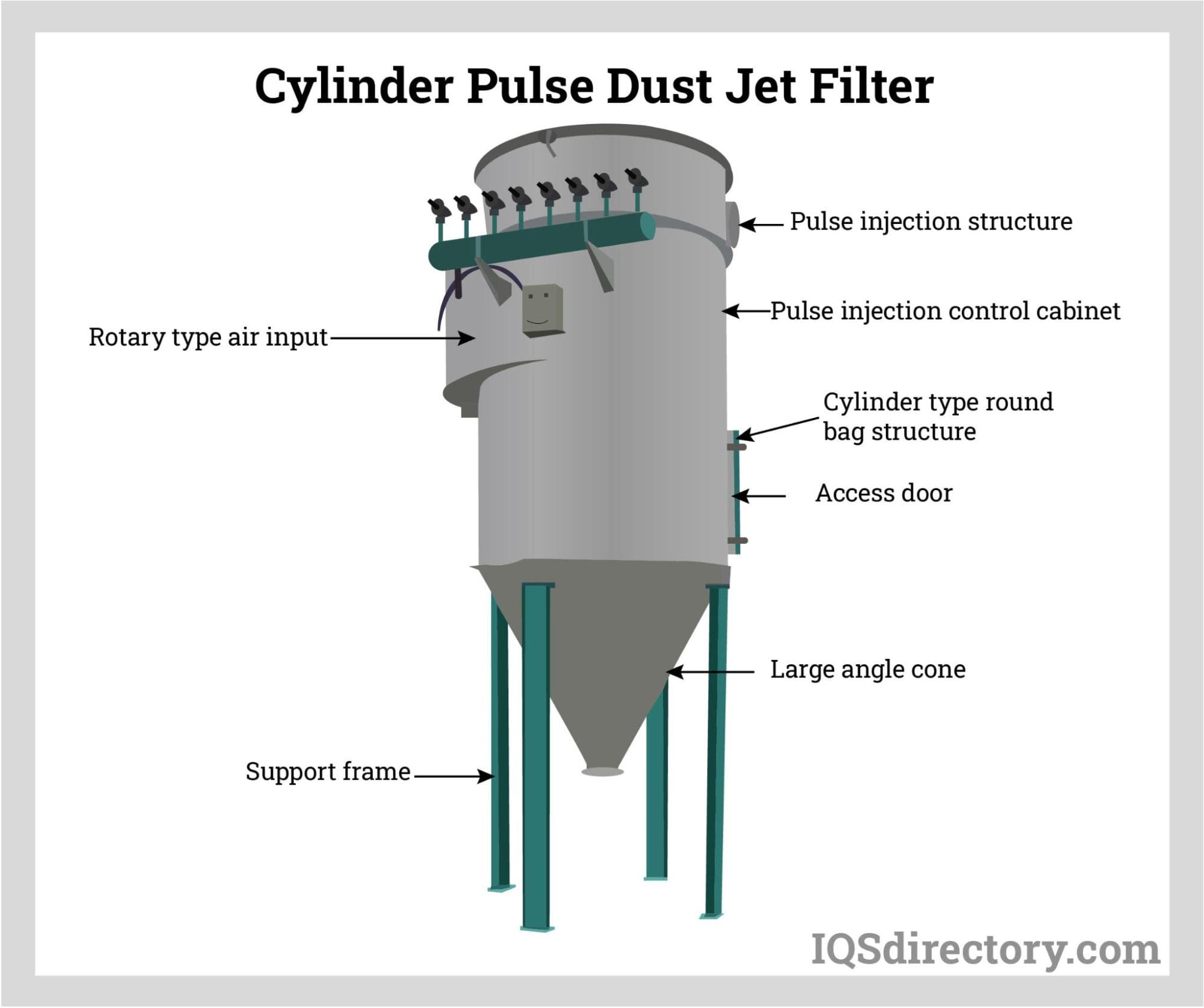
Cylindrical pulse jet dust collectors are built to withstand both internal and external static pressures, making them well-suited for explosion protection and combustible dust applications in industries such as grain processing and woodworking. These industrial dust collectors filter various types of particulates, including sander dust, fine textile lint, grain residues, cellulose fibers, and sawdust. With airflow capabilities reaching up to 20 feet per minute (FPM) or 6 meters per minute, cylindrical pulse jet baghouse collectors efficiently handle large volumes of process air. The design features a tangential cyclone-style inlet, which creates centrifugal force to spin airborne dust. This action separates and directs heavier particles against the collector wall for collection in a hopper or dust bag, while lighter fines are captured on the surface of the filter media. This dual-stage separation improves filtration efficiency and reduces wear on the filter bags, contributing to long-term operational reliability and lower maintenance costs.
Offline System Pulse Jet Dust Collectors
One distinct type of pulse jet dust collector is the offline system, where the system’s inlets and outlets are sealed to halt the flow of contaminated air during the cleaning sequence. Once sealed, a pulse valve releases compressed air into blowpipes positioned above the vertical filter bags, producing a sharp jet that dislodges dust buildup. A pneumatic damper system at both the inlet and outlet prevents air movement, isolating the baghouse compartment.
The pulses of air, delivered at 0.1-second intervals, supply an intense burst to clean filter bags thoroughly. The entire cleaning cycle takes approximately 30 seconds, after which pneumatic dampers reopen, resuming dust-laden airflow. Offline pulse jet systems are ideal for continuous-process environments such as coal-fired boilers, municipal waste incinerators, and chemical plants, where ongoing dust collection and minimal emissions are critical. Enhanced cleaning allows for lower emission levels and compliance with stringent air quality regulations, while preserving the integrity of bag filters for longer service life and reducing overall filtration costs.

Modular Pulse Jet Dust Collectors
Modular pulse jet dust collectors are valued for their scalable design and system flexibility, allowing industrial operators to add or connect multiple dust collector modules to expand air filtration capacity as their facility grows. Each module features a hopper inlet equipped with a deflector plate or baffle that captures heavier particles, directing them into the hopper or dust bin below. This layout minimizes direct dust contact with the filter bags, reducing abrasion, lowering overall pressure drop, and extending the operational lifespan of the filter elements.
Modular pulse jet systems are ideal for process industries requiring adaptable dust and fume extraction, such as metal fabrication, pharmaceuticals, and food processing. These customizable dust collectors support upgrades for HEPA filters, explosion venting, or automated monitoring systems, meeting diverse application requirements—from fine powder containment to hazardous dust mitigation. Modular designs streamline installation, scaling, and maintenance, making them a cost-effective solution for both new and expanding facilities seeking efficient air quality management.

Air Box Style Pulse Jet Dust Collectors
Air box pulse jet dust collectors are a common variation of baghouse dust collectors used to remove airborne dust and pollutants in heavy-duty manufacturing, mining, and bulk materials handling facilities. These collectors draw contaminated air into the system, where an internal baffle at the inlet captures larger particles before they reach the filter bags.
One cleaning method frequently utilized is backflushing, which employs air, chemicals, or water to dislodge embedded dust from the filter media. Many air box pulse jet dust collector designs integrate both backflushing and pulse jet cleaning, delivering deep filter maintenance and boosting operational uptime. This combination enhances particulate removal efficiency, extends filter media lifespan, and reduces downtime associated with filter replacement. Air box collectors can be customized to address a wide range of dust types and gas properties, providing reliable dust control and consistent compliance with air pollution control standards.
Cartridge Pulse Jet Dust Collectors
Cartridge pulse jet dust collectors leverage advanced pleated filter cartridges arranged in a horizontal or vertical configuration, offering a more compact footprint compared to traditional baghouses. These high-efficiency collectors excel at fine particulate and fume collection, capturing airborne contaminants and weld fumes as small as 0.5 microns with an efficiency rating up to 99.99%. The self-cleaning system pulses air through the pleated cartridges, maintaining peak performance even while the dust collection system stays online, resulting in minimal process interruption.
Cartridge collectors are especially suitable for dry, free-flowing dust, pharmaceutical powders, chemical process dusts, and plasma or laser cutting fumes. Their modular, space-saving design, ease of maintenance, high air-to-cloth ratio, and quick-change filter access make cartridge pulse jet dust collectors a preferred solution for operations prioritizing process efficiency, air quality, and environmental compliance.

Bin Vent Pulse Jet Dust Collectors
Bin vent pulse jet dust collectors are engineered to control and collect displaced dust during bulk material handling, specifically those generated during silo filling, pneumatic conveying, or bucket elevator operations. As dust-laden air enters from the bottom, particulates accumulate on the surface of the filter bags. A strategically timed pulse of air, delivered by a Venturi tube, knocks dust loose, allowing it to fall through an open base for safe disposal. These collectors maintain constant pressure via an electronic timer or automated controls, accommodating material loading rates up to 100 grains per cubic foot.
With minimal moving parts and reduced maintenance needs, bin vent pulse jet dust collectors provide reliable dust control during silo loading and unloading, reducing environmental fugitive dust emissions and ensuring sites remain within EPA regulatory limits. As heavier product settles at the silo bottom, finer dust particles rise to the top vent, where the dust collector captures them, preventing their release into the atmosphere and maintaining regulatory compliance.

Fume Style Pulse Jet Dust Collectors
A fume pulse jet dust collector is a specialized cartridge-style filtration system engineered for the capture of microscopic and sub-micrometer particles generated during processes such as welding, soldering, thermal cutting, and chemical manufacturing. The fume inlet is strategically located at the bottom to maximize particulate capture efficiency, with advanced filter media capable of trapping particles in the nanometer size range (1/1000th of a micrometer). This ultra-fine filtration aids in compliance with occupational exposure limits and protects sensitive production areas from hazardous fumes and airborne toxins.
For safe operation in environments where sparks or static discharge may occur, fume pulse jet dust collectors are equipped with spark baffles and, optionally, explosion venting panels. These features make them the optimal choice for laser cutting, polishing, laboratory, and battery manufacturing facilities, nearly eliminating airborne particulate for improved worker safety, product quality, and air cleanliness.

How to Select the Right Pulse Jet Dust Collector?
When evaluating or purchasing a pulse jet dust collector for your facility, consider factors such as dust type (combustible, abrasive, fine), airflow volume (CFM), filter media selection (fabric bags vs. cartridges, HEPA options), available maintenance resources, and compliance with air quality regulations. Leading industrial dust collector manufacturers offer custom engineering options to address unique operating conditions, energy efficiency concerns, and future expansion needs. Consult with experienced dust control solution providers to determine the ideal pulse jet design for your facility and to maximize dust collection system performance while reducing long-term operational costs.
What Are the Different Types of Filters Used in Pulse Jet Dust Collectors?
The filter in a pulse jet dust collector is a critical component for achieving optimal industrial dust collection and maintaining workplace air quality. Pulse jet dust collectors rely on high-efficiency filtration to capture fine particulates, hazardous dust, and contaminants from process air streams. Filters are constructed from a range of specialized filter media—such as polyester, cellulose, fiberglass, PTFE, and more—to target specific application requirements and airborne contaminant profiles. As dust-laden air passes through the collector, particulate matter accumulates on the exterior surface of the filter bag or cartridge, while clean air is discharged back into the work environment.
The pulse cleaning process for pulse jet dust collector filters can be performed online—while the dust collection system is in continuous operation—or offline, during scheduled maintenance or downtime. Filter media selection must take into account factors such as dust type, particle size, humidity, operating temperature, airflow, and chemical compatibility to ensure optimal performance and extended filter life. Pulse jet filters are most commonly manufactured as either disposable bag filters or pleated cartridges designed for energy-efficient filtration and low maintenance. Pulse jet bag filters may be made of paper (cellulose) or high-performance synthetic and woven fabrics to suit a variety of demanding industrial applications.
Cartridge Systems
Cartridge systems in pulse jet dust collectors feature round, pleated air filters designed to maximize surface filtration area within a compact housing. These cartridges efficiently capture fine dust, fumes, and smoke from woodworking, welding, metalworking, and pharmaceutical production environments. Cartridge filters are usually crafted from advanced paper media, including cellulose, polyester, nanofiber, or composite blends for industry-leading particulate removal. The pleated design increases dust-holding capacity and filter longevity while lowering pressure drop, enhancing energy efficiency and reducing system operating costs.

Bag Filters
Bag filters are the most prevalent and versatile option for pulse jet dust collectors, widely used in bulk material handling, food processing, mineral processing, and cement plants. Also referred to as filter bags or baghouse filter bags, these filters operate by collecting dust particles on their outermost layer. Periodic bursts of compressed air, controlled by either a digital timer or a differential pressure (DP) sensor, dislodge accumulated dust, which then falls into a collection hopper below. Proper filter cleaning ensures consistent airflow, prevents filter clogging, and extends the service life of your dust collector filter bags.
The pressure drop system activates only when the filter cake reaches the threshold resistance, signaling the controller to initiate pulse cleaning. The compressed air pulse produces a shockwave and ripple along the filter surface, maximizing cleaning efficiency and restoring airflow. This self-cleaning mechanism enables pulse jet dust collectors to operate with minimal downtime, maintaining high-performance particulate removal for compliance with OSHA and EPA air quality standards.

High-Temperature Filters
Filters for high-temperature pulse jet dust collectors are engineered to withstand extreme heat environments—handling operating temperatures up to 400°F (204°C) and above. These high-temperature dust collector filters are essential in industries such as foundries, power generation, asphalt plants, and chemical processing, where exposure to extremely hot dust, vapors, or gases is routine. Traditionally, high-heat applications required pre-cooling the airstream before filtration to avoid filter damage. However, modern high-temperature filter media—such as fiberglass, PTFE, and aramid—allow for direct filtration of hot process gases, improving process efficiency, system reliability, and filter durability. Eliminating the cooling step reduces maintenance, saves space, and streamlines the entire dust collection process. For thermal oxidizer systems and incineration, these specialty filters offer optimal temperature resistance and chemical durability for demanding environments.

Materials Used to Make Pulse Jet Bag Filters
The selection of filter material directly impacts filter efficiency, service life, and resistance to harsh industrial environments. The suitability of each media is based on several factors, including temperature tolerance, chemical compatibility, particulate characteristics, moisture resistance, and filtration efficiency. Pulse jet dust collector filters may use either woven or non-woven filter media, which further influences filter selection, system performance, and maintenance schedules. Choosing the right dust collector bag material maximizes efficiency in capturing airborne dust and ensures long-term, trouble-free operation.
Fiberglass Filters
Fiberglass pulse jet bag filters excel in environments with corrosive gases or sustained temperatures up to 500°F (260°C), such as metal smelting, incineration, and utility boilers. Fiberglass filter media provides exceptional chemical resistance, thermal integrity, and is non-combustible, making it suitable for industrial processes with intense heat and aggressive fumes. This high-performance media resists moisture absorption, supports dimensional stability, and is designed to prevent filter deformation. Fiberglass filters are available with anti-static or PTFE membrane coatings for enhanced dust release and longer filter life in difficult operating conditions.

Teflon (PTFE) Filters
PTFE (Polytetrafluoroethylene) filters are engineered for continuous operation at temperatures up to 500°F (260°C). Highly resistant to oxidation, aggressive chemicals, UV rays, and microbial attack, PTFE filter bags and membrane-coated filters excel in harsh chemical processing and pharmaceutical manufacturing. The non-stick, hydrophobic properties of PTFE provide superior dust cake release, minimize blinding, and extend filter cleaning intervals. While PTFE is more costly compared to other media, it offers unmatched service life and performance in applications where filter replacement downtime is a concern.

Polyphenylene Sulfide (PPS) Filter
PPS felt filter bags provide outstanding filtration for applications requiring high-temperature stability and superior chemical resistance, tolerating environments up to 374°F (190°C). PPS is commonly deployed in industrial dust collectors for coal-fired power plants, waste incinerators, fluidized bed reactors, cement kilns, and metallurgy due to its ability to withstand aggressive alkaline dust and abrasive particles. In addition to its chemical and thermal integrity, PPS filter media is highly durable, abrasion-resistant, and delivers excellent filtration efficiency for controlling particulate matter and maintaining regulatory compliance in challenging industrial settings.

Aramid Filters
Aramid fiber (often branded as Nomex®) is an industrial-grade synthetic fabric revered for its high-temperature filtration, abrasion resistance, and flame-retardant properties. Operating reliably up to 400°F (205°C), aramid filters are well-suited for asphalt, lime production, kiln exhaust, and situations that demand superior thermal and chemical stability. Available in both felted and woven forms, and produced as either filament or staple fiber, aramid filter bags deliver long service life under rigorous dust loading and repeated pulse cleaning cycles.

Polypropylene Filters
The primary advantage of polypropylene as a filter media is its smooth, non-stick surface that facilitates the easy release of filtered dust. Polypropylene bag filters are favored for their excellent abrasion resistance and resistance to static buildup, making them ideal for light dust loads and dry dust applications. However, due to a relatively low maximum operating temperature of 194°F (90°C), polypropylene is best employed in room-temperature and moderate-duty industrial dust collection systems for applications such as food processing, pharmaceuticals, and chemical powder handling.

Polyester Filters
Polyester filter bags are among the most widely used media in industrial dust collectors due to their optimal balance of cost, durability, and filtration efficiency. Functioning effectively between 266°F and 302°F (130-150°C), polyester filters offer good resistance to oxidation and organic solvents. They are not suitable for environments with high concentrations of acids or alkalis, as exposure can degrade fiber strength over time. Applications for polyester filters range from wood dust collection and grain processing to general manufacturing, offering efficient particulate capture at a competitive cost for diverse dust control challenges. Hydrolysis and wet conditions—especially at high temperatures—should be considered during selection to ensure operational longevity.

Acrylic Filter Bags
Homopolymer acrylic filter bags—fabricated from needle-felt acrylic—provide solid abrasion resistance, energy absorption, and excellent durability in moist or heat-driven environments up to 275°F (135°C). Acrylic felt filter bags are frequently treated with coatings like calcium carbonate or a thin Teflon layer, which can enhance moisture resistance and extend operating life. Their unique fiber structure allows for robust performance in the filtration of ferrous and nonferrous metallurgical dust, as well as other operations where hydrolysis resistance and energy absorption are key requirements.

Holding Bag Filters in Place
Filter bags in pulse jet dust collectors must be securely supported to ensure efficient operation and reliable dust capture. Wire cages, manufactured with 10, 12, or 20 vertical wires, provide the structural support necessary to maintain bag shape during filtration and pulse cleaning. Cages are offered in both top-loading and bottom-loading configurations—allowing convenient installation and removal during routine maintenance. The collar secures the bag and cage assembly, preventing bypass air and maximizing system efficiency. Common cage diameters range from 4 inches to 7 inches, with wire thicknesses between 9 and 11 gauge, ensuring robust performance across different dust collector sizes. Bottom-loading cages include split collar designs for ease of handling while offering the same durability and support as top-loading models. Selecting the appropriate filter cage supports proper pleat spacing and prevents bag collapse during demanding pulse cleaning cycles—crucial for maintaining high air-to-cloth ratios and maximizing dust collector throughput.

Frequently Asked Questions
What Is a Pulse Jet Dust Collector and How Does It Work?
A pulse jet dust collector is an industrial filtration system that uses rapid bursts of compressed air to clean filter bags or cartridges, dislodging dust and maintaining consistent airflow with minimal manual maintenance.
What Types of Filters Are Used in Pulse Jet Dust Collectors?
Pulse jet dust collectors use a variety of filter types, including bag filters and pleated cartridges. These are made from materials like polyester, cellulose, fiberglass, PTFE, aramid, PPS, and acrylic for specific industrial applications and environmental conditions.
How Do Different Pulse Jet Dust Collector Types Address Various Industrial Needs?
Various types such as cylindrical, modular, cartridge, air box, offline, bin vent, and fume pulse jet dust collectors serve industries from metalworking to pharmaceuticals, addressing unique dust types, compliance needs, space limitations, and operational scalability.
What Factors Should I Consider When Selecting a Pulse Jet Dust Collector?
Consider dust type, airflow volume, filter media selection, maintenance resources, and air quality compliance. For unique operating conditions or facility expansion, look for customizable options and consult experienced dust control providers.
What Makes High-Temperature Pulse Jet Filters Suitable for Environments Like Foundries and Asphalt Plants?
High-temperature filters are built to handle temperatures up to 500°F (260°C) using specialized media like fiberglass, PTFE, and aramid. They ensure reliable filtration without pre-cooling, essential in foundries and asphalt production.
Why Is Supporting Filter Bags with Wire Cages Important?
Wire cages keep filter bags in shape, maintain pleat spacing, and prevent collapse during pulse cleaning. This ensures efficient dust capture, sustained airflow, and maximizes dust collector performance over time.
How Pulse Jet Dust Collectors Work?
The core components of a pulse jet baghouse dust collection system include the filter bag assembly, blow pipe, and hopper. These systems are designed to separate dust particles from the air, ensuring that the air is purified and cleansed.
As dust accumulates on the outside of the filters in a filtration system, it forms a layer that needs to be removed to maintain optimal performance. Pulse jet dust collectors address this by using bursts of compressed air to blow off the accumulated dust, allowing the filtration system to continue functioning efficiently.
Workings of Pulse Jet Dust Collectors
Dust Collector Inlet
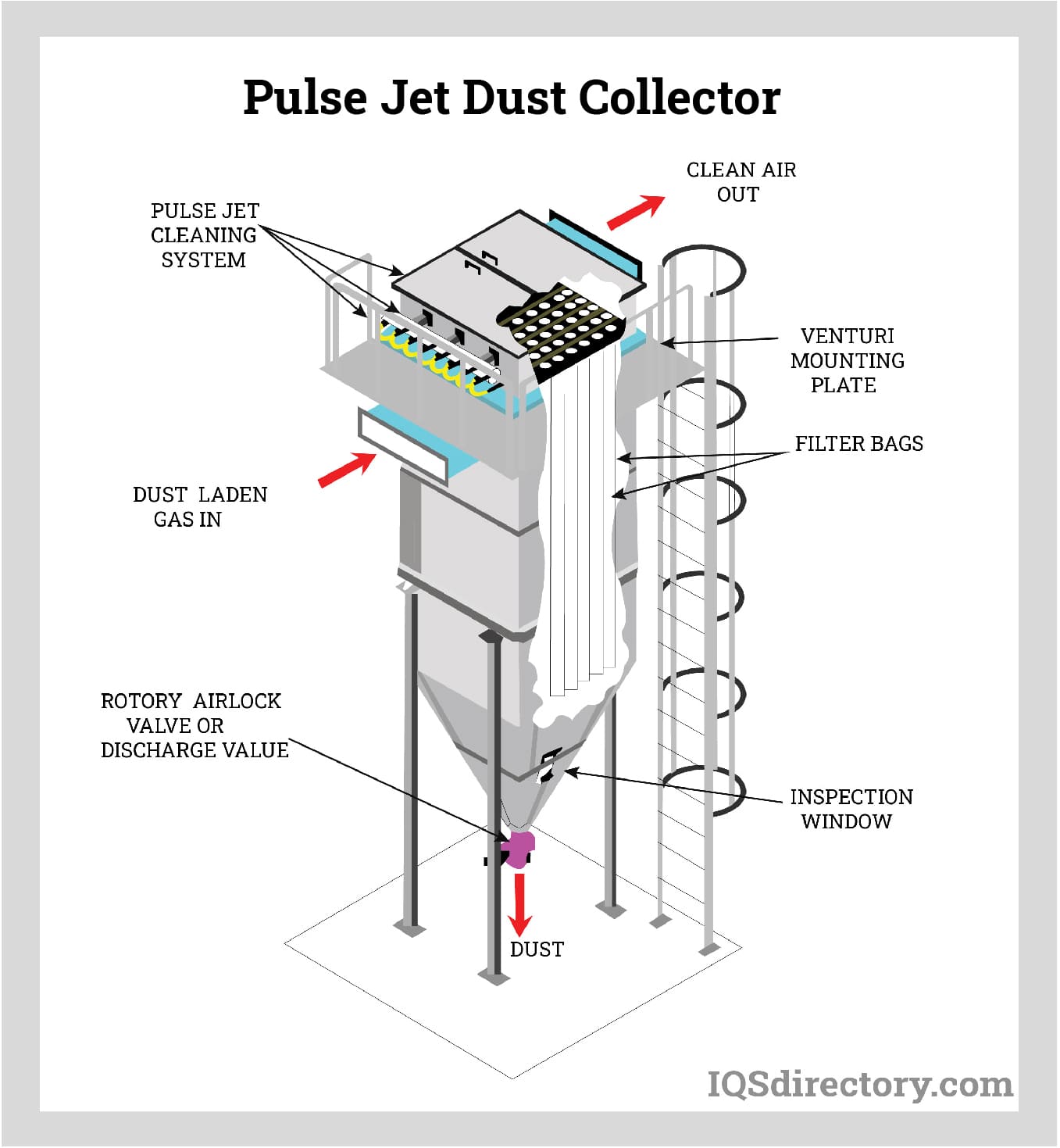
Dust-laden air is introduced into the dust collector through the inlet, located on the left side of the diagram below. As the air flows into the collector, its velocity is reduced due to the increased volume. This decrease in velocity allows larger particles to settle and drop into the hopper positioned beneath the dust collector. In certain pulse jet dust collectors, a baffle plate within the inlet directs the larger particles into the hopper, enhancing the separation process.
Air Flow
Once the larger particles are removed, the remaining dust-laden air passes through the filter bags, which trap the particulate matter on their surfaces.

Bag Filters
As the dust-laden air ascends through the filters, dust particles are collected on the exterior of the filter bags, allowing clean air to be released. The grey section in the diagram below illustrates the filter bags within the filtration system.

Dust Collector Outlet
As the air moves upward, the bag filters capture the finer dust particles, allowing only clean air to pass through. Ultimately, the purified air is expelled through the outlet of the dust collector.

Pulse Jet Valve
Pulse jet valves are indirect solenoid valves that are energized when air is trapped in their diaphragm, causing a pressure difference that forces the diaphragm to suddenly open. When air passes back into the chamber, the new air pressure balance de-energizes and closes the valve. The opening and closing of the diaphragm happen in quick pulses during bag filter cleaning.

Differential Pressure Sensor
Differential pressure is a key metric used to monitor the performance of a pulse jet dust collector. As dust accumulates on the filter surfaces, it increases resistance to airflow. To assess this resistance, a differential pressure reading is taken between the dirty and clean sides of the filter; typically, the pressure is lower on the dirty side.
When the pressure reaches a high threshold, compressed air is discharged through the Venturi valve to clean the filters. In automated systems, a differential pressure sensor notifies operators of any issues with the cleaning process.
Dust Collector Venturi
As dust-laden air passes through the filter bags, a significant buildup of dust accumulates on the outside, increasing resistance and reducing efficiency. To maintain the filter’s performance and extend its lifespan, regular cleaning of the clogged filters is necessary.
One common method for cleaning bag filters is using compressed air jets. This can be triggered manually, by a pressure sensor, or by a timer. In all cases, a solenoid valve and compressed air header release short bursts of air, creating shock waves that dislodge the accumulated dust. These pulses, lasting only a few seconds, move in the opposite direction of the airflow, causing the dust to fall into the hopper.
The air bursts are delivered through a Venturi valve, a cone-shaped device positioned at the top of the tubular filters. The Venturi creates a negative pressure at its top, which helps pull additional air into the filter walls during the pulsing process.
The diagram below shows how the Venturi valve inside the bag cage expels air pulses to remove the dust particles adhering to the filters.

What Are the Benefits of Pulse Jet Dust Collectors?
With increasing regulations on air quality, growing manufacturer concerns, and a heightened focus on environmental issues, pulse jet dust collectors have become more popular and widely used. Their most notable advantage is their ability to maintain continuous operation while the filter bags are being cleaned.
Pulse jet dust collectors now account for about 50% of all dust collectors in use. Effective filter cleaning is crucial for maintaining good air quality and optimizing collector performance, and the pulse jet system's precise cleaning capabilities make it one of the most efficient methods available.
Pulse Jet Dust Collector Benefits
Collector Efficiency
The streamlined design of a pulse jet dust collector enhances performance, reduces maintenance needs, and extends equipment life. Rapid valve actuation ensures effective cleaning of bag filters while minimizing compressed air consumption. Some valves are capable of enduring up to one million cycles.
Pulse Jet Dust Collector Safety
Maintaining a clean and hazard-free work environment is crucial for a company's success. It ensures worker safety and promotes good health. The pulse jet dust collector's efficient air purification process helps keep the work area free from contaminants, safeguarding both employees and equipment.
Increased Productivity
A clean and organized workspace is essential for efficient project completion. Dust and debris can impede production, spread rapidly, and infiltrate machinery, potentially causing malfunctions. Pulse jet dust collectors address these issues by continuously removing dust and ensuring a steady flow of clean air, thereby enhancing productivity and equipment reliability.
Adherence to Regulations
Manufacturing processes often produce air pollutants that must be controlled according to guidelines set by the Environmental Protection Agency (EPA), which has identified five major air pollutants for regulation.
- Ground level ozone
- Particle pollution or particulate matter
- Carbon monoxide
- Sulfur dioxide
- Nitrogen dioxide
Pulse jet dust collectors are engineered to capture and eliminate pollutants from the air in manufacturing and production environments.
The chart below illustrates air quality using a numerical index ranging from 0 to 500. Higher index values indicate greater health risks, with an index of 300 or above denoting hazardous air quality.
| Daily AQI Color | Level of Concern | Values of Index | Description of Air Quality |
| Green | Good | 0 to 50 | Air quality is satisfactory, and air pollution poses little or no risk. |
| Yellow | Moderate | 51 to 100 | Air quality is acceptable. However, there may be a risk for some people, particularly those who are unusually sensitive to air pollution. |
| Orange | Unhealthy for Sensitive Groups | 100 to 150 | Members of sensitive groups may experience health effects. The general public is less likely to be affected. Some members of the general public may experience health affects; members of sensitive groups may experience more serious health effects. |
| Red | Unhealthy | 151 to 200 | Some members of the general public may experience health affects; members of sensitive groups may experience more serious health effects. |
| Purple | Very Unhealthy | 201 to 300 | Health alert: The risk of health effects is increased for everyone. |
| Maroon | Hazardous | 301 and higher | Health warning of emergency conditions: everyone is more likely to be affected. |
Manufacturers of pulse jet dust collectors are well-versed in air quality regulations and continually enhance, design, and adapt their products to comply with EPA standards.
Improved Product Quality
Dust poses significant challenges not only to employees and machinery but also to the quality of products, particularly in sensitive areas like electronics and technical devices. Maintaining high air quality standards is crucial for enhancing product quality and ensuring that the final output meets the manufacturer's specifications.
Collector Customization
Pulse jet dust collectors and filters can be tailored to meet the specific needs of different manufacturing environments. Each production facility has unique requirements based on its location, the type of dust generated, and local regulations. The adaptability of pulse jet dust collectors ensures they can be customized to address any particular conditions.
Some systems may need fire suppression features, while others might prioritize handling high air volumes. Regardless of the specific requirements, pulse jet dust collectors can be adjusted and configured to meet various demands.
Conclusion
- A jet dust collector is a suction filtration unit that pulls dust ladened air into a filtration system that collects particulate matter and releases clean air.
- The efficiency of jet dust collectors has made them the most widely used type of dust collection system.
- Jet dust collectors are a special type of baghouse dust collecting system. The term jet dust collector refers to the method that the dust collector uses to clean its filters, which is a reverse jet of air that forces the dust off the fabric of the dust caked filters.
- The filter of a pulse jet dust collector is the essential piece that completes the dust collection process. They are made of a variety of materials depending on the type of mechanism and the media being filtered.
- With the increasing regulations regarding air quality, manufacturer’s concerns, and society’s focus on the environment, jet dust collectors have gained greater interest and use.