
- 3 leading manufacturers
- 19 additional suppliers
- 12 states and provinces
- 12 related categories
- 2 guide sections
Vibratory Screen Manufacturers and Companies

IQS Directory provides a comprehensive list of vibratory screen manufacturers and suppliers. Use our website to review and source top vibratory screen manufacturers with roll over ads and detailed product descriptions. Find vibratory screen companies that can design, engineer, and manufacture vibratory screens to your company's specifications. Then contact the vibratory screen companies through our quick and easy request for quote form. Website links, company profile, locations, phone, product videos and product information are provided for each company. Whether you are looking for manufacturers of vibrating feeders, grizzly screens, parts feeders, or customized vibratory screens of every type, this is the resource for you.
Suppliers located in MI, MN, NC +9 more states
Contents (5 sections)
Leading Vibratory Screen Manufacturers
Showing all 3
| Placement No. | Manufacturer | Location | Contact | Actions | |
|---|---|---|---|---|---|
| 1 | PPM Technologies Holdings, LLCPPM Technologies Holdings, LLC is an innovative industry leader in the vibratory feeder industry. Our main focus has always been to provide our customers with high-quality products with the exact specifications for their needs. With our wide range of products, we are able to serve various industries. | Newberg, OR | |||
| 2 | Advanced Blending Solutions LLCAt Advanced Blending Solutions, LLC, we provide material handling and process equipment for customers that need accurate feeding, thorough mixing, and dependable drying in plastics, recycling, compounding, and industrial production environments. Our company supports operations where resin, regrind, pellets, powders, additives, and bulk materials must move through each step with control, consistency, and minimal waste. | Wallace, MI | |||
| 3 | CMT Inc.At CMT Inc., we provide vibratory feeder solutions for customers that need controlled, consistent, and efficient movement of parts, powders, granules, and bulk materials through production and assembly processes. Our company supports applications where accurate feed rates, smooth material flow, and dependable equipment performance are essential. We focus on feeder systems that help customers reduce manual handling, improve process timing, and keep materials moving with repeatable control. | Charlotte, NC |
Claim your Page One Spot
Leading vibratory screen manufacturers are listed first on this page, each with a website preview and a Request a Quote button on its row.
Additional Vibratory Screen Companies
The category’s other vibratory screen companies are listed on their own page, with location, phone and website where each supplier provides them.
View 19 Additional Vibratory Screen CompaniesDo not see your company listed in Vibratory Screens?
Engineers and buyers use this page to find vibratory screen suppliers. Add your company to the Vibratory Screens listings so they can find you too.
List Your Company- Listed in the Vibratory Screens directory
- A profile page for your company
- Buyers contact you directly
Vibratory Screen Industrial Manufacturing Guides
Vibratory Screening: Types and Uses
The content of this article will provide everything you need to know about vibratory screening. You will learn: What is Vibratory Screening? How a Vibratory…
6 chapters
Quick Answers
- How many vibratory screen manufacturers are listed on IQS Directory?
- 3 leading manufacturers and 19 additional suppliers.
- Where are vibratory screen manufacturers located?
- The listed suppliers are in 12 states and provinces: Michigan (4), Minnesota (3), North Carolina (3), Texas (3), Ohio (2), California (1), Connecticut (1), Florida (1), and 4 more.
- How do I get quotes from vibratory screen suppliers?
- Select suppliers in the table and choose Request Quotes. IQS reviews your request and forwards it to every supplier you select.
Vibratory Screens
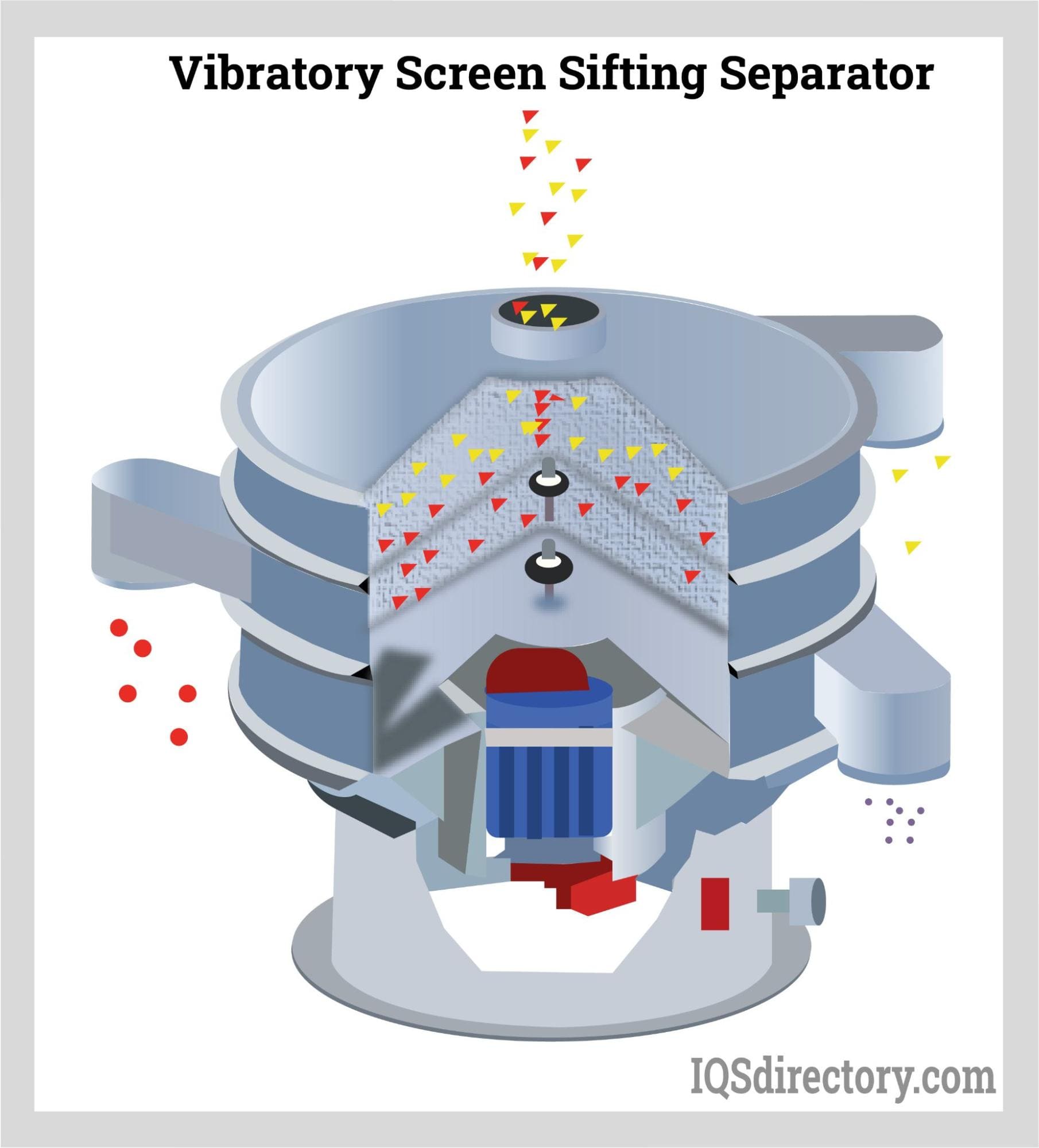
Vibratory screens, otherwise known as high frequency vibratory screens, are vibratory feeders commonly used in the mineral processing industry to filter and separate substances. There are many different designs that are useful for a number of different applications and industries, so it is important to know just how these vibratory screens function and how they might fit into your application. High frequency vibrating screens and normal vibrating screens operate in the same fashion; the high frequency screens only operate at a high frequency to filter specific minerals.
Applications of Vibratory Screens
There are a number of different applications in which you can find a vibratory screen at work. Some of these applications and industries include, processing powder in coal, metallurgy, wood pelleting, fractionated asphalt pavement, ores and minerals, food packaging, chemical applications, and the pharmaceutical industry.
Because they are used in so many industries, there are multiple designs of vibratory screens available. It is important to consult with a trusted vibratory screen manufacturer to determine what design is best for your application. If you do not have the correct design, or the frequency is not set correctly, you may experience inaccuracies when trying to separate particles, as the process is influenced by many different factors, from equipment capacity to the angle at which the vibratory screen is placed.
Benefits of Using Vibratory Screens
Vibratory screens offer many different advantages. They are one of the best ways to filter and separate two or more substances from each other. Vibratory screens do this by breaking down the surface tension between the particles within the substances, which allows the substances to separate more easily. Vibratory screens often function at an angle to further separate materials. This angle provides what is referred to as “the popcorn effect.” This means that the coarser a particle is, the more likely it is going to be lifted higher, while finer particles remain closer to the screen. The rate at which the screen vibrates, or the frequency, can be controlled to achieve the desired popcorn effect or separation.