
- 6 leading manufacturers
- 20 additional suppliers
- 16 states and provinces
- 20 related categories
- 2 guide sections
Ultrasonic Cleaning Systems Manufacturers and Suppliers
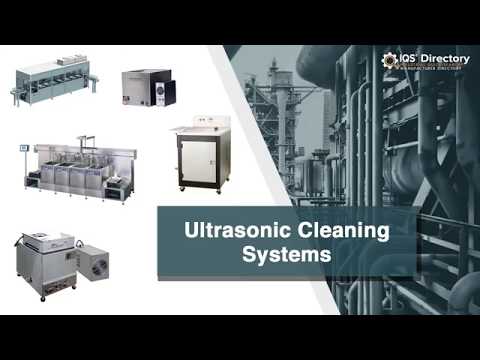
IQS Directory implements a thorough list of ultrasonic cleaning system manufacturers and suppliers. Utilize our listing to examine and sort top ultrasonic cleaning system manufacturers with previews of ads and detailed descriptions of each product. Any ultrasonic cleaning company can design, engineer, and manufacture ultrasonic cleaning systems to meet your companies specific qualifications. An easy connection to reach ultrasonic cleaning system companies through our fast request for quote form is provided on our website. The company information includes website links, company profile, locations, phone, product videos and product information. This source is right for you whether it's for a manufacturer of ultrasonic washing systems, ultrasonic cleaning transducers, and ultrasonic washing equipment.
Suppliers located in IL, OH, CT +13 more states
Contents (4 sections)
Leading Ultrasonic Cleaning Systems Manufacturers
Showing all 6
| Placement No. | Manufacturer | Location | Contact | Actions | |
|---|---|---|---|---|---|
| 1 | ESMA, Inc.Since 1972, Esma Inc. has been producing quality ultrasonic cleaners, as well as benchtop electropolishing equipment. Esma offers a unique and progressive approach to automating the ultrasonic cleaning process by transferring liquids to a single ultrasonic process chamber from individual heated storage tanks, which are designed to re-use and filter the detergents, acids and rinse water. | South Holland, IL | |||
| 2 | Giant Finishing, Inc.Giant Finishing, Inc. is a worldwide manufacturer and supplier of finishing equipment. We are a family owned business with over 25 years of experience in the industry. Our goal is to provide quality equipment and quality customer service for all surface finishing needs, and we supply equipment, chemicals, compounds, and finishing media to companies around the world. Visit our website or call us today to see how we can help! | Addison, IL | |||
| 3 | Great Lakes Finishing EquipmentGreat Lakes Finishing Equipment, Inc. is a full line supplier of aqueous and semi-aqueous ultrasonic cleaning equipment. Equipment includes benchtop cleaners, tank and generator series, immersible transducers, console systems and engineered systems. Our customers include defense, aerospace, medical, firearms and industrial. | South Elgin, IL | |||
| 4 | EmersonWe specialize in ultrasonic cleaning technology that redefines precision and efficiency across industrial applications. At Emerson, we design and manufacture advanced ultrasonic cleaning equipment engineered to remove contaminants from complex parts with unmatched thoroughness. | St. Louis, MO | |||
| 5 | SHARPERTEK USAAt SHARPERTEK USA, we specialize in delivering advanced ultrasonic cleaning equipment that meets the highest standards of precision, reliability, and performance. Based in the United States, we design and manufacture a full line of ultrasonic cleaners that serve industries ranging from medical and dental to aerospace, automotive, and industrial manufacturing. | Pontiac, MI | |||
| 6 | Mettler Electronics CorpWe take pride in being innovators at Mettler Electronics Corp, where we specialize in developing high-performance ultrasonic cleaning equipment trusted by professionals across industries. Our systems are designed to deliver powerful, precise cleaning through advanced ultrasonic technology that removes contaminants from intricate surfaces with efficiency and care. | Anaheim, CA |
Claim your Page One Spot
Leading ultrasonic cleaning systems manufacturers are listed first on this page, each with a website preview and a Request a Quote button on its row.
Additional Ultrasonic Cleaning Systems Companies
The category’s other ultrasonic cleaning systems companies are listed on their own page, with location, phone and website where each supplier provides them.
View 20 Additional Ultrasonic Cleaning Systems CompaniesDo not see your company listed in Ultrasonic Cleaning Systems?
Engineers and buyers use this page to find ultrasonic cleaning systems suppliers. Add your company to the Ultrasonic Cleaning Systems listings so they can find you too.
List Your Company- Listed in the Ultrasonic Cleaning Systems directory
- A profile page for your company
- Buyers contact you directly
Quick Answers
- How many ultrasonic cleaning systems manufacturers are listed on IQS Directory?
- 6 leading manufacturers and 20 additional suppliers.
- Where are ultrasonic cleaning systems manufacturers located?
- The listed suppliers are in 16 states and provinces: Illinois (4), Ohio (4), Connecticut (3), Missouri (2), New Jersey (2), Arizona (1), California (1), Iowa (1), and 8 more.
- How do I get quotes from ultrasonic cleaning systems suppliers?
- Select suppliers in the table and choose Request Quotes. IQS reviews your request and forwards it to every supplier you select.
Ultrasonic Cleaning Systems
Ultrasonic cleaning systems consist of specialized cleaning machines that use high frequencies to clean, degrease and sterilize a variety of parts, products and machines components. These items come into contact with grease, dirt, wax, lubricants, oil or other contaminants during the manufacturing process or industrial use and are otherwise difficult and tedious to clean.
Ultrasonic cleaning systems are more environmentally-friendly than using chemical solvents or hazardous chemicals. These systems use the power of ultrasonic sound frequencies provided by transducers to convert electricity into intense frequencies that cause the formation and implosion of minuscule bubbles in a liquid cleaning medium. The bubbles perform a scrubbing action that reaches into grooves and hidden parts of products that are immersed into an agitated fluid. The frequencies of the sound waves are used in the ultrasonic cleaning systems to adjust the size and amount of cavitation, or the formation and collapse of the bubbles. Ultrasonic cleaning systems are capable of cleaning individual parts as well as multiple items simultaneously and are used in a variety of commercial and industrial applications. The automotive, pharmaceutical, medical, beverage, electronics, marine, sports equipment and weapons industries all use large capacity ultrasonic systems to clean products like hard drive components, small automotive parts and process machine components that have grease or lubricant build up. Smaller models exist for at-home use, which generally involves jewelry cleaning applications.
Ultrasonic cleaning systems are composed of a cleaning tank, which is usually made of stainless steel, cleaning fluid, which can be hot water or a water-based solvent, agitators, transducers, pumps or pressure generators, nozzles and reclamation systems. Many also have drying systems. Larger products are often placed right in the tank, while large amounts of smaller objects are submerged in the cleaning solution in a basket. The ultrasonic cleaning process is fast, automated and requires little manual labor. It has replaced the traditional methods that used scrubbing with toxic and harsh solvents. In order to ensure that every product's surface, holes and cavities are cleaned properly, many systems have rotating parts holders, tumbling baskets or oscillating systems. Once the products or parts have been immersed in the cleaning solution, ultrasonic sound frequencies cause cavitation, which is the formation and implosion of millions of tiny bubbles in the liquid. When these bubbles implode, a scrubbing action to the product surfaces occurs, ridding them of contaminating substances. Small dirt particles that reside in hard-to reach crevices are easily purged when using ultrasonic cleaning systems. There is a direct connection between how the frequency and the number of implosions which allows for a high level of control; high frequencies ideal for the removal of very small particles without harming the surface of the industrial part.
 |
|
Ultrasonic Cleaning Systems - JRI Industries
|
How Do Ultrasonic Cleaning Systems Work?
Ultrasonic cleaning is a cleaning process that employs ultrasound waves, along with a specifically prepared cleaning solution, to clean various articles including industrial machines and their parts. However, water can also be used, depending upon the type of contaminant that has to be removed and the type of metal from which the machine part. Apart from industrial parts, you can also clean objects such as jewelry, watches, musical instruments, and electronic equipment, with this parts washer.
Using the appropriate cleaning solvent is crucial to achieve effective cleaning. Industrial ultrasonic cleaners are an attractive option for manufacturing businesses looking to leverage their effectiveness and affordability.
One of the biggest advantages of ultrasonic parts washers is they take just a few minutes to perform parts cleaning. However, the time of cleaning may vary according to the size of the parts being cleaned—normally the cleaning process lasts around five minutes.
What is Ultrasonic Cleaning or Ultrasonics?
Ultrasonic cleaning systems use ultrasound waves that are inaudible to the human ear. The frequency that these appliances involve is super high. While low ultrasound waves produce bass tones, the high frequencies generate treble tones. The frequencies used by these cleaning systems may range between 20,000 KHz and 100,000 KHz. A high frequency within this range, in addition to a special solution, ensures that all the debris and pollutants are effectively removed from the industrial parts.
To understand how these advanced cleaning systems work, we first need to learn how the high-frequency sound wave is generated. We will also have a look at the principle of ultrasonic sound waves.
But before that, we at first need to understand how a typical sound wave is produced. A sound is a vibration that creates an audible wave, technically, an audible mechanical wave of pressure, combined with displacement, via air or water. For the sound wave to be heard, the wave has to travel or traverse from one place to another, and the presence of some medium, such as air, water, and solid, is important.
An ultrasound wave is a high-frequency sound wave that is more than the audible limit of the human ears. If we would compare ultrasonic waves with ordinary sound waves, we would not find any difference in their physical structure, excluding the inaudibility of the former.
So, as explained above, a sound wave creates some sort of vibration or vibratory motions. When an ultrasonic wave is created, the molecules in the medium (surface of the parts) are influenced by the vibration. The adjacent molecules affect the position of each other, and that is how the debris and pollutants are removed from the surface of the part, and that is how the industrial ultrasonic cleaners work.
By deploying special solution or solvent, the efficiency and quality of cleaning are enhanced. In many applications, the contaminants and bacteria are required to be removed. For such instances, custom ultrasonic can be taken into consideration.
Determining if an Ultrasonic Cleaning System Is Right for Your Business
Deciding which cleaning system would be suitable for your industrial process could be a daunting task. With the progression of technology, many industrial parts washing machines have been introduced and adopted by large and small industrial manufacturers. Industrial ultrasonic cleaners are one such technology, and this article attempts to help you understand how this advancement can help you in meeting your business goals.
Ultrasonic cleaners are modern-day cleaning appliances used for cleaning an array of machines across various industries. These innovative devices can help you accomplish quick and result-oriented cleaning successfully. Working on the principles of the movement of high frequency sound waves, ultrasonic cleaners can forcefully remove contaminants from the surface of machines, parts, worktops, and a number of other objects.
Ultrasonic sound waves are inaudible to humans; however, they are so powerful that they can disinfect and clean any contaminated surface in just a few minutes. The waves that are generated as a result of the conversion of electrical energy into mechanical energy eventually make the droplets of cleaning solution perform high energy brushing or scrubbing on the contaminated part. As a result, the parts come out clean and ready for use.
The ultrasonic transducer produces ultrasonic energy, which, when is supplied into the solution or chemistry, produces a large number of bubbles that move at a very high pace within the tank and scrub the surface of a part or object under high-pressure. This process lifts and removes the contaminants from the upper as well as the inner interfaces of the part. That is why the ultrasonic cleaning process is helpful for cleaning most machine parts—whether large or small or intricate in shape.
Benefits of Ultrasonic Cleaning
Cost-effective: Unlike other parts cleaners, ultrasonic parts washers usually have fewer motors—typically only one for producing the energy and circulating the solution. This simply implies that these machines do not put a strain on your power utilization bills. Additionally, these washers can complete cleaning in a very short time, which translates to more energy saving.
Safe for Environment: Ultrasonic cleaners are safe for the environment, and when you use them, you typically maintain regulation standards. However, you need to ensure that you are using regulated chemicals or solutions.
Effective for Small Parts with Unreachable Areas: Small parts with grip lines, holes, and other inaccessible regions are not a challenge for ultrasonic part washers. By implementing the ultrasonic cleaning system in your solution tank, you can wash these challenging parts within a few minutes.
Delicate, Gentle Cleaning: If you have to clean delicate objects, such as computer parts, jewelry items, etc., which need to be handled with care, ultrasonic process washers are the most suitable option. The sonic energy does not apply any hard force on the parts; rather, it applies a powerful energy being carried by the droplets of cleaning solution.
Based on these worthwhile benefits, you can decide whether you want this cleaning system installed at your facility.
More Ultrasonic Cleaning Systems Information