
- 4 leading manufacturers
- 32 additional suppliers
- 15 states and provinces
- 13 related categories
- 3 guide sections
RTD Sensor Manufacturers and Companies
IQS Directory provides an extensive list of RTD sensor manufacturers and suppliers. Utilize our website to review and source RTD sensor manufacturers with our easy-to-use features which allow you to locate RTD sensor companies that will design, engineer, and manufacture RTD sensors for your exact specifications. Our request for quote forms make it easy to connect with leading RTD sensor manufacturers. View company profiles, website links, locations, phone number, product videos, product specific news articles and other production information. We are a leading manufacturer directory who will connect you with the right manufacturers whether you are looking for heat sensors, thermistors, or temperature sensors.
Suppliers located in CA, OH, PA +12 more states
Contents (5 sections)
Leading RTD Sensor Manufacturers
Showing all 4
| Placement No. | Manufacturer | Location | Contact | Actions | |
|---|---|---|---|---|---|
| 1 | Thermo Sensors CorporationIn business since 1972, Thermo Sensors Corporation is a leading RTD sensor manufacturer and offers an array of other products and services. Thermo Sensors provides the chemical, petrochemical, refining, food, pharmaceutical and other industries with options of standard & special designs. We are dedicated to our extensive quality control program which truly makes us an innovator in the RTD sensor industry. | Garland, TX | |||
| 2 | Thermocouple Technology, LLCWe manufacture a full line of Thermocouples to fit your application. Temperatures from cryogenic to 4000F, and sizes ranging from needle thin to several thousand pound multipoint temperature sensors. In addition to our standardized product lines, TTEC offers design solutions to meet the specific needs of your application. Our products are in use worldwide, in almost every industry. Give us a call today to discuss your requirements. | Quakertown, PA | |||
| 3 | Kelvin Technologies, Inc.Kelvin Technologies is a high-quality thermocouple manufacturer, representative, and distributor for all of your electrical heating, temperature controlling, and temperature sensing requirements. Our products are engineered and manufactured in-house to address specific requirements, such as higher temperatures and more compact profiles. With over 100 years of combined experience, all of us at Kelvin Technologies take pride in the quality of product and level of service we provide our customers. | Mississauga, ON | |||
| 4 | Temperature Specialists, Inc.At Temperature Specialists, Inc., we focus on the design and manufacture of high-performance thermocouples built for accuracy, durability, and dependable operation in demanding environments. We work closely with industrial customers who rely on precise temperature measurement to maintain process control, product quality, and system safety. From initial application review through production, we apply technical knowledge and disciplined manufacturing practices to deliver sensors that meet exact performance requirements. | St. Francis, MN |
Claim your Page One Spot
Leading RTD sensor manufacturers are listed first on this page, each with a website preview and a Request a Quote button on its row.
Additional RTD Sensor Companies
The category’s other RTD sensor companies are listed on their own page, with location, phone and website where each supplier provides them.
View 32 Additional RTD Sensor CompaniesDo not see your company listed in RTD Sensors?
Engineers and buyers use this page to find RTD sensor suppliers. Add your company to the RTD Sensors listings so they can find you too.
List Your Company- Listed in the RTD Sensors directory
- A profile page for your company
- Buyers contact you directly
RTD Sensor Industrial Manufacturing Guides
RTD Sensors: Uses, Types and Elements
This article contains everything you need to know about RTD sensors. You will learn more about topics such as: What is an RTD sensor? Types of RTD sensor…
8 chapters
Quick Answers
- How many RTD sensor manufacturers are listed on IQS Directory?
- 4 leading manufacturers and 32 additional suppliers.
- Where are RTD sensor manufacturers located?
- The listed suppliers are in 15 states and provinces: California (6), Ohio (5), Pennsylvania (4), Texas (4), Massachusetts (3), Minnesota (2), New Hampshire (2), New Jersey (2), and 7 more.
- How do I get quotes from RTD sensor suppliers?
- Select suppliers in the table and choose Request Quotes. IQS reviews your request and forwards it to every supplier you select.
RTD Sensors
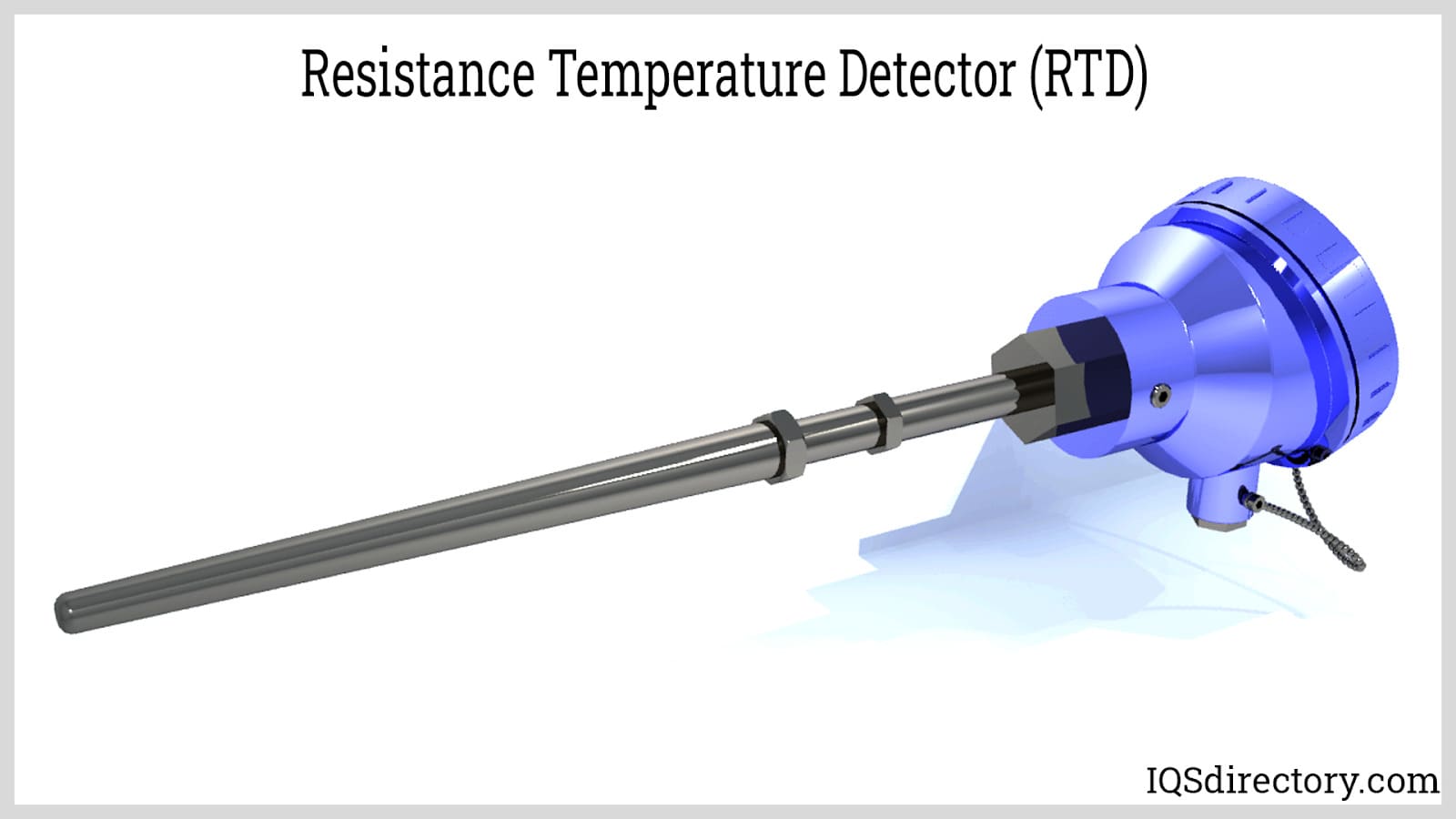
RTD sensors, also known as resistance temperature detectors or resistance thermometers, are a type of heat sensor, or heat transducer, used to measure temperature. They typically do so using coiled wire elements spun around glass or ceramic, which react to temperature and temperature changes with measurable resistance. The relationship between this resistance and temperature change is highly accurate, making RTD sensors very reliable devices.
RTD Sensor Design
RTD sensors can be divided into two main groups: immersion sensors and surface. Immersion sensors are installed directly into the heart of an application, where they experience direct contact with the process medium, typically a liquid or gas. Surface sensors are used at those times when total immersion is not possible. To work with the same level of accuracy as immersion sensors, they require further insulation. RTD sensors are further organized into classes, per their accuracy, construction and applications. They are: Standard Platinum Resistance Thermometers (SPRTs), Secondary-Standard Platinum Resistance Thermometers (SSPRTs) and Industrial Platinum Resistance Thermometers (Industrial PRTs).
Types of RTD Sensors
There are five main element types with which RTD sensors may be made. They are: wire-wound elements, carbon resistor elements, strain-free elements, thin-film elements and coiled elements.
Wire-Wound
Elements are wrapped around an insulating core or mandrel. The types of wire available in the creation of wire-wound elements include copper, iron, platinum and others. Of these, platinum offers the strongest resistance-temperature relationship. Unfortunately, it is also the most expensive wire, so if their application will not suffer a detriment from their choice, many manufacturers opt for a less expensive alternative. Wire-wound elements are valued for the expansion allowance they offer, which is done with minimal strain.
Carbon Resistor
Very economical and offer repeatable results at low temperatures. They are only appropriate for use with very low temperature applications.
Strain-Free
Also use wire coils, but instead of being wrapped around glass or ceramic, this wire is wrapped around a sealed housing filled with inert gas. They only use platinum wire, which must only be loosely coiled, so that the element can expand and contract freely per temperature change. The main disadvantage of this element type is the fact that it is not well-supported and is therefore susceptible to vibration and shock.
Thin-Film
Composed of sensing elements coated with a protective and strain-relieving glass or epoxy. The protected element is formed from the deposit of an extremely thin layer of resistive material, such as platinum, on a ceramic substrate. While useful for some applications, ultimately, thin-film elements are not as stable or as widely applicable as their coiled and wire-wound cousins.
Coiled
Quite similar to wire-wound elements, except that they function without any constriction. They are the most popular type of RTD sensing element. As mentioned, in this context, wire is wrapped around glass or ceramic. Note that, in order to work, this glass or ceramic must be kept contaminant-free.
Things to Consider When Choosing RTD Sensors
If manufacturers are constructing one or more RTD sensors to be immersed in or surrounded by cold temperatures, they will typically equip them with attached insulated leads. Such insulated leads are most often made from materials like PTFE (polytetrafluorethylene), PVC (polyvinyl chloride) or silicone rubber. In addition, manufacturers usually house fragile sensors in protective, chemically inert metal alloy sleeves. The selection of these housings, or sheaths, should be done with care, as they must be able to shield the sensors from the damage of chemicals, physical elements like wind and rain or whatever else they may encounter.
As was first mentioned, RTD sensors are incredibly reliable. In fact, they are so reliable, as well as stable and prone to repeatability, that they have begun to replace thermocouples. In practice, the main difference between RTDs and thermocouples is the fact that thermocouples run and generate voltage using the Seebeck effect, while RTDs require a power source to run and generate voltage using electrical resistance. The resistance they use more closely models the Callendar-Van Dusen equation. The choice of which sensor type to select usually comes down to four main factors: accuracy and stability requirements, response time, temperature and size. To find out more about RTD sensors and to find your best fit, reach out to a knowledgeable sensor engineer today.
RTD Sensors Informational Video