
- 7 leading manufacturers
- 32 additional suppliers
- 18 states and provinces
- 22 related categories
- 8 guide sections
Rotor Stator Technology Manufacturers and Suppliers
IQS Directory provides an extensive list of rotor stator technology manufacturers and suppliers. Utilize our website to review and source rotor mixers manufacturers with our easy-to-use features which allow you to locate rotor stator technology companies that will design, engineer, and manufacture rotor stator technology for your exact specifications. Our request for quote forms make it easy to connect with leading rotor mixers manufacturers. View company profiles, website links, locations, phone number, product videos, product specific news articles and other production information. We are a leading manufacturer directory who will connect you with the right manufacturers whether you are looking for mixing blades, emulsifiers, or food mixers.
Suppliers located in CA, NY, OH +15 more states
Contents (5 sections)
Leading Rotor Stator Technology Manufacturers
Showing all 7
| Placement No. | Manufacturer | Location | Contact | Actions | |
|---|---|---|---|---|---|
| 1 | WAM® Inc.At WAM Inc., we specialize in the design and production of industrial mixers engineered to deliver dependable blending performance across demanding processing environments. Our company supports customers in industries that require accurate material consistency, controlled mixing action, and reliable operation for powders, slurries, liquids, and bulk solids. | Lawrenceville, GA | |||
| 2 | Charles Ross & Son CompanyRoss is a manufacturer of industrial mixing, blending and dispersion equipment since 1842. We offer sanitary, standard and custom equipment designed to meet the varied mixing requirements of our customers from virtually all the process industries. Our plants in the United States, China and India are all fully equipped with advanced engineering and production tools. In the US alone, we operate five plants and maintain an 8000-sq.ft. Test & Development Center. Call us or visit our website today! | Hauppauge, NY | |||
| 3 | Admix, Inc.Admix, Inc. manufactures stainless steel mixing technologies & assists with tough mixing issues for a variety of markets. Choose from products such as basic mixers, Rotomaxx™ high torque mixers, BenchMix™ programmable lab mixers and a multitude of other innovative designs from Admix for your mixing needs. Our equipment meets 3-A, USDA-Dairy, AMS and AG-Canada hygienic & safety standards. | Londonderry, NH | |||
| 4 | Dynamic Air Inc.Our high-performance mixers ensure efficient and consistent material blending across a wide range of industries. Designed to handle everything from fine powders to coarse aggregates, with or without liquid addition, they deliver uniformity and precision in every batch. With innovative engineering, optimized flow patterns, and reduced energy consumption, they enhance productivity while minimizing waste. | St. Paul, MN | |||
| 5 | Akona Process SolutionsAt Akona Process Solutions, we dedicate ourselves to designing and building mixers that deliver consistent performance and long-lasting value. We understand that reliable mixing technology is the foundation of countless operations, so we engineer our mixers with precision, durability, and adaptability in mind. | Monroe, NC | |||
| 6 | Wagner Enterprise, Inc.At Wagner Enterprise, Inc., we design and build high-performance mixers for industrial blending, agitation, and processing. With decades of experience, we deliver custom mixing systems for chemical, food, pharmaceutical, and water treatment industries. Our mixers are engineered for durability, efficiency, and precision, ensuring reliable performance in even the most demanding environments. We tailor each solution to meet your specific process needs. | Troy, MI | |||
| 7 | Silverson Machines, Inc.At Silverson Machines, we design and manufacture high shear mixing equipment giving manufacturers a reliable way to mix, emulsify, homogenize, solubilize, suspend, disperse, and reduce particle size with speed and consistency. Our mixing equipment is engineered to deliver repeatable results from the laboratory through full-scale production. | East Longmeadow, MA |
Claim your Page One Spot
Leading rotor stator technology manufacturers are listed first on this page, each with a website preview and a Request a Quote button on its row.
Additional Rotor Stator Technology Companies
The category’s other rotor stator technology companies are listed on their own page, with location, phone and website where each supplier provides them.
View 32 Additional Rotor Stator Technology CompaniesDo not see your company listed in Rotor Stator Technology?
Engineers and buyers use this page to find rotor stator technology suppliers. Add your company to the Rotor Stator Technology listings so they can find you too.
List Your Company- Listed in the Rotor Stator Technology directory
- A profile page for your company
- Buyers contact you directly
Rotor Stator Technology Industrial Manufacturing Guides
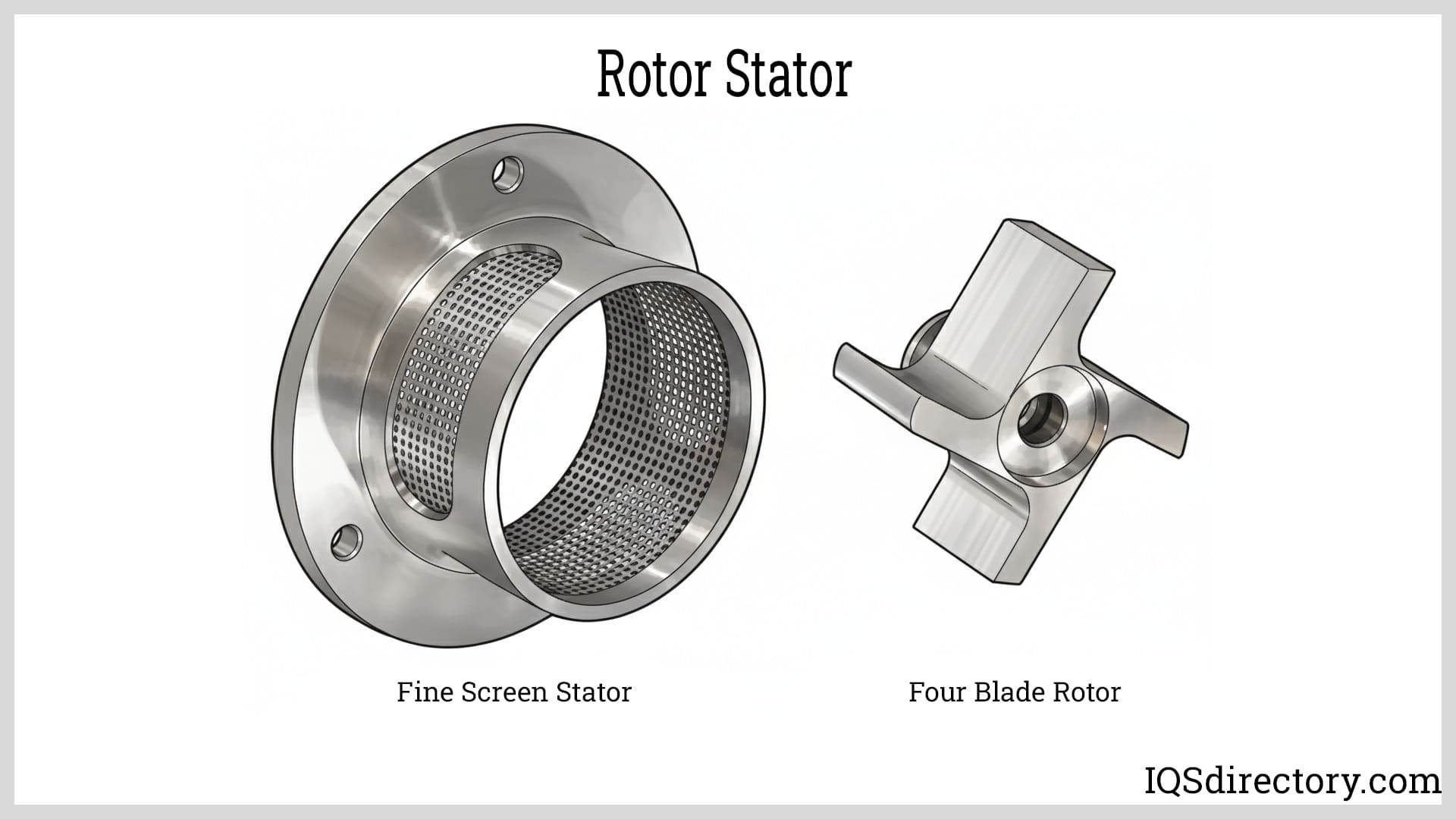
Rotor Stator Technology
An explanation of rotor stator technology with descriptions of its effects on products, mixtures, and materials You will learn: What is Rotor Stator…
5 chapters
Quick Answers
- How many rotor stator technology manufacturers are listed on IQS Directory?
- 7 leading manufacturers and 32 additional suppliers.
- Where are rotor stator technology manufacturers located?
- The listed suppliers are in 18 states: California (6), New York (5), Ohio (5), Massachusetts (3), Minnesota (3), Pennsylvania (3), Kentucky (2), Michigan (2), and 10 more.
- How do I get quotes from rotor stator technology suppliers?
- Select suppliers in the table and choose Request Quotes. IQS reviews your request and forwards it to every supplier you select.
Rotor Stator Technology
Rotor stator technology is a high-performance mixing and fluid processing solution designed to deliver controlled shear, rapid dispersion, and consistent particle size reduction. At its core, a rotor stator mixer consists of a rapidly rotating inner rotor and a stationary outer stator. As material passes through the precisely engineered gaps between these components, it is subjected to intense mechanical and hydraulic shear forces. This process enables efficient emulsification, homogenization, deagglomeration, and dispersion of solids into liquids or immiscible liquid phases.
Rotor stator systems are widely recognized as high shear mixers, capable of producing fine emulsions and uniform suspensions in significantly shorter processing times compared to conventional agitators. Whether configured as inline mixers, batch mixers, or multistage high shear systems, rotor stator technology offers scalability and repeatable results across laboratory, pilot, and full-scale production environments.
How Rotor Stator Mixers Work
The performance of rotor stator equipment is defined by its mechanical design and shear zone geometry. The rotor spins at high speeds within the stator housing, creating a powerful suction effect that draws materials into the mixing head. Once inside, the fluid is forced through narrow slots or perforations in the stator, where velocity gradients and turbulence break down droplets and particles.
This combination of mechanical shear, hydraulic shear, and impact forces results in:
- Rapid particle size reduction
- Improved dispersion of powders into liquids
- Stable emulsions with fine droplet distribution
- Enhanced homogenization of multi-phase systems
The gap between the rotor and stator, rotational speed, and stator design directly influence shear intensity. Multistage rotor stator mixers amplify this effect by forcing material through several shear zones in a single pass, increasing processing efficiency and improving final product consistency.
Applications of Rotor Stator Technology
Rotor stator mixing technology is used across industries that require precise control over particle size, viscosity, and phase distribution. It is particularly valuable where uniformity, product stability, and processing speed are critical performance metrics.
Pharmaceutical and Biotechnology
In pharmaceutical manufacturing, rotor stator homogenizers are used for emulsions, creams, ointments, suspensions, and vaccine formulations. Controlled shear ensures active ingredients are evenly distributed while meeting strict regulatory standards. In biotech applications, rotor stator systems assist in cell disruption, media preparation, and protein dispersion.
Food and Beverage Processing
Food processors rely on high shear rotor stator mixers for sauces, dressings, dairy products, beverages, and flavor emulsions. The ability to create stable emulsions and reduce particle size improves texture, mouthfeel, and shelf stability. Inline rotor stator mixers also support continuous processing, helping manufacturers increase throughput while maintaining product consistency.
Chemical and Industrial Manufacturing
In chemical processing, rotor stator technology supports adhesive production, polymer blending, coatings, inks, sealants, and specialty chemicals. It is especially effective for dispersing pigments, incorporating powders into liquids, and preventing agglomeration. The controlled shear environment improves dispersion quality and reduces downstream rework.
Cosmetics and Personal Care
Lotions, creams, serums, and cosmetic emulsions depend on rotor stator homogenizers to achieve smooth textures and stable formulations. High shear mixing enhances ingredient integration and supports premium product quality.
Design Variations and Configurations
Rotor stator mixers are available in multiple configurations to match specific production goals and facility constraints.
Batch Rotor Stator Mixers
Batch systems are installed directly into mixing tanks or processing vessels. These mixers are ideal for controlled production runs where formulation adjustments and inspection are part of the workflow. Batch rotor stator mixers provide flexibility for R&D environments and specialty product manufacturing.
Inline Rotor Stator Mixers
Inline high shear mixers are integrated into process piping and operate continuously. Product is pumped through the rotor stator mixing head, enabling consistent, repeatable processing. Inline systems are commonly selected for high-volume manufacturing and applications requiring strict process control.
Multistage High Shear Mixers
Multistage rotor stator mixers incorporate multiple rotor and stator assemblies within a single housing. Each stage increases shear exposure, improving emulsification efficiency and reducing processing time. This configuration is often selected when fine particle size distribution is critical.
Benefits of Rotor Stator Mixing Technology
Rotor stator systems offer significant operational and product-quality advantages for manufacturers seeking efficiency and repeatability.
First, they dramatically reduce mixing time. High shear forces accelerate dispersion and homogenization, allowing manufacturers to shorten batch cycles and increase output.
Second, rotor stator technology improves product uniformity. The controlled shear environment produces consistent droplet sizes and uniform suspensions, which directly impacts product stability and performance.
Third, these systems enhance powder incorporation. By drawing powders into the shear zone quickly, rotor stator mixers minimize clumping and reduce the formation of agglomerates.
Finally, inline rotor stator systems support scalable production. As demand grows, processing capacity can be increased without compromising quality or formulation integrity.
Key Factors to Consider When Selecting Rotor Stator Equipment
When evaluating rotor stator technology for industrial mixing applications, decision-makers should consider several performance variables to ensure optimal results.
Shear intensity is one of the most important selection criteria. Higher rotational speeds and tighter rotor-stator clearances generate more intense shear, which is necessary for fine emulsions and particle size reduction.
Viscosity range is another critical factor. Some rotor stator mixers are optimized for low-viscosity liquids, while others are engineered to handle high-viscosity materials such as gels, pastes, and thick emulsions.
Flow rate and throughput requirements determine whether a batch or inline configuration is more appropriate. Continuous processing environments often favor inline systems for efficiency and integration into automated production lines.
Material compatibility is also essential. Stainless steel, specialized alloys, and sanitary designs are commonly selected for food-grade, pharmaceutical, and corrosive chemical applications.
Maintenance accessibility and clean-in-place (CIP) capability can significantly influence long-term operational costs and compliance in regulated industries.
Common Use Cases Driving Buyer Intent
Manufacturers researching rotor stator mixers typically aim to solve one or more of the following challenges:
They may need to improve emulsion stability and prevent phase separation. In this case, rotor stator homogenizers offer superior droplet size control compared to low shear agitators.
They may struggle with powder incorporation and lump formation. High shear rotor stator mixers create strong suction and turbulence, enabling faster dispersion of solids into liquids.
They may need to reduce batch time and increase production efficiency. The rapid mixing action of rotor stator systems accelerates processing without sacrificing product quality.
They may require scalable mixing technology that can transition from laboratory development to commercial production with minimal reformulation. Rotor stator platforms often support this scalability through modular design.
Comparing Rotor Stator Technology to Other Mixing Methods
While conventional impeller mixers and agitators are effective for blending low-viscosity liquids, they typically do not generate the shear intensity required for emulsification or fine particle dispersion. Static mixers provide energy-efficient mixing in pipelines but lack adjustable shear control.
Rotor stator mixers bridge this gap by delivering controllable, repeatable high shear mixing. The adjustable speed, interchangeable stator heads, and multistage options provide flexibility that supports a wide range of formulations and processing conditions.
Enhancing Process Efficiency with Rotor Stator Systems
As manufacturing environments become increasingly competitive, companies prioritize equipment that improves process efficiency, reduces waste, and enhances product consistency. Rotor stator technology supports these objectives by optimizing particle size distribution, reducing rework, and minimizing energy consumption relative to extended low-shear mixing cycles.
By integrating rotor stator mixers into automated production lines, manufacturers gain greater control over process parameters, resulting in improved repeatability and regulatory compliance.
Rotor stator technology continues to be a foundational solution in high shear mixing, homogenization, and industrial fluid processing. For organizations focused on performance, scalability, and product quality, rotor stator mixers offer a proven method for achieving reliable, consistent results across diverse applications.