
- 7 leading manufacturers
- 32 additional suppliers
- 17 states and provinces
- 23 related categories
- 2 guide sections
Ribbon Mixer Manufacturers and Suppliers
IQS Directory provides useful search tools to find leading ribbon mixer manufacturers and suppliers. Find ribbon mixer companies that can design, engineer, and manufacture ribbon mixers to your specifications. Peruse our website to review and discover top ribbon mixer manufacturers with roll over ads and complete product descriptions. Connect with the ribbon mixer companies through our hassle-free and efficient request for quote form. You are provided company profiles, website links, locations, phone numbers, product videos, and product information. Read reviews and stay informed with product new articles. Whether you are looking for manufacturers of static mixers, batch mixers, or rotor mixers of every type, IQS is the premier source for you.
Suppliers located in CA, OH, NY +14 more states
Contents (5 sections)
Leading Ribbon Mixer Manufacturers
Showing all 7
| Placement No. | Manufacturer | Location | Contact | Actions | |
|---|---|---|---|---|---|
| 1 | WAM® Inc.At WAM Inc., we specialize in the design and production of industrial mixers engineered to deliver dependable blending performance across demanding processing environments. Our company supports customers in industries that require accurate material consistency, controlled mixing action, and reliable operation for powders, slurries, liquids, and bulk solids. | Lawrenceville, GA | |||
| 2 | Charles Ross & Son CompanyRoss is a manufacturer of industrial mixing, blending and dispersion equipment since 1842. We offer sanitary, standard and custom equipment designed to meet the varied mixing requirements of our customers from virtually all the process industries. Our plants in the United States, China and India are all fully equipped with advanced engineering and production tools. In the US alone, we operate five plants and maintain an 8000-sq.ft. Test & Development Center. Call us or visit our website today! | Hauppauge, NY | |||
| 3 | Dynamic Air Inc.Our high-performance mixers ensure efficient and consistent material blending across a wide range of industries. Designed to handle everything from fine powders to coarse aggregates, with or without liquid addition, they deliver uniformity and precision in every batch. With innovative engineering, optimized flow patterns, and reduced energy consumption, they enhance productivity while minimizing waste. | St. Paul, MN | |||
| 4 | ProQuip, Inc.Are you searching for industrial mixers? Your search is done and we supply the best quality industrial mixers on the market. We take pride in our manufacturing but also in our customer service. We are more than just a supplier; we desire a long lasting business relationship which results in years of customer satisfaction. Your experience is important to us. For all of your mixing needs visit our website or give us a call today! | Macedonia, OH | |||
| 5 | Akona Process SolutionsAt Akona Process Solutions, we dedicate ourselves to designing and building mixers that deliver consistent performance and long-lasting value. We understand that reliable mixing technology is the foundation of countless operations, so we engineer our mixers with precision, durability, and adaptability in mind. | Monroe, NC | |||
| 6 | Wagner Enterprise, Inc.At Wagner Enterprise, Inc., we design and build high-performance mixers for industrial blending, agitation, and processing. With decades of experience, we deliver custom mixing systems for chemical, food, pharmaceutical, and water treatment industries. Our mixers are engineered for durability, efficiency, and precision, ensuring reliable performance in even the most demanding environments. We tailor each solution to meet your specific process needs. | Troy, MI | |||
| 7 | Silverson Machines, Inc.At Silverson Machines, we design and manufacture high shear mixing equipment giving manufacturers a reliable way to mix, emulsify, homogenize, solubilize, suspend, disperse, and reduce particle size with speed and consistency. Our mixing equipment is engineered to deliver repeatable results from the laboratory through full-scale production. | East Longmeadow, MA |
Claim your Page One Spot
Leading ribbon mixer manufacturers are listed first on this page, each with a website preview and a Request a Quote button on its row.
Additional Ribbon Mixer Companies
The category’s other ribbon mixer companies are listed on their own page, with location, phone and website where each supplier provides them.
View 32 Additional Ribbon Mixer CompaniesDo not see your company listed in Ribbon Mixers?
Engineers and buyers use this page to find ribbon mixer suppliers. Add your company to the Ribbon Mixers listings so they can find you too.
List Your Company- Listed in the Ribbon Mixers directory
- A profile page for your company
- Buyers contact you directly
Ribbon Mixer Industrial Manufacturing Guides
Ribbon Mixers: Parts, Types and Configurations
A description of the types of ribbon mixers and ribbon mixer manufacturers as well as the benefits of ribbon mixers. You will learn: What is a Ribbon Mixer?…
5 chapters
Quick Answers
- How many ribbon mixer manufacturers are listed on IQS Directory?
- 7 leading manufacturers and 32 additional suppliers.
- Where are ribbon mixer manufacturers located?
- The listed suppliers are in 17 states: California (6), Ohio (6), New York (5), Massachusetts (3), Minnesota (3), Pennsylvania (3), Kentucky (2), Michigan (2), and 9 more.
- How do I get quotes from ribbon mixer suppliers?
- Select suppliers in the table and choose Request Quotes. IQS reviews your request and forwards it to every supplier you select.
Ribbon Mixers
The property of ribbon mixers that differentiates them from other forms of mixers is the design of their mixing blades, which have the shape of helical ribbons that move different forms of materials from the middle of the mixer to the walls and back again. Helical blades are chosen for ribbon mixers because they provide the versatility to mix dry and damp powders, pastes, slurries, and liquids. The helical design has a slow rotational speed that efficiently mixes ingredients.
Structure of Ribbon Mixers
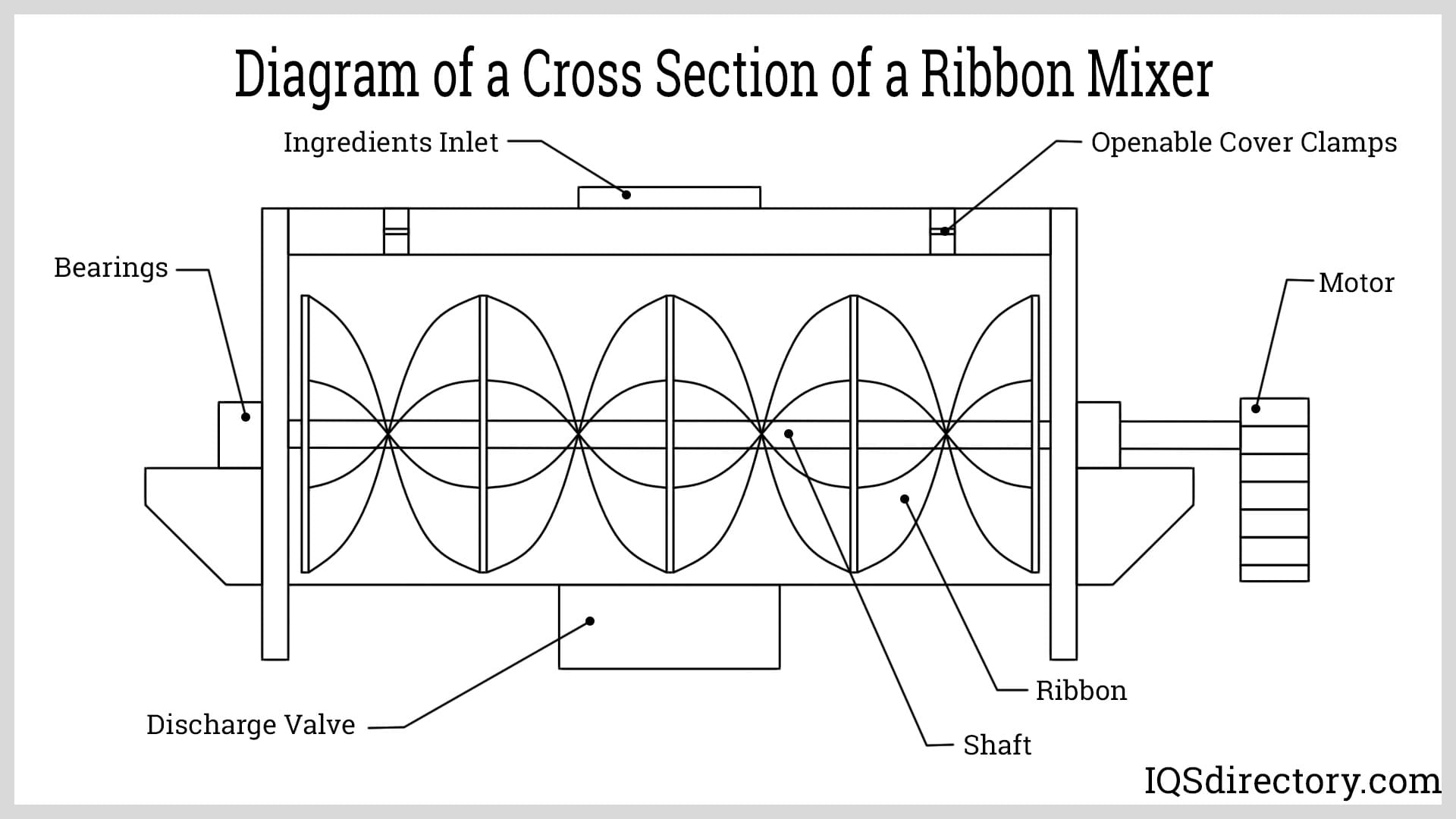
The simple structure of ribbon mixers adds to their efficiency. The two basic types of ribbon mixers are horizontal and vertical with horizontal ribbon mixers being used the most. The components of a ribbon mixer include a trough, ribbon or helical agitator, a direct drive motor, feed inlet or inlets, a discharge valve, and a control panel. Each of the different parts has exceptional durability and resilience in order to withstand constant use.
Trough
The trough is the main structural piece of a ribbon mixer. It has a tub-like construction that is completely sealed to avoid leaks. Troughs come in different designs regarding how ingredients are added. In some configurations, ribbon mixers are directly fed and are part of an assembly or production process. Inlet valves are positioned along the top of the trough with some troughs having lids. Discharge valves are placed in the bottom of the trough in the middle or on one end and are tightly sealed to prevent leakage.
The shaft, which is sealed on both ends and connected to the direct motor, extends along the full length of the trough. It has a helical ribbon attached to it using spokes. The position of the ribbon and shaft is carefully calculated such that the blades of the ribbon do not touch the sides of the trough but are close enough to avoid the build-up of ingredients. In general, horizontal ribbon mixer troughs are U shaped, which allows for easy access and cleaning.
Although the U shape of troughs is the most common, there are variations in the shapes of troughs, which include cylindrical, fully cylindrical, semi-cylindrical, and cone-shaped. The variations in the shape of troughs are in accordance with the applications for which a ribbon mixer is used.
Agitator
The agitator or ribbon is the key feature of ribbon mixers. It includes the shaft and helical blades that are attached to the shaft with spokes. The slow rotation of the agitator moves the ingredients back and forth and up and down. As with troughs, there are different agitator designs, each of which completes the mixing process in a unique way. One version of ribbon mixers has inner and outer ribbons that move the ingredients in different directions. The inner ribbons move the ingredients from the center of the trough to the end of the trough while the outer ribbons move the ingredients back to the center of the trough. The back-and-forth motion gently combines and blends the ingredients to form a homogeneous mixture.
Agitators take several forms and have different designs. Some of the variations include enhanced paddles and plow agitators. In addition to the ribbons, these designs have flat pieces of metal attached to the shaft by spokes and are designed to alter the traditional mixing pattern of ordinary ribbon mixers. While the inclusion of paddles creates another form of mixing pattern, the ribbons on ribbon mixers vary as well and include single, double, triple, and hybrid types. Of the different types of ribbons, double ribbon versions are the most popular and widely used.
Drive Systems
For many years, the drive motors for ribbon mixers had belts and chains that turned the shaft of the mixing blades. The slow speed of the mixing process made the chains and belts a perfect choice. The downside of the method was the deterioration of the belts and chains, which necessitated changing the belts and chains frequently. In addition, mixing and blending were halted causing a slowdown in production.
The landscape of ribbon mixers was changed forever with the introduction of variable speed drives (VSDs) or variable frequency drives (VFDs), which are direct-drive electric motors that are attached directly to the shaft. VSD motors can run continually and require far less maintenance than belt or chain drives. They allow for more precision control and are able to endure the stressful constant use required by mixing.
Feed Inlet
The feed inlet is where ingredients are introduced into a ribbon blender. They can take the form of a nozzle, hopper, or powder inlet and are positioned on the top of a ribbon mixer. Feed inlets take several forms that include hatches, lids, and sealed openings. As with any opening into a ribbon mixer, feed inlets are tightly sealed to avoid leakage. On the interior of the mixer, feed inlets conform with the configuration of the trough such that they do not interfere with the mixing process. Lids are normally locked, so they won’t pop open during mixing.
There are several seals on ribbon mixers to prevent ingredients from moving outside the mixer. Aside from seals on the feed inlets, there are seals on both ends of the shaft, the discharge valve, and the lid. As with the other openings of a ribbon mixer, the seals are positioned such that they do not interfere with the mixing.
Discharge Valve
The discharge valve is an opening through which the contents of a ribbon mixer are removed. As the ingredients move back and forth in the trough, they are forced toward the discharge valve, which is generally located at the bottom of the trough at one end. When the valve is opened, the contents of the mixer drain out of the mixer through the discharge valve. The forms and types of discharge valves vary in accordance with the design of ribbon mixers. Plug valves are the most popular and widely used. They have gaskets and openings that match the interior of the trough and provide a perfect seal.
The types and kinds of discharge valves are endless and include a wide array of valve types. The most common forms of discharge valves are paddle gates, knife gates, butterfly valves, spherical, and universal flanges. Each type has its benefits with some forms not providing a complete seal allowing leakage.
Control Panel
Control panels for ribbon blenders can take different forms from simple on and off buttons to a set of interactive controls. As the controls become more sophisticated and technological, they allow users to change the characteristics and parameters of the mixing process. Control panels, as with all forms of machinery, allow users to adjust settings, change timing, and alter feed protocols to match the requirements of the assembly and packaging processes.
The key feature of control panels is the ability to input the settings for the mixing process and do other things instead of standing with the mixer to oversee mixing. In the computer age, control panels can have an interface such that the mixing process can be controlled by desktop or laptop computers.
Conclusion
Ribbon mixer manufacturers outline the capabilities of their equipment and supply customers with detailed information regarding the operation of ribbon mixers. They work diligently with users to ensure users have the right ribbon mixer for their application. An understanding of the components of a ribbon mixer can assist users in their understanding of the capabilities of ribbon mixers such that users can converse authoritatively with manufacturers.