
- 5 leading manufacturers
- 39 additional suppliers
- 21 states and provinces
- 14 related categories
- 3 guide sections
Modular Buildings Manufacturers and Suppliers

IQS Directory implements a thorough list of modular building manufacturers and suppliers. Utilize our listing to examine and sort top modular building manufacturers with previews of ads and detailed descriptions of each product. Any modular building company can design, engineer, and manufacture modular buildings to meet your companies specific qualifications. An easy connection to reach modular building companies through our fast request for quote form is provided on our website. The company information includes website links, company profile, locations, phone, product videos and product information. This source is right for you whether it's for a manufacturer of modular building systems, prefabricated structures, and conventional buildings.
Suppliers located in CA, IN, CO +18 more states
Contents (6 sections)
Leading Modular Buildings Manufacturers
Showing all 5
| Placement No. | Manufacturer | Location | Contact | Actions | |
|---|---|---|---|---|---|
| 1 | Abtech, Inc.As a manufacturer of modular buildings, including inplant modular offices, exterior steel buildings, guard buildings, fork liftable and crane liftable buildings, multi-level buildings and mezzanines, Abtech offers turnkey installations or packages for install by end user. Our modular structures are constructed of steel, are free-standing & manufactured under strict quality control methods. | Santa Ana, CA | |||
| 2 | Par-Kut International Inc.We offer a wide variety of affordable modular buildings for your convenience. Our engineers are determined to bring you a product with a great value and exceptional customer service. We have been around since 1954 providing portable buildings that are made out of steel. We are able to provide them to be bullet resistant as well as any size you need. Get in touch with our customer service representatives today to learn more! | Harrison Township, MI | |||
| 3 | Panel Built, Inc.Our booths and partitions are available in solid surface, stainless steel, solid plastic, solid phenolic, high pressure laminate, and metal powder coated. Our washroom accessories also include combo towel waste units, paper towel dispensers, waste receptacles, soap dispensers, mirrors, warm air hand dryers, toilet tissue dispensers, toilet seat cover dispensers, grab bars, bathroom accessories, shower tub accessories, urinal screens and child care products and accessories. | Blairsville, GA | |||
| 4 | Inplant OfficesInPlant—Modular Buildings since 1987. Design through installation, InPlant manufactures the widest range in prefabricated buildings—Offices, Cleanrooms, Partitions, Equipment Enclosures, & Booths customized to fit your needs. 1.75" or 3" Walls with Systems in steel or aluminum. Systems are fabricated based on use with materials for environmental control & staff protection. Reconfigure or relocate Systems: a non-progressive design. Add, upgrade & replace Walls, windows or doors—maximizing your ROI. | St. Louis, MO | |||
| 5 | Mobile ModularAt Mobile Modular, we provide modular building solutions designed to give organizations flexible, efficient, and dependable space for a wide range of applications. Our company supplies modular buildings that can be configured for offices, classrooms, administrative facilities, healthcare environments, construction sites, commercial operations, and other temporary or permanent space requirements. | Livermore, CA |
Claim your Page One Spot
Leading modular buildings manufacturers are listed first on this page, each with a website preview and a Request a Quote button on its row.
Additional Modular Buildings Companies
The category’s other modular buildings companies are listed on their own page, with location, phone and website where each supplier provides them.
View 39 Additional Modular Buildings CompaniesDo not see your company listed in Modular Buildings?
Engineers and buyers use this page to find modular buildings suppliers. Add your company to the Modular Buildings listings so they can find you too.
List Your Company- Listed in the Modular Buildings directory
- A profile page for your company
- Buyers contact you directly
Modular Buildings Industrial Manufacturing Guides
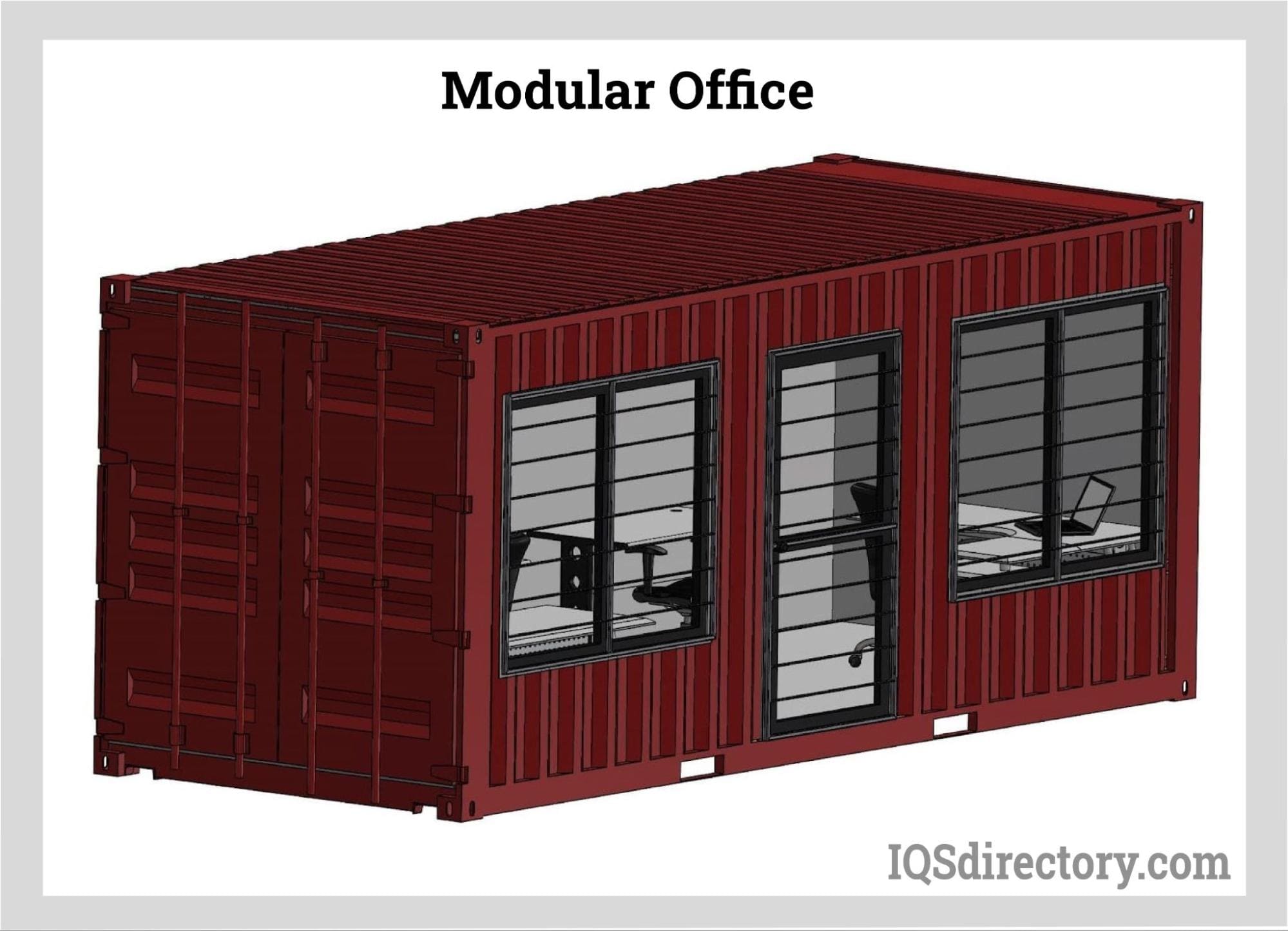
Portable Offices: Everything You Need to Know about Types & Benefits
This article contains everything you need to know about portable offices including their manufacture and use. You will learn: What is a Portable Office?…
7 chapters, the longest in this category
Quick Answers
- How many modular buildings manufacturers are listed on IQS Directory?
- 5 leading manufacturers and 39 additional suppliers.
- Where are modular buildings manufacturers located?
- The listed suppliers are in 21 states and provinces: California (6), Indiana (4), Colorado (3), Florida (3), Georgia (3), Pennsylvania (3), Alabama (2), Illinois (2), and 13 more.
- How do I get quotes from modular buildings suppliers?
- Select suppliers in the table and choose Request Quotes. IQS reviews your request and forwards it to every supplier you select.
Modular Buildings
Modular buildings are prefabricated structures manufactured in controlled factory environments and assembled on-site. This construction method delivers a faster, more predictable alternative to traditional construction while improving cost control, quality consistency, and project timelines. Many organizations exploring faster building solutions often ask, “Is modular construction right for my project?”—and increasingly, the answer is yes.
The terms "prefabricated building" and "modular building" are often used interchangeably, though they are not identical. Modular construction involves standardized sections, or modules, that are engineered for flexible configurations and scalable expansion. Prefabrication refers broadly to offsite manufacturing. All modular buildings are prefabricated, but not all prefabricated structures follow a modular design approach.
The History of Modular Buildings
Modular construction has roots dating back to the early 20th century, when companies such as Sears, Roebuck & Co. delivered kit homes across the United States. These early prefabricated structures laid the groundwork for modern modular design by demonstrating that buildings could be manufactured efficiently and assembled quickly.
Following World War II, demand for housing surged dramatically. Traditional construction methods struggled to keep pace, prompting widespread adoption of modular building techniques. By enabling parallel workflows—site preparation and module fabrication—builders significantly accelerated timelines while maintaining affordability.
Advancements in engineering, materials, and transportation since the 1980s have transformed modular buildings into highly adaptable, large-scale solutions. Today’s modular systems support multi-story construction, advanced architectural finishes, and complex layouts that rival traditional builds in both performance and appearance.
Today, modular buildings are widely used across commercial, industrial, and residential sectors. Their ability to support rapid deployment, consistent quality, and scalable expansion continues to drive adoption across industries seeking efficient construction strategies.
Advantages of Modular Buildings
Modular construction offers a combination of speed, cost efficiency, and design flexibility. Organizations evaluating building options often search for “faster construction methods” or “cost-effective building solutions,” and modular systems consistently emerge as a strong contender.
Assembly Speed Modular construction significantly reduces build time by allowing offsite fabrication and onsite preparation to occur simultaneously. This streamlined approach minimizes delays and accelerates project completion. Factory-controlled production ensures consistent schedules, reduces weather-related disruptions, and improves labor efficiency. Many modular projects are completed in a fraction of the time required for traditional construction. Building Versatility Modular buildings can be configured as standalone structures, interior systems, or expansions to existing facilities. Their flexible design allows organizations to adapt layouts as operational needs evolve. Environmentally Friendly Buildings Modular construction reduces material waste, limits site disruption, and supports sustainable building practices. Reusable modules and efficient material usage contribute to long-term environmental benefits while improving indoor air quality.Modular Building Design
Common Questions
7 questions
What Is the Difference between Modular and Prefabricated Buildings?
Modular buildings use standardized sections for flexible layouts, while prefabricated refers to components built offsite. All modular buildings are prefabricated, but not all prefabricated buildings are modular.
How Fast Can Modular Buildings Be Constructed?
Modular buildings can often be completed in weeks due to simultaneous site preparation and offsite fabrication, significantly reducing project timelines compared to traditional construction.
Are Modular Buildings Environmentally Friendly?
Yes. Modular construction reduces waste, improves material efficiency, lowers emissions, and allows buildings to be reused or relocated, supporting sustainable building practices.
What Materials Are Modular Buildings Made From?
Common materials include wood, steel, aluminum, and engineered composites. Steel is widely used for durability and strength in demanding environments.
Can Modular Buildings Be Customized to Specific Needs?
Yes. Modular buildings can be fully customized with HVAC systems, electrical layouts, finishes, and structural specifications to meet project requirements.
What Are Common Uses for Modular Buildings?
Applications include offices, classrooms, healthcare facilities, industrial buildings, storage units, and temporary or permanent housing solutions.
Do Modular Buildings Meet Local Building Codes?
Yes. Modular buildings must meet the same local and national building codes as traditional construction, including safety and accessibility requirements.