
- 2 leading manufacturers
- 46 additional suppliers
- 20 states and provinces
- 19 related categories
- 7 guide sections
Hazardous Waste Container Manufacturers and Suppliers
IQS Directory is a top industrial directory listing of leading hazardous waste container manufacturers and suppliers. Access our comprehensive index to review and source hazardous waste container manufacturers with preview ads and detailed product descriptions. These hazardous waste container companies can design, engineer and manufacture hazardous waste containers to your specifications and application need. A quick and easy to use request for quote form is provided for you to contact these hazardous waste container manufacturers and suppliers. Each company has detailed profile information, locations, phone number, website links, product videos and product information defined. We are the right resource for your information requirement whether it's for a manufacturer of plastic food containers, plastic buckets, or catch basins.
Suppliers located in CA, IL, PA +17 more states
Contents (5 sections)
Leading Hazardous Waste Container Manufacturers
Showing all 2
Certification, declaration and ownership records are on file for 1 of 2 suppliers in this list, from supplier reports IQS reviewed. A supplier without one listed may still hold it.
| Placement No. | Manufacturer | Location | Contact | Actions | |
|---|---|---|---|---|---|
| 1 | Container Distributors, Inc.Container Distributors offers a solution for all of your plastic container needs, including all sizes of new and reconditioned plastic containers, as well as steel and fibre drums. We also carry a wide range of cubic yard boxes and IBC/totes. We specialize in plastic containers for environmental hazardous waste and material disposal. For more information about our plastic containers, call us today or visit our website! | Venice, IL | |||
| 2 | Hi-Rel Plastics & MoldingWe are Hi-Rel Plastics & Molding, a plastics manufacturing company providing molded plastic containers and related components for customers that require dependable quality, consistent production, and flexible manufacturing support. Our company works with customers to transform product concepts and specifications into functional plastic products suited to storage, handling, packaging, protection, and other commercial and industrial applications.
Hi-Rel Plastics & Molding states: EU RoHS (Supplier-reported, reviewed Sep 2026), EU REACH (Supplier-reported, reviewed Sep 2026), Small Disadvantaged Business (Supplier-reported, reviewed Sep 2026), Minority-owned business (Supplier-reported, reviewed Sep 2026) | Riverside, CA |
Claim your Page One Spot
Leading hazardous waste container manufacturers are listed first on this page, each with a website preview and a Request a Quote button on its row.
Additional Hazardous Waste Container Companies
The category’s other hazardous waste container companies are listed on their own page, with location, phone and website where each supplier provides them.
View 46 Additional Hazardous Waste Container CompaniesDo not see your company listed in Hazardous Waste Containers?
Engineers and buyers use this page to find hazardous waste container suppliers. Add your company to the Hazardous Waste Containers listings so they can find you too.
List Your Company- Listed in the Hazardous Waste Containers directory
- A profile page for your company
- Buyers contact you directly
Hazardous Waste Container Industrial Manufacturing Guides
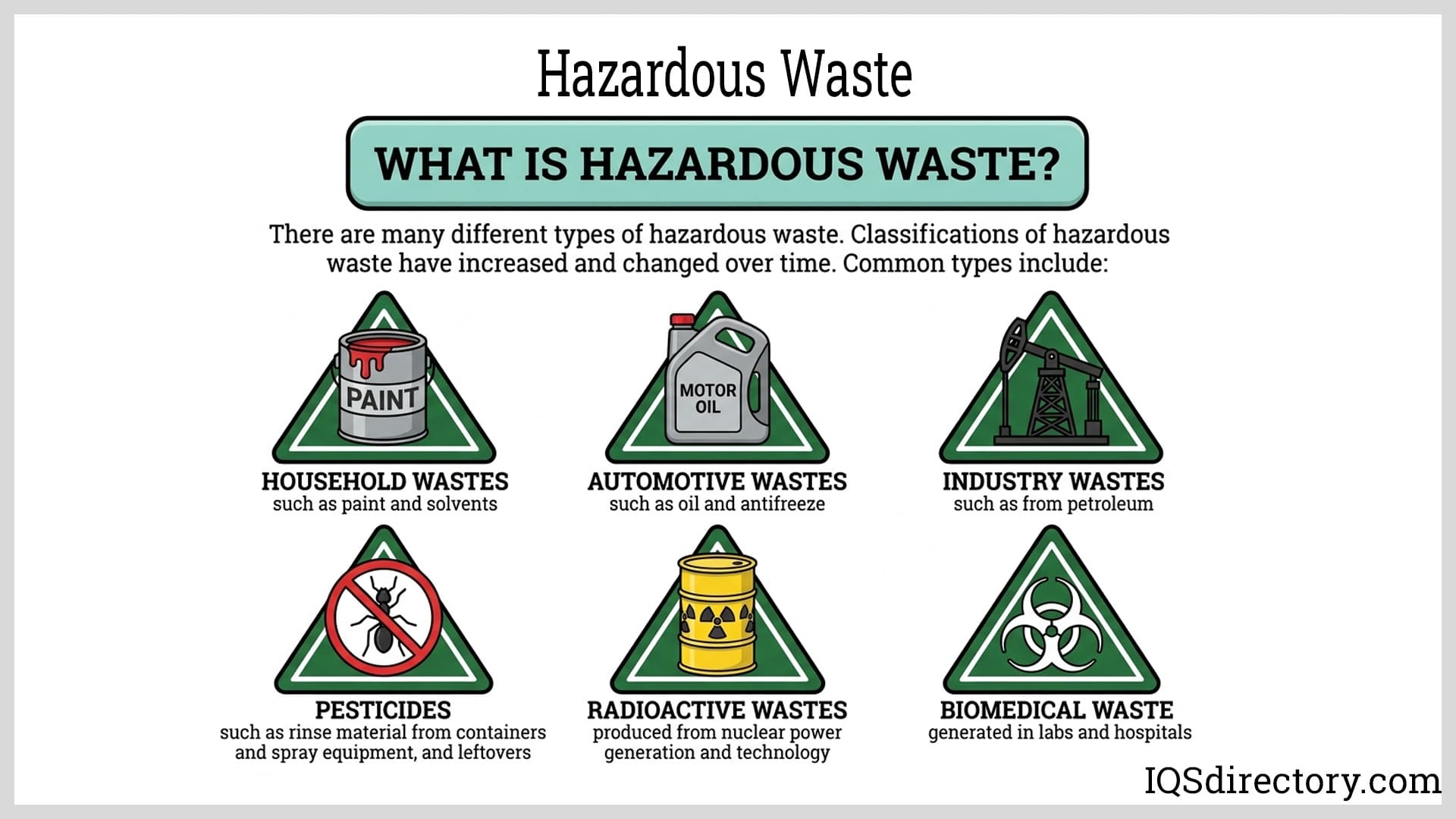
Hazardous Waste Drums & Containers
A definition of a hazardous waste containers using United Nations certification criteria with a list of hazardous waste container distributors You will learn:…
7 chapters
Quick Answers
- How many hazardous waste container manufacturers are listed on IQS Directory?
- 2 leading manufacturers and 46 additional suppliers.
- Where are hazardous waste container manufacturers located?
- The listed suppliers are in 20 states and provinces: California (7), Illinois (7), Pennsylvania (5), Indiana (4), Wisconsin (3), Idaho (2), Kentucky (2), New Jersey (2), and 12 more.
- How do I get quotes from hazardous waste container suppliers?
- Select suppliers in the table and choose Request Quotes. IQS reviews your request and forwards it to every supplier you select.
Hazardous Waste Containers
Hazardous waste containers are specialized storage systems designed to safely hold, transport, and manage materials that pose risks to human health or the environment. These containers are engineered to meet strict regulatory standards for hazardous material storage, ensuring proper containment of chemicals, flammable substances, corrosives, toxic waste, and biohazardous materials. Built for durability and compliance, they play a critical role in industrial safety, environmental protection, and regulatory adherence across a wide range of industries.
Advantages and Disadvantages of Hazardous Waste Containers
Advantages
Enhanced Safety and Compliance
Hazardous waste containers are designed to meet OSHA, EPA, and DOT requirements, helping businesses maintain compliance while minimizing exposure risks.
Leak and Spill Prevention
With reinforced seams, sealed lids, and chemical-resistant materials, these containers significantly reduce the risk of leaks, spills, and contamination.
Durability in Harsh Environments
Manufactured from high-performance materials such as HDPE, steel, or polypropylene, they withstand extreme temperatures, corrosive substances, and mechanical stress.
Versatility Across Applications
Available in drums, bins, carboys, and intermediate bulk containers (IBCs), they accommodate various waste types, volumes, and handling methods.
Disadvantages
Higher Initial Cost
Compared to standard storage containers, hazardous waste containers often require a larger upfront investment due to regulatory compliance and specialized materials.
Strict Handling Requirements
Improper use, labeling, or storage can lead to regulatory violations, requiring trained personnel and ongoing monitoring.
Limited Reusability in Certain Cases
Some containers, especially those used for highly reactive or biohazardous waste, may require disposal after a single use.
Design of Hazardous Waste Containers
Hazardous waste containers are engineered with a focus on containment integrity, compatibility, and regulatory compliance. Their design varies depending on the type of waste being stored, but all configurations prioritize secure sealing, structural strength, and resistance to chemical degradation. Common designs include open-head drums for solid waste, closed-head drums for liquids, and stackable IBC totes for bulk storage.
Materials play a crucial role in design performance. High-density polyethylene (HDPE) containers offer excellent resistance to acids and bases, while carbon steel or stainless steel drums are often used for flammable or combustible liquids. Many containers incorporate features such as gasketed lids, locking rings, venting systems, and secondary containment options to enhance safety. Color coding and labeling panels are also integrated to support hazard identification and compliance with labeling standards like GHS (Globally Harmonized System).
Portability and handling are also key considerations. Containers are often designed with ergonomic handles, forklift-compatible bases, or palletized structures to streamline transportation and storage. Stackability and space efficiency are essential for facilities managing large volumes of hazardous waste, allowing for organized storage while maintaining accessibility and safety.
Applications of Hazardous Waste Containers
Hazardous waste containers are used across a wide spectrum of industries where safe waste management is essential. In manufacturing environments, they store byproducts such as solvents, oils, and chemical residues generated during production processes. In healthcare and laboratory settings, they are used for biohazard waste disposal, including sharps containers, contaminated materials, and pharmaceutical waste.
The chemical processing industry relies heavily on hazardous material containers to manage corrosive liquids, reactive compounds, and hazardous intermediates. In the automotive and aerospace sectors, these containers are used for storing fuels, lubricants, and cleaning agents that require controlled handling. Environmental services and waste management companies depend on these containers for collection, transportation, and disposal of regulated waste streams.
Construction and industrial maintenance operations also utilize hazardous waste containers to manage materials such as paints, coatings, adhesives, and contaminated debris. Their role extends to emergency response scenarios, where spill containment and temporary storage solutions are critical for mitigating environmental impact.
Manufacturing Process of Hazardous Waste Containers
The production of hazardous waste containers involves precision engineering and strict quality control to ensure compliance with regulatory standards and performance requirements. For plastic containers, rotational molding and injection molding are commonly used processes. Rotational molding is particularly effective for creating seamless, uniform containers with consistent wall thickness, enhancing durability and leak resistance.
In the rotational molding process, powdered polymer is placed inside a mold that rotates along multiple axes while being heated. This allows the material to evenly coat the interior surface, forming a hollow container without seams or weak points. Once cooled, the container is removed, inspected, and finished with fittings or closures.
Steel drums and metal containers are typically manufactured through a combination of rolling, welding, and forming processes. Sheets of metal are shaped into cylindrical forms, welded along seams, and reinforced with ribs for added strength. Interior linings or coatings may be applied to improve chemical resistance and prevent corrosion.
Quality assurance is a critical step in the manufacturing process. Containers undergo rigorous testing, including leak testing, pressure testing, and drop testing, to ensure they meet UN/DOT certification standards for hazardous materials packaging. Labeling, marking, and documentation are also integrated into the production workflow to ensure traceability and compliance.
Key Considerations When Choosing Hazardous Waste Containers
Selecting the right hazardous waste container requires careful evaluation of several factors to ensure safety, compliance, and operational efficiency. One of the most important considerations is material compatibility. The container must be resistant to the specific chemical properties of the waste it will hold, including corrosiveness, flammability, and reactivity.
Capacity and size are also critical. Businesses must choose containers that align with their waste generation volume while allowing for safe handling and storage. Overfilling or underutilizing containers can create inefficiencies and potential safety hazards.
Regulatory compliance is non-negotiable. Containers must meet applicable standards such as UN ratings, DOT specifications, and local environmental regulations. Proper labeling, including hazard symbols and waste identification, is essential for safe handling and transportation.
Storage conditions and environmental factors should also be considered. Containers used outdoors may require UV resistance, weatherproofing, or secondary containment systems to prevent environmental contamination. For indoor use, ventilation and fire safety requirements may influence container selection.
Buyer Intent and Industry Trends
As regulations around hazardous waste management continue to evolve, businesses are increasingly prioritizing compliant, sustainable, and cost-effective storage solutions. Buyers are not only searching for "hazardous waste containers" but also related terms such as "chemical storage drums," "UN-rated containers," "spill containment systems," and "industrial waste bins." This reflects a growing emphasis on safety, environmental responsibility, and operational efficiency.
Sustainability is becoming a key factor in purchasing decisions. Reusable and recyclable containers, as well as systems designed to minimize waste and improve handling efficiency, are gaining traction. Additionally, innovations in smart labeling, tracking systems, and IoT-enabled monitoring are enhancing visibility and control over hazardous waste management processes.
Businesses are also looking for solutions that integrate seamlessly into their existing workflows. This includes containers that are compatible with automated handling systems, easy to clean or decontaminate, and adaptable to multiple waste streams. Customization options, such as specialized fittings or tailored dimensions, are increasingly valued in industries with unique operational requirements.
Conclusion
Hazardous waste containers are essential components of safe and compliant waste management systems, providing reliable containment for materials that pose significant risks. Through advanced design, durable materials, and strict manufacturing standards, these containers support a wide range of industrial, medical, and environmental applications. By carefully selecting the right container based on compatibility, capacity, and regulatory requirements, businesses can enhance safety, improve efficiency, and ensure responsible handling of hazardous materials.