
- 3 leading manufacturers
- 6 additional suppliers
- 6 states and provinces
- 16 related categories
- 4 guide sections
Gate Latch Manufacturers and Suppliers

Find gate latches manufacturers and gate latches suppliers from IQS Directory. Use the time-saving Request for Quote tool to submit your inquiry to all the gate latches companies you select.
Suppliers located in MO, CT, CA +3 more states
Contents (5 sections)
Leading Gate Latch Manufacturers
Showing all 3
| Placement No. | Manufacturer | Location | Contact | Actions | |
|---|---|---|---|---|---|
| 1 | Delson Hinge CorporationAt Delson Hinge, we specialize in providing high-quality latches and hardware solutions designed to deliver reliable fastening, secure closures, and consistent performance across a variety of industries. Our company focuses on supplying dependable products that meet the functional requirements of industrial, commercial, and manufacturing environments. | Cheshire, CT | |||
| 2 | Norse®, Inc.Cabinet latches are our specialty! Based in Torrington, CT, we proudly serve customers nationwide, delivering reliable solutions wherever they’re needed. Every product undergoes rigorous testing to ensure we provide only the highest quality to our valued customers. Visit our website or contact us by email or phone to learn more about how we can assist you! | Torrington, CT | |||
| 3 | DLP (D. La Porte)At DLP, we specialize in providing dependable latch solutions designed to meet the fastening, securing, and access requirements of various industries. Our company offers a range of latches engineered for durability, ease of operation, and consistent performance. | Cedar Falls, IA |
Claim your Page One Spot
Leading gate latch manufacturers are listed first on this page, each with a website preview and a Request a Quote button on its row.
Additional Gate Latch Companies
The category’s other gate latch companies are listed on their own page, with location, phone and website where each supplier provides them.
View 6 Additional Gate Latch CompaniesDo not see your company listed in Gate Latches?
Engineers and buyers use this page to find gate latch suppliers. Add your company to the Gate Latches listings so they can find you too.
List Your Company- Listed in the Gate Latches directory
- A profile page for your company
- Buyers contact you directly
Gate Latch Industrial Manufacturing Guides
Gate Latches: Applications, Principles and Benefits
This article will take an in-depth look at Gate Latches. The article will provide more detail on topics such as: Principles of Gate Latches Types of Gate…
4 chapters
Quick Answers
- How many gate latch manufacturers are listed on IQS Directory?
- 3 leading manufacturers and 6 additional suppliers.
- Where are gate latch manufacturers located?
- The listed suppliers are in 6 states: Missouri (3), Connecticut (2), California (1), Florida (1), Illinois (1), and Iowa (1).
- How do I get quotes from gate latch suppliers?
- Select suppliers in the table and choose Request Quotes. IQS reviews your request and forwards it to every supplier you select.
Gate Latches
Gate latches are one of many varying types of latches, which are fastening mechanisms used to bring together and hold together adjacent segments of an opening. Gate latches in particular are used to fasten and secure adjacent segments of fencing or any other gate-like openings, such as those of cages and walls. Typically, these opening segments serve as entrances and/or exits. Gate latches serve the needs of fastening applications in agricultural, commercial, industrial, private, and residential settings alike. To make sure that they always serve their application well, gate latches must be both sturdy and accessible.
The History of Gate Latches
Among the oldest types of gate, latches are Suffolk latches and Norfolk latches, which are each named after their place of origin. Suffolk latches originated in the sixteenth century, using a simple thumb-actuated lever to open and close wooden gates and doors. Similarly, Norfolk latches sprang up between 1800 and 1825. They are almost exactly the same as their predecessor, the Suffolk latch, but they have one key difference, which is the fact that they feature a backplate to which the thumb piece is attached. While both the Suffolk and Norfolk latches fell out of favor in the nineteenth century, in recent years, they have enjoyed a resurgence in popularity, as “old-timey” latches on sheds and garden gates. For more serious latching power, gate latches are available in a myriad of more modern configurations.
Advantages of Gate Latches
Regardless of whether or not stainless steel gate latches are enhanced, they always stand strong in the face of wear and tear and threats from the weather. Therefore, they are appropriate for use in both indoor and outdoor applications. When making gate latches for lighter duty applications, like gate latches used on baby gates, the materials chosen need not necessarily be metal. Rubber and thermoplastics, for example, are excellent choices as they are less expensive but still effective for less demanding purposes. Gate latches are easy to install on walled-in gates, but they may prove to be more of a challenge to gates in fencing, as the space upon which to attach latches may be limited. For advice on selection, purchase, installation, and maintenance of gate latches, contact one or more of the reputable latch manufacturers listed on this page.
Features of Gate Latches
Gate latches such as these include slam latches, spring latches, bolt latches, and countless other types of light-duty and industrial latches. Slam latches are named as they are because they are activated by the slamming, or shutting, of a gate or door. Large slam latches are used most often used in agricultural and industrial settings, as they allow for relatively quick and easy access to a gated area. Slam latches need not be manually fastened, which is particularly helpful if the area in which people are working must be frequently entered and exited, and/or their hands often not free or are dirty as they traverse the gate. In a home garden or commercial building, the ability to enter or exit a space without manually locking it proves equally useful for the same reasons.
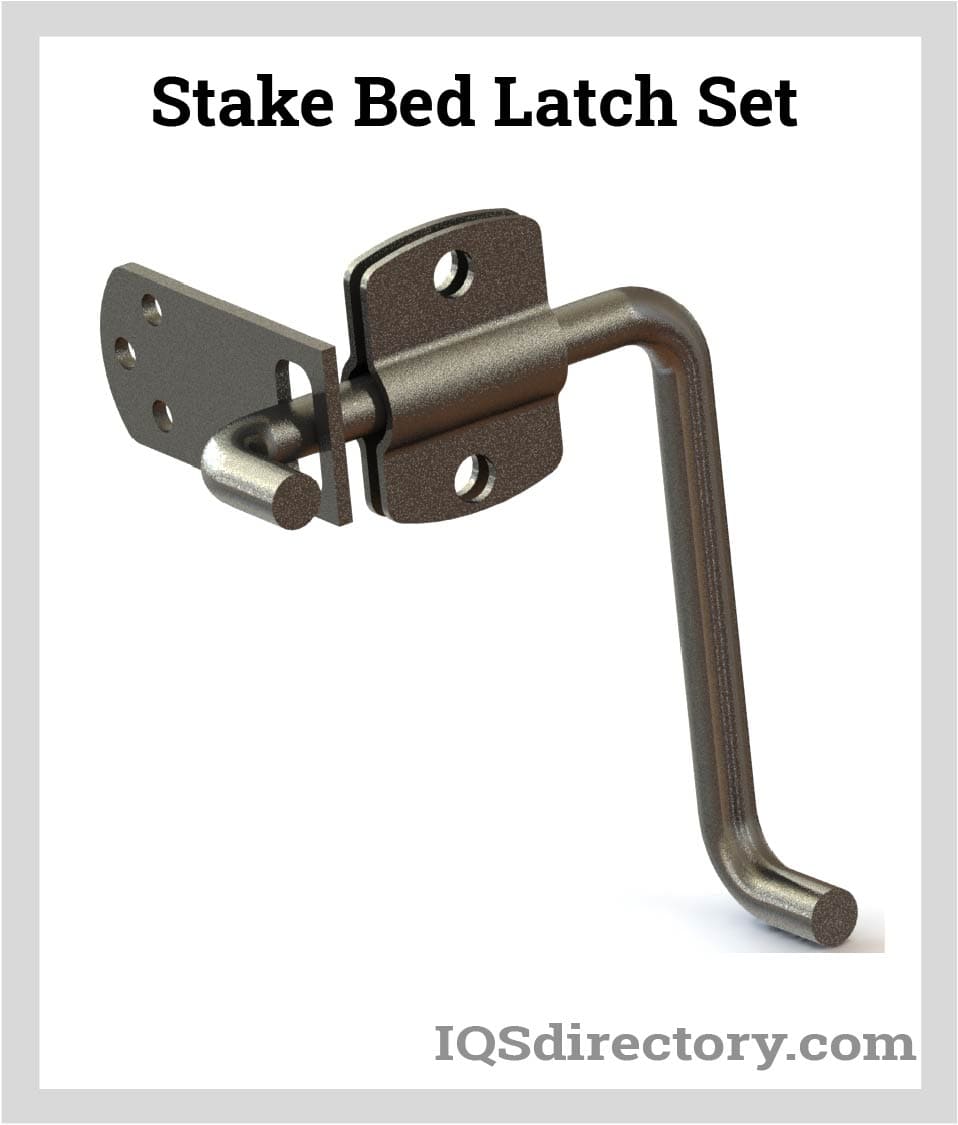
Typically, slam latches made for industrial purposes are formed from high-strength metals, such as stainless steel, while smaller slam latches made for use on private property or commercial gates are usually made from other metals, rubber, or plastics. Next, spring latches are likewise popular for application in agricultural and industrial settings. They are of particular usefulness there, where their spring mechanism makes sure that the gate is both easily released and securely fastened. Spring latches are opened and closed without any trouble. Simple to work but very effective in holding a gate closed securely, bolt latches are an incredibly common example of gate latches. They consist of a sliding pin or bolt and two plates with cleats that are connected to the bolt. In general, bolts are incredibly common components of latches.
Design of Gate Latches
Speaking of the components of latches, gate latches tend to be rather varied in their construction. However, all gate latches consist of components made through forging, stamping, or die casting that allows for the regular mechanical fastening and unfastening of two adjacent surfaces or objects.
Some of the common components of gate latches include parts such as:
- Bolts
- Pins
- Levers
- Backplates
- Hook
Depending on their intended application, gate latches may be made from a great variety of materials. For heavier duty and more industrial applications, materials like stainless steel, brass, and aluminum alloy are appropriate. Stainless steel in particular is so frequently used in the construction of gate latches because it is corrosion-resistant, strong, and durable. In addition, it can be coated with paints and other finishes to suit those who wish to change its physical appearance or imbue it with magnified physical qualities, such as strength, corrosion resistance, or weather resistance.