
- 5 leading manufacturers
- 29 additional suppliers
- 18 states and provinces
- 29 related categories
- 9 guide sections
Hinge Manufacturers and Suppliers

IQS Directory provides a comprehensive list of hinge manufacturers and suppliers. Use our website to review and source top hinge manufacturers with roll over ads and detailed product descriptions. Find hinge companies that can design, engineer, and manufacture hinges to your companies specifications. Then contact the hinge companies through our quick and easy request for quote form. Website links, company profile, locations, phone, product videos and product information is provided for each company. Whether you are looking for manufacturers of specialty hinges, barrel hinges, hinges and handles, or customized hinges of every type, this is the resource for you.
Suppliers located in CT, IL, CA +15 more states
Contents (6 sections)
Leading Hinge Manufacturers
Showing all 5
| Placement No. | Manufacturer | Location | Contact | Actions | |
|---|---|---|---|---|---|
| 1 | Marlboro Manufacturing, Inc.We take our customer evaluations as our only measure of success. If our customers are not happy, we are not happy! We will work with you until we find the right hinges solution for you. We work hard to foster innovation in everything we do. If there is a better way to do something, we will find it! Discover what we can do for you by contacting us today! | Alliance, OH | |||
| 2 | S & D Products, Inc.We are here to provide you with any hinge you could ever possibly need! We are the hinge specialists committed to bringing you a level of customer service that is unmatched by the competition. Our team of professionals is committed to upholding the principles on which we were founded including honor and integrity. We strongly believe that our business hinges on your business and we couldn’t have made it to the top without you! Call or email us today to find out more! | Bartlett, IL | |||
| 3 | Kiesler Machine Inc.At Kiesler Machine Inc., we specialize in the design and manufacture of high-quality hinges that meet the demanding requirements of various industries. Our team is dedicated to producing durable, precision-engineered hinges that are used in a wide range of applications, including medical, industrial, and commercial sectors. We offer both standard and custom hinge solutions, ensuring that each product we create delivers superior functionality and reliability. | Palmyra, IN | |||
| 4 | Brookfield IndustriesBrookfield Industries is a manufacturer of high-capacity door hinges and pivots. We also manufacture special application door operators with a full-line of detention grade and industrial stainless steel hinges with capacities ranging from 300 lbs to 50 tons. We offer seven categories of hinges, and within those categories we offer several subcategories – we can meet your company’s hinge needs. | Thomaston, CT | |||
| 5 | Larsen & Shaw LimitedWe’ve been manufacturing custom hinges in various metals and finishes since 1919, and are known by our customers as “The Hinge People®.” Larsen and Shaw offers custom hinges, enclosure hinges, heavy equipment hinges, light duty hinges, architectural hinges, industrial hinges, stop hinges, furniture hinges, and the new revolutionary R2 Hinge and PermAlign hinge. With manufacturing facilities in both the United States and Canada and our in-house design team, we are your one-stop-shop for all of your quality hinge needs. | Walkerton, ON |
Claim your Page One Spot
Leading hinge manufacturers are listed first on this page, each with a website preview and a Request a Quote button on its row.
Additional Hinge Companies
The category’s other hinge companies are listed on their own page, with location, phone and website where each supplier provides them.
View 29 Additional Hinge CompaniesDo not see your company listed in Hinges?
Engineers and buyers use this page to find hinge suppliers. Add your company to the Hinges listings so they can find you too.
List Your Company- Listed in the Hinges directory
- A profile page for your company
- Buyers contact you directly
Hinge Industrial Manufacturing Guides
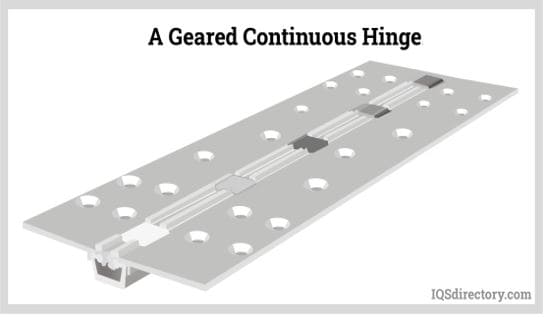
Continuous Hinges: Types & Uses
This article takes an in depth look at continuous hinges. You will learn more about topics such as: What is a Continuous Hinge Uses for Continuous Hinges Types…
7 chapters, the longest in this category
More Guides
- Butt Hinges: Types, Uses, Features and Benefits4 chapters
- Concealed Hinge: Types, Parts and Requirements5 chapters
- Friction Hinge: Types, Operations and Features4 chapters
- Hinges: Types, Uses, Components and Considerations6 chapters
- Spring Hinges: Types, Uses, Components and Considerations6 chapters
- Stainless Steel Hinges: Types, Uses and Benefits4 chapters
Quick Answers
- How many hinge manufacturers are listed on IQS Directory?
- 5 leading manufacturers and 29 additional suppliers.
- Where are hinge manufacturers located?
- The listed suppliers are in 18 states and provinces: Connecticut (5), Illinois (4), California (3), Florida (3), Minnesota (3), Indiana (2), New York (2), Ohio (2), and 10 more.
- How do I get quotes from hinge suppliers?
- Select suppliers in the table and choose Request Quotes. IQS reviews your request and forwards it to every supplier you select.
Hinges
A hinge is a mechanical bearing designed to connect two objects while enabling controlled rotational movement between them. In both industrial engineering and everyday applications, hinges provide a dependable pivot point that allows components to open, close, or reposition while remaining securely attached. This combination of strength, stability, and motion control makes hinges a foundational element in mechanical design, product manufacturing, and architectural systems.
Hinges are used across a wide range of industries including construction, aerospace, automotive manufacturing, furniture production, electronics, and heavy equipment. From standard residential doors and cabinets to industrial enclosures, gates, access panels, and precision instruments, hinges support countless applications where controlled movement is required. Whether you are evaluating hinge types for load-bearing capacity, corrosion resistance, or smooth operation, understanding hinge functionality helps guide better purchasing and design decisions.
Common use cases include doors, cabinetry, storage units, machinery panels, safety gates, toolboxes, laptops, appliances, and custom enclosures. Hinges are also widely used in specialty applications such as medical equipment, marine systems, and aerospace assemblies where performance, durability, and reliability are key decision factors.
The History of Hinges
Hinges date back thousands of years, with early designs appearing in the Bronze Age. Archaeological findings show hinges used in ancient structures, including temples and fortified buildings, where durability and controlled movement were necessary. Over time, as metalworking techniques improved, hinges became more accessible and transitioned into everyday use across homes, tools, and transportation systems.
The Industrial Revolution accelerated hinge manufacturing, introducing standardized production, improved materials, and advanced designs. Innovations such as ball-bearing hinges improved performance in high-traffic applications, while modern engineering has expanded hinge capabilities into aerospace systems, robotics, and precision equipment. Today, hinges are engineered for specific performance requirements including load capacity, environmental resistance, and cycle life.
Hinge Design
Hinge manufacturing involves processes such as casting, forming, machining, and assembly. The chosen method depends on production volume, material type, and design complexity. Precision manufacturing ensures consistent performance, especially in applications requiring tight tolerances or high durability.
Material selection plays a significant role in hinge performance. Stainless steel hinges are commonly used in corrosive environments, while brass and bronze offer aesthetic appeal and resistance to wear. Surface treatments such as plating, coating, and polishing further enhance durability, especially in outdoor or industrial environments.
Each hinge consists of core components including leaves, a pin, and a knuckle. These elements work together to create a pivoting mechanism capable of supporting loads while maintaining smooth motion. Custom hinges can be designed with specialized features such as concealed mounting, self-closing mechanisms, or multi-axis movement depending on the application.
Hinge Types
There are many hinge types designed for specific applications, including butt hinges, continuous hinges, friction hinges, heavy-duty hinges, and concealed hinges. Selecting the right hinge type depends on factors such as weight load, frequency of use, environmental conditions, and required motion control.
For example, ball bearing hinges are ideal for high-cycle doors, while continuous hinges provide uniform support along the entire length of a panel. Friction hinges allow controlled positioning without additional support, and stainless steel hinges are commonly used in marine or chemical environments due to their corrosion resistance.
Features of Hinges
Hinges are designed to provide smooth motion, load support, and long-term reliability. Key performance factors include load capacity, wear resistance, corrosion protection, and alignment precision. Understanding hinge dimensions such as leaf width, pin diameter, and knuckle spacing helps ensure proper fit and functionality.
Compared to alternative mechanisms, hinges offer greater stability and controlled motion, making them suitable for both simple and complex applications. Their ability to maintain connection while allowing movement makes them widely used across industries.
Hinge Standards and Specifications
Hinges are manufactured according to industry standards such as ANSI and BHMA to ensure quality, durability, and safety. These standards define performance requirements including load testing, cycle testing, and material specifications. Compliance helps ensure compatibility and reliability across different applications.
Things to Consider When Purchasing a Hinge
When selecting a hinge, consider application requirements such as load weight, usage frequency, environmental exposure, and installation method. Choosing the right material, finish, and hinge type ensures long-term performance and reduces maintenance requirements.
Working with a qualified manufacturer allows for customized solutions tailored to specific applications. Whether you need standard hinges or specialized designs, selecting the right supplier ensures quality, consistency, and performance.
Installation of a Hinge
Proper installation ensures optimal hinge performance. Align hinge leaves correctly, secure mounting points, and ensure proper pin placement. For complex installations, following manufacturer guidelines helps prevent misalignment and premature wear.
Proper Care for Hinges
Regular maintenance helps extend hinge lifespan. Lubrication reduces friction and wear, while cleaning prevents buildup that can affect performance. Selecting corrosion-resistant materials also helps maintain long-term durability.
Hinge Accessories
Accessories such as door stops, dampers, and mounting hardware enhance hinge functionality. Selecting the right accessories improves usability, safety, and overall system performance.
Common Questions
3 questions
What Is the Basic Function of a Hinge?
A hinge connects two objects while allowing controlled angular movement, making it ideal for doors, cabinets, and mechanical systems.
What Materials Are Commonly Used to Make Hinges?
Hinges are typically made from stainless steel, brass, bronze, and other metals selected for durability, corrosion resistance, and load capacity.
Which Types of Hinges Are Used for Heavy-Duty Applications?
Heavy-duty hinges and ball bearing hinges are commonly used in industrial doors, gates, and high-cycle environments due to their strength and smooth performance.