
- 3 leading manufacturers
- 61 additional suppliers
- 23 states and provinces
- 12 related categories
- 4 guide sections
Food Grade Lubricant Manufacturers and Suppliers
IQS Directory implements a thorough list of food grade lubricant manufacturers and suppliers. Utilize our listing to examine and sort top food grade lubricant manufacturers with previews of ads and detailed descriptions of each product. Any food grade lubricant company can design, engineer, and manufacture food grade lubricants to meet your companies specific qualifications. An easy connection to reach food grade lubricant companies through our fast request for quote form is provided on our website. The company information includes website links, company profile, locations, phone, product videos and product information. This source is right for you whether it's for a manufacturer of food lubricants, clarion food grade, or oil food grade lubricants.
Suppliers located in IL, OH, CA +20 more states
Contents (4 sections)
Leading Food Grade Lubricant Manufacturers
Showing all 3
| Placement No. | Manufacturer | Location | Contact | Actions | |
|---|---|---|---|---|---|
| 1 | Clearco ProductsAt Clearco Products, we specialize in providing high-quality lubricants and specialty silicone-based products designed to meet the needs of various industrial applications. Our company offers lubrication solutions that help reduce friction, minimize wear, and support efficient equipment operation. | Willow Grove, PA | |||
| 2 | Fluoramics Inc.At Fluoramics Inc., we specialize in developing and manufacturing high-performance lubricants designed to reduce friction, minimize wear, and improve the efficiency of mechanical equipment. Our company provides innovative lubrication solutions for industrial, automotive, commercial, and specialized applications. | Winona, MN | |||
| 3 | B'laster CorporationAt B'laster Corporation, we provide high-performance lubricants and maintenance products designed to help protect equipment, reduce friction, loosen stubborn components, and keep mechanical systems operating reliably. Our company develops lubricant solutions for automotive, industrial, commercial, and general maintenance applications. | Valley View, OH |
Claim your Page One Spot
Leading food grade lubricant manufacturers are listed first on this page, each with a website preview and a Request a Quote button on its row.
Additional Food Grade Lubricant Companies
The category’s other food grade lubricant companies are listed on their own page, with location, phone and website where each supplier provides them.
View 61 Additional Food Grade Lubricant CompaniesDo not see your company listed in Food Grade Lubricants?
Engineers and buyers use this page to find food grade lubricant suppliers. Add your company to the Food Grade Lubricants listings so they can find you too.
List Your Company- Listed in the Food Grade Lubricants directory
- A profile page for your company
- Buyers contact you directly
Quick Answers
- How many food grade lubricant manufacturers are listed on IQS Directory?
- 3 leading manufacturers and 61 additional suppliers.
- Where are food grade lubricant manufacturers located?
- The listed suppliers are in 23 states: Illinois (9), Ohio (8), California (5), New Jersey (5), Georgia (4), Michigan (4), Texas (4), Wisconsin (4), and 15 more.
- How do I get quotes from food grade lubricant suppliers?
- Select suppliers in the table and choose Request Quotes. IQS reviews your request and forwards it to every supplier you select.
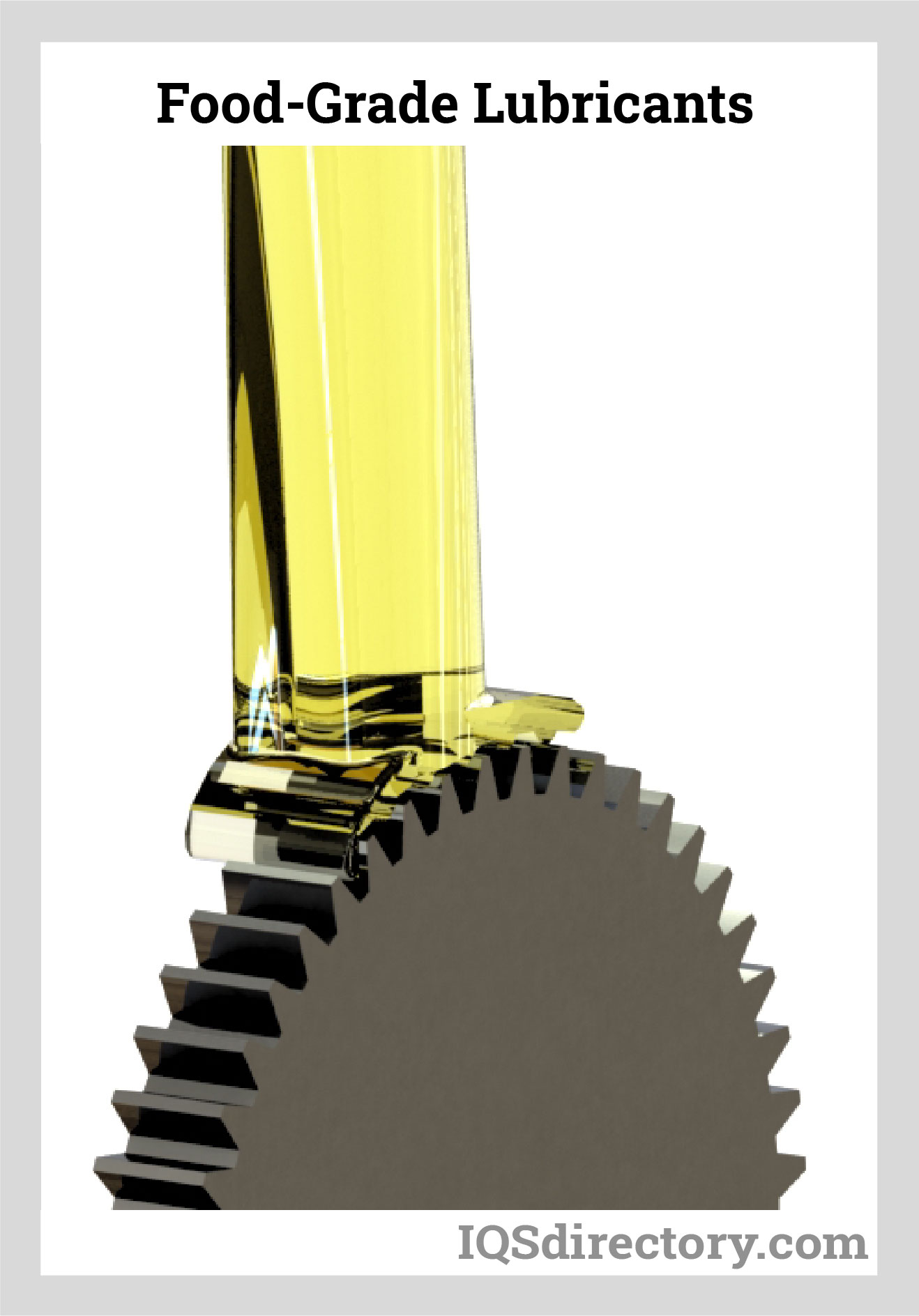
Food-Grade Lubricants
A food-grade lubricant is an industrial lubricant deemed suitable for incidental contact with products consumed by humans or animals, as long as it does not exceed a specific concentration. Lubricants must be able to dissolve sugars and demonstrate neutral behavior toward polymers and elastomers for a variety of applications in the food and pharmaceutical industries. They must also resist deterioration from chemicals, water, steam, and food items. Additionally, these oils must be internationally accepted, physiologically inert, tasteless, odorless, and comply with all applicable food, health, and safety requirements.
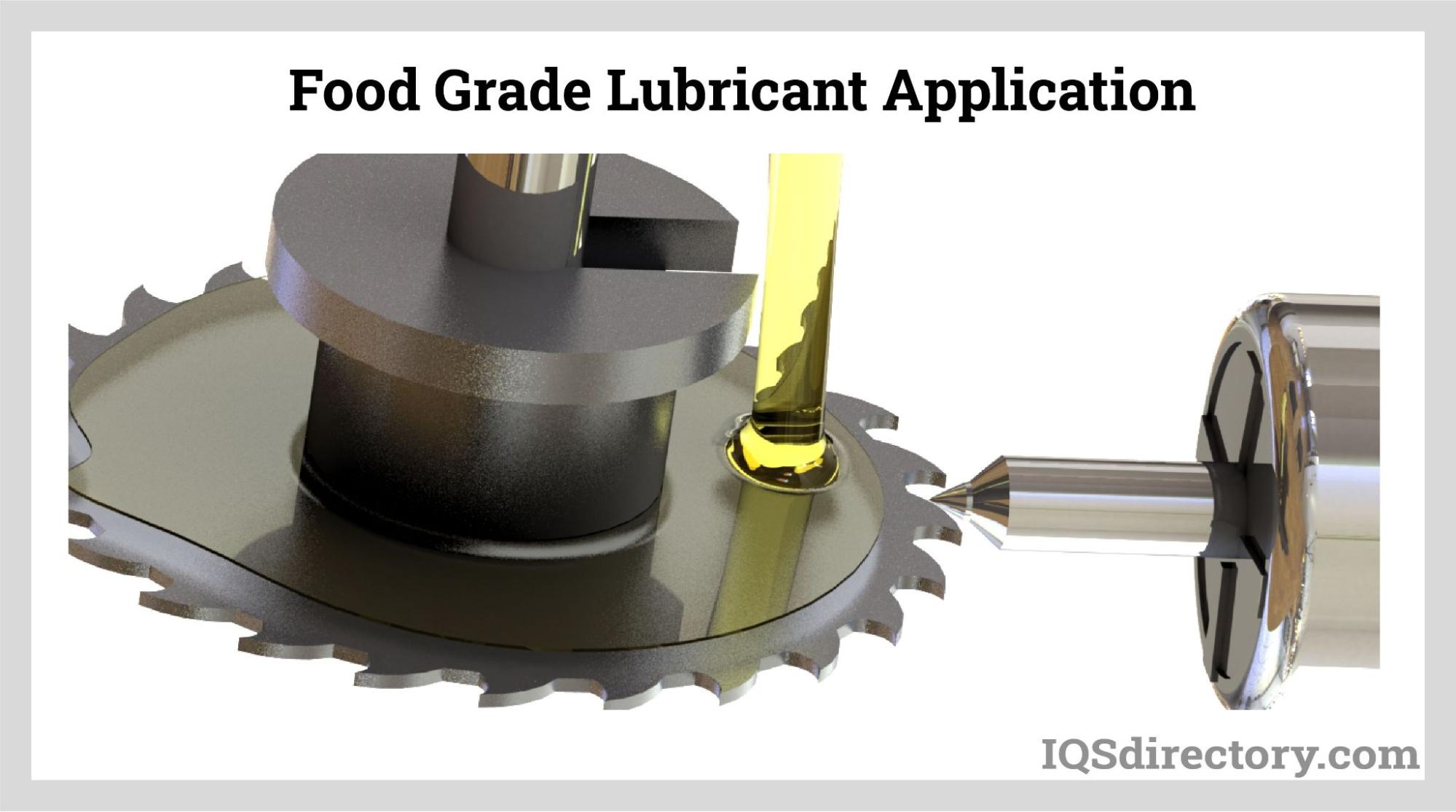
Food-Grade Lubricants Application
Food, beverages, medications and dietary supplements, cosmetics, animal feed, and pet food are among the products that need to be produced with food-grade lubricants. These products are produced with food-grade lubricant. Only incidental consumption is thought to be safe. Incidental contact can happen by dripping, touch, or spillage and is often unintentional. Lubricants shall not exceed ten parts per million after contact to be considered incidental. Like other lubricants, food-grade lubricants must protect against wear, friction, corrosion, and oxidation, disperse heat, transfer power, be compatible with rubber and other sealing materials, and in some situations, produce a sealing effect.
Biodegradable Lubricant Creation
Chemical substances known as synthetic lubricants often have a foundation of silicone, ester, glycol, and fluorinated lubricants. Depending on the application's needs, other substances are combined with them. Given the proximity of consumables to lubricated machinery in the food service sector, biodegradable lubricants are preferable. Normally, vegetable oil serves as the foundation for these lubricants, but recently, genetically modified soybeans have taken over because of their improved oxidative and viscosity stability. The main distinction between grease lubes and oil lubes is their viscosity levels. When a substance has low viscosity, it is fluid, like oil, and when it has a high viscosity, it is thicker and travels slowly or not at all, like grease. Equipment in the food business is protected with specialized polymer greases. The majority of food-grade lubricants lack both color and smell. As a result, petroleum jelly is a lubricant frequently used to lubricate the machinery used to create and prepare meals.
Three Levels of Classifications for Food-Grade Lubricants:
The initial food-grade designations, H1, H2, and H3, were created by the United States Department of Agriculture (USDA). The ingredients list determines whether a new lubricant is approved and registered under one of these headings.
H1
Food-grade lubricants known as H1 are utilized in food processing settings where there is a chance of unintentional food contact. Only one or more of the authorized base stocks, additives, and thickeners (if grease) listed in 21 CFR 178.3750 may be used in lubricant compositions.
Typically, when someone refers to "food-grade lubricants," they mean something like this. Amounts in food must not be more than ten ppm (0.001%). Only the base stocks, additives, and thickeners listed in the FDA regulations found in 21 CFR 178.3750 may be used in H1 lubricant compositions. The additives must meet the NSF additive (HX-1) standards in H1. Additionally, they must be colorless, odorless, and tasteless.
H2
H2 lubricants are used on machinery and machine parts in places where there is no chance of contact. They are food-grade lubricants.
H2 lubricants are used on machinery and equipment parts where there is no chance that the lubricant or lubricated surface will come into contact with food. H2 lubricants do not have a set list of approved components because there is no interaction risk with food. However, they cannot purposefully contain heavy elements like antimony, arsenic, cadmium, lead, mercury, or selenium. Additionally, the contents must not contain any teratogens, mutagens, carcinogens, or mineral acids.
H3
H3 lubricants, usually edible oils, are food-grade lubricants used to stop rust on hooks, trolleys, and other similar equipment. Hooks, trolleys, and other similar equipment are cleaned and protected from rust using H3 lubricants, commonly known as soluble or edible oil.
These substances can be used on food processing equipment as a releasing agent for gaskets or seals on tank closures, as a protective anti-rust layer, and as a lubricant for machine parts and equipment in places with a risk of the lubricated portion coming into contact with food. The quantity used must be the minimum necessary to provide the equipment with the desired technical result. For example, if used as an anti-rust film, the compound must be removed from the surface of the equipment by washing or wiping, as necessary, to effectively rid the surface of any substance that could be transferred to food being processed.
Choosing the Proper Food Grade Lubricant Supplier
To make sure you have the most positive outcome when purchasing food-grade lubricants from a food grade lubricant supplier, it is important to compare at least four suppliers using our food grade lubricant directory. Each food grade lubricant supplier has a business profile page that highlights their areas of experience and capabilities and a contact form to directly communicate with the supplier for more information or request a quote. Review each food grade lubricant business website using our proprietary website previewer to get an idea of what each company specializes in, and then use our simple RFQ form to contact multiple food-grade lubricant companies with the same quote.