
- 7 leading manufacturers
- 29 additional suppliers
- 20 states and provinces
- 19 related categories
- 5 guide sections
Curing Ovens Manufacturers and Companies

IQS Directory is a top industrial directory listing of leading industrial curing oven manufacturers and suppliers. Access our comprehensive index to review and source curing oven manufacturers with preview ads and detailed product descriptions. These curing oven companies can design, engineer and manufacture curing ovens to your specifications and application need. A quick and easy to use request for quote form is provided for you to contact these curing oven manufacturers and suppliers. Each company has detailed profile information, locations, phone number, website links, product videos and product information defined. We are the right resource for your information requirement whether its for a manufacturer of epoxy curing oven, tunneling curing oven, large curing oven.
Suppliers located in MI, OH, IN +17 more states
Contents (5 sections)
Leading Curing Ovens Manufacturers
Showing all 7
| Placement No. | Manufacturer | Location | Contact | Actions | |
|---|---|---|---|---|---|
| 1 | Weiss TechnikWeiss Envirotronics is a worldwide leader in the design, manufacturer and service of environmental test chambers. A complete line of standard and custom chambers, from bench top models to full walk-in and drive-in solutions to meet any testing requirement. Not sure what you need? Let one of our applications engineers help. Weiss Envirotronics, Inc is ISO 9001 registered and A2LA accredited. | Grand Rapids, MI | |||
| 2 | Quality Finishing SystemsComplete finishing systems are designed around your specific process needs and are optimized to fit within your space requirements. We specialize in producing paint systems for wet and powder coatings, while also providing comprehensive design, fabrication, installation, start-up, and training services. Our complete finishing systems consist of an overhead conveyor, pretreatment washer, dry-off oven, paint/powder booths, cure oven, and controls. | Grant, MI | |||
| 3 | Belco Industries, Inc.At Belco Industries, we specialize in the design and manufacture of high-performance industrial ovens engineered to meet the rigorous demands of modern production environments. Our company focuses on delivering reliable thermal processing solutions that support consistent product quality, operational efficiency, and long-term durability. | Belding, MI | |||
| 4 | Surface Combustion, Inc.Surface Combustion offers a diverse product offering for batch, continuous furnace designs for atmosphere, non-atmosphere, or vacuum processing of ferrous and/or nonferrous components/materials. The convection design is optimal for temperatures between 350°F – 1400°F and are engineered to perform and built to last. | Maumee, OH | |||
| 5 | Therma-Tron-X, Inc.At Therma-Tron-X Inc., we specialize in designing and manufacturing high-performance industrial ovens that deliver precision, consistency, and efficiency across a wide range of heat-processing applications. Our ovens are engineered to meet the demanding requirements of industries such as automotive, aerospace, agriculture, and general manufacturing, where thermal processing is critical to product integrity and performance. | Sturgeon Bay, WI | |||
| 6 | L & L Special Furnace Company, Inc.L & L Special Furnace is a manufacturer of industrial heat treating batch ovens for tempering, stress relieving, aluminum solution treating, aluminum aging, metal additive manufacturing annealing, and other heat treating processes. We provide quality engineering and workmanship with excellent service. Let us be your source for batch ovens. | Aston, PA | |||
| 7 | Platinum Finishing SystemsAt Platinum Finishing Systems, we provide industrial ovens designed to support reliable heating, curing, drying, baking, and finishing processes. Our company works with manufacturers that require controlled thermal processing for coatings, paints, powders, adhesives, composites, and other production materials. | Santa Rosa, CA |
Claim your Page One Spot
Leading curing ovens manufacturers are listed first on this page, each with a website preview and a Request a Quote button on its row.
Additional Curing Ovens Companies
The category’s other curing ovens companies are listed on their own page, with location, phone and website where each supplier provides them.
View 29 Additional Curing Ovens CompaniesDo not see your company listed in Curing Ovens?
Engineers and buyers use this page to find curing ovens suppliers. Add your company to the Curing Ovens listings so they can find you too.
List Your Company- Listed in the Curing Ovens directory
- A profile page for your company
- Buyers contact you directly
Curing Ovens Industrial Manufacturing Guides
Curing Ovens: Types, Applications & Creation
This article takes an in-depth look at curing ovens and their uses. You will learn more about topics such as: Curing Ovens and How They Work How Curing Ovens…
6 chapters
Quick Answers
- How many curing ovens manufacturers are listed on IQS Directory?
- 7 leading manufacturers and 29 additional suppliers.
- Where are curing ovens manufacturers located?
- The listed suppliers are in 20 states and provinces: Michigan (5), Ohio (5), Indiana (3), Wisconsin (3), Massachusetts (2), Ontario (2), Pennsylvania (2), Washington (2), and 12 more.
- How do I get quotes from curing ovens suppliers?
- Select suppliers in the table and choose Request Quotes. IQS reviews your request and forwards it to every supplier you select.
Curing Ovens
A curing oven is defined as a thermal processing piece of equipment that causes a chemical reaction in a product with the use of heat. Curing ovens are utilized to harden products made from rubber, plastics, and various types of metals, and are almost exclusively used in the manufacturing industry. However, curing ovens come in many varieties, and there are numerous applications within the realm of manufacturing that require their use.
Advantages to Curing Ovens
UV curing has quite a few advantages. UV-curable inks, adhesives, and coatings serve as a beneficial alternative to materials that are solvent-based. As opposed to solvent evaporation, which creates environmental pollutants and can reduce the thickness of the coating by up to 50 percent, UV curing involves no solvents, and thus no loss of volume or thickness in the coating. In turn, UV curing grants higher productivity, reduced turnaround time, less waste, less consumption of energy, and less emission of pollutants.
Other benefits of UV curing include improvement in the physical properties of adhesives, coatings, and inks, reduced work-in-process, drastically reduced setup and cleanup labor, and less necessary floor space.
Design of Curing Ovens
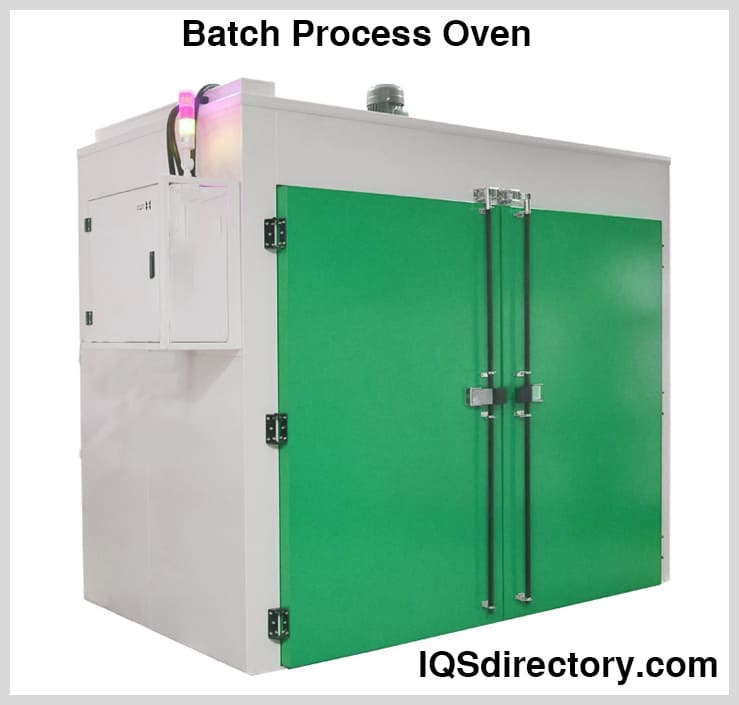
Curing ovens are usually built with steel insulated panels, steel frames, and include a heating element. Curing ovens can be powered by either electricity or by natural gas, and can often be custom-designed to meet the requirements of a specific application. In addition to customization, there are specialized curing methods that fortify certain materials, such as carbon fiber material and paint.
Materials Used for Curing Ovens
Powder coating is one example of the many types of processes carried out by a curing oven. The process of powder coating involves using static electricity to apply a powdered thermoplastic resin to a surface. The powdered resin gels and forms a protective layer around the surface of a product upon exposure to the curing oven’s heat. Numerous industries use this method of curing in order to enhance the appearance of their products, such as aerospace, marine, automotive, and furniture.
Aesthetic purposes aside, various industries also utilize curing ovens to dry, preheat, and cure specific parts and components of a product. Curing ovens are used for the curing of rubber, also known as vulcanization, which involves strengthening rubber products using chemicals and heat. Other processes which can be carried out by curing ovens include temperature testing, baking, sintering, and metal finishing.
Curing ovens deal with a wide variety of materials. Although the properties of these materials vary, they all react nearly the exact same way to the curing process. For example, resin materials, with the help of added heat and sometimes chemical additives, are strengthened during curing due to the process catalyzing the cross-linking of the resin’s polymer chains. Metal materials are prone to oxidation, or the degradation of surfaces due to prolonged exposure to oxygen. Heat curing the metal can not only help prevent oxidation, but also improve the metal’s durability and strength. If manufacturers need to cure metal in environments where oxidation must be avoided, there are specially designed vacuum ovens available that will enable manufacturers to cure metal under a strictly controlled atmospheric and chemical environment.
Methods Used for the Curing Oven
A curative method that has been recently discovered and is becoming more widely utilized is curing by way of exposure to ultraviolet radiation. UV curing was originally introduced in the 1960’s, and became quickly adopted by a multitude of industries such as metal, glass, and plastic decorating, converting, electronics, telecommunications, automotive, and graphic arts.
Over the next 50 years, UV curing has grown into a multi-billion dollar worldwide industry. The UV curing process uses a photochemical reaction. In other words, UV curing uses light instead of heat. The desired material is mixed with a small percentage of photo-initiators before being exposed to ultraviolet light. The material—whether it is an adhesive, a coating, or an ink—hardens within a matter of seconds.
Applications for Curing Ovens
Today, UV curing technology has evolved to the point where manufacturers are now able to apply it to three-dimensional components. Examples include:
- Fiberglass Composite Parts
- Electric Motor Housings
- Golf Balls
- Contoured Wood Products
- Automotive Lighting Assemblies
- Plastic Molded Parts Such as Mobile Phone Cases
UV curing of 3-D parts is not without its challenges, however. UV curing is a “line of sight” process, meaning that every part of a given surface must be exposed to the UV radiation in order for the curing to be successful. “Shadow” areas, or any part of the object’s surface which is hidden, will not be cured. Fortunately, hybrid thermal and UV coatings are being developed that will assist manufacturers in achieving a thorough cure.