
- 7 leading manufacturers
- 30 additional suppliers
- 20 states and provinces
- 19 related categories
- 5 guide sections
Conveyor Ovens Manufacturers and Companies

IQS Directory provides a comprehensive list of conveyor oven manufacturers and suppliers. Use our website to review and source top conveyor oven manufacturers with roll over ads and detailed product descriptions. Find conveyor oven companies that can design, engineer, and manufacture conveyor ovens to your companies specifications. Then contact the conveyor oven companies through our quick and easy request for quote form. Website links, company profile, locations, phone, product videos and product information is provided for each company. Whether you are looking for manufacturers of conveyor drying oven, commercial conveyor ovens, lab slide conveyor ovens or customized conveyor ovens of every type, this is the resource for you.
Suppliers located in MI, OH, IN +17 more states
Contents (5 sections)
Leading Conveyor Ovens Manufacturers
Showing all 7
| Placement No. | Manufacturer | Location | Contact | Actions | |
|---|---|---|---|---|---|
| 1 | Weiss TechnikWeiss Envirotronics is a worldwide leader in the design, manufacturer and service of environmental test chambers. A complete line of standard and custom chambers, from bench top models to full walk-in and drive-in solutions to meet any testing requirement. Not sure what you need? Let one of our applications engineers help. Weiss Envirotronics, Inc is ISO 9001 registered and A2LA accredited. | Grand Rapids, MI | |||
| 2 | Quality Finishing SystemsComplete finishing systems are designed around your specific process needs and are optimized to fit within your space requirements. We specialize in producing paint systems for wet and powder coatings, while also providing comprehensive design, fabrication, installation, start-up, and training services. Our complete finishing systems consist of an overhead conveyor, pretreatment washer, dry-off oven, paint/powder booths, cure oven, and controls. | Grant, MI | |||
| 3 | Belco Industries, Inc.At Belco Industries, we specialize in the design and manufacture of high-performance industrial ovens engineered to meet the rigorous demands of modern production environments. Our company focuses on delivering reliable thermal processing solutions that support consistent product quality, operational efficiency, and long-term durability. | Belding, MI | |||
| 4 | Surface Combustion, Inc.Surface Combustion offers a diverse product offering for batch, continuous furnace designs for atmosphere, non-atmosphere, or vacuum processing of ferrous and/or nonferrous components/materials. The convection design is optimal for temperatures between 350°F – 1400°F and are engineered to perform and built to last. | Maumee, OH | |||
| 5 | Therma-Tron-X, Inc.At Therma-Tron-X Inc., we specialize in designing and manufacturing high-performance industrial ovens that deliver precision, consistency, and efficiency across a wide range of heat-processing applications. Our ovens are engineered to meet the demanding requirements of industries such as automotive, aerospace, agriculture, and general manufacturing, where thermal processing is critical to product integrity and performance. | Sturgeon Bay, WI | |||
| 6 | L & L Special Furnace Company, Inc.L & L Special Furnace is a manufacturer of industrial heat treating batch ovens for tempering, stress relieving, aluminum solution treating, aluminum aging, metal additive manufacturing annealing, and other heat treating processes. We provide quality engineering and workmanship with excellent service. Let us be your source for batch ovens. | Aston, PA | |||
| 7 | Platinum Finishing SystemsAt Platinum Finishing Systems, we provide industrial ovens designed to support reliable heating, curing, drying, baking, and finishing processes. Our company works with manufacturers that require controlled thermal processing for coatings, paints, powders, adhesives, composites, and other production materials. | Santa Rosa, CA |
Claim your Page One Spot
Leading conveyor ovens manufacturers are listed first on this page, each with a website preview and a Request a Quote button on its row.
Additional Conveyor Ovens Companies
The category’s other conveyor ovens companies are listed on their own page, with location, phone and website where each supplier provides them.
View 30 Additional Conveyor Ovens CompaniesDo not see your company listed in Conveyor Ovens?
Engineers and buyers use this page to find conveyor ovens suppliers. Add your company to the Conveyor Ovens listings so they can find you too.
List Your Company- Listed in the Conveyor Ovens directory
- A profile page for your company
- Buyers contact you directly
Conveyor Ovens Industrial Manufacturing Guides
Conveyor Ovens: Everything You Need to Know about Belts & Uses
This article takes an in depth look at conveyor ovens. You will learn more about topics such as: What is a conveyor oven? Types of conveyor ovens Types of…
7 chapters
Quick Answers
- How many conveyor ovens manufacturers are listed on IQS Directory?
- 7 leading manufacturers and 30 additional suppliers.
- Where are conveyor ovens manufacturers located?
- The listed suppliers are in 20 states and provinces: Michigan (5), Ohio (5), Indiana (3), Wisconsin (3), Massachusetts (2), Ontario (2), Oregon (2), Pennsylvania (2), and 12 more.
- How do I get quotes from conveyor ovens suppliers?
- Select suppliers in the table and choose Request Quotes. IQS reviews your request and forwards it to every supplier you select.
Conveyor Ovens
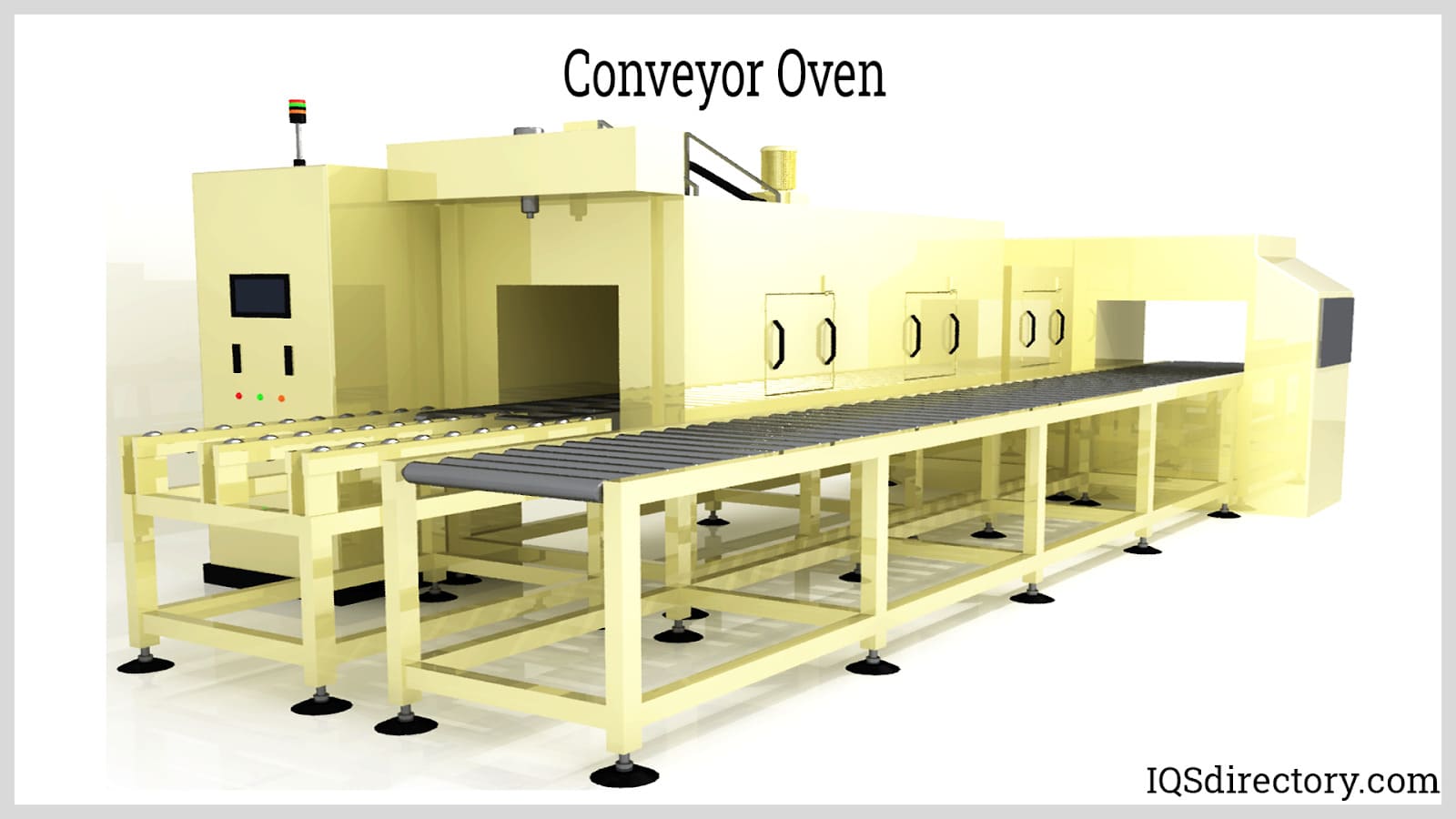
Continuous ovens are widely used in mass production of durable and consumer products around the world. Production lines for mass products must run without any form of interruptions, which is why this type of ovens is the most preferred. A conveyor belt makes it possible for the oven to produce a stream of items. The oven guarantees a streamlined heat treatment process in food service and production industries. Products that require heating along a conveyor belt are normally heated by an industrial oven. Conveyor belts are moved through an open oven when the machine is under operation.
Oven Design
Customization of ovens is very important because each customer has unique needs. The ovens are available in different sizes depending on the production needs of a particular customer. The oven’s maximum temperature is stabilized by a set of insulated steel walls which can be seen on some conveyor belts. A conveyor or continuous oven is a type of an industrial oven that has quite a number of important features but the most important ones include a cooling zone, multiple heat zones, and exhaust hood.
Ovens are of great use in industries because they minimize labor intensity that is normally associated with most productions. In addition, the ovens facilitate the automation of most production processes. Minimum technical supervision is required when ovens are in use, and this is made possible when processes that come before heat treatment are efficient. This type of oven is largely used as a drying oven in most production processes.
Continuous ovens are widely applied in the food service industry because it requires a lot of heat. It is possible to use the ovens when baking various food items such as sandwiches and pizza. The food that is being produced maintains its flavor and taste because of the oven’s moisture retention capabilities. Specific applications and uses of continuous ovens are defined by the characteristics of each type of oven.
Types of Conveyor Ovens
Continuous Oven Drawbacks
There are many contexts in which continuous ovens can be advantageous to users. However, it is important to point out that the machines have their own share of drawbacks just like any other types of machines. To begin with, continuous ovens are not enclosed and not suitable for processes that require a vacuum. Secondly, industries that are involved in small-scale operations cannot use continuous ovens.
In order to maintain their efficiency, the machines require continuous input during production. A batch oven costs less compared to continuous ovens, and that is why the ovens cannot be used by certain industries. Therefore, the intended industrial application of the oven should be a major determining factor when deciding whether to use it or not.
Things to Consider When Purchasing a Conveyor Oven
It is advisable to first consider the desired application and the practical use of a particular oven before you can select a particular application. First consider the length of the heated tunnel by assessing the dwell time of the desired component, production rate, and dimensions. The production rate and the density of the load are normally used to determine the speed of the belt. Secondly; one has to decide the loading pattern of their oven by determining the width needed. The three major loading patterns include four abreast, side by side, and single file line.
You can multiply the belt speed by the product dwell time to determine the length of the heat zone. In order to select the most suitable oven that can meet your unique production needs, it is advisable to work closely with the manufacturers. It is crucial to consider other features such as control style, dual belts, and belt width.
Continuous ovens are available in different measurements when it comes to cook chamber length and belt width. Most continuous ovens have a chamber length of between 20 inches and 28 inches. The most common measurements for the belt width of continuous ovens range between 9 inches and 26 inches.
Conveyor Belt Materials and Applications
There are multiple factors that are normally put into consideration by an oven manufacturer when it comes to designing continuous ovens. It is important to select the best belt material in order to come up with the most appropriate oven for the specified application. It is advisable to look beyond belt type and oven configuration when designing an oven. An oven’s purpose is to determine the material for manufacturing belts for continuous ovens. The following are some of the notable materials that normally used to belts for continuous ovens including their specific applications.
High Carbon Steel Most ovens have belts made from carbon steel because of its flatness, belt straightness, precision tracking, and durability. In addition, carbon steel belts have abrasion-resistant surfaces and are also easy-to-clean making them very hygienic. Most continuous ovens that are normally used in product transportation, drying, cooling, heating, food processing and baking have belts made from high carbon steel. The only disadvantage associated with high carbon steel belts is that it tends to discolor and rust easily as compared to stainless steel belts. Stainless Steel & Stainless Alloys Belts made from stainless steel or stainless alloys do not require regular cleaning like other metals because they do not corrode and rust. The fact that the material is resistant to corrosion and durable makes oven belts made from this material to be suitable for a wide range of applications and industries. Some of the most notable applications for stainless steel belts include food, chemical, rubber, wood, lamination, and plastic production. Rubber in Belts This may appear as an unusual choice when it comes to material for making belts for continuous ovens. The fact that rubber can melt easily makes the material unsuitable for application in industries. However, it is important to point out that the rubber can withstand high temperatures when it is treated properly. Food production is the most notable application for an oven belt made from rubber. Plastic Material The plastic material works well for low-heat applications such as cooling chambers despite the fact that it may appear to be a surprise selection. Plastic requires less maintenance and is also considered to be a cost-effective material. Belts that are made from plastic are normally divided into separate sections that are later linked together. Further cost reduction is made possible by the fact that damaged modules can be replaced easily. Polypropylene Material This material has a wide range of applications because it is a special type of thermoplastic polymer. The material is suitable for belts in continuous ovens because it has additional benefits. Apart from being flexible, sturdy, and lightweight, the material is also resistant to corrosion, chemicals, abrasion, mold, and water. Continuous oven belts made from polypropylene are known to be very versatile as a result of these many positive properties. Teflon-Coated Fabric Fabric that is coated with Teflon can be used to create belts for ovens. The Teflon makes it become heat-resistant and non-stick. The belts are widely applied in drying and baking applications as a way of complying with the FDA rules. Woven PVC Woven PVC material can also be used to make solid conveyor oven belts. In order to make the belts fire-resistant, the belts are normally treated with chemicals. The PVC oven belts are suitable when it comes to processes such as baking and drying. It is important to point out that each material that is used in making belts for continuous ovens has its own advantages and disadvantages that must be put into consideration. Custom building is a very important concept that should always be considered when it comes to the design and manufacture of conveyor belts in order to avoid the risk of having to replace the oven after a very short period of time. It is, therefore, important to let an oven manufacturer know your intended applications and production specifications.