
- 4 leading manufacturers
- 27 additional suppliers
- 18 states and provinces
- 18 related categories
- 5 guide sections
Clean Room Equipment Manufacturers and Suppliers
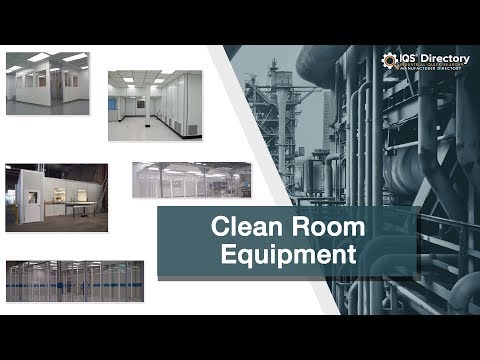
IQS Directory implements a thorough list of clean room equipment manufacturers and suppliers. Utilize our listing to examine and sort top clean room equipment manufacturers with previews of ads and detailed descriptions of each product. Any clean room equipment company can design, engineer, and manufacture clean room equipment to meet your companies specific qualifications. An easy connection to reach clean room equipment companies through our fast request for quote form is provided on our website. The company information includes website links, company profile, locations, phone, product videos and product information. This source is right for you whether it's for a manufacturer of clean room ceilings, clean room air showers, and pass-thrus.
Suppliers located in CA, MI, MN +15 more states
Contents (4 sections)
Leading Clean Room Equipment Manufacturers
Showing all 4
| Placement No. | Manufacturer | Location | Contact | Actions | |
|---|---|---|---|---|---|
| 1 | Abtech, Inc.As a manufacturer of clean rooms, including inplant modular offices, exterior steel buildings, guard buildings, fork liftable and crane liftable buildings, multi-level buildings and mezzanines, Abtech offers turnkey installations or packages for install by end user. Our modular structures are constructed of steel, are free-standing & manufactured under strict quality control methods. | Santa Ana, CA | |||
| 2 | Clean Rooms International, Inc.For the very best of clean rooms, look no further than Clean Rooms International! We can provide the ultimate in quality, customer service, durability, and unique designs just for you! Our customers are important to us, which is why we always strive to exceed your expectations and desires. We work hard to provide you with durable products for less. Contact us today for more info! | Grand Rapids, MI | |||
| 3 | Atmos-Tech IndustriesWe offer a full spectrum of clean room equipment that adheres to all qualifications. Atmos-Tech Industries provides you with engineering expertise, innovative mounting tracks, and the best vinyl you can find. We manufacture mounting systems, sealed corners, entryway, RF-welded seams, and more. Our mission is to provide you with cleaner inner zones and will exceed your expectations. These units offer reliability that cannot be found with any other product. Please visit our website to learn more! | Ocean, NJ | |||
| 4 | Modular Cleanrooms, Inc.Our complete line of clean rooms will meet your needs. We are the experts of the clean room industry and our engineers can work with you to determine which clean room models work best for your business. We offer a variety of softwall, bio-clean, hardwall, and micro-clean options, all of which are manufactured with the highest standards. You will not be upset with our products. Contact us for more information! | Denver, CO |
Claim your Page One Spot
Leading clean room equipment manufacturers are listed first on this page, each with a website preview and a Request a Quote button on its row.
Additional Clean Room Equipment Companies
The category’s other clean room equipment companies are listed on their own page, with location, phone and website where each supplier provides them.
View 27 Additional Clean Room Equipment CompaniesDo not see your company listed in Clean Room Equipment?
Engineers and buyers use this page to find clean room equipment suppliers. Add your company to the Clean Room Equipment listings so they can find you too.
List Your Company- Listed in the Clean Room Equipment directory
- A profile page for your company
- Buyers contact you directly
Quick Answers
- How many clean room equipment manufacturers are listed on IQS Directory?
- 4 leading manufacturers and 27 additional suppliers.
- Where are clean room equipment manufacturers located?
- The listed suppliers are in 18 states and provinces: California (3), Michigan (3), Minnesota (3), Texas (3), Colorado (2), Massachusetts (2), New Jersey (2), North Carolina (2), and 10 more.
- How do I get quotes from clean room equipment suppliers?
- Select suppliers in the table and choose Request Quotes. IQS reviews your request and forwards it to every supplier you select.
Cleanroom Equipment
Cleanroom equipment includes all movable items that are not part of the walls or panels, though most parts of modular and portable cleanrooms can be considered cleanroom equipment. As a result of the broad description, cleanroom equipment can encompass a wide range of parts and products. Since keeping a sterile and sanitary environment is essential to many cleanroom applications, cleanroom equipment must be manufactured from easy-to-clean materials, such as stainless steel, polycarbonate, or plastic laminates.
Applications of Cleanroom Equipment
Cleanroom equipment manufacturers serve a broad spectrum of industries, the most common of which includes the pharmaceutical, biotech, medical device, microelectric, and nanotechnology industries as well as many hospitals and research laboratories.
Cleanroom Equipment Design and Customization
Cleanrooms often incorporate parts and components such as storage cabinets, ergonomic work stations, carts, ducting, benches and shelving, and trolleys, which are all considered cleanroom equipment. Isolation systems and industry or application-specific machines and equipment also fall under this category, as well as many other items such as cleanroom gloves, fume hoods, garment cabinets, and garbing stations. In addition to the previously mentioned equipment, every cleanroom has hand-held or built-in sensors that monitor the room's particle density, making sure it is at the appropriate level.
The class of cleanroom that it is will determine what the appropriate level or particle density will be; these classes range from Class 100 to Class 10000 and even higher. Some examples of cleanroom equipment are air shower systems, which are located at the entrance and remove particles and dirt as people enter or move around the cleanroom, and sticky mats, which use adhesive film to clean shoes before they enter. Additionally, individuals working in cleanrooms also have special outfits called bunny suits, shoes, and mouth coverings that are worn in the rooms at all times.
Factors to Consider When Using Cleanroom Equipment
Many factors are taken into account in the design of a cleanroom, such as maintenance, limited space, strict cleanliness guidelines, safety, reliability, and temperature and humidity control bands; these factors make it challenging. However, to simplify the process there are various design approaches, which helps to design a facility that meets all the requirements.
In ideal cleanrooms, there are many kinds of cleanroom equipment, including:
- Demand Controlled Filtration
- Dual Temperature Chilled Water Loops
- Fan-Filter Units (FFUs)
- Low Pressure Drop Air Systems
- Mini-Environments
- HVAC Air Systems
- Vacuum Pump Optimization
- Water-Side Free Cooling
All these systems are necessary to achieve and comply with ISO cleanroom standards.
Fan-Filter Unit Design and Function
Air quality plays an important role in the cleanliness of cleanrooms. As such, we will explain the function and design approach of fan-filter units (FFUs) here. A FFU commonly has a controller, a HEPA, or ULPA filter set in a box, and a small fan. FFUs fit into ceiling grids, usually in two-by-two or four-by-four configuration.
In FFUs, for air re-circulation, small fans push air through various air filters. In the process, they consume a significant amount of energy. Under some conditions, certain types of the FFUs might not perform efficiently; therefore, it is important to select a functional unit based on the designing conditions. The concern to design approach is minimum efficiency criteria. The criteria must be the benchmark that should be followed during the construction. Another concern is energy performance data. The data used should be based on testing methods developed by concerned authorities, such as the Lawrence Berkeley National Laboratory.
These two considerations help in the selection of FFUs that will perform efficiently:
Modern Alternatives
Newer FFUs come with Electronically Commutated (EC) motors—a brushless direct current motor but use AC power as input. They are proving to be significantly more efficient than AC induction motors. EC motors can be as efficient as 80%, almost double than those of AC motors. Application of these motors can cut operational cost and endow longer service life, and easy controllability.
New Codes Involving Energy Efficiency
Cleanroom equipment includes any tools, furniture, storage systems, and work surfaces specifically manufactured for use in cleanrooms. A cleanroom is an area in which the air is filtered in order to minimize the introduction, generation, and the retention of airborne particles inside the room. As a result, cleanrooms are incredibly clean environments.
New Standards for Cleanrooms
The cleanroom industry is constantly receiving new innovations to improve and perfect the cleanliness levels within a cleanroom. In March of 2013 there was a new publication regarding British standards for cleanrooms. This code titled BS 8568:2013 was released by the British Standards Institution. The purpose of this new 36 page code is to boost energy efficiency by optimizing energy consumption. One component is to improve the specifications for sheet metal ductwork regarding low, medium, and high pressure air systems. This code also raises the standard in which the operators of a cleanroom are trained. The higher level of training is meant to hopefully generate less contaminants simply because the users are more knowledgeable and efficient.
Although BS 8568:2013 is a British standard it still works in support of ISO 14001:2004. The new code is beneficial because it can save users in operation costs due to energy efficient applications. Also, these procedures aim to improve sustainability conservation measures by reducing negative environmental issues. The code also invokes more automatic features, such as an energy control system that will adjust the amount of air flow based on the operation of the cleanroom. If the cleanroom is not in use, then the HVAC units will run at a decreased rate. The new ductwork requirements save significant amounts of energy by utilizing a pre-filter on the FFUs, which will help eliminate possible blockages of the high efficiency particular air filters. It seems that the more filters the better because the incoming air is one of the main factors that can lead to unwanted particle levels.