
- 6 leading manufacturers
- 27 additional suppliers
- 15 states and provinces
- 24 related categories
- 4 guide sections
Wire Handle Manufacturers and Companies

IQS Directory provides an extensive list of wire handle manufacturers and suppliers. Utilize our website to review and source wire handle manufacturers with our easy-to-use features which allow you to locate wire handle companies that will design, engineer, and manufacture wire handles for your exact specifications. Our request for quote forms make it easy to connect with leading wire handle manufacturers. View company profiles, website links, locations, phone number, product videos, product specific news articles and other production information. We are a leading manufacturer directory who will connect you with the right manufacturers whether you are looking for wire racks, wire guards, or wire hooks.
Suppliers located in IL, OH, MI +12 more states
Contents (5 sections)
Leading Wire Handle Manufacturers
Showing all 6
| Placement No. | Manufacturer | Location | Contact | Actions | |
|---|---|---|---|---|---|
| 1 | Acme Wire Products Company, IncorporatedAcme Wire Products provides close tolerance wire fabrications using steel and stainless steel. Customized applications include a wide range of wire forms for many different applications. Acme works with wire from .050 to .500 diameter. Whether your application is simple or sophisticated, the team at Acme Wire Products can provide you with a part that meets your needs. Contact them today! | Mystic, CT | |||
| 2 | Stalder Spring WorksAt Stalder Spring Works, we specialize in the design and production of precision wire forms built to meet the performance requirements of customers across a wide range of industries and applications. We manufacture custom wire components that support functional, structural, and mechanical needs while maintaining close attention to consistency, dimensional accuracy, and repeatable quality. | Springfield, OH | |||
| 3 | Elyria Spring & Specialty, LLCAt Elyria Spring & Specialty, LLC, we are proud to offer a wide array of high-quality wire forms and comprehensive solutions tailored to meet the diverse needs of our valued customers. With a rich history of expertise and a steadfast commitment to excellence, we have established ourselves as a trusted leader in the wire forming industry. Our product portfolio encompasses a diverse range of wire forms, including custom-designed shapes, clips, hooks, and brackets, among others. | Elyria, OH | |||
| 4 | M.D. Hubbard Spring CompanyAt M.D. Hubbard Spring, we specialize in manufacturing precision wire forms and spring components designed to meet the diverse requirements of industrial applications. Our company produces custom wire forms in various shapes, sizes, and configurations to support mechanical assemblies, fastening systems, and specialized equipment. | Oxford, MI | |||
| 5 | Northwest Fourslide, Inc.At Northwest Fourslide, we specialize in manufacturing precision wire forms designed to meet the requirements of a wide range of industrial applications. Our company focuses on producing high-quality wire components that combine durability, accuracy, and consistent performance. We manufacture custom wire forms in various shapes, sizes, and configurations to accommodate specific customer needs. | Lewiston, ID | |||
| 6 | Sterling Spring LLCAt Sterling Spring LLC, we specialize in precision wire forming, delivering high-quality custom solutions tailored to meet the unique needs of our customers. With decades of experience, we leverage advanced manufacturing techniques and state-of-the-art equipment to produce complex wire forms with exceptional accuracy and consistency. | Chicago, IL |
Claim your Page One Spot
Leading wire handle manufacturers are listed first on this page, each with a website preview and a Request a Quote button on its row.
Additional Wire Handle Companies
The category’s other wire handle companies are listed on their own page, with location, phone and website where each supplier provides them.
View 27 Additional Wire Handle CompaniesDo not see your company listed in Wire Handles?
Engineers and buyers use this page to find wire handle suppliers. Add your company to the Wire Handles listings so they can find you too.
List Your Company- Listed in the Wire Handles directory
- A profile page for your company
- Buyers contact you directly
Wire Handle Industrial Manufacturing Guides
Wire Handles: Everything You Need to Know about Types & Uses
The content of this article contains everything you will need to know about wire handles and bucket handles. You will learn: What is a Wire Handled? How Wire…
5 chapters
Quick Answers
- How many wire handle manufacturers are listed on IQS Directory?
- 6 leading manufacturers and 27 additional suppliers.
- Where are wire handle manufacturers located?
- The listed suppliers are in 15 states and provinces: Illinois (7), Ohio (6), Michigan (5), California (2), Connecticut (2), Wisconsin (2), Georgia (1), Idaho (1), and 7 more.
- How do I get quotes from wire handle suppliers?
- Select suppliers in the table and choose Request Quotes. IQS reviews your request and forwards it to every supplier you select.
Wire Handles
Wire handles have become a staple of material handling due to their convenience, ability to handle heavy loads, and exceptional durability in the face of harsh conditions. The use of wire handles goes back thousands of years to wire type handles that were used to carry baskets, pots, tea kettles, and cooking tools.
In the modern era, wire handles have taken on an all-new use and image due to the materials that are available to produce them. Ancient wire handles were more substantial and made of bent metal rods that were attached to containers with mountings or ears. The use of metal rods at the time was necessary since the technology was not available to produce and shape wire.
How Wire Handles Are Made
The process for manufacturing wire handles begins with the manufacturing of the wire using one of the many wire-forming processes. To achieve the specifications for wires for wire handles, the wire has to be drawn, pulled, or pushed through a die with the required diameter. The force and pressure of the process changes the diameter or thickness of the wire.
The die with the appropriate dimensions is referred to as a draw plate that is tightly secured in order to withstand the force of the drawing process. In order for the wire to fit through the drawplate, the blunt end is tapered by hammering or milling. As the wire comes through the drawplate, it is captured onto a spool.
The manufacture of wire handles begins with placing the spool of wire next to the wire shaping machine. Although the wire has been pulled, drawn, and had its dimensions adjusted, it still can have kinks, bends, and imperfections that will make it difficult for the manufacturing process. To overcome any deformations, the wire is fed through a straightening machine that consists of rollers that apply pressure to the wire such that kinks and bends are removed.
From the straightening machine, the wire is fed to a high-pressure press, which cuts the wire to the exact length to form the wire handle. The press uses a die that has the shape of the ends of the wire handle and the shape of the handle. The number of passes of the press is dependent on the complexity of the wire handle with most handles having a simple curved shape with twisted or bent ends that are used to attach the wire handle to a container.
The shaping of wire handles happens rather rapidly with hundreds or thousands being completed in a short period of time. Some containers require the wire handles to include additional features. For example, some wire handles have a gripper placed at the top of the arc to make lifting the bucket more comfortable.
Once the wire has been shaped, pressed, and customized, the wire is dropped into a container, bin, or other form of collection unit, which will be used to move the wire to the location where it will be attached to a bucket, pot, or pail. Much like other aspects of the wire handle manufacturing process, how the wire is attached to a container can take several forms from being pressed into the side of a bucket to having a special mounting form, referred to as ears.
Types of Wire Handles
The numbers and types of wire handles is endless and includes a wide variety of configurations, types, and shapes with new and unique wire handle forms being developed for special and unique applications. The simple wire handle is one of those tools that is required to be strong, sturdy, and dependable. It is a tool that has become a major part of product transporting and convenience.
Bail Wire Handle
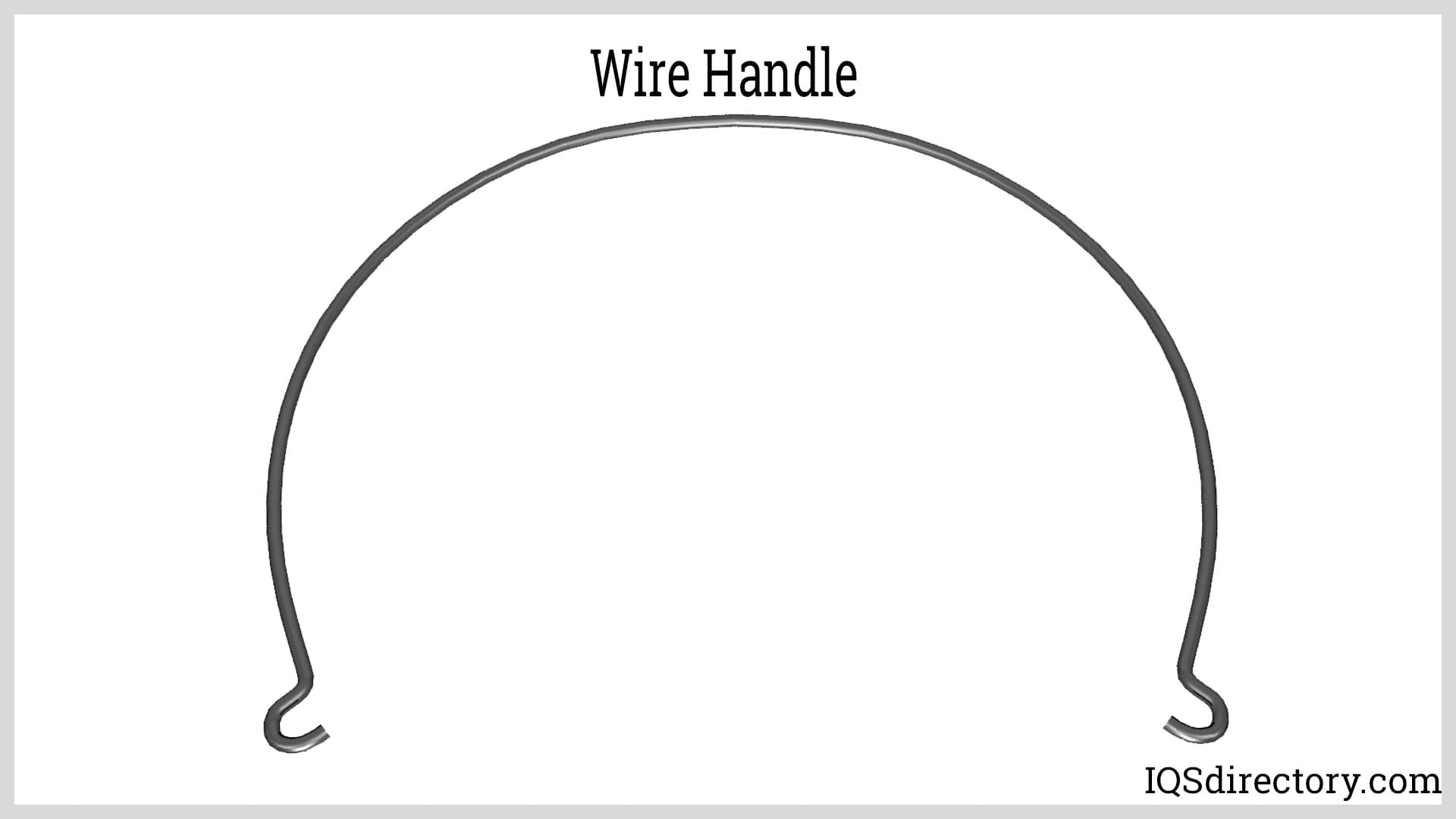
Bail wire handles are the oldest of the wire handles and have been used for centuries with cooking pots, bowls, and kettles. The original bail wire handles were used to suspend a pot over a fire and were made of metal rods that were bent and shaped to fit on a pot. The shape of modern bail wire handles is similar to the ancient variety but is made of light galvanized steel wire and is attached to buckets and pails using a bent loop.
Fixed Wire Handle
Fixed wire handles are placed in a fixed position and can be movable depending on the type of bucket to which they are attached. Fixed wire handles tend to be sturdier because of how they are used. Although they are attached using the traditional loop, they are also attached using screws or bolts, which make it possible to determine the movement of the handle.
Folding Wire Handles
Folding wire handles come in pairs and are commonly found at the supermarket attached to baskets to collect food purchases. The wire handles are spaced several inches apart and are attached using loops, which allow the two handles to fold down to the top of the basket. In most cases, folding wire handles have grippers for comfort and ease of handling.
Wire Loop Handles
Wire loop handles are smaller than the wire handles used for buckets and pails. They are made using a short strand of wire that can be from 6 to 15 inches depending on the tool to which they are attached. The use and type of tool determines the thickness of the wire with heavy brushes requiring heavier wire. Wire loop handles are permanently attached to tools using spot welding or a form of bracket that is squeezed around the wire.
The four wire handles described here are a sampling of the many wire handles that are available. Industrial wire loop handles that are used to move raw materials, tools, and pieces of machinery take several forms with their main characteristic being their strength. The use of wire handles covers the full spectrum of carrying methods with new wire handles being regularly developed.
Choosing the Right Wire Handle
As simplistic as wire handles may be, there are certain factors that manufacturers use to select the right wire handle for an application. While the type of material is an essential factor in choosing a wire handle, there are other aspects of wire handles that determine the best one for an application. The two factors that are most critical are load capacity and wire material.
The material for wire handles is generally some form of galvanized steel due to its ability to resist corrosion, low cost, and formability. Stainless steel may be used for some applications, especially ones that involve sanitary and hygienic environments. Copper and aluminum alloys are used for light loads or aesthetic purposes.
The load capacity for wire handles varies from a few pounds to a couple hundred pounds. Large loads are found in industrial applications and rigorous conditions. This aspect of the selection process influences the type of wire and its thickness. A primary concern with load capacity is safety since a wire handle breaking under a heavy load can be harmful and dangerous.
Conclusion
The simple wire handle that is used to lift a bucket of paint is more complicated and complex due to its use and importance. Manufacturers of buckets, pails, pots, and baskets carefully consider every aspect of a wire handle to ensure that the right one is used for their products. Although wire hands are not the most significant tool, their care and use is an essential part of product and material handling.