
- 5 leading manufacturers
- 19 additional suppliers
- 12 states and provinces
- 13 related categories
- 4 guide sections
Vacuum Conveyor Manufacturers and Suppliers

Suppliers located in MN, ON, OH +9 more states
Contents (5 sections)
Leading Vacuum Conveyor Manufacturers
Showing all 5
| Placement No. | Manufacturer | Location | Contact | Actions | |
|---|---|---|---|---|---|
| 1 | Dynamic Air Inc.Dynamic Air Inc. custom designs and manufactures a complete line of pneumatic conveying systems for dry bulk granular materials. Our products include dense phase and dilute phase pneumatic conveying systems, mixers, bulk bag unloaders, bin dischargers, feeders, vibratory equipment and more. Our state-of-the-art test facility is available to perform full pneumatic conveying testing. All dry material characteristics are analyzed to determining their exact handling and product performance values. | St. Paul, MN | |||
| 2 | Whirl-Air-Flow CorporationSince 1946, Whirl-Air-Flow has been a leader in design, fabrication and service. Our pneumatic conveyors transport powders and dry granulars to one or more destination points. Our products serve a range of industries and are able to move flowable material. We have our own testing facility and also we provide customers with field support and services. If you would like more information please give us a call today! | Princeton, MN | |||
| 3 | Akona Process SolutionsAt Akona Process Solutions, we take pride in designing and delivering pneumatic conveying systems that keep bulk material handling safe, efficient, and reliable. We have built our expertise around developing equipment that moves powders, granules, and other bulk solids with precision, minimizing downtime and maximizing productivity for our customers. | Monroe, NC | |||
| 4 | Air Dynamics Industrial Systems CorporationAt Air Dynamics Industrial Systems, we provide pneumatic conveying systems designed to move bulk materials efficiently, reliably, and safely through industrial processing environments. Our company supplies engineered conveying solutions for powders, granules, pellets, and other dry materials, supporting applications where controlled product transfer, cleanliness, and dependable operation are essential. | York, PA | |||
| 5 | Nilfisk Industrial VacuumsAt Nilfisk Industrial Vacuums, we deliver advanced cleaning and material handling solutions designed to meet the rigorous demands of modern industry. Our company engineers high-performance pneumatic conveyors that improve efficiency, protect workers, and maintain clean, controlled environments. | Brooklyn Park, MN |
Claim your Page One Spot
Leading vacuum conveyor manufacturers are listed first on this page, each with a website preview and a Request a Quote button on its row.
Additional Vacuum Conveyor Companies
The category’s other vacuum conveyor companies are listed on their own page, with location, phone and website where each supplier provides them.
View 19 Additional Vacuum Conveyor CompaniesDo not see your company listed in Vacuum Conveyors?
Engineers and buyers use this page to find vacuum conveyor suppliers. Add your company to the Vacuum Conveyors listings so they can find you too.
List Your Company- Listed in the Vacuum Conveyors directory
- A profile page for your company
- Buyers contact you directly
Vacuum Conveyor Industrial Manufacturing Guides
Vacuum Conveyors: Everything You Need to Know About
This article will take an in-depth look at vacuum conveyors. We will go into detail about: Functions of Vacuum Conveyors Types of Vacuum Conveyors Applications…
3 chapters
Quick Answers
- How many vacuum conveyor manufacturers are listed on IQS Directory?
- 5 leading manufacturers and 19 additional suppliers.
- Where are vacuum conveyor manufacturers located?
- The listed suppliers are in 12 states and provinces: Minnesota (4), Ontario (4), Ohio (3), Pennsylvania (3), Delaware (2), North Carolina (2), Illinois (1), Iowa (1), and 4 more.
- How do I get quotes from vacuum conveyor suppliers?
- Select suppliers in the table and choose Request Quotes. IQS reviews your request and forwards it to every supplier you select.
Vacuum Conveyors
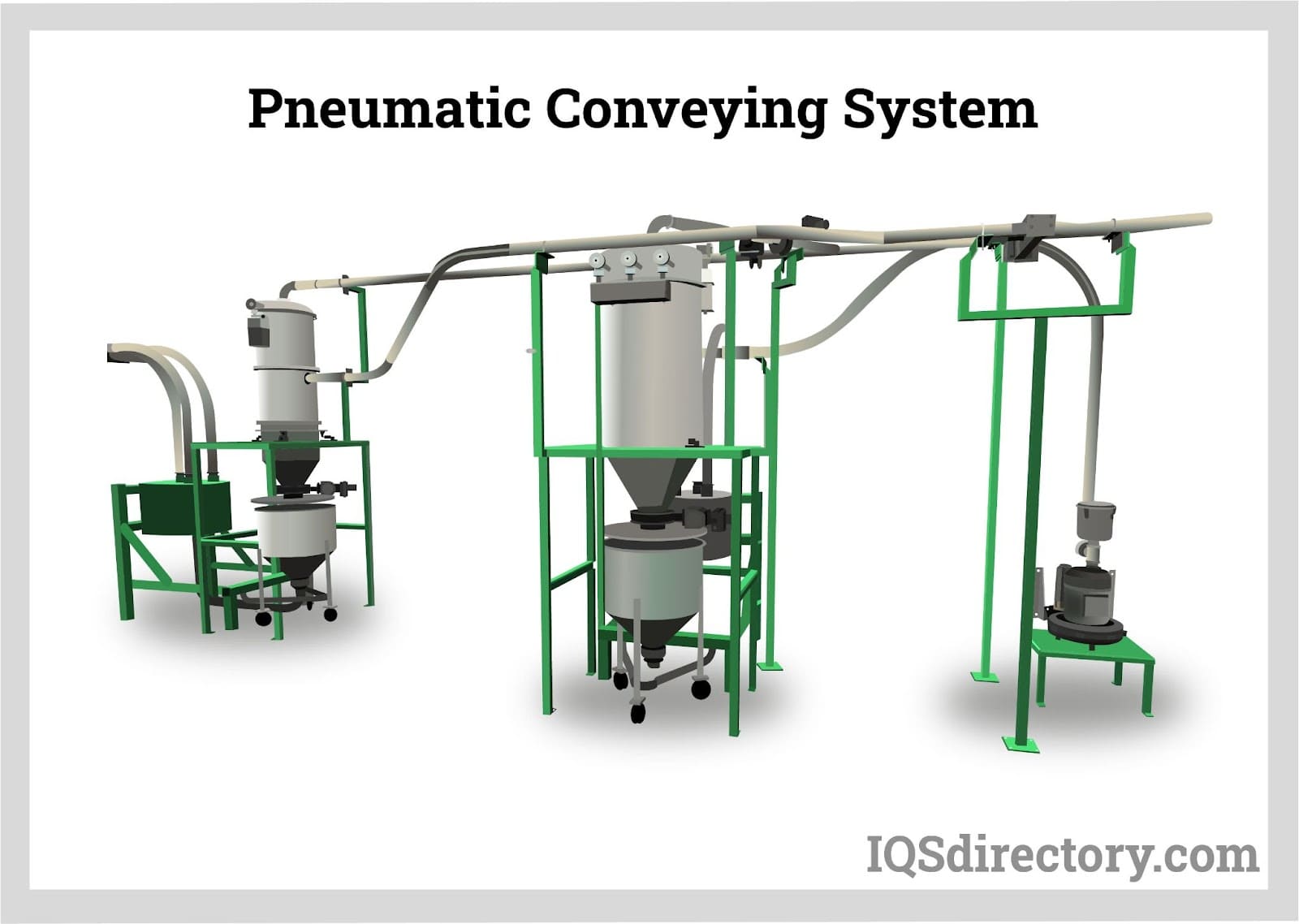
A vacuum conveyor is a type of pneumatic conveyor. Also known as air conveyors, pneumatic conveyors are highly beneficial to industries. One primary feature of a typical vacuum conveyor is a set of perforated belts. Air is drawn through the perforated areas, which assists in holding equipment in place during conveying. Perforated belts are an essential component, especially for processing items that are light in weight.
Industries Using Vacuum Conveyors
- Commericial
- Industrial
- Manufacturing
These industries frequently face the challenges of efficiently transporting items from one place to another in an efficient manner, especially when the products are in powder, pellet, or granule form. Vacuum conveyors can reduce this challenge as they can move materials across distances up to 330 feet and are ideal for transporting items from multiple sources to a single destination.
Powdered products must be efficiently transferred to the packaging systems from the production equipment from which they are made. Depending on the ultimate use of products, they may require being stored in certain types of containers, such as a bag or barrel. Therefore, the conveying system must be equipped to safely and efficiently dispense the material into the container. This step in the process must be carefully analyzed, for some types of material, such as several types of fertilizers, can pose a safety and environmental risk if not properly handled. Therefore, a pneumatic conveyor is one of the safest, most efficient, and most effective options available for handling potentially harmful products.
Features and Processes of Vacuum Conveyors
Vacuum conveyors feature an enclosed chamber to contain the materials and a vacuum mechanism that uses suction to move them along.
- The vacuum mechanism is located in a chamber that draws the material into the chamber where the materials are stored. A more specific example is a grain storage container, which can sometimes be equipped with a hose positioned with one end at the chamber’s highest point and the other at its lowest, where the receiver tank is located.
- The receiver tank features a valve at its bottom that maintains pressure while the vacuum is in use.
- The suction of the vacuum pump pulls the materials through the hose toward the entryway to the receiver tank, where they are ultimately contained.
- Once the chamber becomes full, the vacuum pump shuts down.
- The pressure valve opens, emptying the materials into the chamber.
No matter the conveyor system type, they all share a similar process.
Factors to Consider with Vacuum Conveyors
There are several factors that a business should take into consideration in deciding whether or not a vacuum conveyor is a necessary investment.
- The conveyor is required to traverse varying elevations. Components need to pass through areas of a workspace on multiple levels promptly. A workspace may be unused. Vacuum conveyors can not only efficiently transport items but help eliminate wasted space.
- Suppose the parts need to move upside down. Vacuum conveyors can generate enough pressure to move items along regardless of how the conveyor is oriented. Therefore, vacuum conveyors are ideal for applications where moving items upside down is inevitable.
- Suppose the parts need to be transported through a vacuum-sealed space. Sensitive environments such as clean rooms or factories that manufacture semiconductors cannot afford disruptions such as sparking, contamination, or mechanical interruptions. Vacuum conveyors can safely transport items while greatly minimizing these risks.
Types of Vacuum Conveyors
Dilute phase conveyors transport materials for longer distances at a higher velocity and are ideal for handling materials that tend not to compress or pack. They are typically handled by dilute phase vacuum conveyors, which include fibrous materials, wood shavings, and hazardous materials.
Dense phase vacuum conveyors are gentler. They transport materials for shorter distances and at a lower velocity. These conveyors are often utilized to handle materials that are abrasive or fragile.
No matter the type of structure, vacuum conveyors are highly beneficial across many industries because of their efficiency, flexibility, and versatility. However, before investing in a vacuum conveyor, it is highly recommended that you get in touch with a manufacturer to ensure that the features of the vacuum conveyor appropriately fulfill the requirements of your application.
More Vacuum Conveyor Information