
- 7 leading manufacturers
- 36 additional suppliers
- 15 states and provinces
- 15 related categories
- 11 guide sections
Titanium Companies and Suppliers

IQS Directory provides a comprehensive list of titanium manufacturers and suppliers. Use our website to review and source top titanium manufacturers with roll over ads and detailed product descriptions. Find titanium companies that can design, engineer, and manufacture titanium to your companies specifications. Then contact the titanium companies through our quick and easy request for quote form. Website links, company profile, locations, phone, product videos and product information is provided for each company. Whether you are looking for manufacturers of titanium cables, titanium ingots, titanium scrap metal, or customized titanium of every type, this is the resource for you.
Suppliers located in CA, IL, NY +12 more states
Contents (6 sections)
Leading Titanium Manufacturers
Showing all 7
| Placement No. | Manufacturer | Location | Contact | Actions | |
|---|---|---|---|---|---|
| 1 | All Titanium MetalsAll Titanium Metals is a leader in the titanium industry, embodying a commitment to excellence as your trusted titanium supplier. In our unwavering pursuit of providing top-notch commercially pure-grade titanium products, we take immense pride in our high quality products. | Temecula, CA | |||
| 2 | Liberty Specialty MetalsAt Liberty Specialty Metals, we are a metal distributor focused on providing high-quality titanium products for demanding industrial applications. Our company offers titanium in a variety of forms to support manufacturing, fabrication, and precision machining needs. From small prototype quantities to monthly programs we can help you whether you’re prototyping or mass producing. From Grade 2 to Grade 12, we can help with rod/bar, tube/pipe and plate/sheet. Customs shapes also available. | Livingston, NJ | |||
| 3 | Service Steel Aerospace Corp.Service Steel Aerospace (SSA) is one of the largest titanium distributors in the World. SSA stocks titanium rounds, plate, block, billet, and ingot for the Aerospace and Defense markets, as well as other critical industries. We rely on our vast inventory to offer quick deliveries. SSA places the highest value on quality and customer service. SSA also offers value added processing such as cut to size, heat treating, trepanning, water jet cutting, sonic inspection and mechanical testing. | Fife, WA | |||
| 4 | Cada Stainless & AlloysAt Cada Stainless & Alloys, we specialize in supplying high-performance titanium and specialty metal solutions for industries that demand exceptional strength, corrosion resistance, and long-term reliability. We work closely with customers who require titanium materials for challenging environments, including aerospace, chemical processing, marine, medical, and advanced industrial applications. | Chester, NY | |||
| 5 | Alcobra Metals, Inc.At Alcobra Metals, Inc., we provide titanium products for customers that need lightweight strength, corrosion resistance, and dependable material performance in demanding applications. Our company supports manufacturers, machine shops, fabricators, engineers, and industrial buyers that require titanium for aerospace, medical, marine, chemical processing, defense, motorsports, and specialty equipment. We focus on supplying material that helps customers build durable components while managing weight, wear, and environmental exposure. | Spokane, WA | |||
| 6 | Fort Wayne MetalsAt Fort Wayne Metals, we manufacture and supply titanium and stainless steel materials for customers who need precision, consistency, and dependable performance. Our company supports medical, industrial, and technical applications with metal products engineered for demanding environments. We focus on quality-driven production, responsive service, and close customer collaboration so every order reflects the exact standards, tolerances, and delivery expectations each project requires on schedule. | Fort Wayne, IN | |||
| 7 | Grandis TitaniumAt Grandis Titanium, we supply titanium products for customers who need a dependable source for strong, lightweight, corrosion-resistant materials. Our company works with manufacturers, fabricators, and industrial buyers seeking metal solutions that perform in demanding environments while supporting efficient production. We focus on responsive service, dependable supply, and practical support so our customers can source titanium with confidence for purchasing needs and specialized applications. | Rancho Santa Margarita, CA |
Claim your Page One Spot
Leading titanium manufacturers are listed first on this page, each with a website preview and a Request a Quote button on its row.
Additional Titanium Companies
The category’s other titanium companies are listed on their own page, with location, phone and website where each supplier provides them.
View 36 Additional Titanium CompaniesDo not see your company listed in Titanium?
Engineers and buyers use this page to find titanium suppliers. Add your company to the Titanium listings so they can find you too.
List Your Company- Listed in the Titanium directory
- A profile page for your company
- Buyers contact you directly
Titanium Industrial Manufacturing Guides
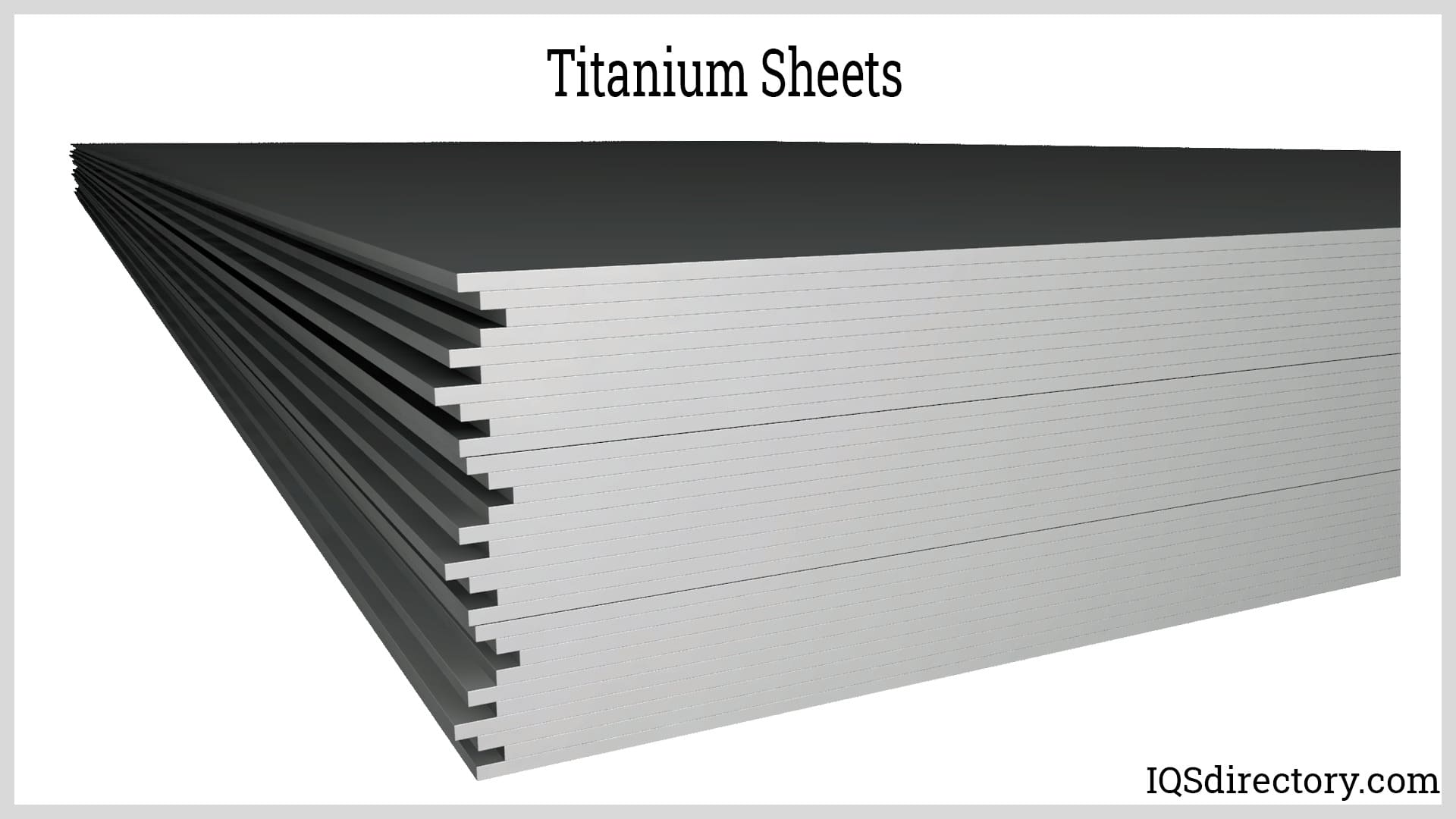
Titanium Metal: Properties and Uses
Information about titanium metals, grades, uses, and chemistry with a list of manufacturers. You will learn more about topics such as: What is titanium metal?…
9 chapters, the longest in this category
More Guides
Quick Answers
- How many titanium manufacturers are listed on IQS Directory?
- 7 leading manufacturers and 36 additional suppliers.
- Where are titanium manufacturers located?
- The listed suppliers are in 15 states: California (15), Illinois (4), New York (4), Florida (3), Ohio (3), Pennsylvania (3), New Jersey (2), Washington (2), and 7 more.
- How do I get quotes from titanium suppliers?
- Select suppliers in the table and choose Request Quotes. IQS reviews your request and forwards it to every supplier you select.
Titanium
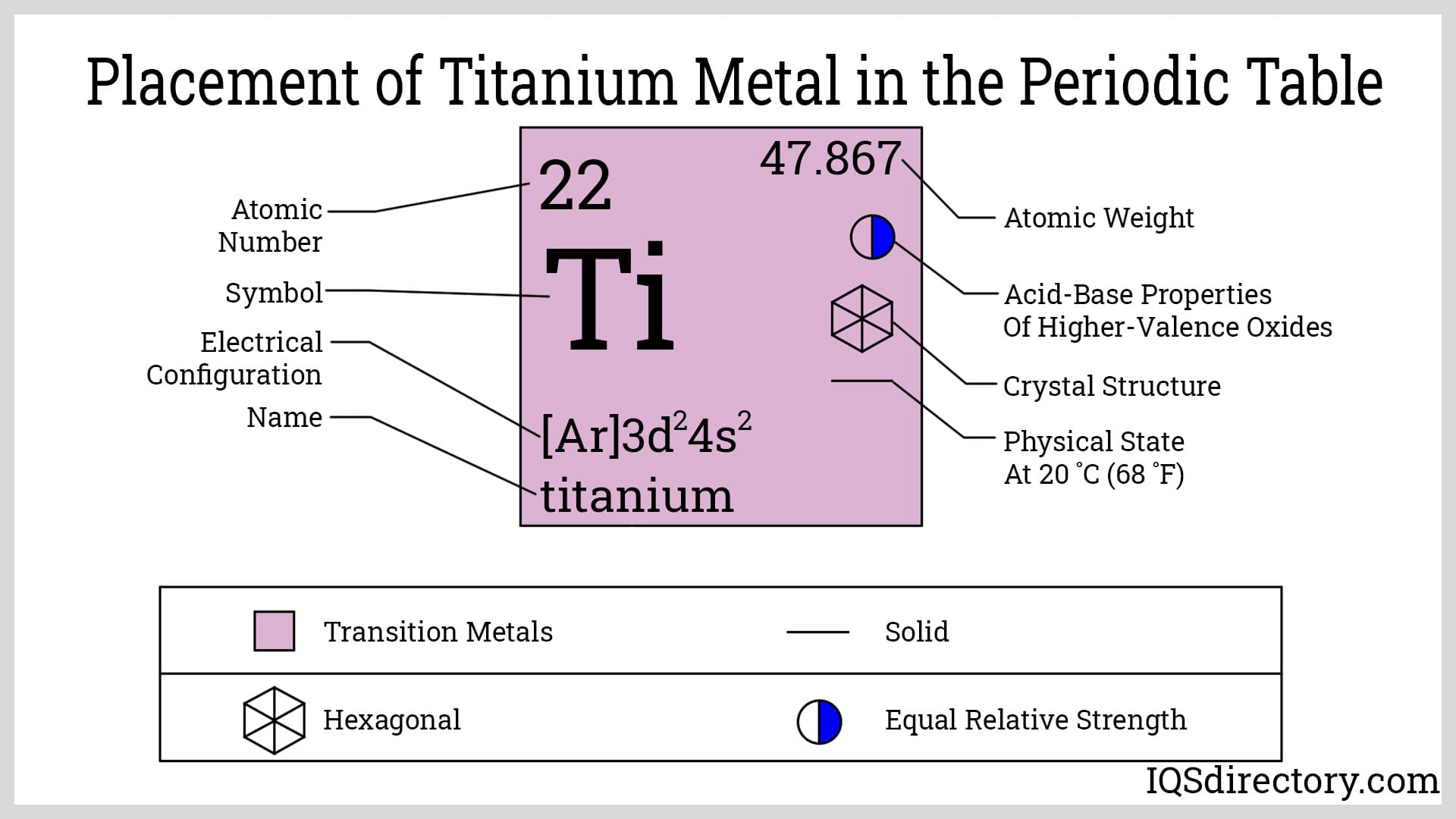
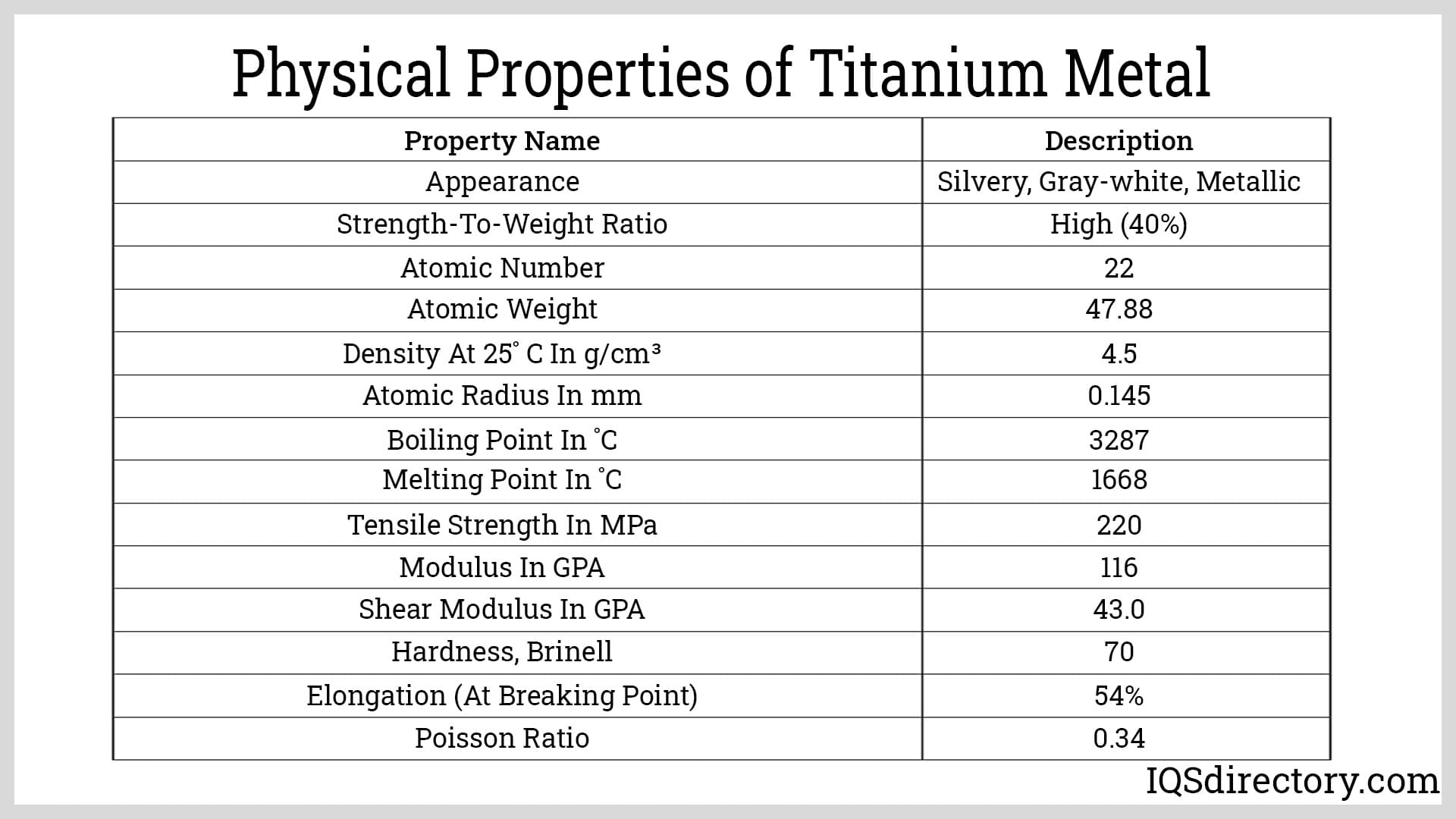
Titanium, symbolized as Ti, is a transition metal with atomic number 22 and an atomic weight of 47.90. Known for its silver-gray appearance, light weight, and impressive durability, titanium metal is widely valued across manufacturing, aerospace, medical, marine, and chemical processing markets. Although titanium is the ninth most abundant element in the Earth's crust, it rarely appears in pure metallic form because of its reactivity. Titanium makes up roughly 0.62% of the Earth’s crust and occurs in minerals, rocks, water, and other natural sources, most often as oxide compounds and chlorides that are later refined into usable mill products, titanium alloys, and fabricated parts.
Benefits of Titanium
Titanium offers a wide range of advantages that make it a preferred material for manufacturers, engineers, and OEM buyers. It readily forms alloys, delivers excellent durability, maintains low electrical and thermal conductivity, and provides an outstanding strength-to-weight ratio. Titanium is also valued for ductility, corrosion resistance, heat resistance, a high melting point, and long service life in aggressive environments. For buyers researching titanium manufacturers, titanium suppliers, or titanium fabrication partners, these benefits often translate into lower maintenance, longer equipment life, and reliable performance in applications where stainless steel, aluminum, or other metals may wear faster.
Alloy-Ability Titanium can be combined with other metals to produce versatile alloys for aerospace parts, medical components, marine hardware, chemical processing equipment, fasteners, tubing, plate, sheet, and bar stock. This flexibility helps designers match a titanium grade or alloy family to the exact balance of strength, corrosion resistance, and formability they need. Strength and Durability One of titanium’s best-known advantages is its durability. It is denser than aluminum yet much stronger, and it performs well in applications where low weight and mechanical strength must work together. That combination makes titanium attractive for structural assemblies, pressure systems, fabricated components, and high-performance industrial products. Conductivity (Or Lack Thereof) Titanium has relatively low thermal and electrical conductivity. In many applications, that trait is useful rather than limiting, particularly where equipment must tolerate temperature swings, corrosive media, or electrically sensitive operating conditions. Cost Although titanium can have a higher upfront material cost than some common metals, it often delivers good long-term value. Titanium pipes, fittings, tubing, and fabricated parts may reduce replacement frequency, downtime, and corrosion-related failure, which can improve lifecycle cost in marine, medical, and process-industry settings.The History of Titanium
Titanium was discovered in 1791 in Cornwall, England, by William Gregor, a clergyman and geologist. While studying black sand near a stream, he noticed magnetic material and identified two oxides within it. One was iron oxide, while the other was a white metallic oxide in ilmenite that contained an unknown metal. Gregor named the substance Manaccanite after his parish and published his findings in both the Royal Geological Society of Cornwall and the German journal Crell’s Annalen.
In 1795, Prussian chemist Martin Heinrich Klaproth rediscovered titanium dioxide in rutile from Slovakia and gave the element the name titanium, drawing from the Titans of Greek mythology. Once he learned of Gregor’s earlier work, Klaproth confirmed that Manaccanite contained the same newly identified metal.
Pure metallic titanium at 99.9% purity was first produced in 1910 by Matthew A. Hunter at Rensselaer Polytechnic Institute using what became known as the Hunter process. In 1932, William Justin Kroll developed the Kroll process, first using calcium and later magnesium to reduce titanium tetrachloride. The Kroll method remains the dominant commercial route for titanium sponge production and paved the way for broader use of titanium alloys in aerospace, military hardware, medical devices, industrial processing, and specialty fabrication.
During 1900’s and Beyond During the 1950s and 1960s, the Soviet Union adopted titanium for military, submarine, and aircraft programs to gain a technological advantage during the Cold War. Titanium’s resistance to atmospheric and saltwater corrosion made it especially valuable in jet aircraft and naval systems, while the United States supported commercial titanium development for defense and industrial use. Today, titanium is used across biomedical, aerospace, marine, chemical, petrochemical, automotive, desalination, offshore energy, and architectural markets. Engineers and product designers continue to expand its role as new fabrication methods, powder processing routes, and alloy development strategies make titanium more accessible for modern manufacturing.Applications of Titanium
Titanium is used to manufacture parts and products for a broad range of industrial and commercial applications. Components made from titanium are selected when designers need corrosion resistance, low weight, reliable mechanical properties, and long service life. Buyers comparing titanium suppliers often look for mill products and fabricated parts that can handle saltwater exposure, elevated temperatures, chemical attack, repeated stress, or a demanding sanitary environment.
Industries where titanium performs especially well include healthcare, aerospace, defense, marine, chemical processing, metal fabrication, automotive racing, aquariums, and jewelry. Because titanium’s density is close to that of human bone, it is well suited to orthopedic implants and prosthetics. In marine and offshore service, titanium tubing, sheet, plate, and fabricated assemblies stand up well to corrosion, pitting, and microbial attack. In aerospace, titanium alloys help reduce weight while maintaining structural strength.
Design of Titanium
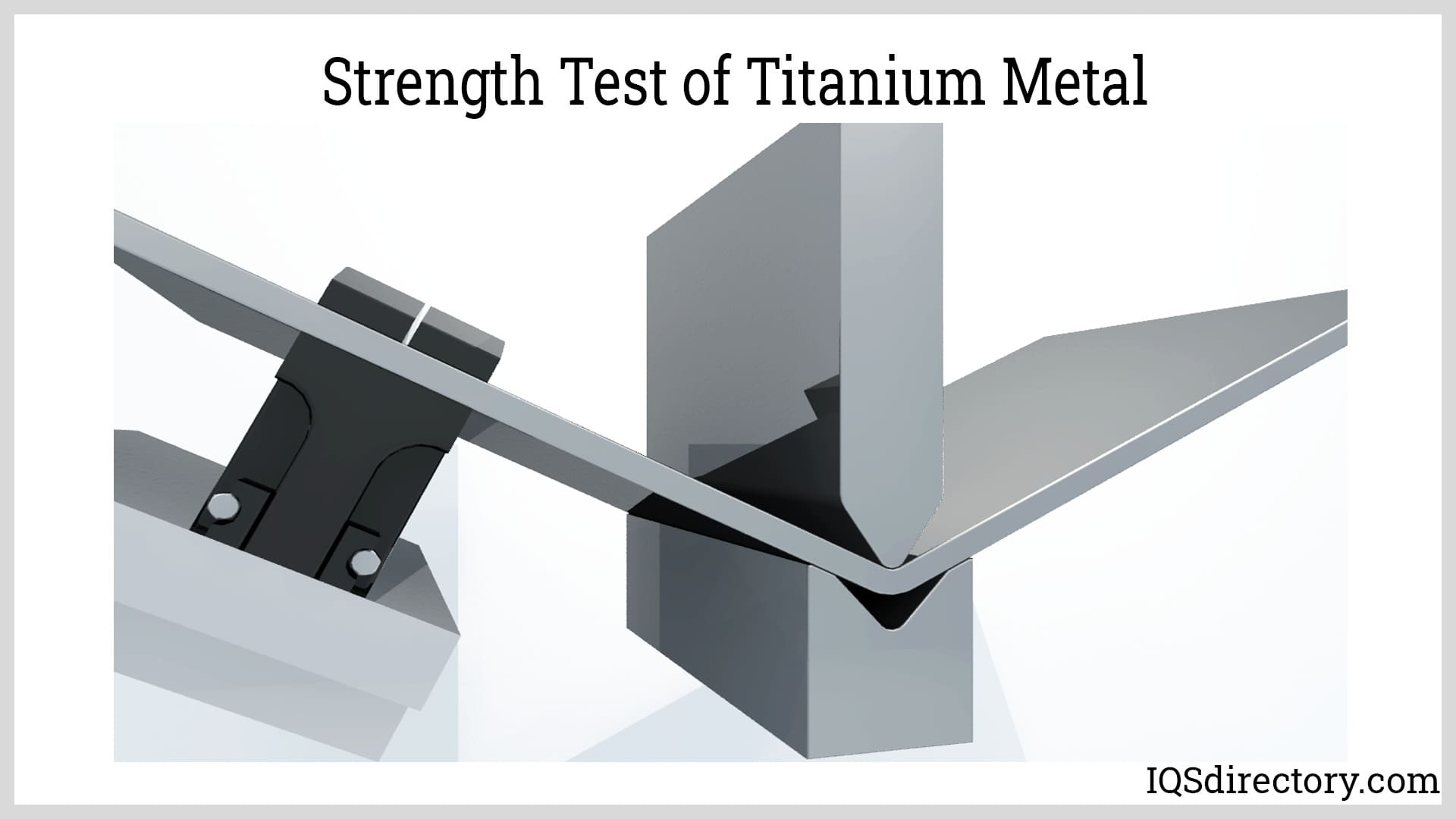
Although titanium is lightweight, it is among the strongest materials available for many engineered applications. It shares some characteristics with zirconium and silicon, and it is well known for strong resistance to corrosion and elevated temperatures. With a density of about 4510 kg/m3, titanium offers a lower-weight alternative to many ferrous materials while still performing well in marine, aerospace, medical, and chemical process environments. It can withstand very high temperatures and retains useful properties in applications where strength, durability, and corrosion resistance must all be considered at the same time.
With a high strength-to-weight ratio, titanium is as strong as steel in many comparisons while weighing much less by volume. The most common titanium used in manufacturing is titanium alloy, since alloying helps tailor weldability, hardness, formability, tensile strength, and service-life performance for specific applications.
Titanium's combination of high tensile strength, low density, ductility, and heat resistance is often improved through alloying. Titanium steels can be lighter and more corrosion resistant than conventional steels, while aluminum-titanium combinations may provide improved strength and grain refinement. Alloys containing iron, copper, manganese, vanadium, molybdenum, palladium, or other additions are selected when buyers need a more specialized property profile for fabrications, forgings, tubing, fasteners, or precision-machined parts.
Titanium Production Process
The titanium production process involves several stages, including extraction, reduction to sponge, ingot formation, primary fabrication, and secondary fabrication. Understanding these stages helps buyers compare titanium manufacturers and determine whether a supplier can deliver raw material, mill products, or fully finished parts.
Extraction Although titanium is abundant in nature, it is not usually found in pure metallic form. It is primarily extracted from mineral sources such as ilmenite and rutile, where it exists as a compound that must be chemically processed before it can be turned into usable titanium metal. Reduction to Sponge After extraction and chemical refinement, titanium is reduced into a porous metallic form known as sponge. This is commonly done through the Kroll or Hunter process, and the resulting sponge becomes the starting point for ingot production and alloy development. Titanium Ingot Formation Titanium sponge is pressed or melted, often with alloying additions, to create ingots. These large metal masses serve as the feedstock for downstream rolling, forging, extrusion, machining, and other fabrication processes used to create titanium mill products. Primary Fabrication Manufacturers convert ingots into commonly requested stock shapes such as titanium tubing, pipes, wire, bars, plates, foil, rods, and sheets. These forms may be hot worked, cold worked, rolled, extruded, or welded, then sold as stock material or further processed into finished assemblies for aerospace, marine, medical, and industrial use. Secondary Fabrication Secondary fabrication covers the processes used to turn titanium mill products into finished parts. These operations include cold forming such as pressing, bending, and shearing; welding methods such as plasma, laser, resistance, electron beam, MIG, and friction welding; machining like drilling and grinding; cutting by torch, waterjet, or laser; cladding processes such as explosive bonding, mechanical lining, roll cladding, resistance weld lining, and diffusion bonding; as well as heat treating, annealing, turning, polishing, and surface finishing. Titanium forgings produced through these methods are known for high strength and reliable performance. Titanium Metal Alloys Researchers have developed more than a thousand titanium alloys, and manufacturers sort them by grade and by structural family so they can be matched to particular service conditions. Titanium grades help identify the characteristics, processing behavior, and likely applications of each alloy type. ASTM recognizes dozens of titanium grades, with the first five being commercially pure titanium and many later grades containing alloying additions such as aluminum, cobalt, vanadium, tin, molybdenum, palladium, zirconium, niobium, nickel, ruthenium, silicon, and iron. The three major structural groups of titanium alloys are Alpha, Alpha-Beta, and Beta titanium. Alpha titanium, often alloyed with aluminum and tin, offers low to medium strength, strong weldability, very good ductility, and high toughness at low temperatures, along with strong corrosion resistance for aircraft and chemical processing equipment. Alpha-Beta titanium offers medium to high strength, can be heat treated, and is widely used in marine equipment, aircraft parts, and prosthetics. Beta titanium, though a smaller group, provides very high strength, excellent hardenability, and good formability, making it useful for aircraft parts and other heavily loaded components.Titanium Images, Diagrams and Visual Concepts
Types of Titanium
Products Produced by Titanium
Titanium is used in a wide range of products across many end-use markets. The following list organizes common titanium products by the industries where they are most often used, helping buyers connect titanium properties with specific applications.
Medicine and Healthcare Products Titanium is used to produce catheters and many orthopedic devices, including joint replacements, hip prostheses, rods for scoliosis surgery, bone plates, heart stents, dental implants, bowl replacements, and wire and bars for other medical uses. When produced from high-purity titanium, these products are less likely to corrode inside the body and are often well suited to long-term implantation. Homecare and Consumer Products Titanium alloys and titanium compounds appear in many everyday products, including paints, inks, toothpaste, cosmetics, and selected food-related applications. Aerospace Products Titanium is widely used throughout the aerospace industry in missiles, spacecraft, space stations, jet engines, aircraft structures, and other systems that benefit from weight reduction and high strength. Sports and Recreation Products Many kinds of sports equipment make use of titanium, including racing bicycles and performance gear where lower weight and durability are both valued. Marine and Naval Products Marine industries use titanium tubing and sheet for underwater ship components and related equipment because titanium resists saltwater corrosion, pitting, stress damage, and microbial attack. Automotive Products Automotive manufacturers use lightweight titanium plates and alloys for valve springs, rocker arms, connecting rods, exhaust systems, drive shafts, and steering components in performance-oriented vehicles. Chemical Products Titanium alloys are used to create heat exchange coils, linings, pump units, and other process components in chemical plants where corrosion resistance and long equipment life matter. Gas and Oil Products Titanium is used as a coolant-related material in condenser tubes and other energy-sector components that face aggressive media and demanding operating conditions. Industrial Products Titanium is increasingly used in construction and industrial fabrication because it is lightweight, durable, and resistant to corrosion, making it attractive for outdoor structures and long-life assemblies. Miscellaneous Products Other titanium-based products include battery and semiconductor wires, agri-food tubing, paper and plastics processing components, cement-industry parts, and jewelry.Things to Consider When Choosing Titanium
With many titanium manufacturers and suppliers in the market, choosing the right source can feel overwhelming. A directory like this can help narrow the field by bringing together suppliers that serve different grades, forms, and fabrication needs. When comparing companies, ask practical questions: Do you need titanium tubing for saltwater service, titanium sheet for fabrication, titanium bar for machining, or a custom titanium alloy for aerospace or medical use? Review each supplier’s product range, fabrication capabilities, industry experience, quality systems, pricing, lead times, and delivery support. Contact several companies, explain your application and specifications, and compare how clearly they address material selection, tolerances, finishing, compliance needs, and service. That process can help you identify a supplier that fits both your technical requirements and your purchasing goals.
Overseas Market of Titanium
The overseas market for titanium has long been shaped by global sponge production, aerospace demand, defense spending, industrial growth, and regional pricing pressure. Major production has historically come from China, Japan, Russia, Kazakhstan, the United States, Ukraine, and India. China has often led in total output, while American titanium production has remained closely tied to aerospace and advanced manufacturing demand. For buyers comparing domestic and overseas titanium suppliers, it is smart to look beyond price alone and consider mill capacity, lead times, logistics, product certifications, fabrication support, and the stability of the supply chain. In many purchasing decisions, those factors matter just as much as the posted titanium prices.
Titanium Terms
Common Questions
7 questions
What Is Titanium and Where Is It Found?
Titanium is a lightweight, silver-gray transition metal found naturally in minerals such as ilmenite and rutile. While it is relatively abundant in the Earth’s crust, it rarely appears in pure form because it readily bonds with oxygen and other elements.
Why Is Titanium Used in Aerospace and Marine Industries?
Titanium is widely chosen for aerospace and marine service because it combines high strength with low weight and strong corrosion resistance. It performs well in saltwater, humid environments, and elevated temperatures, making it useful for aircraft structures, marine hardware, offshore components, and high-performance process equipment.
How Strong Is Titanium Compared to Steel or Aluminum?
Titanium offers a strong strength-to-weight ratio. It can deliver strength comparable to many steels while weighing much less, and it is notably stronger than aluminum in many structural applications, which is why buyers often compare titanium tubing, bars, plates, and fasteners when reducing weight is a design goal.
What Are the Main Types of Titanium Alloys?
Titanium alloys are commonly grouped into Alpha, Alpha-Beta, and Beta families. Alpha alloys are known for corrosion resistance and weldability, Alpha-Beta grades balance strength and formability, and Beta alloys provide very high strength and heat-treat response for demanding fabricated parts.
What Is the Kroll Process Used for in Titanium Production?
The Kroll process is the main commercial method used to produce titanium sponge. It reduces titanium tetrachloride with magnesium, creating high-purity titanium that can be melted, alloyed, and converted into ingots, billet, plate, sheet, rod, wire, tubing, and other mill forms.
Why Is Titanium Preferred for Medical Implants?
Titanium is often selected for implants because it is biocompatible, corrosion resistant, and well suited to long-term contact with the human body. It is used in orthopedic implants, dental devices, surgical components, and specialty medical fabrications where strength, cleanliness, and longevity matter.
Which Countries Produce the Most Titanium Today?
Major titanium sponge production has historically been concentrated in countries such as China, Japan, Russia, Kazakhstan, the United States, Ukraine, and India. Buyers often watch global output, aerospace demand, and mill lead times when comparing titanium suppliers and sourcing strategies.