
- 6 leading manufacturers
- 25 additional suppliers
- 10 states and provinces
- 11 related categories
- 4 guide sections
Powdered Metal Part Manufacturers and Suppliers
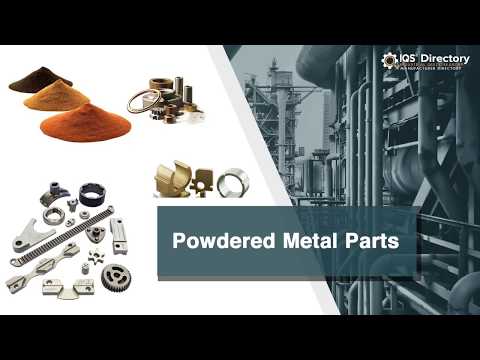
IQS Directory provides an extensive list of powdered metal part manufacturers and suppliers. Utilize our website to review and source powdered metal part manufacturers with our easy-to-use features which allow you to locate powdered metal part companies that will design, engineer, and manufacture powdered metal parts for your exact specifications. Our request for quote forms make it easy to connect with leading powdered metal part manufacturers. View company profiles, website links, locations, phone number, product videos, product specific news articles and other production information. We are a leading manufacturer directory who will connect you with the right manufacturers whether you are looking for powdered metal gears, sintered metal parts, or metal injection molding services.
Suppliers located in PA, MI, IL +7 more states
Contents (4 sections)
Leading Powdered Metal Part Manufacturers
Showing all 6
| Placement No. | Manufacturer | Location | Contact | Actions | |
|---|---|---|---|---|---|
| 1 | Precision Sintered PartsSince 1967, PSP has been a leader in small, intricate custom powdered metal parts for a wide range of industries, such as Sports & Recreation, Power Tools, Industrial Equipment, Oil & Gas. We make the economic benefits of powder metallurgy – or P/M – available to a wider range of customers. Let us show you the superior design, consistency, precision & finish over casting, forging or machining. | Tulsa, OK | |||
| 2 | Liberty Pressed Metals, LLCLiberty Pressed Metals is a designer and producer of Powder Metals (PM) components for use in various industries, such as automotive, lawn and garden, office equipment, power tool, home appliances, and more. Our process boost product strength, precision, and durability. We are ISO 9001: 2015 certified. Our quality management system assures top-quality sourcing of materials, as well as unmatched customer service. | Kersey, PA | |||
| 3 | Ridgway Powdered Metals Inc.At Ridgway Powdered Metals Inc., we specialize in the production of precision powdered metal parts engineered for strength, consistency, and cost-effective performance. Our company partners with manufacturers across demanding industries to supply components formed through advanced powder metallurgy processes that deliver reliable tolerances and repeatable quality. | Ridgway, PA | |||
| 4 | Volunteer Sintered ProductsTOYOTA. SUBARU. EMERSON. TECUMESH. BALDOR. COOPER STANDARD. When global OEMs need precision powder metal components, they choose Volunteer Sintered Products, Inc. Tennessee-based company since 1981, ISO 9001 certified, and backed by 45 years of sintered metal expertise. Engineering tight-tolerance parts that replace costly machined or cast components, prototype through production. | Lafayette, TN | |||
| 5 | Baxter Machine & Tool Co., IncAt Baxter Machine & Tool Co., we take immense pride in crafting top-quality powdered metal parts that drive innovation across a multitude of industries. With our extensive expertise and state-of-the-art facilities, we specialize in delivering a wide array of precision-engineered components that meet the most demanding specifications. | Jackson, MI | |||
| 6 | Advantage Sintered Metals, Inc.At Advantage Sintered Metals, we are a powder metal parts manufacturer focused on producing precision components for customers that require reliable performance, repeatable quality, and efficient production. Our company uses powder metallurgy processes to manufacture parts with complex geometries, controlled dimensions, and consistent material properties. | Battle Creek, MI |
Claim your Page One Spot
Leading powdered metal part manufacturers are listed first on this page, each with a website preview and a Request a Quote button on its row.
Additional Powdered Metal Part Companies
The category’s other powdered metal part companies are listed on their own page, with location, phone and website where each supplier provides them.
View 25 Additional Powdered Metal Part CompaniesDo not see your company listed in Powdered Metal Parts?
Engineers and buyers use this page to find powdered metal part suppliers. Add your company to the Powdered Metal Parts listings so they can find you too.
List Your Company- Listed in the Powdered Metal Parts directory
- A profile page for your company
- Buyers contact you directly
Quick Answers
- How many powdered metal part manufacturers are listed on IQS Directory?
- 6 leading manufacturers and 25 additional suppliers.
- Where are powdered metal part manufacturers located?
- The listed suppliers are in 10 states and provinces: Pennsylvania (14), Michigan (4), Illinois (3), Indiana (2), Ohio (2), Tennessee (2), California (1), Connecticut (1), and 2 more.
- How do I get quotes from powdered metal part suppliers?
- Select suppliers in the table and choose Request Quotes. IQS reviews your request and forwards it to every supplier you select.
Powdered Metal Parts
The term "powdered metal parts" refers broadly to any solid metal part made through a process known as "powder metallurgy," which involves metal pressed into powder form.
Applications of Powdered Metal Parts
Powdered metal parts are used in a diverse set of industries, including automotive engineering, computer technology, electronics, hardware, and lawn and garden. Within these industries and others, powdered metal parts are valued for their properties, including magnetism and porosity, the latter which naturally dampens sound. The applications of these durable metal parts include automobile parts, bearings, bushings, magnetic assemblies, structural parts, and filtration systems.
Materials Used in Manufacturing Powdered Metal Parts
The list of metal materials that can be converted into powder metal parts is quite long and includes steel, bronze, brass, aluminum, copper, and iron. All of these metals have different properties and different uses. Steel, including tool steel and stainless steel, has high strength and is popular for making parts related to automobile weight reduction.
Meanwhile, bronze and brass are both quite dense and mechanically useful. Bronze, however, is the denser of the two and exhibits the highest mechanical performance. Therefore, it is quite popular in the creation of self-lubricating bearings. Next, aluminum exhibits properties of lightness, high flammability, and conductivity. These qualities make it popular for use with high strength structural applications and pyrotechnics. Copper, on the other hand, exhibits quality thermal and electrical conductivity. Thus, copper parts are often used in electrical contractor and heat sink applications. Finally, iron powder, which contains a graphite additive, is useful in the production of filters, bearings, and structural parts.
Manufacturing Process of Powdered Metal Parts
Before powdered metal can be formed into a part, it must be formed. This is where the process of powder metallurgy, which takes metal from powder to a finished part, comes in. To kick things off, raw metal material is converted into powder by any of the following methods: atomization, chemical reduction, electrolytic techniques, mechanical alloying, or pulverization. Note that atomization is the most common process by which metal is turned into powder.
Regardless, once the raw metal material has been processed into powder form, it is impregnated with a lubricant that acts as a friction reducer when the powder is sent to the pressing dies. Next, the raw metal powder goes on to said pressing dies or any other tools and machines used in the forming process. Common among forming processes are forging, molding, and pressing. Once the metal has undergone forming, it is put through either sintering or metal injection molding. Most often, manufacturers choose sintering.
There are a number of reasons that sintering is more popular than metal injection molding. For one, sintered parts tend not to be shape sensitive, a fact that allows manufacturers to create more diverse parts. In addition, sintering, which uses approximately 97% of the material inputted, produces little waste. During sintering, the compacted raw materials (called green parts) are heated together in a furnace at temperatures below their melting part. In this way, the particles of the green parts are bonded, but the parts’ shapes do not change. Once sintering is complete, the powdered metal part has its final properties, and it also has gained extra strength and better control over its porosity. More porosity control means a part can self-lubricate and can be better used in liquid and gas filtration.
The alternative to sintering that some manufacturers use is metal injection molding, which offers more design freedom, reduced waste, and reduced assembly costs. It is useful in the creation of small, thin, complex, high performance, and high density parts with higher levels of corrosion resistance and magnetism. Such parts are used widely in the automotive, computer, dental, electronic, firearm, hardware, and medical industries. This process, however, is only useful in the creation of small, thin parts, and it comes with higher tooling costs than sintering. The process begins when manufacturers add wax or polymers/thermoplastics to the powdered metal via resin impregnation. Then, the metal and the additives are heated together until they become pliable. Once pliable, the combination is injected into a mold, which is then clamped shut. The heated metal is held here until it takes on the shape of the mold, cools, and solidifies.
Points to Consider When Purchasing Powdered Metal Parts
If necessary, a powdered part can undergo secondary operations like machining, heating, deburring, or sizing. Finished powdered metal parts look solid, but technically, they are not. Rather, they are made up of many small, interconnected capillaries, which is why they are about 25% porous. If an application requires these pores be sealed, a manufacturer can put the finished part through a few treatments. These include infiltration with a metal that has a lower melting point, impregnation with oil or plastic resin, and steam treatment. Parts with very tight tolerances, such as bearings and bushings, sometimes require secondary sizing.