
- 3 leading manufacturers
- 12 additional suppliers
- 12 states and provinces
- 25 related categories
- 4 guide sections
Plastic Caps Companies and Manufacturers

IQS Directory implements a thorough list of plastic cap manufacturers and suppliers. Utilize our listing to examine and sort top plastic cap manufacturers with previews of ads and detailed descriptions of each product. Any plastic cap company can design, engineer, and manufacture plastic caps to meet your companies specific qualifications. An easy connection to reach plastic cap companies through our fast request for quote form is provided on our website. The company information includes website links, company profile, locations, phone, product videos and product information. This source is right for you whether it's for a manufacturer of rubber pipe caps, protective rubber caps, and plastic molded caps.
Suppliers located in OH, MA, CT +9 more states
Contents (5 sections)
Leading Plastic Caps Manufacturers
Showing all 3
| Placement No. | Manufacturer | Location | Contact | Actions | |
|---|---|---|---|---|---|
| 1 | Precision Dip Coating LLCPrecision Dip Coating provides dip coating services for the manufacture of soft plastic parts such as cap plugs. hand grips, and more. Decorative and protective, our services are very cost effective and we have a proven track record for on time delivery and precise manufacturing. We can match any color you need, and offer services such as assembly, die cutting, packaging, and decorating. | Waterbury, CT | |||
| 2 | Production SciencesAt Production Sciences, Inc., we pride ourselves on being pioneers in the realm of dip-molded plastics, sculpting a legacy of innovation and excellence that spans decades. As a collective force, we embody a commitment to precision, creativity, and unwavering quality in the realm of plastic manufacturing. | Chestertown, MD | |||
| 3 | Innovative Coatings, Inc.Innovative Coatings is a manufacturer of plastisol dip molding and fluidized bed powder coatings of epoxy, polyolefins, nylon and vinyl. Our dip coatings are of FDA-approved and biomedical grades. Customers can also have a choice of color plus foam, gloss or texture finish. We draw from 40 years of experience in the plastic molding and protective coating industry. Let's talk about your project. | Medway, MA |
Claim your Page One Spot
Leading plastic caps manufacturers are listed first on this page, each with a website preview and a Request a Quote button on its row.
Additional Plastic Caps Companies
The category’s other plastic caps companies are listed on their own page, with location, phone and website where each supplier provides them.
View 12 Additional Plastic Caps CompaniesDo not see your company listed in Plastic Caps?
Engineers and buyers use this page to find plastic caps suppliers. Add your company to the Plastic Caps listings so they can find you too.
List Your Company- Listed in the Plastic Caps directory
- A profile page for your company
- Buyers contact you directly
Plastic Caps Industrial Manufacturing Guides
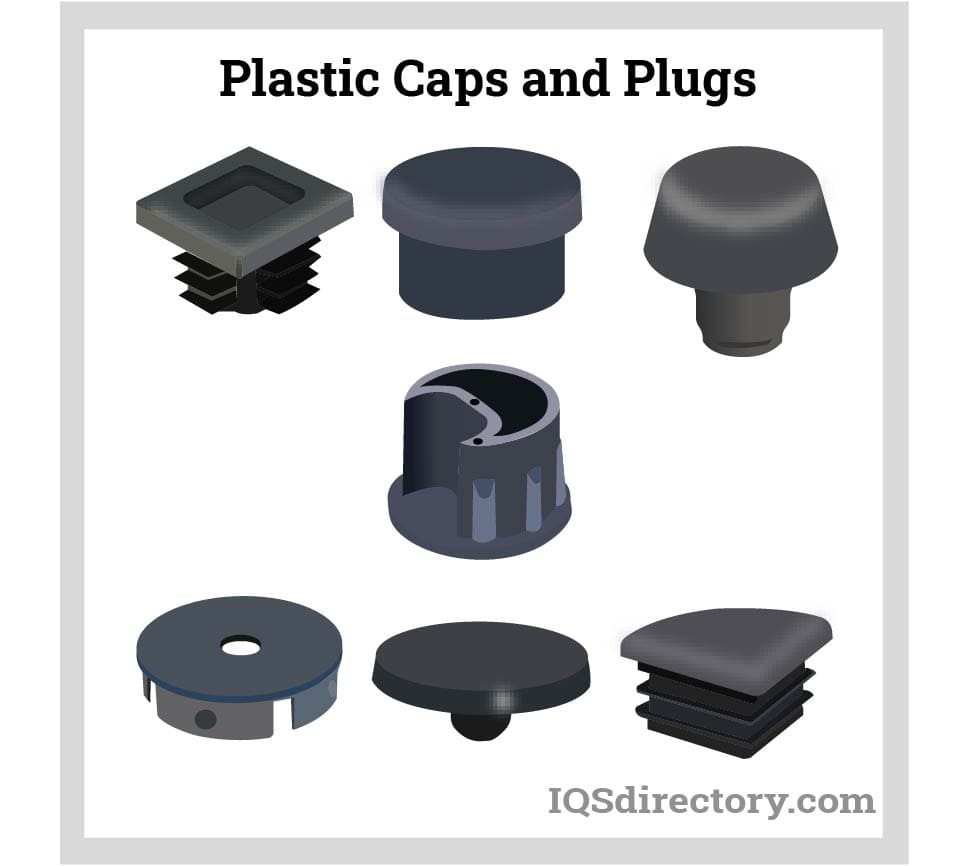
Plastic Caps: Types & Applications
Here is the most complete guide on the internet about You will learn: What are Plastic Caps and Plugs? Types of Plastic Caps and Plugs How Plastic Caps and…
7 chapters
Quick Answers
- How many plastic caps manufacturers are listed on IQS Directory?
- 3 leading manufacturers and 12 additional suppliers.
- Where are plastic caps manufacturers located?
- The listed suppliers are in 12 states and provinces: Ohio (3), Massachusetts (2), Connecticut (1), Illinois (1), Indiana (1), Iowa (1), Maryland (1), Michigan (1), and 4 more.
- How do I get quotes from plastic caps suppliers?
- Select suppliers in the table and choose Request Quotes. IQS reviews your request and forwards it to every supplier you select.
Plastic Caps
Plastic caps and similar products like plastic seals and plastic plugs are very common items, made to seal the open ends of products like pipes, tubes and containers. These popular devices come in a wide variety of shapes, sizes and colors and their material options are many. Formed during dip molding or plastic coating, plastic caps have applications in food service, chemical, medical and consumer industries alike.
Advantages of Plastic Dip Molding
Plastic dip molding and plastic dip coating present many advantages to those seeking the services of plastic caps. First, since the leftover molten polymer from a dipping process can easily be reused, dip molders create very little material waste. This makes the use of dip molders very economical for manufacturers, as well as a good choice for those who wish to keep their use of fossil fuels to a minimum. In addition, the use of automatic dip machines ensures relatively low labor costs. Another reason that dip molding and dip coating are so popular of methods with plastic object manufacturers is that they offer such versatility.
Dip Molding Process
The process of dip molding usually involves the engagement of dip molders, which take a mold or mandrel, which is a cylindrical rod around which material is forged or shaped, and lower it into a molten polymer, where it sits for a predetermined period of time. As the mold sits in the molten polymer, which is usually plastisol or PVC, the liquid sets and takes its shape. This allows the mold to become a precisely sized cap or plug. The longer the mold stays in the liquid plastic, the thicker the walls of the cap will be. Once the prescribed period of time is up, the mold is slowly removed from the polymer and allowed to harden and cool. The speed at which the mandrel is removed is very important, because removing it too quickly could cause irregularities on the surface of the cap. After the cap has solidified and cooled, it is removed from the mold. Dipped products rarely require secondary finishing processes. If at all, the most likely secondary process required is the heat treatment of some plastic coatings.
Plastic Coating Process
Plastic coating is a process very similar to dip molding that also uses dip molders to achieve its purposes. The goal of plastic coating is to provide a protective or insulative surface for manufactured products, including plastic caps. Other parts and products that plastic coating serve include wire form, tool handles, sports equipment, medical equipment and electrical components. Plastic coated parts undergo the same dip molding process, though objects to be dip molded may be coated in a primer before being lowered into the molten plastic. Primers ensure that objects receive full and ideal plastic coverage. Plastic coatings may be as thin one quarter of an inch, though they are usually thicker than that. Just as before, the thickness of the coating is determined by the length of time that the object is immersed in the molten plastic. As noted, the most common polymers used for plastic dipping and coating are plastisol and PVC. However, a host of other polymers are available for use, such as latex, neoprene, urethane, epoxy and silicone. UV resistant coatings are available for products with outdoor applications. Plastisol, a vinyl compound, reigns as most popular because it becomes liquid at room temperature, therefore requiring a very low amount of energy to undergo dip manufacturing. Also, once it is heated, plastisol hardens permanently, a feature that is ideal for bulk manufacturing.
Plastic Cap Customization
The reason that most plastic caps and other dip moldings do not require secondary processes is that plastic cap manufacturing demands the diligent adherence to high precision standards. High precision is necessary to make sure that plastic caps have the tight fit needed to seal containers. Manufacturers create high quality caps using precisely controlled ovens, dip times, dip speeds and withdrawal speeds. Also, automatic dip machines help ensure process consistency. Due to the nature of the materials and process used, manufacturers have a lot of freedom to custom design aspects of plastic caps, such as length, material hardness, color, texture and wall thickness. In addition, caps other products, such as plastic plugs and plastic closures, may have a round, vinyl hex or pull tab design, widening their field of applications and uses. Another type of common plastic cap is the threaded cap, which is a twist-on cap that provides a tighter seal, one that is sometimes even water-tight. Another common custom features a tamper-proof capability, common with medicine bottles. Because they are so commonly used and because so many plastic containers that require sealing and closures are produced in standard sizes, warehouses also usually carry a wide variety of stock plastic caps. These caps can be shipped at a moment’s notice to those seeking them for use with their standard containers.