
- 7 leading manufacturers
- 31 additional suppliers
- 19 states and provinces
- 18 related categories
- 3 guide sections
Helical Gear Manufacturers and Companies

IQS Directory provides a comprehensive list of helical gear manufacturers and suppliers. Use our website to review and source top helical gear manufacturers with roll over ads and detailed product descriptions. Find helical gear companies that can design, engineer, and manufacture helical gears to your companies specifications. Then contact the helical gear companies through our quick and easy request for quote form. Website links, company profile, locations, phone, product videos and product information is provided for each company. Whether you are looking for manufacturers of internal helical gears, plastic helical gears, metric helical gears, or customized helical gears of every type, this is the resource for you.
Suppliers located in WI, IL, FL +16 more states
Contents (5 sections)
Leading Helical Gear Manufacturers
Showing all 7
| Placement No. | Manufacturer | Location | Contact | Actions | |
|---|---|---|---|---|---|
| 1 | Houston Gear USA, Inc.Manufacturing industrial and commercial gears is what Houston Gear USA does. We produce gears from 1 3/4 DP – 200 DP in a choice of materials. Choose from spur gears, custom gears, helical gears, double helicals, splines, straight bevel gears, worm gears, sprockets, and herringbone gears. | Stafford, TX | |||
| 2 | Buffalo Gear, Inc.At Buffalo Gear, Inc., we manufacture gears for customers who need dependable motion control components built for strength, precision, and long-term performance. Our company supports a wide range of industrial applications by producing gear products that help transmit power efficiently and reliably. We focus on quality workmanship, responsive service, and practical manufacturing support, helping customers move from design requirements to finished gear solutions with confidence for every project. | Sanborn, NY | |||
| 3 | Ascent Precision Gear CorporationAt Ascent Precision Gear Corporation, we focus on manufacturing high-precision gears that support smooth, reliable power transmission in demanding mechanical systems. We engineer our gears to meet exacting tolerances for strength, accuracy, and durability, using carefully controlled processes that ensure consistent performance under load. | Jasper, FL | |||
| 4 | Linn Gear Co.At Linn Gear Co., we specialize in providing high-quality gears and power transmission components designed to meet the demands of industrial applications. We offer a comprehensive selection of gears, including spur gears, helical gears, bevel gears, and other precision-engineered components. Our products are designed to deliver reliable performance, efficient power transfer, and long-lasting durability. | Lebanon, OR | |||
| 5 | Fairlane Gear, Inc.At Fairlane Gear, we specialize in providing precision-manufactured gears and gear-related solutions for a wide range of industrial applications. Our company is committed to delivering high-quality gear components that meet the demanding requirements of modern machinery and mechanical power transmission systems. | Canton, MI | |||
| 6 | Martin Sprocket & Gear, Inc.At Martin Sprocket & Gear, we specialize in providing high-quality gears, power transmission components, and industrial solutions designed to meet the demands of diverse manufacturing applications. Our company offers a comprehensive selection of precision-engineered gears, including spur gears, helical gears, bevel gears, and worm gears, designed to deliver reliable performance and efficient power transfer. | Arlington, TX | |||
| 7 | Ramsey Products CorporationAt Ramsey Products Corp., we specialize in providing high-quality industrial power transmission solutions, with a strong focus on gears, chain drives, and specialized drive systems. Our company offers precision-engineered products designed to deliver reliable performance in demanding industrial environments. | Belmont, NC |
Claim your Page One Spot
Leading helical gear manufacturers are listed first on this page, each with a website preview and a Request a Quote button on its row.
Additional Helical Gear Companies
The category’s other helical gear companies are listed on their own page, with location, phone and website where each supplier provides them.
View 31 Additional Helical Gear CompaniesDo not see your company listed in Helical Gears?
Engineers and buyers use this page to find helical gear suppliers. Add your company to the Helical Gears listings so they can find you too.
List Your Company- Listed in the Helical Gears directory
- A profile page for your company
- Buyers contact you directly
Helical Gear Industrial Manufacturing Guides
Helical Gears: Types, Uses and Considerations
This article takes an in-depth look at Helical Gears. After reading this article, you will be able to understand more about Helical Gears, including: What are…
4 chapters
Quick Answers
- How many helical gear manufacturers are listed on IQS Directory?
- 7 leading manufacturers and 31 additional suppliers.
- Where are helical gear manufacturers located?
- The listed suppliers are in 19 states and provinces: Wisconsin (5), Illinois (4), Florida (3), Michigan (3), North Carolina (3), Texas (3), Connecticut (2), Missouri (2), and 11 more.
- How do I get quotes from helical gear suppliers?
- Select suppliers in the table and choose Request Quotes. IQS reviews your request and forwards it to every supplier you select.
Helical Gears
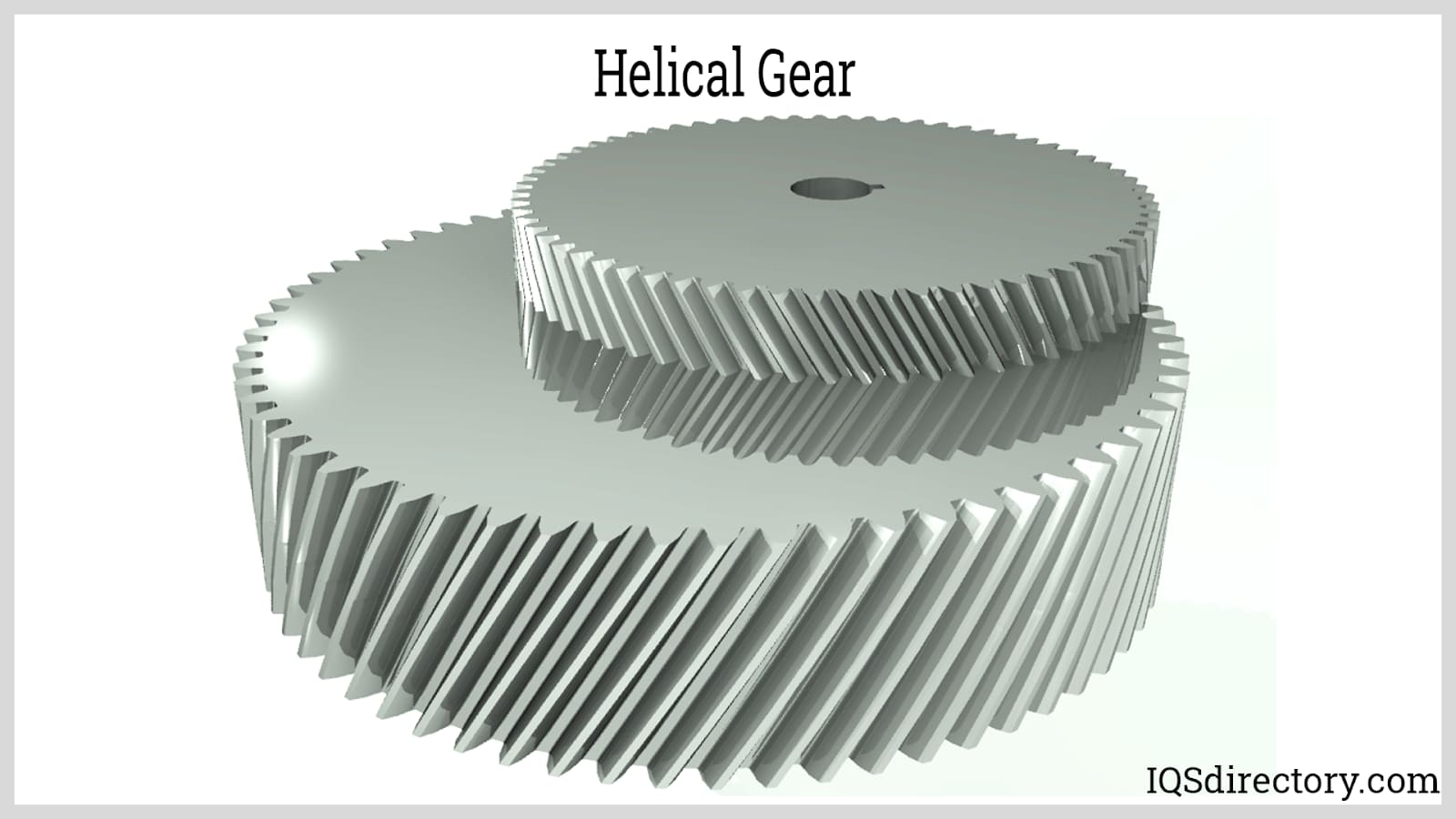
Helical gears are one of many types of machine parts called gears, designed with teeth, or cogs, that mesh with one another to transmit torque, as well as change it, along with speed and the direction of a power source.
Applications of Helical Gears
Helical gears, sometimes also called dry fixed gears, are named for both their circular shape and their teeth, which are cut in a helical path at an angle relative to the gear’s axis of rotation. Since the rotation angle of a gear’s teeth can be adjusted by 90°, they may also be meshed at a parallel or crossed orientation to transmit torque perpendicularly. The most common helical gear orientation is a parallel one. Note that this refers not to the teeth, but rather to the shafts upon which the gears are mounted. When mounted at a right angle, a helical gear may be alternatively called a spiral gear. They assist the automotive, food processing, marine, medical military, mining, oil and gas, packaging, rubber, and steel industries.
Helical gears are quite commonly used in applications similar to those used with spur gears. Consisting of a cylinder and straight teeth that are aligned parallel to the gear’s axis of rotation, or its wheel, spur gears, also known as straight-cut gears, are the simplest type of gear. While excellent for use with many applications at moderate speeds, spur gears are less ideal for high-speed applications, as they tend to make quite a bit of noise. Helical gears offer a more refined and less noisy alternative. Because their teeth are cut in such a way that they are set angularly in relation to the axis of rotation, rather than parallel to it, they generate overlapping tooth contact. This contact fosters smoother and quieter functioning, making helical gears perfect where spur gears are not, namely in high speed and power transmission applications. Helical gears and double helical gears alike are used to assist equipment like blowers, clay working machinery, compressors, conveyors, cutters, feed drives, manual transmissions, presses, rolling mills, and sand mullers.
Helical Gear Design and Function
Helical gears consist of two major circles, which are the outside circle and the pitch circle. The diameter of the outside circle is chosen based on the distance around the outside edge of the teeth of the helical gear. The diameter of the pitch circle, on the other hand, is determined by the needs and allowances of its location, which is the point at which the teeth of two gears meet. The two main configurations of helical gear connections are parallel and non-parallel configurations. In the former configuration, parallel shafts are connected by a pair of helical gears. To meet configuration criteria, these gears must have the same pressure angle, helix angle, and pitch (the distance between a point on one tooth and the corresponding point on an adjacent tooth), but they must also have opposite hand configurations. This means that one gear must have a right hand helical gear configuration and the other must have a left hand helical gear configuration. An easy way to check this type of orientation on a helical gear is to look at its teeth. If they are leaning to the right, they have a right hand configuration, and if they are leaning to the left, they have a left hand configuration. Helical gears that have a non-parallel configuration are used in pairs to connect non-parallel shafts. Non-parallel configurations necessitate that the gears have normal pressure angles and matching normal pitch angles, but whether or not they have an opposite hand configuration depends on the angle of the shaft.
Helical gears are most commonly used in conjunction with one another. However, regular helical gears may also be used together with worm gears. This is possible because the teeth of worm gears are arranged around a screw-like, cylindrical gear. To begin working, the teeth of the helical gear mesh with the teeth of the worm gear, so that their axes become perpendicular to one another. Once interlocked, the gears may begin to gradually rotate, spreading contact from one end of a tooth to another. Most often, the worm gear drives the gear function, as it provides the process with a high level of speed reduction.
Double Helical Gears
Similar to helical gears are double helical gears, which use two sets of teeth set in a “V” shape, to best the issue of axial thrust and eliminate the need for thrust bearings. They do so by canceling out the net axial thrust of each individual gear thrust. They are sometimes referred to as herringbone gears, but this is a misnomer because, while quite similar, double helical gears have a groove in the middle where herringbone gears do not. While quite useful, double helical gears are not as popular because their manufacturing process is longer and more involved.