
- 4 leading manufacturers
- 33 additional suppliers
- 20 states and provinces
- 20 related categories
- 4 guide sections
Glass Manufacturer and Companies

IQS Directory provides a detailed list of glass manufacturers and suppliers. Find glass companies that can design, engineer, and manufacture glass to your specifications. Peruse our website to review and discover top glass manufacturers with roll over ads and complete product descriptions. Connect with the glass manufacturer companies through our hassle-free and efficient request for quote form. You are provided company profiles, website links, locations, phone numbers, product videos, and product information. Read reviews and stay informed with product new articles. Whether you are looking for manufacturers of industrial glass manufacturing, scientific glass manufacturing, and traditional glass manufacturing of every type, IQS is the premier source for you.
Suppliers located in CA, PA, MO +17 more states
Contents (5 sections)
Leading Glass Manufacturers
Showing all 4
| Placement No. | Manufacturer | Location | Contact | Actions | |
|---|---|---|---|---|---|
| 1 | S & S Optical Company, Inc.We make it our goal to offer the top glass cutting services in the industry. Although we started small when we were founded in 1950, we have grown every year and are now one of the largest glass suppliers in the industry. We make products for more than just the optical industry, and can make customized products to suit any need. Contact us for a quote today! | New Haven, IN | |||
| 2 | Insaco Inc.Established in 1947, we have been providing glass cutting using very precise tolerances in order to ensure that our products are among the best. Our skilled designers and technicians are available around the clock in order to work with you from design to delivery to ensure that you are receiving a product that will fit your needs perfectly! For more information on what we may be able to do for you, visit our website today! | Quakertown, PA | |||
| 3 | Pegasus GlassGlass cutting is a varied industry, and we have done it all for the past 50 years. We believe in manufacturing high quality glass products that will exceed customer expectations every time. Our goal and mission has always been to ensure our customers are satisfied and will come to us with all of their glass needs. Contact us to learn more today! | Cambridge, ON | |||
| 4 | HOYA CORPORATION USA Optics DivisionAt HOYA Corporation USA, we specialize in advanced glass fabrication and optical technologies, delivering high-quality materials and precision-engineered solutions for demanding industrial applications. Our company combines expertise in glass manufacturing, material science, and optical engineering to develop products that meet exacting performance requirements. | Milpitas, CA |
Claim your Page One Spot
Leading glass manufacturers are listed first on this page, each with a website preview and a Request a Quote button on its row.
Additional Glass Companies
The category’s other glass companies are listed on their own page, with location, phone and website where each supplier provides them.
View 33 Additional Glass CompaniesDo not see your company listed in Glass Manufacturers?
Engineers and buyers use this page to find glass suppliers. Add your company to the Glass Manufacturers listings so they can find you too.
List Your Company- Listed in the Glass Manufacturers directory
- A profile page for your company
- Buyers contact you directly
Glass Industrial Manufacturing Guides
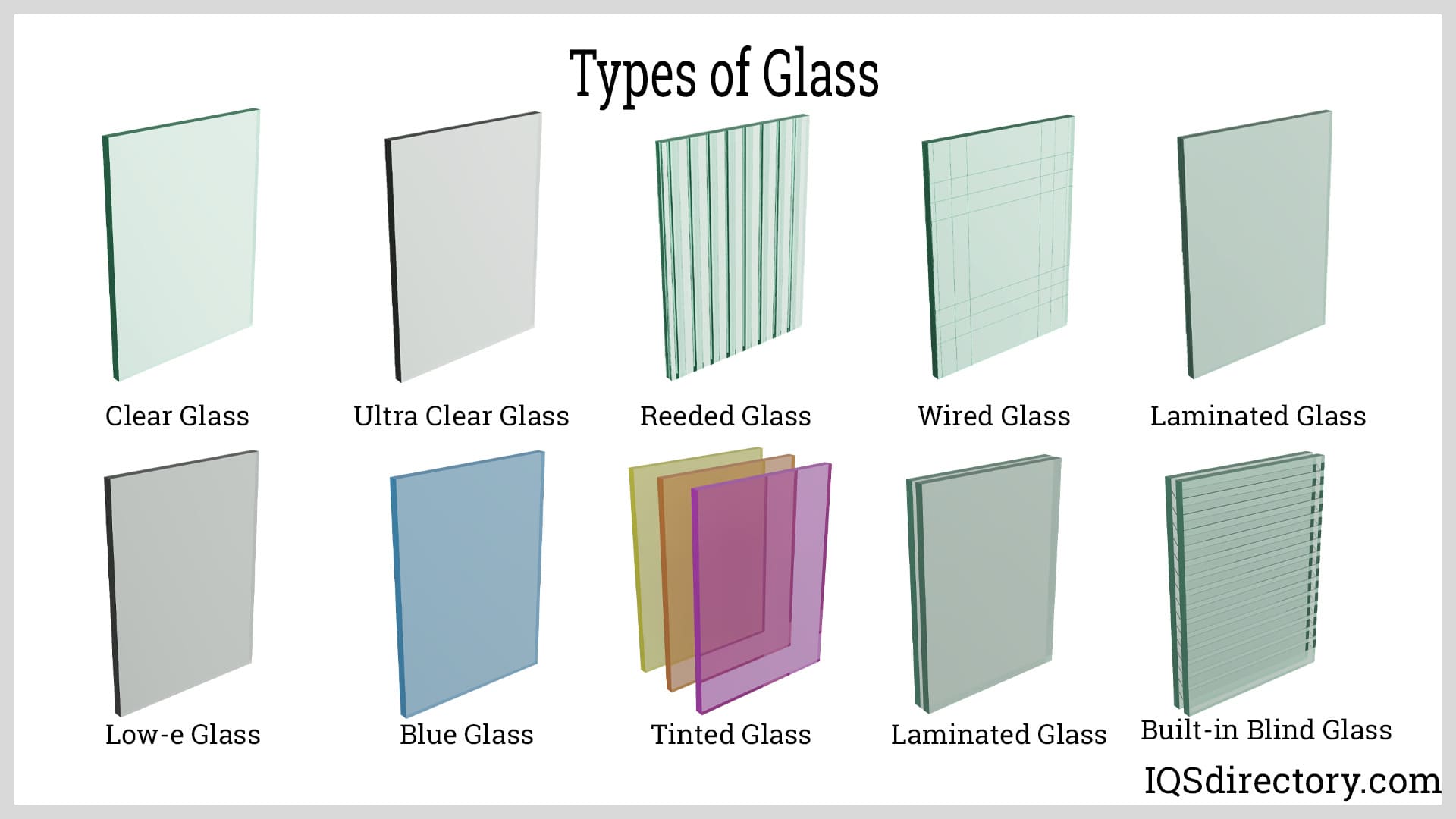
Glass Types: Everything You Need to Know about Properties & Uses
Information about different types of glass with a list of glass manufacturers You will learn: What are the Different Types of Glass? How the Different Types of…
6 chapters
Quick Answers
- How many glass manufacturers are listed on IQS Directory?
- 4 leading manufacturers and 33 additional suppliers.
- Where are glass manufacturers located?
- The listed suppliers are in 20 states and provinces: California (7), Pennsylvania (5), Missouri (3), New York (3), Virginia (3), Oklahoma (2), Arizona (1), Connecticut (1), and 12 more.
- How do I get quotes from glass suppliers?
- Select suppliers in the table and choose Request Quotes. IQS reviews your request and forwards it to every supplier you select.
Glass Manufacturing
The word "glass" is a very broad term that can be applied to a wide range of typically transparent or translucent non-crystalline amorphous solids with uses in industrial, practical, scientific and decorative industries alike.
Glass Manufacturing History and Applications
Glass has been around for thousands of years, with the use of volcanic obsidian glass dating back to the Stone Age and the use of silica glass dating back to the mid third millennium BC in the areas of Mesopotamia and Egypt. It was not until around the fifteenth century, however, that glass became widely used. During the Middle Ages and Renaissance, glass was heavily used in church architecture. Today, glass manufacturers are enlisted to make countless products. Some of these products include: window panes, mirrors, glassware and eating vessels, jars, vases and paperweights. Over the years, glass has been made using many different methods and formulas. The oldest and most traditional types of glass are made from silica, which is one of the many components of sand. Today, the top three most common ingredients that modern glass manufacturers use to make glass are silica, lime from limestone and alkali-based sodium bicarbonate, also known as soda ash.
Silicate glass, or glass composed primarily of silica, can be divided into several subgroups, based on its additives. These subgroups are as follows: fused quartz or fused silica glass, soda lime silica glass or window glass, sodium borosilicate glass or Pyrex, lead-oxide glass or crystal glass, aluminosilicate glass and germanium oxide glass. All of these glass types have different positive qualities, the ranges of which include characteristics like: weather resistance, low thermal expansion, high temperature resistance, hardness, transparency, formability, water erosion resistance, dimensional stability, thermal shock resistance and clarity.
Glass Production Processes
Glass Manufacturing Three-Part Operations
To create glass types such as these, most modern glass manufacturers work in three-part operations: the batch house, the hot end and the cold end. Inside the glass house are stored all the raw glass materials. Usually, one to five days worth of supplies can be found there. Glass manufacturers (or automated machines) who work in the batch house assemble, mix and deliver the raw glass materials to the hot end, or the furnace. The raw materials, or batch arrive, in the furnace via a series of chutes, conveyors and scales. They are fed slowly and in deliberate increments into the fuel oil-fired or natural gas-fed furnaces. Inside the furnaces, which are usually heated to around 2500, the ingredients that make up the batch fuse together into a new composition. If glass manufacturers wish to add additional ingredients to modify the glass’s color or shine, they do so while it is still hot. Once the glass has been fused to satisfaction, it is cooled by several hundred degrees, but remains hot. At cooler (but not cold) temperatures, the glass is easier to shape and mold. Thus, at this point, the newly created glass is sent on to be shaped into a usable product.