
- 4 leading manufacturers
- 18 additional suppliers
- 12 states and provinces
- 11 related categories
- 3 guide sections
Friction Disc Manufacturers and Suppliers
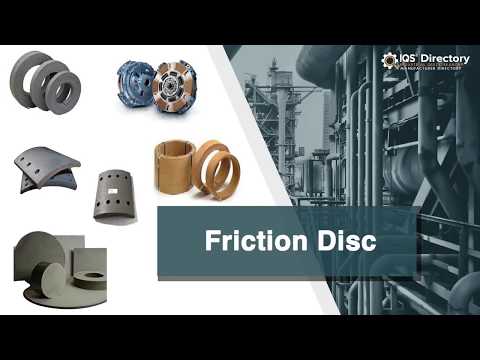
IQS Directory provides an extensive list of friction disc suppliers. Utilize our website to review and source friction disc suppliers with our easy-to-use features which allow you to locate friction disc companies that will design and engineer friction disc suppliers for your exact specifications. Our request for quote forms make it easy to connect with leading friction disc suppliers. View company profiles, website links, locations, phone number, product videos, product specific news articles and other production information. We are a leading manufacturer directory who will connect you with the right manufacturers whether you are looking for friction disc clutch, friction disc system, or industrial friction discs.
Suppliers located in OH, MI, WI +9 more states
Contents (4 sections)
Leading Friction Disc Manufacturers
Showing all 4
| Placement No. | Manufacturer | Location | Contact | Actions | |
|---|---|---|---|---|---|
| 1 | Cook Bonding & Manufacturing Co., Inc.You only need to know one name for your friction material needs: Cook Bonding & Manufacturing. We have been working hard for over 3 decades and specialize in the manufacture of high quality friction materials, gear tooth facings, press blocks, crane brake shoes and hoist frictions. Most products are in stock; custom-made products are also available. Let our experience and expertise work for you. | Cleveland, OH | |||
| 2 | Bremskerl North America Inc.At Bremskerl North America, we are a trusted manufacturer and supplier of high-performance friction materials engineered to meet the demanding requirements of industrial, transportation, and specialized applications. Our company develops friction solutions designed to deliver dependable stopping power, wear resistance, thermal stability, and consistent performance under a wide range of operating conditions. | Bartlett, IL | |||
| 3 | Carlisle Brake & FrictionAt Carlisle Brake & Friction, we specialize in friction materials and braking solutions engineered for demanding industrial, commercial, off-highway, aerospace, and transportation applications. We provide advanced friction products designed to deliver consistent stopping power, heat resistance, durability, and long service life. | Medina, OH | |||
| 4 | TMD FrictionAt TMD Friction, we develop and manufacture friction materials engineered to deliver dependable braking performance across demanding automotive, commercial vehicle, and industrial applications. Our company produces brake pads, brake linings, disc brake components, and related friction solutions designed to provide controlled stopping power, durability, reduced noise, and consistent performance under changing operating conditions. | Troy, MI |
Claim your Page One Spot
Leading friction disc manufacturers are listed first on this page, each with a website preview and a Request a Quote button on its row.
Additional Friction Disc Companies
The category’s other friction disc companies are listed on their own page, with location, phone and website where each supplier provides them.
View 18 Additional Friction Disc CompaniesDo not see your company listed in Friction Disc?
Engineers and buyers use this page to find friction disc suppliers. Add your company to the Friction Disc listings so they can find you too.
List Your Company- Listed in the Friction Disc directory
- A profile page for your company
- Buyers contact you directly
Quick Answers
- How many friction disc manufacturers are listed on IQS Directory?
- 4 leading manufacturers and 18 additional suppliers.
- Where are friction disc manufacturers located?
- The listed suppliers are in 12 states and provinces: Ohio (6), Michigan (3), Wisconsin (3), Pennsylvania (2), Illinois (1), Indiana (1), Minnesota (1), New Jersey (1), and 4 more.
- How do I get quotes from friction disc suppliers?
- Select suppliers in the table and choose Request Quotes. IQS reviews your request and forwards it to every supplier you select.
Friction Disc
Friction discs, sometimes also called clutch discs or brake discs, are elements of the common disc brake. Their purpose is to slow or completely stop the motion of drive shafts, so that they may in turn slow or stop the rotation of the wheels. Composed of friction materials and bonded with rivets or an extremely strong adhesive to a metal plate (the brake shoe), they are found pressed against the brake pads of all types of vehicles and many types of industrial machines and equipment.
How Friction Discs Work
To work, friction disks engage the other components of the disc brake, which include calipers, pistons and rotors. Disc brake calipers house both the brake pads and the pistons. For the process to begin, pressure must be applied to the brake pedal; remember that the brake pad is connected to the brake pedal and, in this case, the friction discs make up the brake pad. As the aforementioned pressure is applied, the calipers squeeze the brake pad and force the discs to close around the rotors. This action creates friction sufficient to slow or halt the rotation of the rotor. Depending on the design of the engine being engaged, the pressure can be generated from pneumatic, hydraulic, or mechanical power.
Design of Friction Discs
During the process that creates the friction necessary to achieve braking of the drive shaft, a substantial amount of kinetic energy is converted into dissipative heat energy. To work properly, friction disks must be fabricated using materials and methods that ensure that they are tough enough to withstand the extremely high temperatures, tension and stress that come along with the friction process. To meet these stringent requirements, friction disks are made of woven fibers that are textured or rough and exhibit characteristics of extreme heat resistance, good conductivity, stability in the face of thermal expansion, superior thermal conductivity and high corrosion resistance. Materials that meet the marks on this checklist are called friction materials or clutch materials. Some friction materials that are often used to make friction disks are a variety of carbon composites and semi-metallic and non-metallic materials such as: aramid fibers, cellulose, ceramics, chopped glass, copper fibers, glass, iron, Kevlar mineral, rubber and steel fibers. To decide which exact material or mix of materials may be acceptable for any specific application, a manufacturer will consider the specifics of that application as well as the other brake material being used, and make sure that they are compatible. The most widely used friction material used to be asbestos, but that has long not been the case, as asbestos fibers are now universally known to be incredibly detrimental to human health; prolonged exposure can lead to lung disease, lung cancer and other devastating illnesses.
Things to Consider When Purchasing Friction Discs
When searching for high quality friction disc manufacturers, customers should look to their body of work. The marks of a well made friction disc are smooth braking, smooth shifting and discs that wear at the same right. A poorly constructed friction disc, whether it is slotted for ventilation, drilled for high performance vehicles or solid, will cause engine vibrations and chatter. Such vibrations can be divided into two categories: hot judder and cold judder. Hot judder vibrations, also known as thermal judder vibrations, are the result of uneven thermal distributions, or hot spots, that distort discs and cause waviness around their edges. These usually come about when a driver heavily reduces the vehicle speed from a high speed to a moderate speed without actually coming to a full stop. Next, cold judder vibrations are typically caused by uneven thicknesses of discs or uneven wear of discs. Likely, unless remedied, they will result in the damage of the braking system. This condition is known as disc thickness variation (DTV). Common causes of DTV include: misalignment of axis (runout), wear and friction material transfers, roughness and waviness of disc surface or extensive vehicle road usage. Because of the nature of the work of friction discs, they must be checked from time to time and they will inevitably need occasional replacement. All friction discs generate something called brake dust, which is simply the residue of the discs and the pads rubbing together. Typically, it builds up on the calipers, pistons and wheels. Though the dust is not particularly harmful to humans, now that brake components are no longer made from asbestos, it can cause damage to the finish of a machine’s or vehicle’s wheels if it is not washed off in time. Learn more about friction discs and friction disc care by contacting an experienced friction disk manufacturer today.