
- 5 leading manufacturers
- 23 additional suppliers
- 17 states and provinces
- 10 related categories
- 12 guide sections
Corrugated Box Manufacturers and Suppliers

IQS Directory provides a detailed list of corrugated box companies and suppliers. Find corrugated box companies that can design and engineer corrugated boxes to your specifications. Peruse our website to review and discover top corrugated box companies with roll over ads and complete product descriptions. Connect with the corrugated box companies through our hassle-free and efficient request for quote form. You are provided company profiles, website links, locations, phone numbers, product videos, and product information. Read reviews and stay informed with product new articles. Whether you are looking for manufacturers of custom corrugated boxes, corrugated plastic boxes, or corrugated box styles of every type, IQS is the premier source for you.
Suppliers located in IL, NY, OH +14 more states
Contents (6 sections)
Leading Corrugated Box Manufacturers
Showing all 5
| Placement No. | Manufacturer | Location | Contact | Actions | |
|---|---|---|---|---|---|
| 1 | Deluxe Packaging, Inc.At Deluxe Packaging, our goal is to always create a cost-effective solution for you and to service you better than anyone else. We offer a full array of high quality corrugated boxes in a variety of shapes, sizes, materials, and features. Deluxe Packaging has a proven track record in custom packaging design and timely delivery. | Pennsauken, NJ | |||
| 2 | Alpha Packaging, Inc.At Alpha Packaging, Inc., we provide corrugated packaging solutions designed to protect products, improve handling, and support efficient shipping and storage operations. Our company manufactures corrugated boxes in a wide range of sizes, styles, and configurations to meet the needs of industrial, commercial, retail, and distribution customers. | Greenwood, AR | |||
| 3 | Croton Point ProductsAt Croton Point Products, we provide comprehensive packaging solutions centered on corrugated boxes for shipping, storage, distribution, inventory management, and product presentation. Our company supplies corrugated packaging in a broad selection of standard sizes, styles, and strength ratings while also developing custom boxes for specialized requirements. | Croton on Houston, NY | |||
| 4 | Associated BagAt Associated Bag, we have built a reputation among many industries by providing a broad range of high-quality corrugated boxes and exceptional customer service. Our 6-month quote guarantee is unequalled in our industry, giving our customers the flexibility to order whenever the time is best for them. Our line of boxes include corrugated shipping boxes, insulated boxes, and more. Contact Associated Bag today! | Milwaukee, WI | |||
| 5 | DIA PackagingAt DIA Packaging, we specialize in providing high-quality corrugated boxes and custom packaging solutions for industrial and commercial applications. Our company offers shipping boxes, die-cut cartons, protective packaging, and custom box designs. We provide packaging consultation, design assistance, and manufacturing services tailored to customer requirements. Our capabilities focus on delivering durable, cost-effective packaging that protects products and improves shipping efficiency. | Marengo, IL |
Claim your Page One Spot
Leading corrugated box manufacturers are listed first on this page, each with a website preview and a Request a Quote button on its row.
Additional Corrugated Box Companies
The category’s other corrugated box companies are listed on their own page, with location, phone and website where each supplier provides them.
View 23 Additional Corrugated Box CompaniesDo not see your company listed in Corrugated Boxes?
Engineers and buyers use this page to find corrugated box suppliers. Add your company to the Corrugated Boxes listings so they can find you too.
List Your Company- Listed in the Corrugated Boxes directory
- A profile page for your company
- Buyers contact you directly
Corrugated Box Industrial Manufacturing Guides
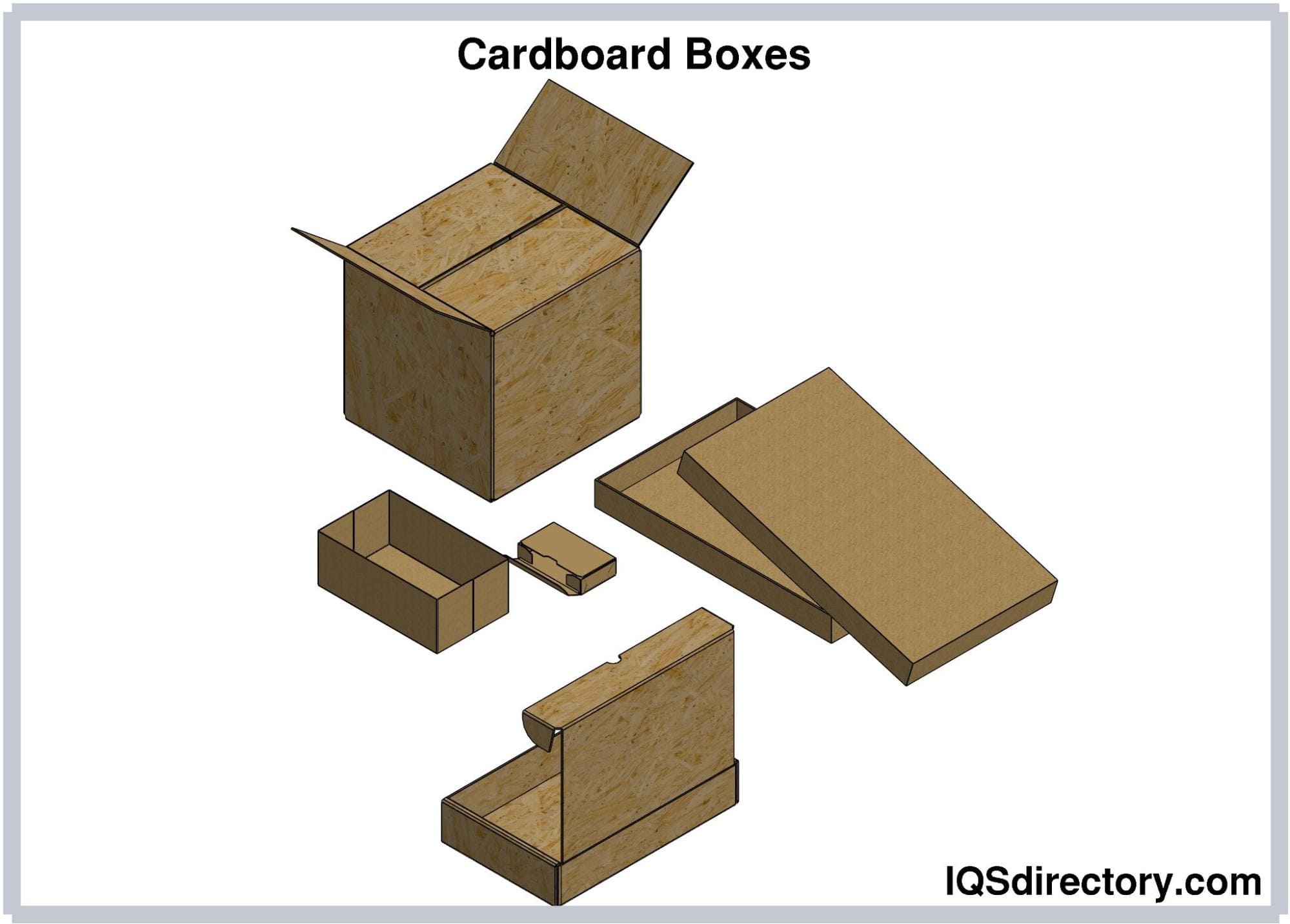
Cardboard Boxes: Types, Materials, and Manufacturing Process
This article is an in-depth guide to how cardboard boxes are made. You will learn more about topics such as: What is a Cardboard Box? How Cardboard Boxes are…
7 chapters, the longest in this category
Quick Answers
- How many corrugated box manufacturers are listed on IQS Directory?
- 5 leading manufacturers and 23 additional suppliers.
- Where are corrugated box manufacturers located?
- The listed suppliers are in 17 states and provinces: Illinois (3), New York (3), Ohio (3), Wisconsin (3), Ontario (2), Pennsylvania (2), Texas (2), Arkansas (1), and 9 more.
- How do I get quotes from corrugated box suppliers?
- Select suppliers in the table and choose Request Quotes. IQS reviews your request and forwards it to every supplier you select.
Corrugated Boxes
Corrugated boxes are storage and shipping containers made from corrugated materials, which typically consist of a type of paperboard that has been fluted, rippled, or ridged for added strength and durability. These containers are most commonly constructed from corrugated fiberboard, a material that features a wavy, corrugated sheet positioned between two flat liner sheets. This layered design enhances structural integrity, making the boxes lightweight yet highly durable. Although the term "cardboard box" is frequently used to describe these containers, it is technically inaccurate, as true cardboard lacks the reinforced structure that defines corrugated packaging.
The History of Corrugated Boxes
Throughout history, packaging materials have consistently been chosen based on cost-effectiveness, favoring the least expensive options available. As a result, paper and its derivatives were largely absent from packaging applications for most of human history. It was only in the mid-1800s, with the development of industrial pulping processes, that paper became widely used for packaging.
The first recorded use of corrugated paper dates back to 1856, when it was patented in England for use as a hat liner. However, it was not until 15 years later, in 1871, that Albert Jones of New York City patented single-faced corrugated board for shipping purposes. Jones’s design laid the groundwork for modern corrugated materials, and in 1874, Oliver Long expanded upon it by adding a second liner sheet, creating the foundational structure of corrugated fiberboard as it exists today. That same year, G. Smyth introduced the first large-scale corrugating machine, enabling mass production of corrugated materials.
The corrugated packaging boxes familiar today—both in terms of material and structural design—emerged toward the end of the 19th century. In 1884, Swedish chemist Carl F. Dahl pioneered the development of kraft paper, a strong, tear-resistant material derived from pulverized wood chips. By 1906, kraft paper was being produced on a large scale, forming the basis for stronger, more durable packaging solutions. Interestingly, the discovery of corrugated shipping boxes was largely accidental. In 1890, Brooklyn-based printer Robert Gair stumbled upon the key technique when a malfunctioning creasing tool on a paper seed bag production line unexpectedly performed cutting actions instead. Initially, corrugated boxes were used mainly for packaging fragile items such as glass and pottery, but their applications soon expanded to include farm produce and a variety of other goods.
By the turn of the millennium, paper-based packaging had transformed from a last-resort option into a dominant force in the industry. In 1992, corrugated fiberboard production in the United States surpassed 25 million tons, a testament to its widespread adoption and growing importance in global packaging and logistics.
Differences Between Paper Products
Although the terms cardboard, paperboard, and corrugated material are often used interchangeably, they have distinct technical differences. The broad term cardboard can refer to any heavy material derived from paper pulp, but it is generally avoided in the packaging industry due to its imprecision. Similarly, paperboard describes a heavy paper-based material that differs from standard sheet paper primarily in its greater thickness.
Chipboard is a more specific term, referring to a product made from recycled paper that is pressed to a designated thickness. Lightweight packaging, such as boxes for board games or cereal, is typically made from chipboard. Based on the earlier definitions, these boxes could also be categorized as cardboard or paperboard boxes, though chipboard remains the most accurate designation.
Corrugated fiberboard is the correct technical term for the most commonly used material in corrugated boxes. This material consists of three layers of kraft paper (a specialized type of paperboard or cardboard), with a corrugated (rippled) interior layer sandwiched between two flat liners. Although some sources mistakenly define corrugated material as any three-layered construction, the term "corrugated" specifically refers to the presence of flutes—the rippled or pleated structure within the middle layer. These flutes serve a crucial role by trapping air, which enhances cushioning and significantly improves the durability of corrugated products. While many three-layered materials exist, corrugated fiberboard is distinct due to this structural reinforcement.
Despite these technical distinctions, the packaging industry sometimes uses colloquial terms like "corrugated cardboard" to simplify communication and prevent confusion among consumers. Additionally, different industries may label these materials differently based on their specific applications. However, for consumers, understanding these differences is important, particularly for making informed purchasing and recycling decisions.
Advantages of Corrugated Fiberboard
Some advantages of corrugated fiberboard include:
Corrugated Boxes Cost One of the greatest advantages of corrugated boxes is their affordability. Thanks to advancements in industrial technology, paper-based packaging has evolved from a secondary choice into one of the most highly valued options in the industry. The production, filling, and shipping costs for corrugated containers are low, and the materials used to manufacture them remain inexpensive, making them an economical solution for businesses. Easy Handling of Boxes Corrugated boxes are widely preferred in the packaging industry due to their lightweight nature. Their low weight makes them easy to handle, transport, and store, significantly reducing shipping costs and simplifying logistics for businesses. Reliability for Shipping Products Despite being made from kraft paper, the fluting structure of corrugated boxes provides exceptional strength and cushioning, ensuring that products inside are well-protected. This built-in shock absorption minimizes damage from weather-related conditions or travel-related shipping hazards, making them a trusted choice for packaging fragile or valuable goods. Durability of Boxes Corrugated boxes are designed to be long-lasting. As long as they are kept dry and free from excessive moisture exposure, they can be reused multiple times, making them a durable packaging solution for both businesses and consumers. Versatility of Corrugated Boxes The adaptability of corrugated boxes contributes significantly to their widespread use. These boxes can be customized in terms of shape, size, color, and structure, making them suitable for industries with unique packaging requirements. Beyond their initial use, corrugated boxes are highly reusable—what starts as packaging for a microwave can later serve as a moving box, storage container, or even repurposed for creative DIY projects. Compatibility With Graphic Design The flat linerboard layers on the exterior of corrugated fiberboard provide an ideal surface for branding, marketing text, and custom graphics. Unlike more expensive or less printable materials, corrugated boxes allow businesses to showcase logos, product information, and promotional designs directly on the packaging, enhancing visibility and customer engagement. Boxes are Recyclable Corrugated boxes are one of the most sustainable packaging options available today. Over 70% of corrugated materials are recovered, recycled, and repurposed into new corrugated boxes and other paper-based products. In 2006 alone, 25.2 million tons of corrugated material were recycled, reinforcing their role in environmentally responsible packaging. This high recyclability makes corrugated boxes an appealing choice for industries looking to reduce their environmental impact and support sustainable business practices.Disadvantages of Corrugated Boxes
Production Process of Corrugated Boxes
As previously mentioned, corrugated boxes are primarily made from a high-quality paperboard known as kraft paper. While corrugated boxes are typically constructed from paper-based materials, they can also be manufactured from other materials when additional strength or durability is required. Corrugated plastic containers serve as a common alternative, particularly for applications demanding greater structural integrity.
Kraft paper is produced using recycled paper, sawdust, and wood chips, which undergo a sophisticated bonding process involving heat, pressure, and adhesives to create heavy-duty paper. Although kraft paper serves as the foundation of corrugated boxes, its production is typically separate from the corrugation process. Paper mills focus on manufacturing kraft paper, while corrugating plants transform it into corrugated fiberboard, an arrangement driven by economic efficiency.
At its core, the foundation of corrugated boxes is the pine tree. Some of the largest manufacturers own thousands of acres of pine forests, along with paper mills dedicated to processing harvested, branchless trunks. At these mills, pine trunks are stripped of their bark and reduced to small wood chips before undergoing the kraft (or sulfate) process. During this process, the wood chips are "cooked" in a highly alkaline sodium hydroxide (NaOH)-based solution, breaking them down into a fibrous pulp. This pulp is then refined and processed using a specialized paper-making machine called a Fourdrinier machine, which forms it into sheets of kraft paper through an extensive dehydration process.
Corrugated box manufacturers maintain large inventories of kraft paper reels received from paper mills. To convert this paper into corrugated fiberboard, they employ massive machines known as corrugators, which can be as long as a football field. The kraft paper is first humidified at high pressures using preheating rollers, softening it for the corrugation process. Next, it passes through corrugated molds, which press ripples or flutes into the material, forming the essential structure of corrugated fiberboard.
The first gluing stage, called the single-facer glue station, bonds the first flat liner to the newly corrugated material. The double-backer glue station then attaches the second flat liner to the opposite side, completing the corrugated fiberboard sheet. The fluted paper is secured to both liner layers using a corn starch-based adhesive, which forms strong, permanent bonds. The newly assembled corrugated fiberboard is then dried over steamy hot plates and often sanded for smoothness or coated with a glossy, waterproof finish for added durability.
At the end of the corrugator, the continuous sheet of fiberboard is cut into large sheets (or box blanks), preparing them for conversion into finished boxes. High-precision corrugators used in modern manufacturing facilities can produce up to 500 feet of corrugated fiberboard per minute, ensuring mass production efficiency.
Although the raw materials for corrugated fiberboard are typically processed at separate facilities, the production of finished boxes is often integrated within the same plant. Once formed, the corrugated fiberboard is fed into box-making machines, which cut, fold, and shape it into ready-to-assemble boxes or containers. Most corrugated boxes are produced in high volumes and sold in bulk, typically in bundles of 20 to 50 boxes at a time. To maximize shipping efficiency, these boxes are always sold and transported in a flattened state, reducing storage space and transportation costs.
Design of Corrugated Boxes
- Telescope-type boxes (Series 03) – Feature a movable lid for adjustable depth.
- Folder-type boxes (Series 04) – Constructed from a single folded piece, typically forming the bottom of the box rather than the sides.
- Sleeve-style boxes (Series 05) – Designed with a separate sleeve-like lid that slides into place.
- Rigid three-piece boxes (Series 06) – Require stitching and gluing for structural assembly.
Usage of Corrugated Boxes
Corrugated fiberboard is widely used for container manufacturing because corrugation significantly enhances strength without adding excessive weight. Corrugated boxes are known for their durability and longevity, making them the preferred choice for shipping, storage, and short-term organization, such as mail delivery applications.
Consumers and businesses encounter corrugated boxes in everyday life across various industries. Many commercial products rely on corrugated packaging, including toothpaste, cereal, soap, computer paper, and check refills. Other common corrugated products include pizza boxes, retail packaging, gift boxes, jewelry containers, bakery and cake boxes, and custom display packaging.
Corrugated packaging is a critical component in numerous industries, including food processing, toys, automotive, publishing, electronics, and construction. Its ability to provide protection, customization, and sustainability makes it an essential packaging material across global markets.
Corrugated Box Types
Standards and Specifications for Corrugated Packaging
The corrugated packaging industry commonly adheres to standards established by ASTM International, a U.S.-based organization that develops and publishes technical standards through voluntary consensus. These standards play a critical role in assessing key properties of corrugated fiberboard and its products, such as breaking strength, tear resistance, and durability.
Below are the primary ASTM standards used in the industry:
- D1974 / D1974M -16 – Standard Practice for Methods of Closing, Sealing, and Reinforcing Fiberboard Boxes
- D2658 – 04 (2013) – Standard Test Method for Determining Interior Dimensions of Fiberboard Boxes (Box Gage Method)
- D3951 – 15 – Standard Practice for Commercial Packaging
- D4727 / D4727M – 17 – Standard Specification for Corrugated and Solid Fiberboard Sheet Stock (Container Grade) and Cut Shapes
- D5118 / D5118M – 15 – Standard Practice for Fabrication of Fiberboard Shipping Boxes
- D5168 -12 (2017) – Standard Practice for Fabrication and Closure of Triple-Wall Corrugated Fiberboard Containers
- D5639 / D5639M – 11 (2015) – Standard Practice for Selection of Corrugated Fiberboard Materials and Box Construction Based on Performance Requirements
- D6804 – 02 (15) – Standard Guide for Hand Hole Design in Corrugated Boxes
These standards ensure quality, consistency, and performance in corrugated packaging, helping manufacturers meet industry expectations for strength, durability, and usability in various applications.
Things to Consider When Purchasing Corrugated Boxes
With well over a thousand corrugated box manufacturers in the United States alone, selecting the right manufacturer for your packaging needs is a crucial decision. The ideal manufacturer will provide customized solutions, adhere to industry standards, ensure product security, and support branding efforts.
- The intended purpose of your corrugated packaging
- Preferred box design and customization options
- The manufacturing timeline
- How the boxes will be stored and transported
The right manufacturer will offer custom-printed corrugated boxes, corrugated boxes with dividers, wax-coated corrugated boxes, and other specialized designs to fit various applications.
- If the boxes will be used internally (e.g., with pallets or machinery), order based on external dimensions.
- If the boxes are intended for shipping to end users, focus on internal dimensions to ensure a proper fit for your products.
Proper Care for Boxes
Moisture compromises one of the key advantages of corrugated boxes—durability. Keeping corrugated boxes dry is essential to maintaining their structural integrity and ensuring long-term usability. Exposure to moisture can weaken the material, causing it to lose strength and collapse under weight or pressure.
Corrugated fiberboard should always be handled with consideration for its anisotropic properties. Anisotropic materials exhibit physical characteristics that vary based on directionality and orientation. In the case of corrugated fiberboard, its behavior depends on the alignment of macromolecules, the flute structure, and the overall grain direction. Improper handling against these natural orientations can reduce strength and performance. Consulting with your corrugated box manufacturer will help ensure that you store, transport, and utilize corrugated fiberboard in a manner that aligns with its anisotropic nature rather than working against it.
Corrugated Box Terms
Common Questions
7 questions
What Makes Corrugated Boxes Stronger Than Regular Cardboard Boxes?
Corrugated boxes are made from corrugated fiberboard, which features a fluted inner layer sandwiched between two flat liners. The air pockets within the flutes provide rigidity and cushioning, making these boxes significantly stronger and more durable than standard cardboard containers.
When Were Corrugated Boxes First Used for Packaging?
The first corrugated paper was patented in England in 1856 for hat liners, but Albert Jones of New York patented single-faced corrugated board for shipping in 1871. By 1874, Oliver Long added the second liner, creating the foundation for modern corrugated fiberboard packaging.
Why Are Corrugated Boxes Popular for Shipping and Storage?
Corrugated boxes are lightweight, strong, and cost-effective, making them ideal for shipping and storage. Their fluted structure absorbs shocks, protecting fragile items during transport, while their affordability and recyclability make them a preferred choice for businesses nationwide.
What Are the Main Types of Corrugated Box Flutes?
Flute types include A, B, C, E, and F, each offering different cushioning and strength characteristics. C-flute is the most common, with about 39 flutes per linear foot, providing an ideal balance of durability, printability, and compression resistance for shipping applications.
How Are Corrugated Boxes Manufactured?
Corrugated boxes are produced by bonding fluted kraft paper between two liners using a starch-based adhesive. Large corrugators shape the flutes, glue the layers, and dry the sheets before cutting them into box blanks, which are folded and assembled into finished boxes for packaging use.
What Are Some ASTM Standards for Corrugated Packaging?
Common ASTM standards include D5118 for fabrication of fiberboard boxes, D4727 for sheet stock specifications, and D5639 for material selection. These standards ensure strength, durability, and consistency across corrugated packaging used in industries throughout the United States.
Can Corrugated Boxes Be Recycled?
Yes. Over 70% of corrugated materials are recovered and recycled into new boxes and paper-based products. Their high recyclability and use of kraft paper make corrugated boxes one of the most sustainable packaging options available for businesses and consumers.