- 5 leading manufacturers
- 8 additional suppliers
- 6 states and provinces
- 16 related categories
- 2 guide sections
Autonomous Mobile Robot Manufacturers and Companies
IQS Directory provides an extensive list of autonomous mobile robot manufacturers and suppliers. Utilize our website to review and source autonomous mobile robot manufactures with our easy-to-use features which allow you to locate autonomous mobile robot companies that will design, engineer, and manufacture autonomous mobile robots for your exact specifications. Our request for quote forms make it easy to connect with leading autonomous mobile robot manufacturers. View company profiles, website links, locations, phone number, product videos, product specific news articles and other production information. We are a leading manufacturer directory who will connect you with the right manufacturers whether you are looking for self propelled vehicles, automatic guided vehicles, or self guided vehicles.
Suppliers located in MI, GA, NC +3 more states
Contents (5 sections)
Leading Autonomous Mobile Robot Manufacturers
Showing all 5
| Placement No. | Manufacturer | Location | Contact | Actions | |
|---|---|---|---|---|---|
| 1 | America In MotionAmerica In Motion was founded in 2007 with a mission to bring customized automated vehicle designs and solutions to the masses. Serving customers in the fibers, paper, automotive, food, consumer products, heavy equipment, and general manufacturing. Our team specializes in fully customizable AGVs but also offers the option to build an automated vehicle by using a simplified modular approach (also known as eBOT). | Charlotte, NC | |||
| 2 | InvioAt Invio Automation, we design and deliver automatic guided vehicle solutions that help manufacturers and distributors move materials more efficiently, safely, and predictably throughout their facilities. We develop AGV systems that replace manual transport tasks with automated movement, improving flow while reducing congestion and handling errors. Our vehicles are engineered for reliable navigation, smooth operation, and seamless integration into active production and warehouse environments, supporting consistent performance in demanding day-to-day operations. | New Baltimore, MI | |||
| 3 | IDC CorporationIDC Corporation produces a line of Automated Guided Carts (AGCs) for various industrial applications, including standard product line carts and custom-designed systems tailored to specific customer needs. The various models are built on a common control architecture that support various mechanical configurations, and support operations ranging from simple delivery loops to sophisticated multi-destination routes with “Dispatch” bits that allow the units to dynamically navigate at run-time based on simple user destination selections. | Dimondale, MI | |||
| 4 | SwisslogAt Swisslog, we specialize in providing advanced warehouse automation and material handling solutions, with a strong focus on automatic guided vehicles (AGVs) and intelligent intralogistics systems. Our company delivers automated transportation solutions designed to improve operational efficiency, streamline material movement, and reduce manual handling requirements. | Atlanta, GA | |||
| 5 | Rocrich AGV Solutions LLCAt Rocrich AGV Solutions, we specialize in providing automated guided vehicle (AGV) solutions that improve material handling efficiency, productivity, and safety in industrial environments. Our company delivers advanced automation systems designed to streamline internal transportation, reduce manual handling requirements, and support continuous material movement throughout manufacturing plants, warehouses, and distribution facilities. | Houston, TX |
Claim your Page One Spot
Leading autonomous mobile robot manufacturers are listed first on this page, each with a website preview and a Request a Quote button on its row.
Additional Autonomous Mobile Robot Companies
The category’s other autonomous mobile robot companies are listed on their own page, with location, phone and website where each supplier provides them.
View 8 Additional Autonomous Mobile Robot CompaniesDo not see your company listed in Autonomous Mobile Robots?
Engineers and buyers use this page to find autonomous mobile robot suppliers. Add your company to the Autonomous Mobile Robots listings so they can find you too.
List Your Company- Listed in the Autonomous Mobile Robots directory
- A profile page for your company
- Buyers contact you directly
Autonomous Mobile Robot Industrial Manufacturing Guides
Autonomous Mobile Robots: Everything You Need to Know about Uses
This article includes everything you need to know about autonomous mobile robots and their use. You will learn: What is an Autonomous Mobile Robot? Types of…
5 chapters
Quick Answers
- How many autonomous mobile robot manufacturers are listed on IQS Directory?
- 5 leading manufacturers and 8 additional suppliers.
- Where are autonomous mobile robot manufacturers located?
- The listed suppliers are in 6 states: Michigan (4), Georgia (3), North Carolina (2), Texas (2), California (1), and Massachusetts (1).
- How do I get quotes from autonomous mobile robot suppliers?
- Select suppliers in the table and choose Request Quotes. IQS reviews your request and forwards it to every supplier you select.
Autonomous Mobile Robots (AMR)
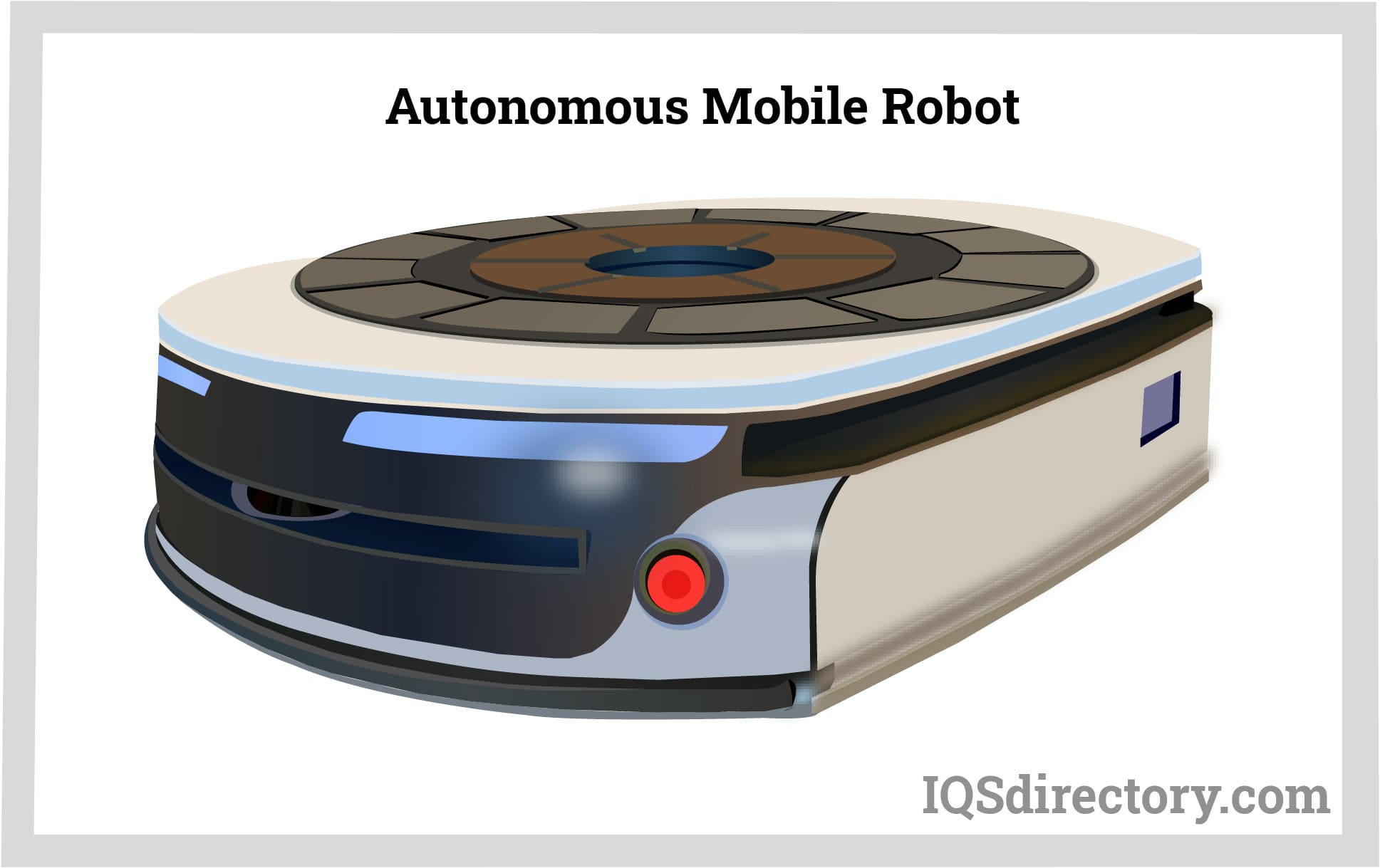
Autonomous mobile robots are rapidly becoming a fixture in manufacturing and industrial operations. Capable of completing a variety of tasks and activities, AMRs can move independently while receiving instructions from a central computer and making adjustments using SLAM algorithms. They can perform routine tasks and rescue operations and are the next step in automated guided vehicle (AGV) technology with expanded functions and capabilities.
AMRs use computer software and mapping technology to move around their environment with sensors to help them detect obstacles and avoid collisions. Initially, AMRs were implemented to perform menial, repetitive tasks that required constant movement by workers. However, this particular function has expanded into more complex, intricate, and essential activities.
How an Autonomous Mobile Robot Works
Unlike AGVs, autonomous mobile robots are able to navigate a facility without the use of tape, tracks, reflectors, or other forms of guidance systems. AMRs are completely independent and can operate on their own using information programmed into their system. They have a complex collection of technical instruments, including sensors, artificial intelligence, machine learning, and computer software, for planning their path and interpreting their environment.
AMRs can "see" where they are going through the use of light detection and ranging (LiDAR) scanners, ultra-wideband (UWB) scanners, and two- and three-dimensional cameras. These devices allow an AMR to observe its environment and make immediate adjustments. Furthermore, visualization tools make it possible for an AMR to create its own path. In addition, some AMRs are designed with sound identification software that enables them to have auditory navigation systems.
Mapping
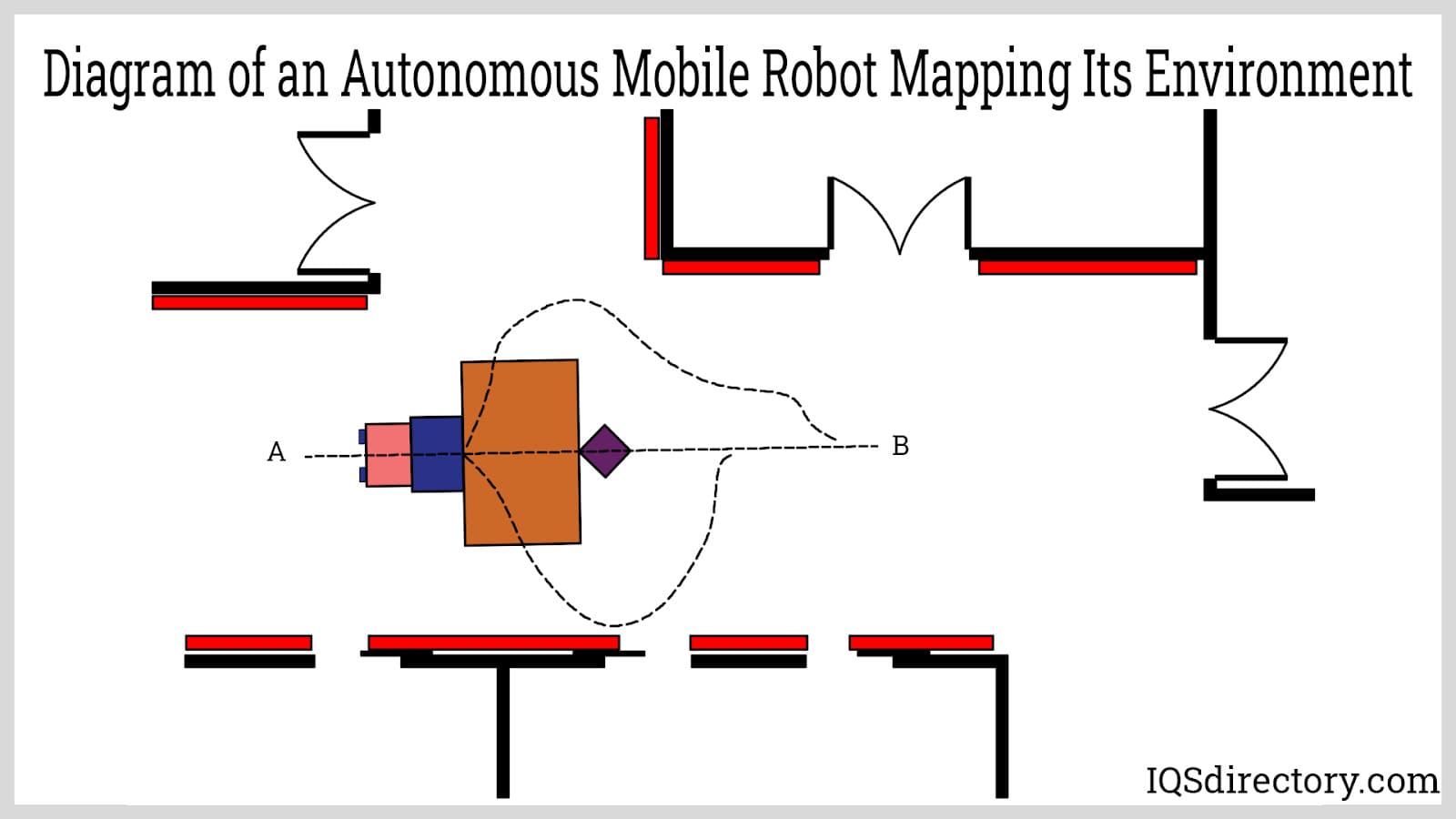
A critical aspect of an AMR‘s navigation is its mapping software that provides an overview of the facility where they are being used. Aspects of a building that do not change are programmed into the mapping software, such as shelving, pillars, machines, entrances, and other obstacles.
In conjunction with the mapping software, sensing technology is used to detect possible obstructions that may become obstacles during the work of an AMR, such as workers, vehicles, and other AMRs. This aspect of AMRs makes it possible for them to "understand" their surroundings and efficiently perform their function.
Simultaneous Localization and Mapping (SLAM)
The mapping process uses the SLAM to build maps and place AMRs in the maps. The algorithms of SLAM assist AMRs in "seeing" the characteristics of their environment or new and unknown environments. SLAM has existed for many years and has been the subject of studies. It hasn‘t been until recent advances in computer processing speeds and sensors that SLAM has been put to practical use.
Visual SLAM
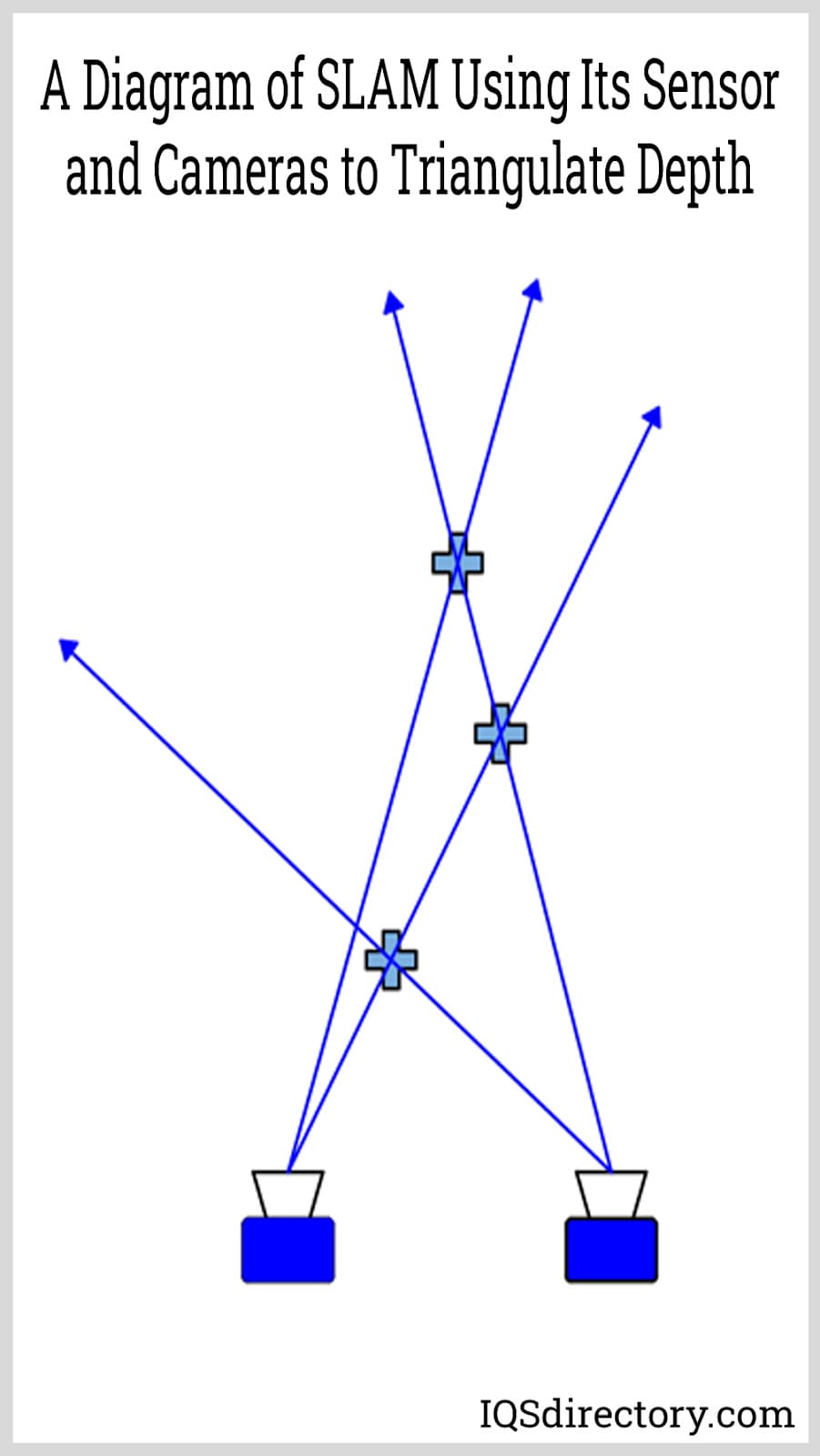
Visual SLAM uses images it receives from cameras and sensors. Although a single camera can be used for visual SLAM, additional sensors and cameras give an AMR depth perception and movement estimates. The cameras and sensors are not like those in television or photography. They provide an approximation of the environment and can calculate distances and depth. The data collected is used to estimate the position of the AMR in space and build a map of the features it has "seen."
Light Detection and Ranging (LiDAR)
LiDAR uses pulsed laser light to measure distances and other data to create three-dimensional information. The components of LiDAR are a laser, scanner, and global positioning sensor (GPS). The laser sensor is the central component that provides precision distance measurements and works in combination with map constructions from SLAM. The calculated travel distance collected by LiDAR is used to localize an AMR.
An interesting aspect of LiDAR is its need for obstacles, without which it is unable to align and will lose track of an AMR‘s location. Additionally, high-speed processing is essential to improve AMR speed.
How AMRs Are Used
AGVs have become a valuable tool for inventory movement and assisting assembly operations. However, their flexibility is limited by the track, tape, or reflectors they depend on to complete any task. Such limitations are removed from AMRs, which can go anywhere to perform a task.
The increased use of AMRs has added a new tool to industrial and commercial operations. Since AMRs automatically adjust and change with conditions, they can be instantly repurposed without having to make structural alterations.
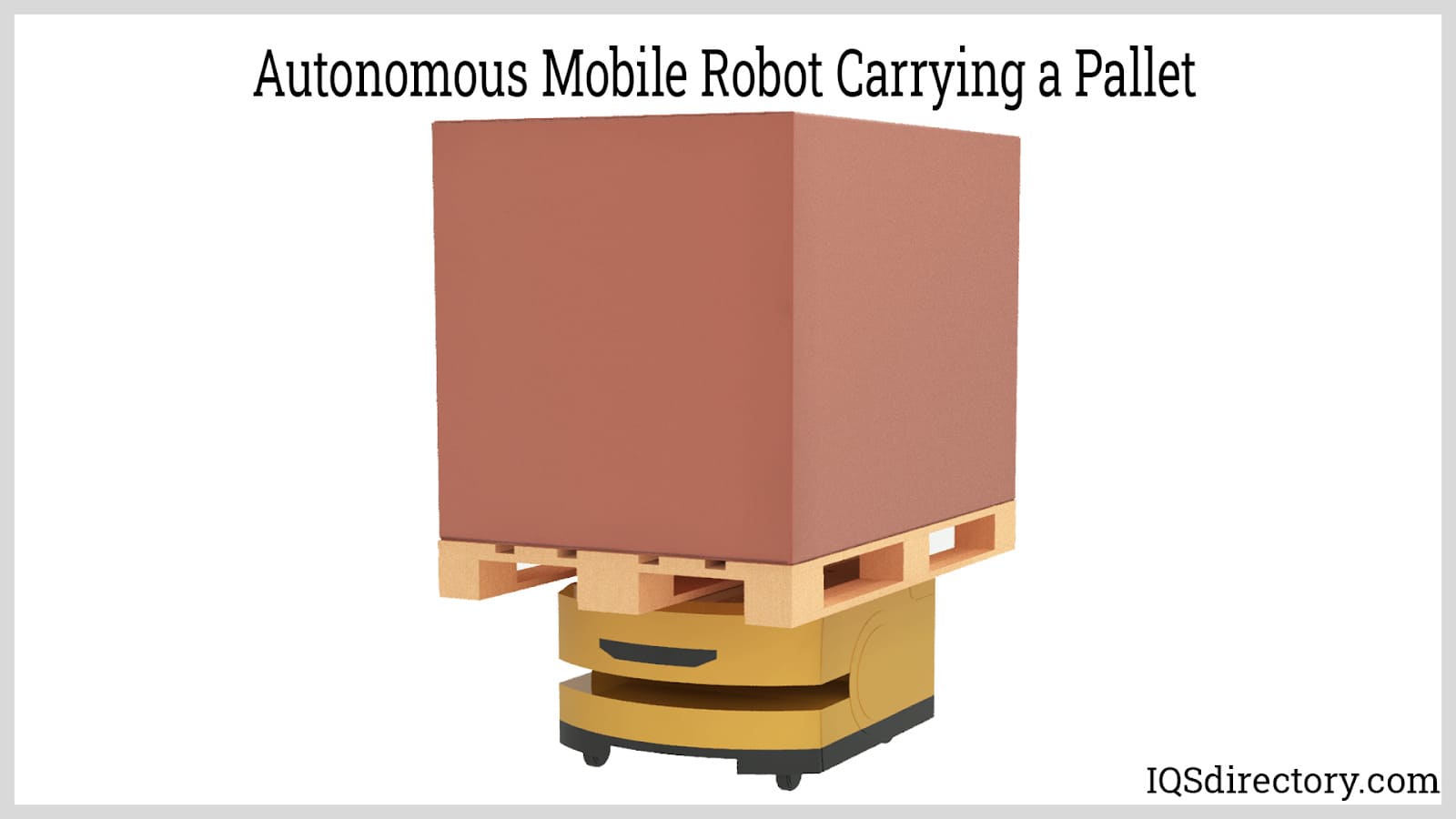
Inventory Transport
The movement of inventory from one location to another is a low-level task that is one of the first jobs to be allocated to AMRs. The automation of inventory movement saves time and allows workers to do more important work.
Order Picking
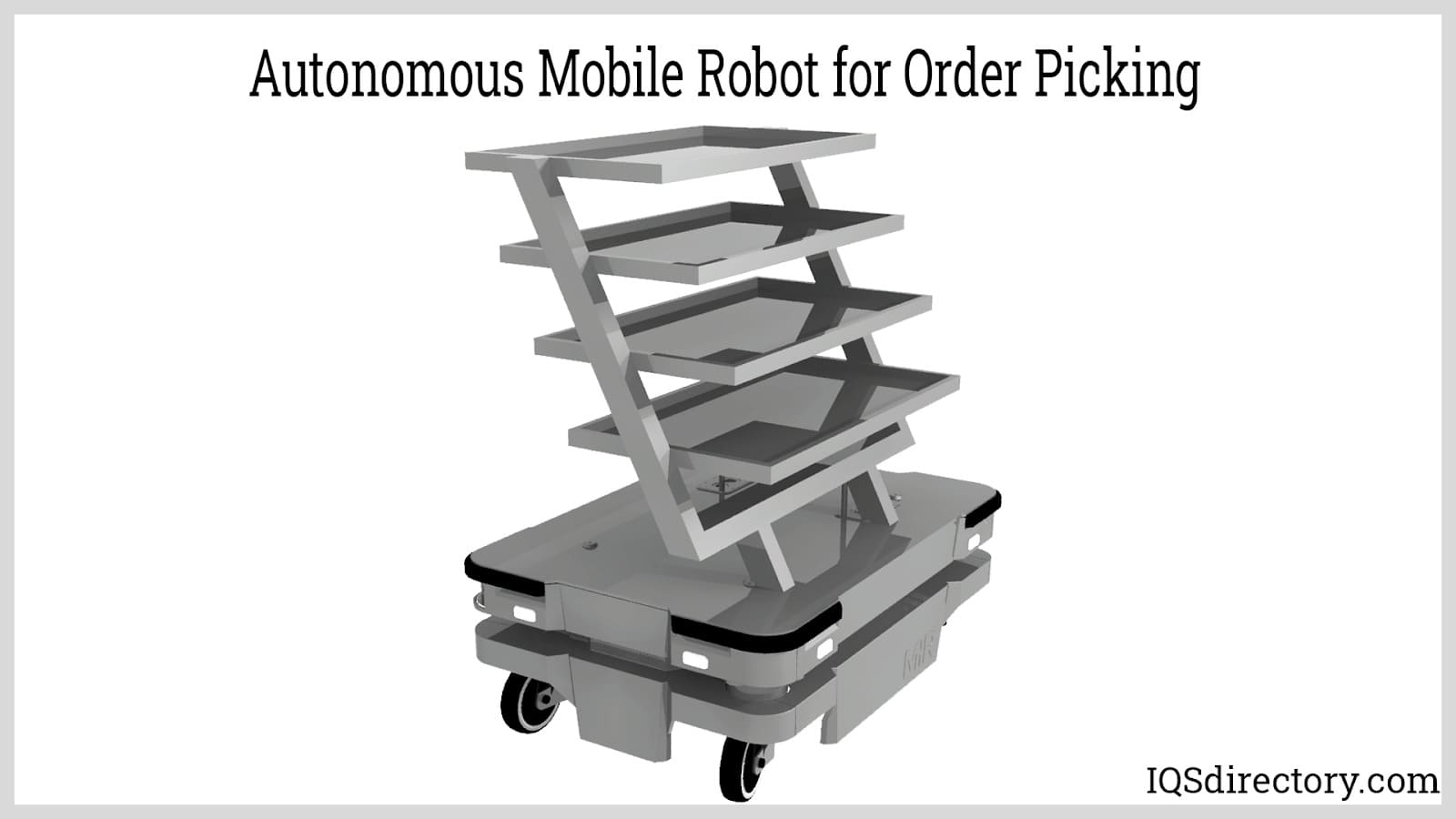
A tedious task that has been the function of warehouse workers for centuries is picking and assembling inventory for shipment, production, and delivery. It is an exceptionally expensive function that requires significant training, experience, and skill. Additionally, order picking is one of the most time-consuming jobs of any organization because it requires multiple trips, correction of errors, and constant searching. Simply walking from one part of a facility to another consumes time.
The effortless work of AMRs makes it possible to efficiently complete order picking at low cost and increase inventory visibility. They assist in eliminating errors, remove the need for multiple trips, and operate with precision and accuracy.
Sortation
Sortation is a method for distributing pieces, cases, totes, and baggage for packing. AMRs designed for sortation come with tilt trays, cross belt systems, and belt trays for parcel sortation, e-commerce preparation, and classifying returns. In the sortation process, high-speed AMRs are used to rapidly complete the sortation process.
Medical Disinfection
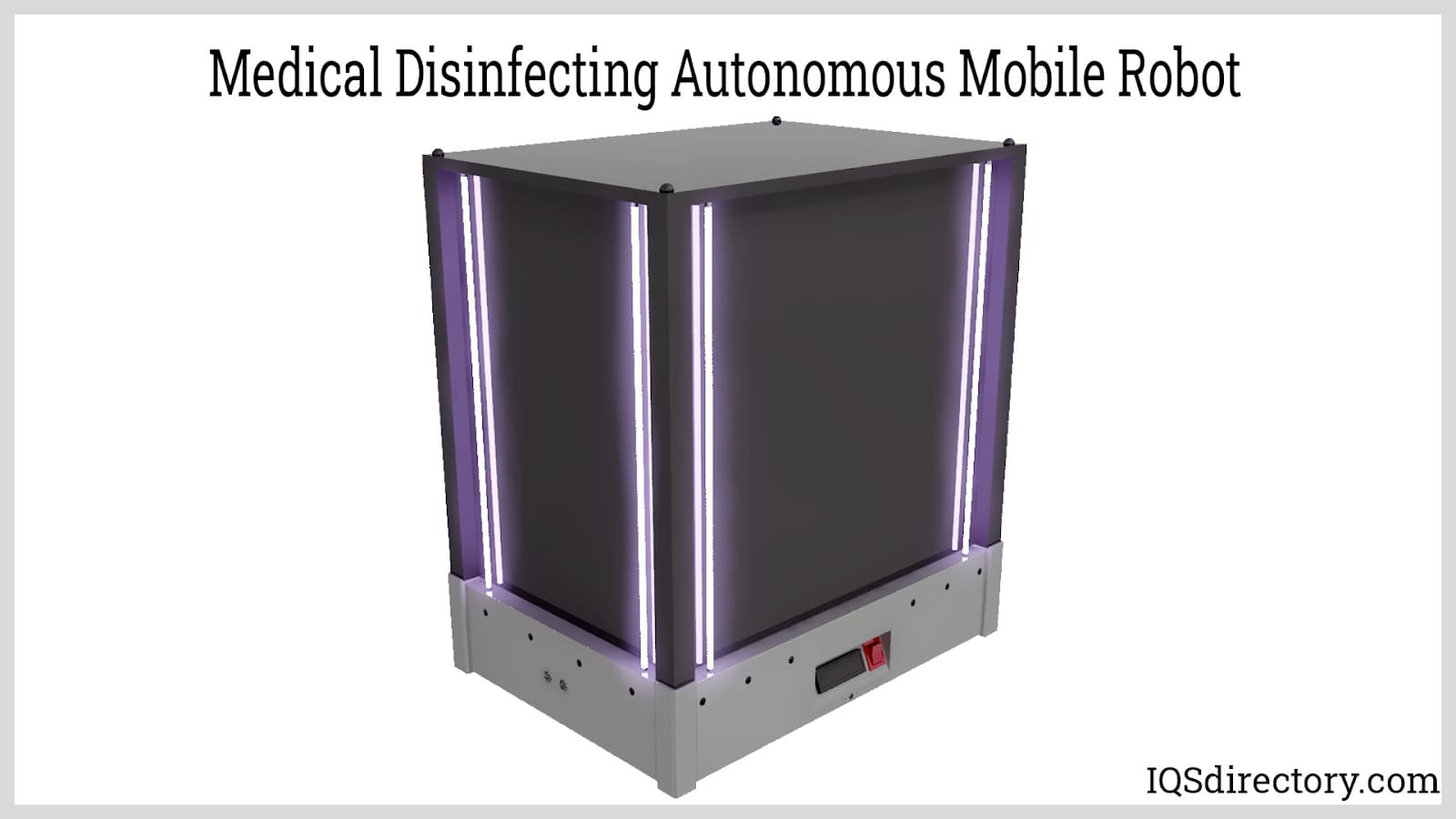
Medical disinfection autonomous mobile robots combine an AMR with a disinfecting system to disinfect and sanitize rooms using sprays and ultraviolet light. The purpose of medical disinfection AMRs is to protect medical personnel from contaminated environments that may be dangerous to humans.