


Adjustable Workbench: Everything you need to know about Types & Uses
IQS Directory EditorialUpdated 5 chapters
5 leading suppliers listed with this guide
Browse adjustable workbench suppliersContents (5 chapters)
This article takes an in depth look at adjustable work benches.
You will learn more about topics such as:
- What is an Adjustable Work Bench?
- Types of Adjustable Work Benches
- Uses for Adjustable Work Benches
- Materials Used to Construct Adjustable Work Benches
- And much more …
What Is an Adjustable Work Bench?
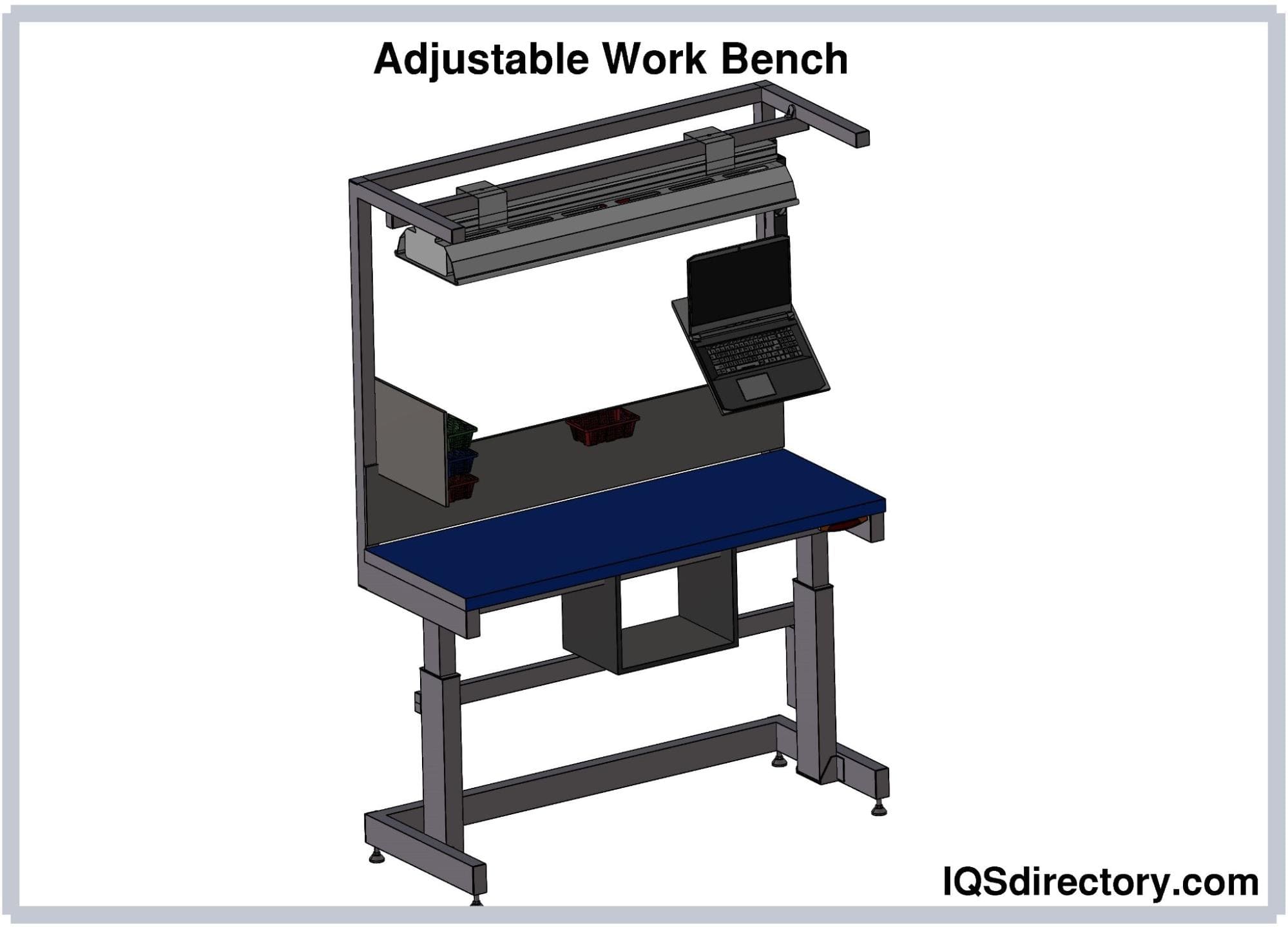
An adjustable work bench is a versatile ergonomic work surface that enables users to alter the height of the work area, making daily tasks more comfortable, efficient, and safer. Also known as a height-adjustable workbench or industrial work table, this solution helps support better posture and a more productive workflow in manufacturing, assembly, repair, inspection, and laboratory environments. There are several types of adjustable work benches, some of which can support over a ton and feature settings that allow them to automatically adjust to the preferred working height of the user.
To enhance workplace safety and efficiency, employers emphasize the importance of their employees' health by reducing discomfort and preventing strain. This is primarily achieved by investing in adjustable work benches, which help alleviate muscle tension, reduce repetitive motion injuries, and lower the risk of work-related musculoskeletal disorders. In facilities focused on lean manufacturing, order fulfillment, or precision assembly, an ergonomic bench can also improve accuracy, reduce fatigue, and support higher throughput across shifts.

These benches can be equipped with a variety of tops, such as steel, plastic, or wood, depending on the specific needs of the work being performed. The adjustment mechanisms can vary widely, ranging from simple manual hand cranks to sophisticated electric lift systems and remote-controlled controls. Buyers often compare load capacity, durability, height range, mobility, and surface material when selecting the right adjustable work bench for a production line, workshop, or assembly station.
Among the significant innovations in workbench design for the modern era is the computer workbench, integrated with vital power outlets and organizational elements for technical tasks. Ergonomically designed benches play a crucial role in industries where tasks involve assembling or examining small parts, as they help reduce the strain of maintaining static positions for extended periods. Additional options such as casters, storage, integrated lighting, and accessory rails can further improve workflow, making these benches ideal for quality control, electronics, maintenance, and other precision applications.
The rising importance of ergonomics and the persistent effects of uncomfortable working positions have pushed HR professionals and production managers to seek out ergonomic solutions. In response, workbench manufacturers focus on creating benches that cater to particular application requirements, embedding features that maximize worker comfort and operational efficiency. For businesses evaluating an adjustable industrial workbench, key purchase considerations often include customization options, safety compliance, ease of adjustment, and long-term return on investment.
What Are the Different Types of Adjustable Work Benches Available?
Every industrial, commercial, or laboratory work environment requires specialized equipment that aligns with specific application demands and the ergonomics of its workforce. This has fueled the rapid adoption of adjustable workbenches, widely recognized for their versatility, customization, and adaptability to diverse production and research settings. Whether in manufacturing, electronics assembly, research laboratories, cleanrooms, or educational institutions, an appropriately chosen adjustable height workbench can improve productivity, worker safety, and comfort.
Adjustable workbenches come in a variety of styles and configurations, which can be categorized by surface material, mechanism of height adjustment, network connectivity, weight-bearing capacity, and suitability for specialized environments such as scientific laboratories, ESD-sensitive electronics workstations, cleanrooms, or heavy-duty operations like machine repair and mechanical assembly. As workplace health and efficiency have become top priorities, manufacturers are increasingly innovating to provide custom, ergonomic, and smart workbench solutions to support lean manufacturing, modular workflows, and unique user requirements.
Adjustable Work Bench Types
Portable Work Benches
Portable adjustable workbenches are engineered for easy movement and flexible deployment, especially in dynamic industrial environments, field service operations, or workshops where materials and tools need to move frequently. Typically equipped with durable casters or locking wheels, these mobile workbenches enable users to transport work surfaces safely and efficiently between different locations. Depending on workplace requirements, lifting mechanisms may include hydraulic actuators, manual cranks, pneumatic lifts, or electric motors for effortless, secure height adjustments. The ability to reconfigure portable benches quickly makes them ideal for sites with changing tasks, space constraints, or frequent process adjustments, such as automotive service centers, maintenance departments, and industrial production lines.
For height changes, mobile benches often use compact hydraulic lifts or manual crank systems—the latter being the most common for robust, cost-effective adjustability. Some advanced portable adjustable benches integrate smart controls for preset height settings to enhance workflow precision and operator comfort.

Plain Adjustable Work Bench
A plain adjustable height workbench offers a basic yet highly durable solution for heavy-duty industrial applications. With no hydraulic, electronic, or crank-based height adjustment, these benches use robust steel legs featuring two pins or detents to lock the supports at the desired level. Height adjustment is performed manually by repositioning the work surface to a fixed setting. This no-frills approach provides reliable load-bearing strength, minimal maintenance, and high resilience against wear—making such benches well-suited for metalworking, woodworking, and manufacturing environments requiring infrequent height changes but maximum steadiness and capacity.
Available in standard lengths of four, six, and eight feet, plain adjustable benches feature reinforced rectangular frames beneath the work surface—ensuring stability and a long service life even under rigorous use. These benches are a preferred choice in heavy equipment repair, machine shops, and assembly lines where predictable, static work heights support throughput and worker safety.

Scientific Workstations
Within scientific laboratories, research facilities, and experimental settings, ergonomic adjustable laboratory workbenches are vital for protecting researchers, lowering fatigue, and enabling precision. These scientific workstations come in various designs, including electrically powered height adjustments, manual crank systems, pneumatic lifts, or hybrid configurations. Easy, rapid adjustability is crucial for quickly accommodating personnel of different heights or for switching from seated to standing positions, helping comply with occupational health and safety guidelines.
Lab workbenches demand high stability, level surfaces, and sturdy leg construction to prevent vibration, minimize contamination risks, and protect sensitive instruments or experimental materials. Options often include modular shelving, integrated data and power management, built-in sinks, or chemical-resistant surfaces. Scientific workstations are tailored for applications ranging from sample preparation and microscopy to analytical chemistry and quality control, providing a safe, comfortable space for extended research tasks.

Heavy Duty Work Benches
Heavy-duty adjustable workbenches are engineered for demanding environments where strength, durability, and variable-height function are essential. Featuring robust hand-crank or electric motor mechanisms, these benches offer an adjustable height range—commonly from 30 to 42 inches—making them well-suited for handling large, heavy workpieces or supporting industrial tools and equipment. Heavy-duty benches routinely incorporate interchangeable work surfaces (such as solid hardwood, stainless steel, or anti-static laminates) to match the specific technical needs of each industry.
Additional configurations may include footrests, modesty panels, or under-bench storage, and their high load capacities (often 750 pounds or more) cater to machine assembly, metal fabrication, automotive repair, and other manufacturing sectors requiring reliable, dynamic work support. Enhanced structural components provide excellent rigidity and vibration resistance even under continuous use.

Benches for Electronics
Electronic assembly, testing, and repair processes demand ESD-safe adjustable electronic workbenches for both efficiency and protection of sensitive components. These workbenches offer precise ergonomic positioning through intuitive electronic or manual height controls, reducing technician fatigue and improving focus during intricate tasks such as PCB assembly or soldering. Proper bench height is critical to prevent awkward postures and to maintain high accuracy over prolonged periods.
Common features of electronic workbenches include modular tool storage compartments, integrated power outlets, antistatic surfaces, equipment shelves for computers and test instruments, LED lighting, and cable management systems. Built-in grounding and ESD-safe designs prevent static damage to microelectronics. Many advanced models provide customizable configurations and digital memory for frequently used height settings—making them ideal for electronics manufacturing, quality assurance, and service labs.

Wire Harness Assembly Benches
The assembly of complex wire harnesses—integral to automotive, aerospace, and industrial controls—requires highly adaptable workbenches for precision and organization. Adjustable height and tilting work surfaces are crucial to improving ergonomics and visibility, minimizing errors, and reducing strain during repetitive assembly tasks. These specialized workbenches may feature grid layouts, fixture points, and custom jigs for routing and securing wire bundles, cable ties, and tubing efficiently.
Height adjustments can be facilitated by advanced foot pedal controls, electronic interfaces, or manual mechanisms—enabling workers to fine-tune the workstation for each job. Integrated work lighting, tool trays, and ESD protection further support efficient and safe assembly of intricate wire harnesses, boosting productivity in high-mix, low-volume manufacturing environments.
For instance, electronic adjustments on wire harness assembly workbenches may include user-friendly controls such as a foot pedal, as illustrated in the image below.

Desk and Work Bench
Modern work environments often demand multi-purpose furniture that combines the versatility of a desk with the strength of a workbench. Desk-workbench hybrids deliver both: generous storage for files and personal items alongside a large, robust surface designed for technical or administrative tasks. These models feature advanced crank or electrically operated height adjustment mechanisms and often support weights up to 750 pounds or more, catering to users who transition between traditional office work and hands-on technical tasks.
The fusion of ergonomic design and industrial-grade strength makes these hybrid benches suitable for office labs, R&D centers, and collaborative workspaces. Options such as integrated data ports, overhead shelving, and locking storage make these benches ideal for multi-functional laboratory environments, engineering departments, and creative industrial settings.

Electrostatic Discharge (ESD) Adjustable Work Bench
In electronics manufacturing and assembly, ESD adjustable workbenches are essential to protect sensitive electronic components from electrical discharge damage. These workbenches feature high-resistance, static dissipative surfaces and integrated grounding to safeguard workers and products from static build-up, especially when handling printed circuit boards or semiconductors. Surface materials with resistance values as low as 1.0 x 10⁹ Ω or lower ensure proper dissipation of residual charge, maintaining an ultra-safe environment for delicate electronics.
ESD workbenches can be equipped with multiple antistatic outlets, wrist strap connections, and compliant laminate surfaces. Their critical role in modern electronics manufacturing, testing, repair, and cleanroom assembly lines cannot be overstated, especially with rapidly advancing component sensitivity and miniaturization.

Computer Work Bench
With technology now central to most workplaces, adjustable computer workbenches have evolved to serve IT labs, electronic workshops, engineering departments, and manufacturing enterprises. These specialized workstations accommodate multiple computer monitors, CPU holders, cable management systems, and secure power supplies. Many models feature ESD protection for data-sensitive equipment and ergonomically designed surfaces to facilitate prolonged computer-based tasks.
Key features in computer workbenches include flexible display mounts, retractable keyboard trays, integrated power/data ports, and modular storage for technical tools. Height-adjustable designs allow users to alternate between sitting and standing, encouraging healthy posture and reducing repetitive strain injuries. Whether supporting single-PC mobile workstations or large-scale configurations for multiple users, these benches ensure effective workflow and adaptable workspace layouts for dynamic business needs.
Their ergonomic design, customizable options, and modular scalability make adjustable computer benches ideal for modern business, education, and research settings, delivering long-term comfort, organization, and operational efficiency.
Vibration Isolation Work Benches
Vibration isolation workbenches utilize advanced dampening technologies—such as pneumatic suspension or elastomeric rubber mounts—to mitigate both vertical and horizontal vibrations. This is critical for industries performing high-precision measurement, sensitive testing, or fine mechanical and optical assembly, where even minor disruptions can compromise results. Labs focused on electron microscopy, semiconductor fabrication, or metrology frequently rely on these benches to provide a stable work platform.
Capable of supporting loads up to 500 lbs (226.7 kgs), vibration isolation workbenches absorb and dissipate shock from heavy equipment or building movement. Many models pair isolation features with anti-microbial or cleanroom-compatible surfaces, thus meeting specialized standards for contamination control. Enhanced vibration dampening protects valuable instruments, ensures measurement accuracy, and improves product quality in critical environments.
The adjustable workbenches highlighted above represent a diverse selection within an ever-growing market driven by worker safety, technological innovation, and ergonomic design. As modularity and digital integration become priorities in industrial and laboratory settings, both off-the-shelf and custom-built adjustable workbenches address the specific challenges of today's evolving workplaces. Choosing the right workbench—tailored to job function, user needs, and industry-specific regulations—is essential for maximizing productivity, safeguarding worker well-being, and supporting long-term operational success.
What Are the Common Surface Types Available for Adjustable Work Benches?
The work surface of an adjustable workbench must be tailored to accommodate diverse workpieces and provide the strength and stability required for demanding tasks. Adjustable workbenches are engineered for ergonomic flexibility, allowing users to modify height and surface to meet their specific needs. These benches feature tops crafted from a wide array of durable materials, each designed to optimize productivity, support heavy loads, and provide optimal resistance to wear and specialized conditions.
Common types of work surfaces for adjustable work benches range from simple laminated heavy-duty plywood to advanced options like stainless steel. In general, the more rigorous the industrial application, the more robust and resilient the workbench surface must be. Selecting the correct surface is crucial for applications including manufacturing, laboratory use, assembly lines, electronics repair, and cleanroom environments, where factors such as chemical resistance, cleanliness, static control, and ease of maintenance must be considered.
Surfaces for Adjustable Work Benches
Butcher Block Tops
Butcher block workbench tops are prized in woodworking shops, educational settings, laboratories, and light industrial use for their classic appearance, shock-absorbing qualities, and durability. These heavy-duty surfaces can withstand repetitive impact, making them ideal for assembly work or detailed craftsmanship. The manufacturing process—gluing, kiln-drying, curing, and sanding, followed by a protective finish—ensures long-term performance. Butcher block adjustable workbench surfaces are commonly constructed from premium woods such as birch, ash, and maple, each providing exceptional strength and a smooth finish that can be easily refinished when worn. When properly maintained, they provide excellent resistance to gouging and splintering, supporting both precision and longevity in workshop environments.

Electrostatic Discharge (ESD) Work Bench Surfaces
ESD (Electrostatic Discharge) adjustable workbench surfaces are uniquely engineered for environments where sensitive electronics are handled, such as electronics assembly, repairs, and laboratories. These anti-static workbench tops feature advanced static control properties, often incorporating conductive laminates and reinforced with high-density plastic glides. ESD-compliant surfaces are meticulously tested for electrical conductivity to prevent damaging static discharge, ensuring the safety of components like circuit boards and semiconductors. Adjustable ESD workbenches often include grounding points and wrist strap connections for optimal static protection, making them a critical choice for professionals in electronics manufacturing and technical servicing industries.

Stainless Steel Surfaces
Stainless steel adjustable workbenches are engineered for high-performance, heavy-duty use in demanding environments such as cleanrooms, laboratories, food processing facilities, and pharmaceutical production. Stainless steel tops offer outstanding resistance to chemicals, corrosion, heat, and moisture. Their non-porous surface is easy to sanitize, making them ideal for sterile applications and workspaces that must meet strict hygienic standards. In addition to worktop cleanliness, these adjustable benches often feature heavy-gauge steel frames that enhance durability and load capacity, with ergonomic height adjustments to support efficiency and compliance with workplace safety requirements. Stainless steel workbench surfaces are favored in manufacturing, healthcare, and laboratory research for their longevity and easy maintenance.

Steel Work Bench Tops
Steel adjustable workbench tops are highly robust, capable of sustaining substantial weight and heavy-duty equipment frequently found in automotive shops, metalworking, and manufacturing plants. These industrial-grade tops are usually finished with a durable powder coat, enhancing their resistance to oil, chemicals, scratches, and stains. Steel workbenches provide a stable foundation for high-torque operations and repetitive motion assembly tasks. Most adjustable steel workbenches offer a height adjustment range from 27 inches to 36 inches, using manual or powered lift mechanisms. Level adjusters are included to maintain surface stability even on uneven floors, which is vital for safety and precision during detailed or repetitive operations. Their adaptability makes them suitable for welding, fabrication, and mechanical assembly applications.

Wood Adjustable Tops
Wood adjustable workbench tops are among the most traditional and versatile types, valued for their tactile surface, natural aesthetics, and adaptability to various project types. Available in a range of wood species, from maple and oak to birch, these benches can be mounted on robust steel frames or constructed as all-wood systems for lighter applications. The adjustability of these benches comes via different mechanisms, including hand cranks, scissor lifts, or hydraulic systems, allowing users to quickly change the working height according to task requirements.
The longevity and performance of wood-topped adjustable workbenches in industrial use largely depend on the type and quality of protective finish applied. Premium finishes provide better resistance to oils, solvents, and abrasion, extending lifespan even in high-traffic environments. With the right frame and reinforcements, a wood adjustable workbench can support loads of up to one ton, making them suitable for both precision tasks and heavy assembly work where comfort and workability are important.

Plastic Topped Work Benches
Adjustable workbenches with plastic tops deliver a resilient, impact-resistant, and non-porous surface that excels in environments prone to moisture, chemicals, or frequent cleaning. Plastic workbench surfaces, commonly made from high-pressure laminates or polyethylene, offer exceptional resistance to burns, stains, chemical spills, and impact. Their smooth, non-scratch finish is favored in laboratory, assembly, and educational applications where contamination must be minimized. Because the sealed surface resists warping and swelling from liquid exposure, plastic-topped benches are ideal for wet environments and cleanrooms.
Frames for industrial-grade plastic workbenches are typically constructed from heavy-duty steel to provide stability and accommodate adjustable height mechanisms. Manual, electric, or hydraulic lift systems are available, catering to diverse ergonomic needs and enabling safe, efficient workflow in fast-paced or precision-based settings.

How to Choose the Right Adjustable Workbench Surface
Selecting the ideal surface for your adjustable workbench depends on your unique requirements, including industry standards, load capacity, resistance to chemicals, static control needs, and ergonomic considerations. Assessing the typical tasks, materials handled, and environment will help determine whether you need the ruggedness of steel, the hygiene of stainless steel, the anti-static properties of ESD laminates, or the classic feel of a butcher block or wood top. Proper investment in the appropriate workbench surface can boost productivity, safety, and equipment longevity in workshops, laboratories, and industrial facilities.
For more information on optimizing your workspace or to compare adjustable workbench surface materials, consult with an industrial furniture expert or review material specification sheets to ensure you select the optimal solution for your application. For additional reference guides on workbench materials and ergonomic solutions, you may consider reading relevant industry publications.
Frequently Asked Questions
What Is an Adjustable Work Bench and How Does It Improve Ergonomics?
An adjustable work bench allows users to change the height of the work surface for comfort and safety. This ergonomic feature helps reduce muscle tension and risk of injuries by letting workers perform tasks in optimal positions.
What Types of Adjustable Work Benches Are Available for Specialized Industries?
Adjustable work benches are offered as portable benches, heavy-duty models, ESD-safe electronics benches, scientific workstations, wire harness assembly benches, desk-workbench hybrids, and vibration isolation benches—each designed for specific industrial, laboratory, or electronic environments.
What Are the Common Surface Options for Adjustable Work Benches?
Common surfaces include butcher block, ESD laminate, stainless steel, steel, wood, and plastic tops. Each surface is chosen based on needs such as chemical resistance, static control, cleanliness, and durability required for various tasks.
How Are Adjustable Work Benches Customized for Electronics Assembly?
Electronics work benches offer antistatic surfaces, ESD protection, modular storage, integrated power outlets, and precise ergonomic height adjustments to protect sensitive components and reduce technician fatigue during assembly or repairs.
Which Adjustable Work Bench Surfaces Are Ideal for Laboratory or Cleanroom Use?
Stainless steel and plastic-topped adjustable work benches are preferred for laboratories and cleanrooms due to their chemical resistance, non-porous surfaces, and ease of sanitation, meeting strict hygiene requirements.
What Height Adjustment Mechanisms Are Used in Modern Adjustable Work Benches?
Modern adjustable benches use mechanisms like manual hand cranks, hydraulic lifts, electric motors, pneumatic actuators, foot pedals, and even remote-control or smart settings, depending on application and user preference.
What Basic Mechanisms Are Used to Adjust Adjustable Work Benches?
The ergonomic advantage of an adjustable workbench lies in its capability to be set at various heights to match the stature of a worker or technician. This feature distinguishes adjustable workbenches and is achieved through a variety of adjustment mechanisms, ranging from simple manual controls to sophisticated hydraulics.
The different ways to adjust adjustable work benches are built into the table whether it is slots along the legs to insert tabs or bolts or scissor lift hydraulics. Though other methods for height adjustment are being used to overcome muscle stress for workers, adjustable work benches tend to be the most practical.
Mechanisms for Adjustable Work Bench Adjustments
Slot Adjustment Method
Adjustable workbenches using the slot method for height adjustment feature punched slots on each leg, allowing for incremental height adjustments of one inch. Heights can typically be adjusted between 30 inches to 40 inches.
To make adjustments, the workbench legs are raised, and bolts or spacers are removed. The desired height is then measured from the table surface. The legs are adjusted by pulling them out or pushing them in to match the desired height. Once the correct height is achieved, bolts or spacers are reinserted and secured.
Manually adjusted adjustable workbenches typically have frames made from heavy-duty 13 to 16 gauge steel, capable of supporting loads ranging from half a ton to one ton.

Crank Adjustable Work Benches
Crank adjustable workbenches are manual but feature a more convenient adjustment system compared to the slot method. A crank handle is connected to a gearbox. When the crank is turned, the gears within the gearbox rotate a shaft that in turn adjusts a set of shafts running the length of the legs, allowing for precise height adjustments by pushing them up or down.

Hydraulic Work Benches
Hydraulic adjustable work benches use hydraulic cylinders to adjust the table’s height. They can be electrical or crank with two or four cylinders. There are many versions of hydraulic adjustable work benches with electrical sockets, computers, shelves, and attached drawers. When activated, the fluid in the hydraulic cylinder forces the shaft attached to the leg of the table, under pressure, to elevate. When the pressure is released, the table lowers.
Hydraulic adjustable tables can lift up to 1000 pounds, depending on the number of hydraulic cylinders.

Scissor Lift Work Benches
Scissor lift adjustable workbenches are specifically designed for heavy-duty tasks and can handle substantial loads. These benches utilize hydraulic or crank lift mechanisms. In industrial settings, hydraulic scissor lift adjustable workbenches are invaluable for machine repair and lifting heavy equipment. To enhance mobility and convenience, they often come equipped with wheels, allowing them to be easily transported to repair locations and maneuvered into repair bays.

Electric Height Adjusting Work Benches
Electric height-adjusting adjustable workbenches utilize hydraulics or gears to raise and lower the table. The mechanism can be activated by a switch on the table or a foot pedal. Similar to crank adjustable workbenches, electric ones enable precise adjustment of the table surface and can be preset.
Electric adjustable workbenches can adjust in height up to 12 inches and typically support loads exceeding 500 pounds. They are available with various types of work surfaces and frames, including laminate, steel, stainless steel, and heavy-density plastics.

What Are Some Common Uses for Adjustable Work Benches?
The use of adjustable workbenches is experiencing rapid growth as concerns shift towards worker health, efficiency, and productivity. Their ergonomic design and ease of operation make adjustable workbenches an ideal solution for reducing musculoskeletal work injuries.
In industrial activities and technical repairs where employees or technicians must stand in one place for extended periods, precision work requiring concentration is common. Bending over to reach a workpiece can strain lower back muscles. Adjustable workbenches allow technicians to position the workpiece within easy reach, avoiding muscle problems and facilitating efficient completion of tasks.
Adjustable Work Bench Use
Use in Cleanrooms
Cleanrooms use adjustable tables and work benches since much of the work in a cleanroom requires hours of testing, examining, and recording data and results. Having work benches that can be raised and lowered to accommodate the needs of technicians makes the work environment friendlier and more comfortable.
Adjustable workbenches designed for cleanrooms are constructed from materials that do not absorb contaminants and are easy to sterilize and clean. Typically, these workbenches are made of stainless steel.
Industrial Assembly
Industrial assembly involves a range of motions such as bending, twisting, lifting, pushing, and pulling materials and workpieces. Workstations that can reduce strain caused by these movements are essential, making adjustable workbenches and their accessories ideal choices.
Modern manufacturing and production prioritize ergonomic and productive tools and equipment. These factors are crucial for the success of both organizations and their workers. Adjustable workbenches are central to planners' designs when configuring operational elements.
Shipping and Packing
Shipping and packing operations involve handling various materials of different sizes that need to be readily accessible. Adjustable workbenches are utilized to store boxes, tape, wrapping paper, labels, and recordkeeping materials, ensuring each item is within easy reach and instantly accessible. Efficient and ergonomic shipping and packing stations are essential for providing prompt service to customers and maintaining a positive company image.

Conveyor Work Benches
Conveyor adjustable workbenches are specifically designed to reduce the need for personnel to constantly handle and shift materials, which can be harmful to worker health due to repetitive muscular motions.
These workbenches feature height adjustments and may also include tilting mechanisms and rollers for the instant transfer of workpieces. The primary goal of conveyor workbenches is to minimize unnecessary physical exertion and motions, allowing work to be performed smoothly and effortlessly with minimal stress on workers.

Electronics Industry Uses
The electronics industry has specific requirements for the types of workbenches used, as workers need protection from electrostatic discharges (ESDs). In electronics manufacturing, handling, assembling, and testing products and materials must be done in workspaces that are non-conductive and free from electrical charges.
Adjustable workbenches, in addition to their ergonomic features, provide ESD protection through non-conductive work surfaces. During the assembly of these workbenches, surfaces are tested for conductivity and adjusted to eliminate any potential for accidental electrical charges.
Conclusion
- An adjustable work bench is a tool that allows the user to adjust and regulate the height of the work surface to a more ergonomic and comfortable position for the safe and effortless performance of work.
- Employers are concerned about the health and safety of their workers and search for ways to increase efficiency while eliminating discomfort and unnecessary strain. A key part of their efforts is an investment in adjustable work benches to prevent muscle strain and other work related injuries.
- Every work environment demands equipment that meets the specifications of a project and conforms to the needs of workers. This particular requirement is one of the reasons that adjustable work benches have gained such great popularity because they are flexible enough to fit any situation or working conditions.
- Adjustable work bench tops are made from a wide variety of materials to conform to the requirements of any application.
- The use of adjustable workbenches is rapidly growing as concern focuses on worker health, efficiency, and productivity. Adjustable work benches’ ergonomic design and ease of operation make them an ideal solution for eliminating muscle related work injuries.