




Open-Loop and Closed-Loop Cooling Towers: Types and Operations
IQS Directory EditorialUpdated 5 chapters
4 leading suppliers listed with this guide
Browse cooling towers suppliersContents (5 chapters)
This article will take an in-depth look at Open Loop and Closed Loop Cooling Towers.
The article will bring more understanding on topics such as:
- Open Loop and Closed Loop Cooling Tower Operation
- Open Loop and Closed Loop Cooling Tower Components and Functions
- Types of Open Loop and Closed Loop Cooling Towers
- Applications and Benefits of Open Loop and Closed Loop Cooling Towers
- And Much More…
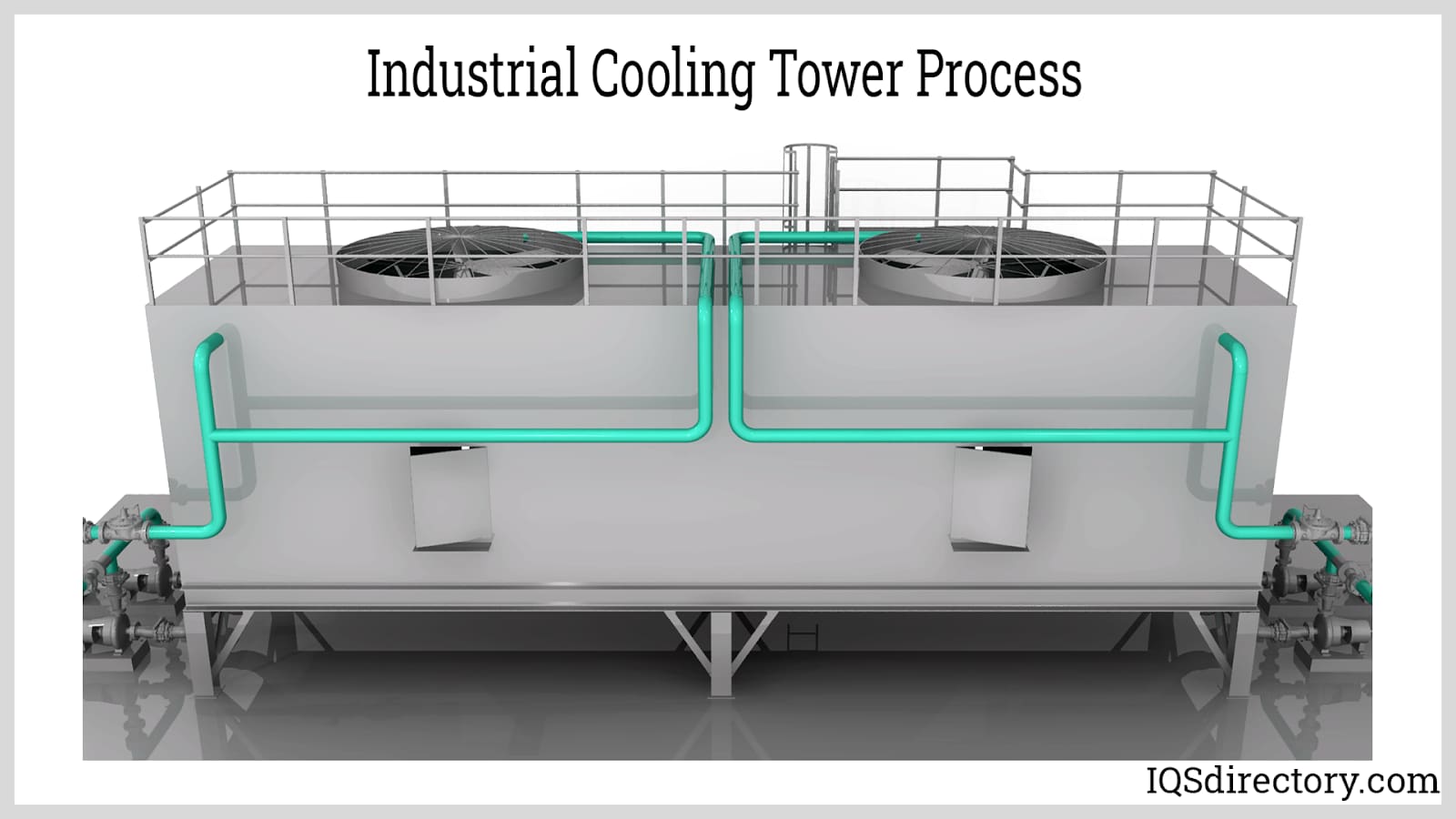
Chapter 1: How Do Open Loop and Closed Loop Cooling Tower Operating Principles Work?
This section explores the operating principle of both open loop and closed loop cooling towers, including how each system handles heat rejection, water circulation, and evaporative cooling in industrial applications.
An open loop cooling tower is a system where the water being cooled comes into direct contact with the surrounding air to dissipate heat. Because the process water is exposed to air, this type of evaporative cooling tower is often used where simple, cost-effective heat removal is the priority.
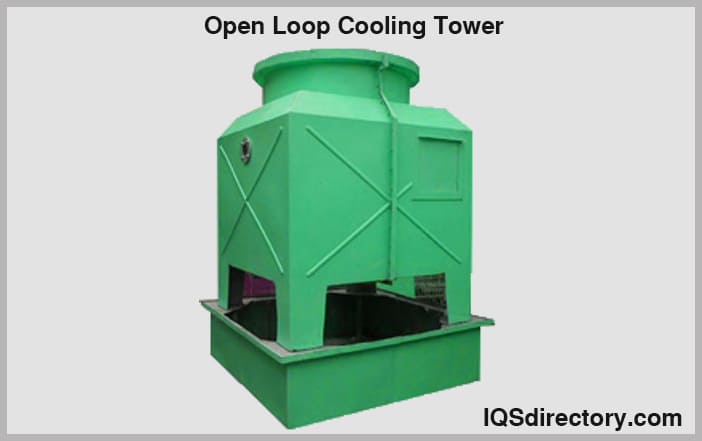
An open loop cooling tower utilizes direct interaction with the air to lower the temperature of the water. Functioning as a type of heat exchanger, it facilitates partial heat transfer through the exchange between air and water. Additionally, cooling is achieved through the evaporation of a small portion of water, enabling the system to reach temperatures below the surrounding ambient conditions. This design is commonly selected for HVAC systems, industrial cooling, and process water applications where makeup water and water treatment can be managed effectively.
How Open Loop Cooling Towers Operate
In the cooling tower, the water that needs to be cooled is introduced at the top. It is dispersed over the tower's packing through nozzles, creating a thin, uniform film across the packing material. This design increases the contact area significantly, enhancing the heat exchange process and improving thermal efficiency.
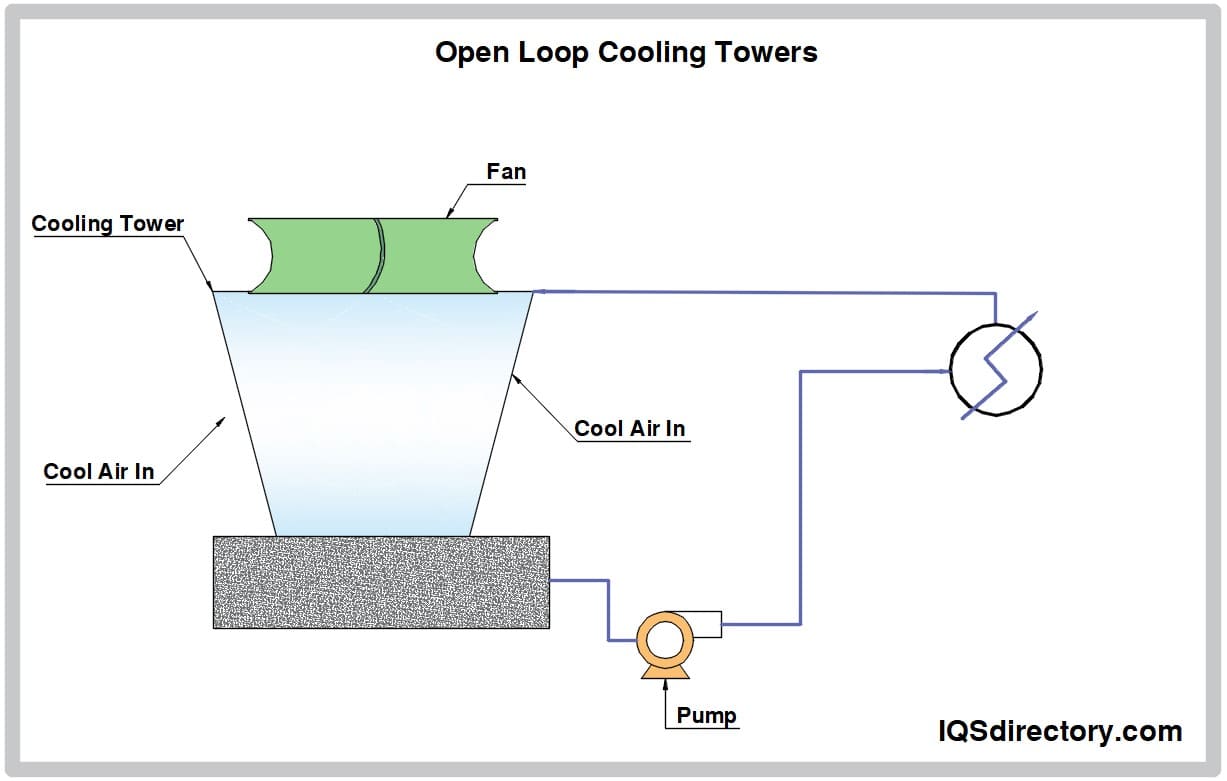
The fan either blows or pulls ambient air through the packing, depending on its design. This air cools the water through two main mechanisms: convection, where the heat is transferred from the warm water to the cooler air, and evaporation, which primarily reduces the water temperature. The moist air is then expelled from the top of the cooling tower. Meanwhile, the cooled water collects in a basin below for reuse in industrial processes. Drop eliminators positioned above the nozzles ensure that water droplets do not escape the cooling tower, helping reduce water loss, drift, and maintenance concerns.
Closed Loop Cooling Towers
Closed Loop Cooling Towers are heat dissipation systems where the water being cooled never directly interacts with the air inside the cooling tower. Instead, the system operates in a closed loop, keeping the water separate from the air and reducing the risk of contamination, scaling, and corrosion.
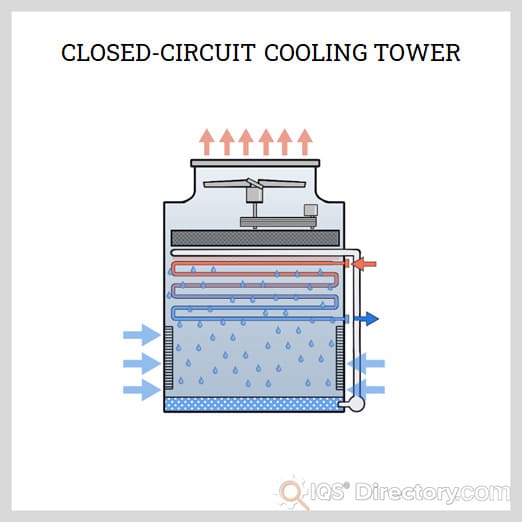
Closed loop cooling towers use an extra heat exchanger to manage heat transfer, unlike open loop systems where the water and air come into direct contact. Additionally, some cooling towers incorporate piping and plate heat exchangers to facilitate this process. This configuration is often preferred in applications that require cleaner process fluid, tighter temperature control, and lower water treatment requirements.
How Closed Loop Cooling Towers Operate
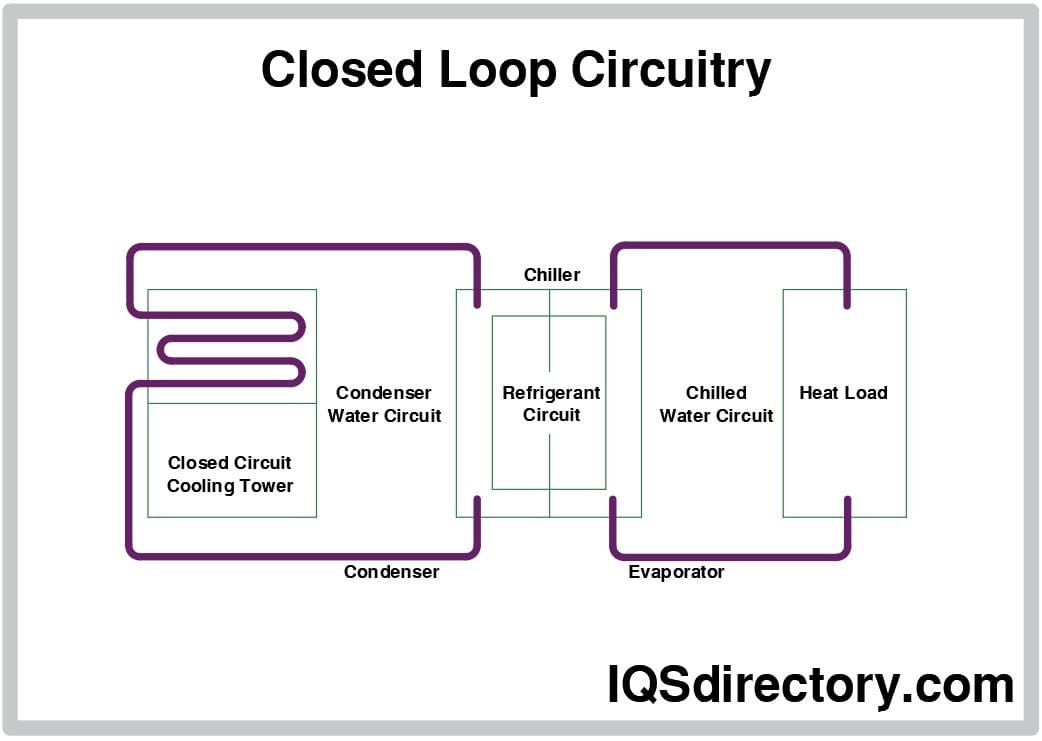
Closed loop cooling towers are similar and yet differ from open loop cooling towers. When there can’t be direct contact between the water that needs to be cooled down and the air (e.g. in food industries), it is necessary to employ a heat exchanger. The heat exchanger separates the processed water to be cooled down from the cooling tower’s evaporation water. This prevents the processed water from getting into contact with the air. In closed loop cooling towers, it might be necessary to use antifreeze, whereas in open loop cooling towers antifreeze is unnecessary. Closed circuit cooling towers are often chosen for sensitive processes, chilled water systems, and facilities where fluid cleanliness and reliability are critical.
Closed Loop Cooling Tower Process Side
The water needing cooling passes through a heat exchanger, which is constructed from stainless-steel plates and located in a separate room adjacent to the cooling tower. Within this heat exchanger, heat is transferred from the process water to the cooling water. As a result, the process water is cooled and can be reused, creating a closed-loop system where cooling water circulates between the heat exchanger and various users like condensers and production equipment. This arrangement supports stable operation, improved energy efficiency, and reduced exposure to airborne debris.
Closed Loop Cooling Tower Side
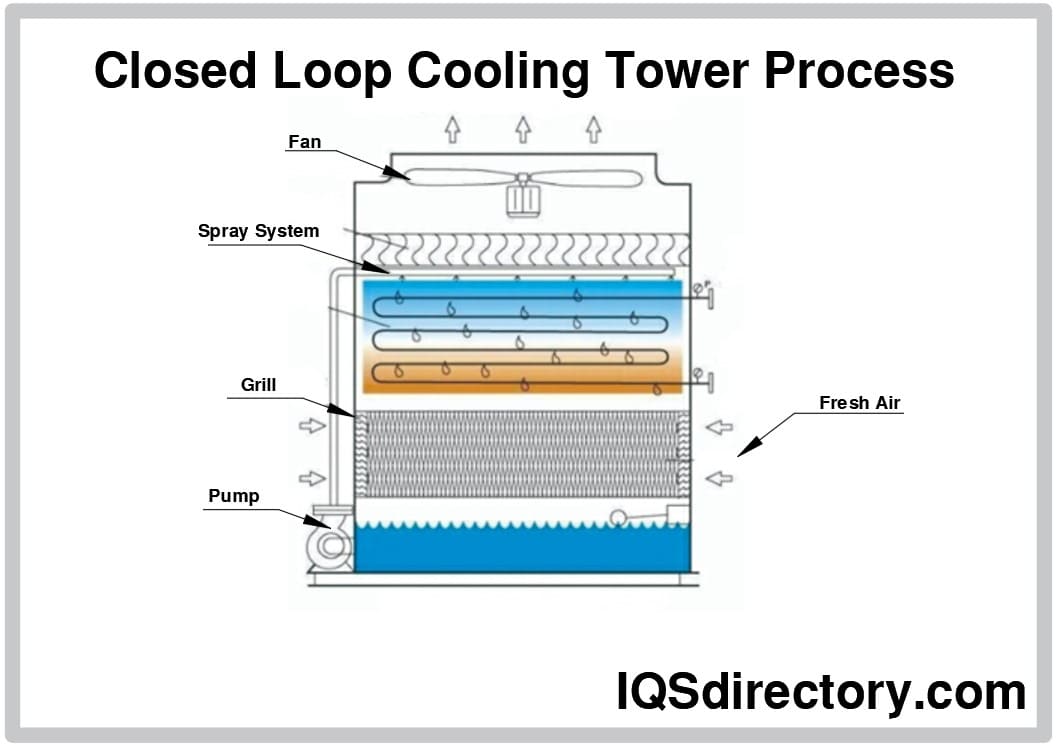
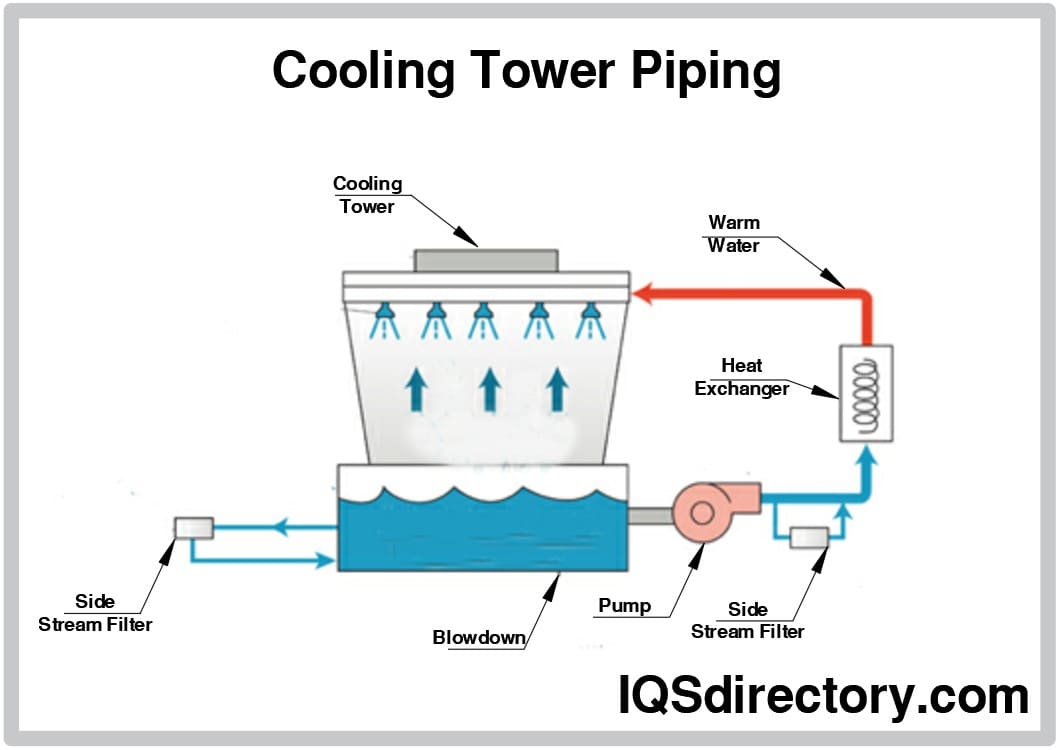
Once the reheated water exits the plate heat exchanger, it is channeled via piping to the top of the cooling tower. The water is then spread over the tower packing by nozzles. As it descends through the packing, it cools and collects in a basin. From there, it is pumped back to the heat exchanger for reuse. In the heat exchanger, the water is cooled by air that flows in countercurrent through the tower. This air absorbs heat and becomes saturated before being expelled through the tower’s top. Drop eliminators above the nozzles prevent water droplets from escaping the cooling tower, supporting efficient operation and minimizing drift losses.
Factors Affecting Open Loop and Closed Loop Cooling Tower Performance
The efficiency of open loop and closed loop cooling towers can be influenced by several factors, such as:
Temperature Range
The range refers to the temperature difference between the incoming hot water and the outgoing cold water at the cooling tower. For example, if hot water enters at 100°C and needs to be cooled to 80°C, the range is 20°C. Increasing the range can help lower both the initial investment and operating costs of the cooling tower. In system sizing, range is a key parameter because it directly affects tower capacity, pump selection, and overall heat rejection performance.
Heat Load
The heat load of a cooling tower is influenced by the specific process it supports. The required level of cooling is dictated by the target operating temperature. Generally, a lower operating temperature is preferred to enhance process efficiency or improve the quality and quantity of the product. Conversely, higher temperatures may be beneficial for certain applications, such as in internal combustion engines. An increased heat load necessitates a larger and more expensive cooling tower. While process heat loads can be challenging to measure accurately due to their variability, heat loads in refrigeration and air conditioning are typically easier to quantify with precision. For buyers comparing cooling tower options, understanding the duty rating, flow rate, and expected seasonal load is essential before selecting a model.
Wet-Bulb Temperature (WBT)
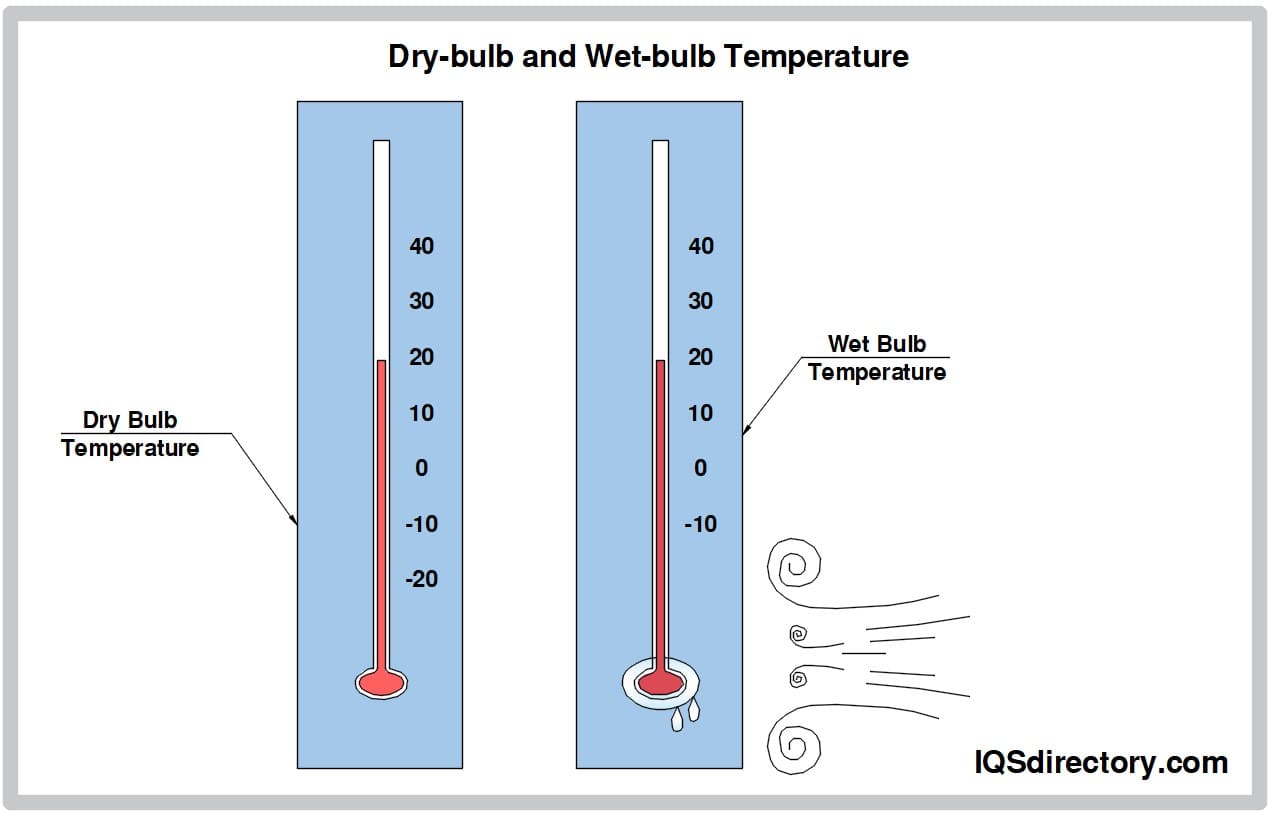
The wet-bulb temperature indicates the local temperature conditions by using a thermometer with its bulb wrapped in a moist cloth. This reading is compared to the 'dry bulb' temperature (DBT), which is taken from a thermometer with a dry bulb. By comparing these two readings, and referring to a psychrometric chart or air properties table, the relative humidity can be calculated. Typically, the wet-bulb temperature is lower than the dry-bulb temperature, except when the air is fully saturated with water, known as 100% relative humidity. In such cases, the wet-bulb and dry-bulb temperatures are the same. Because wet-bulb temperature is a major design criterion, it is often used to determine cooling tower selection, thermal performance, and expected outlet water temperature.
A cooling tower cannot reduce the temperature of the hot process water below the wet-bulb temperature of the incoming air, which also represents the dew point of the air. It is not feasible to design a cooling tower that cools water to a temperature equal to or lower than the ambient wet-bulb temperature. Each cooling tower must be tailored to the specific wet-bulb temperatures experienced in its location during summer. High-efficiency mechanical draft towers can typically lower water temperatures to within 5 to 6°F of the wet-bulb temperature, while natural draft towers usually achieve temperatures within 10 to 12°F of the wet-bulb temperature.
Typically, it is assumed that the wet-bulb temperature of the ambient air reflects the temperature of the air entering the cooling tower. However, this assumption holds true only if the cooling tower is positioned away from any heat sources that might elevate the local temperature. Ideally, the ambient wet-bulb temperature should be measured from 50 to 100 feet upwind of the tower, at a height of 5 feet above the base of the tower, without any interference from nearby heat sources. In practice, very few cooling tower setups meet this precise criterion, which is why real-world performance testing and site-specific engineering are so important.
Temperature Approach
The term "approach" refers to the difference between the temperature of the water exiting the cooling tower and the wet-bulb temperature of the incoming air. To determine the approach, subtract the wet-bulb temperature of the ambient air from the temperature of the water leaving the tower. For example, if a cooling tower produces water at 86°F while the wet-bulb temperature is 79°F, the approach is 7°F.
Approach is a key performance indicator for a cooling tower, as it sets a limit on how low the temperature of the outgoing cold water can be, independent of the tower's size, heat load, or range. The temperature of the water cannot fall below the wet-bulb temperature of the surrounding air. When the wet-bulb temperature drops, the temperature of the water leaving the cooling tower will also decrease proportionally, provided that the flow and range remain constant. Typically, the approach temperature ranges from 5 to 20°F, meaning that the outgoing cold water temperature will always be 5 to 20°F higher than the ambient wet-bulb temperature, regardless of the cooling tower's capacity or heat load.
Reducing the approach temperature requires a significantly larger cooling tower, with the size increasing exponentially as the approach decreases. Cooling towers with an approach below 5°F are generally not cost-effective, and manufacturers typically do not guarantee performance for approaches lower than this threshold. Buyers should also compare operating costs, water consumption, drift eliminator effectiveness, fan horsepower, and maintenance requirements when evaluating open circuit and closed circuit cooling tower designs.
Calculations Involved in Cooling Towers
Approach is calculated using the formula: Approach = CWT - WBT, where CWT represents the temperature of the cold water and WBT denotes the wet-bulb temperature.
Range is determined by the formula: Range = HWT - CWT, where HWT stands for the temperature of the hot water and CWT represents the cold water temperature.
To calculate cooling tower efficiency, use the formula: Efficiency = (Range / (Range + Approach)) * 100.
Chapter 2: What Are the Components of Open Loop and Closed Loop Cooling Towers, and What Functions Do They Serve?
This section will cover the various components of both open loop and closed loop cooling towers and explain their respective functions.
Cooling Tower Instrumentation
Most open loop and closed loop cooling towers consist of the following instrumentation systems: blow down rate; flow meters for cooling tower makeup water; water level switches for hot and cold water basins; vibration switches; high and low level switches; thermocouples for the measurement of the temperature of hot and cold water; and high and low oil level switches.
Cooling Tower Fan Motor
In refinery and petrochemical cooling tower applications, explosion-proof fan motors are essential because of the risk of leaks from heat exchangers. Additionally, these motors need to be equipped with protective systems, including overload relays and earth fault relays, to ensure safety and reliability.
Cooling Tower Nozzles
Cooling tower nozzles are typically crafted from various plastics, such as polypropylene, ABS, PVC, and glass-filled nylon. These nozzles are designed to evenly distribute hot water throughout the cooling tower's cell.

Distribution Valves
These valves control the flow of hot water to ensure it is distributed evenly within the cells. They are designed to withstand harsh, corrosive conditions.
Drive Shafts
They deliver power from the motor’s output shaft to the input shaft of the gear reduction unit.
Gear Box
They reduce the magnitude of the speed depending on the requirements of the cooling tower. The gear reducer, motor and driveshaft are permanently alighted by the torque tube.
Cooling Tower Louvers
Cooling tower louvers, typically constructed from asbestos sheets, serve two main purposes: (i) to prevent the loss of circulating water within the tower, and (ii) to evenly distribute the airflow into the fill media.
Fan Cylinder and Fan Deck
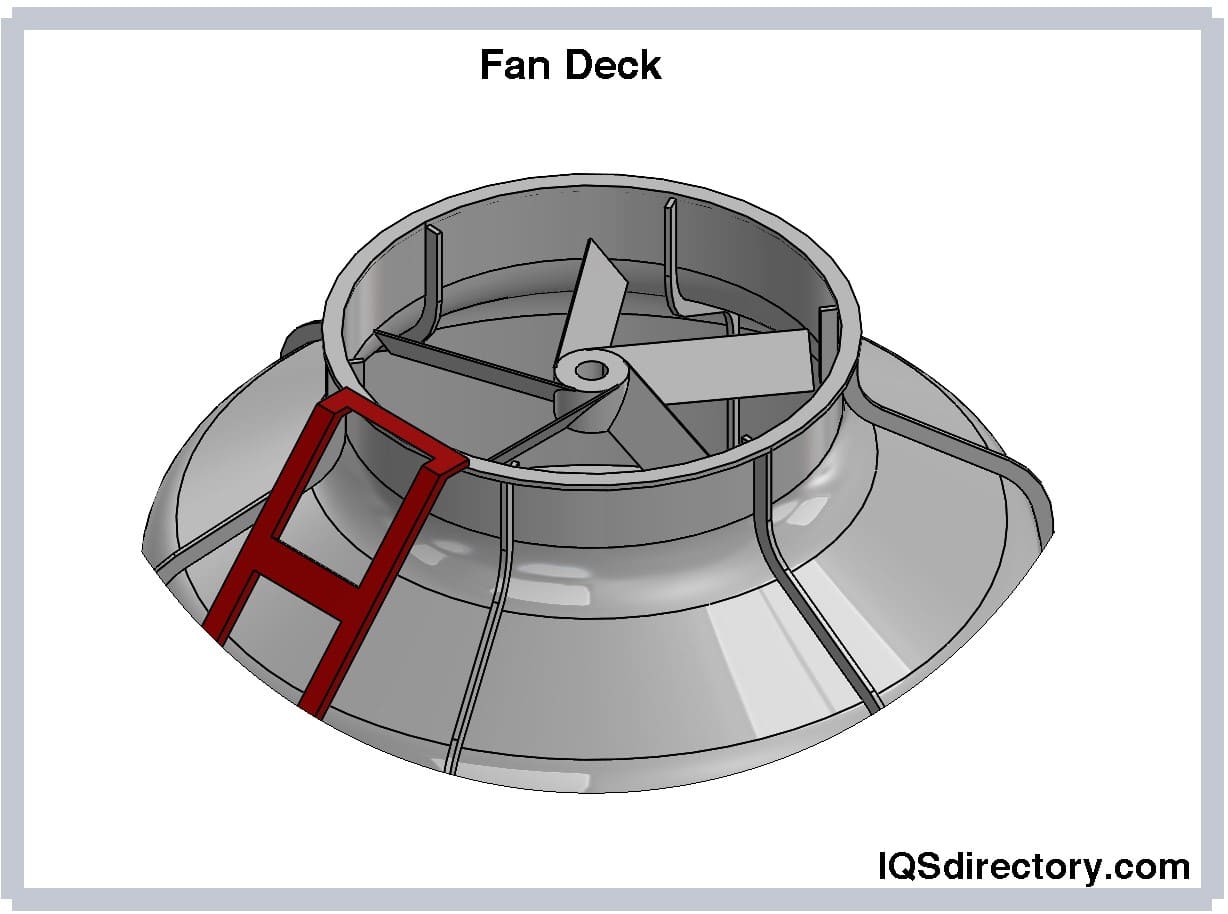
This serves as a support structure for the fan cylinders and offers easy access to both the fan and the water distribution system.
Water Distribution Piping
It must either be buried underground or properly supported on the ground to avoid thrust loading on the cooling tower. This thrust loading is due to the pressure exerted by the water in the pipe and the weight of the pipe itself.
Cooling Tower Fans
Cooling tower fans are crucial components in both open loop and closed loop systems. Common materials used for these fans include fiberglass, hot-dipped galvanized steel, fiber-reinforced plastic (FRP), and aluminum. Fiber-reinforced plastic is often preferred due to its lightweight nature, which helps to reduce the energy consumption of the fan. The blade angles of cooling tower fans are adjusted based on the season. For example, during the summer, when air density is lower, the blade angle is increased to enhance fan capacity.
Cooling Tower Structure Materials
Most open loop and closed loop cooling tower structures are constructed from chemically treated wood. However, depending on the specific application, some cooling towers are now built using fiber-reinforced plastic (FRP) or reinforced cement concrete.
Cold Water Basin
Cold water basins, typically constructed from reinforced cement concrete (RCC), serve two primary functions. First, they act as reservoirs for collecting and storing water from the cooling tower. Second, they provide the foundational support for the cooling tower structure. These basins are generally positioned either below ground level or on the surface of the soil. The height of the cooling tower, whether open loop or closed loop, is determined by measuring the distance from the top of the water basin to the fan assembly.
Drift Eliminators
Drift eliminators are designed to minimize the amount of water carried away by the exhaust air in a cooling tower. By directing the air flow in multiple paths, these devices reduce water loss. Typically made from PVC, drift eliminators work by increasing the number of air passes through them, which lowers drift loss but also raises pressure drop, thereby increasing fan power consumption. In large-scale industrial settings, more robust drift eliminators are employed to handle the demands.

Cooling Tower Fill Media
In open loop and closed loop cooling towers, the fill media facilitates the contact between air and the water surface. This media helps the water spread into thin, flowing layers, maximizing the surface area exposed to the air flow. Fill media is typically made from materials such as polypropylene, wood, or PVC. There are three primary types of fill media: vertical offset fill, cross-corrugated fill, and vertical fill.
Chapter 3: What Are the Different Types of Open Loop and Closed Loop Cooling Towers?
This section will explore the different types of both closed loop and open loop cooling towers.
Types of Closed Loop Cooling Towers
Closed loop cooling towers can be categorized into the following types:
Adiabatic Cooling Towers
These closed loop cooling towers operate similarly to dry cooling systems, but they also incorporate pre-cooling pads. As water passes over the porous media, air is drawn through the pads to enhance cooling efficiency.

Dry Cooling Towers
These closed loop cooling towers are ideal for applications where water conservation and minimal maintenance are crucial. They do not require water treatment as they operate without using water.

Eco/Hybrid Cooling Towers
These closed loop cooling towers enhance efficiency by integrating both dry and evaporative cooling methods, which helps to minimize water usage.

Evaporative Cooling Towers
This variety of closed loop cooling tower removes the necessity for a heat exchanger between the heat rejection system and the process loop. By relying primarily on evaporation for cooling, these towers offer energy-efficient performance within a smaller footprint compared to dry coolers.

Closed loop systems enhance water conservation compared to open loop systems by significantly reducing the need for blowdown of basin water.
In dry mode, these units handle heat rejection up to their dry capacity. Once the load surpasses this threshold, the system transitions to evaporative mode, thereby boosting its cooling capability.
By reducing the temperature of the incoming air measured by the dry bulb, greater heat rejection is achieved. Consequently, adiabatic systems are ideal for hot, dry climates and are more water-efficient.
Types of Open Loop Cooling Towers
Open loop cooling towers can be categorized into the following types:
Cross Flow Cooling Tower
This cooling tower type is ideal for industrial uses. It features a design where air moves horizontally through the fill media, while water descends vertically.

Fan-Less, Fill-Less Cooling Towers
As the name suggests, the fan-less, fill-less cooling tower operates without a fan or fill media for cooling wastewater. Instead, it relies on ambient wind to pass through its cooling structure.

This type of open loop cooling tower features wooden louvers that act as sidewalls to prevent water from spilling. It is considered the most cost-effective option and demands minimal maintenance compared to other cooling tower types.
This type of cooling tower is typically employed in environments with dirty water, such as in oil refineries and chemical processing. It is designed to handle water contaminated with substances like ammonia compounds, fats, oils, and other pollutants.
Field Erected Cooling Tower
The field erected cooling tower is available for those industries or manufacturing plants that cannot find the right standardized design of cooling towers for their specific needs. This type of open loop cooling tower is custom made. It is constructed using pultruded fiberglass and it uses steel as fasteners, fiberglass reinforced polyester sheets for cladding, pultruded FRP sections.

Round/Bottle Cooling Towers
The round or bottle cooling tower is renowned for its advanced technology and highly efficient compact design. Available in various sizes, its circular shape promotes uniform airflow, ensuring optimal heat transfer across its surface area and unit volume.

This type of open loop cooling tower employs counter flow induced draft technology and features cross-corrugated PVC film for its fill media. Constructed from fiberglass-reinforced plastics, it is typically pre-fabricated at the manufacturer's facility and assembled at the installation site.
Square or Rectangular Cooling Tower
This cooling tower is one of the most well-known models. It also utilizes counter flow-induced draft technology, similar to the round cooling tower. It features heat transfer media composed of cross-corrugated PVC film fills.

The rectangular cooling tower is constructed from fiberglass-reinforced plastics, with architectural elements made of mild steel or hot-dipped galvanized steel. It comes in both single-cell and multi-cell configurations.
This type of cooling tower is suitable for both new and existing projects. Fiberglass-reinforced plastic (FRP) provides several benefits over traditional construction materials such as wood, concrete, and steel.
Frequently Asked Questions
What Is the Main Difference between Open Loop and Closed Loop Cooling Towers?
Open loop cooling towers directly expose the water to air for cooling via evaporation, while closed loop cooling towers keep water isolated from air, transferring heat through a heat exchanger.
Which Factors Most Influence the Efficiency of Cooling Towers?
Key factors are temperature range, heat load, wet-bulb temperature, and approach. These parameters set efficiency limits and determine the design and size required for optimal cooling tower performance.
What Are the Main Types of Closed Loop Cooling Towers?
Closed loop cooling towers include adiabatic cooling towers, dry cooling towers, eco/hybrid cooling towers, and evaporative cooling towers, each offering unique water conservation and efficiency features.
What Components Are Vital for Both Open Loop and Closed Loop Cooling Towers?
Key components include fan motors, nozzles, distribution valves, drive shafts, gear boxes, louvers, fill media, drift eliminators, piping, and cold water basins, each serving specific operational roles.
How Does Wet-Bulb Temperature Affect Cooling Tower Installation Location?
The ambient wet-bulb temperature, ideally measured upwind and above the tower’s base, sets the minimum achievable water temperature. Location-specific measurements are critical for proper cooling tower sizing.
Which Open Loop Cooling Tower Type Is Best for Dirty Water Environments?
Fan-less, fill-less open loop cooling towers are well-suited for dirty water found in oil refineries or chemical processing, offering cost-effective and low-maintenance operation for heavily contaminated water sources.
Chapter 4: AWhat Are the Primary Applications of Open Loop Cooling Towers?
This section will explore the various uses, advantages, and enhancements in efficiency associated with both open loop and closed loop cooling towers. It will also cover important factors to consider when selecting between these types of cooling towers.
Applications of Open Loop and Closed Loop Cooling Towers
Open loop and closed loop cooling towers can be applied in various scenarios, including:
- Power plants
- Petrochemical plants
- Petroleum refineries
- Natural gas processing plants
- Food processing plants
- Semiconductor plants
- Water cooled air compressors
- Die casting machines
- Refrigeration
- Plastic injection and blow molding machine
- Distilleries
Benefits of Open Loop Cooling Towers
Advantages of using open loop cooling towers are as follows:
- A lower approach can be easily achieved
- Lower initial cost due to the absence of the intermediate heat exchanger
- Easier expansion
Benefits of Closed Loop Cooling Towers
Advantages offered by closed loop cooling towers include:
- Contaminant-free cooling loop
- Dry operation in winter
- Ease of maintenance
- Lower overall system costs
- Reduced water loss through evaporation
- Reduced need for chemical treatment
- Protection of the process fluid’s quality
- Operational flexibility at a slightly higher cost at first
- They can provide totally dry sensible heat rejection which can extremely lower the overall consumption of water at a project
- Based on the switchover temperatures of a dry bulb, they can be sized for partial load or full design.
Improving Efficiency of Open Loop and Closed Loop Towers
To enhance the performance of both open loop and closed loop cooling towers, consider the following:
Installing New Water Piping
Adding a new pipe in necessary locations can boost energy efficiency, even if only a single section of new piping is required.
Ensuring That the System Is Recycling Water Properly
A cooling tower should recycle at least 98% of the water. If it fails to achieve this, maintenance is necessary. Efficient water recycling enhances both water and energy usage.
Increase Cooling Cycles
It's important to monitor the number of cooling cycles your tower operates. Increasing the cycles from three to six can notably improve efficiency and conserve water.
Chapter 5: What Factors Should Be Considered When Selecting an Open Loop or Closed Loop Cooling Tower?
Key factors to keep in mind when choosing between open loop and closed loop cooling towers include:
Heat Transfer Efficiency
In closed loop cooling towers, the heat transfer efficiency between the cooling water and the process can be optimized under peak design conditions. This is because closed loop systems use clean water, leading to an improved coefficient of heat transfer. Additionally, some closed loop towers may incorporate a separate intermediate heat exchanger. This setup simplifies maintenance and reduces overall capital expenses. Should any fouling occur, it will be confined to the intermediate heat exchanger involved in the heat rejection process, making it easier to address.
Lower Cooling Tower Approach
Open loop cooling towers can achieve a lower approach temperature with relative ease. It's important to consider that in these systems, there are two types of approaches to account for: one at the cooling tower and another at the heat exchanger. When aiming for a lower approach, open loop cooling towers are often advantageous.
Power Saving Operation
Return head can be used effectively since there is no exposure of cooling water to the atmosphere in closed loop cooling towers. The head that is needed for the circulation of the cooling water shall only be the resistance of the heat exchanger and the frictional head. The static head needed by the pump can be totally eliminated. Since the cooling water used for heat transfer is not exposed to the atmosphere, corrosion and scaling problems can be eliminated.
Volume of Water Treatment
Closed loop cooling towers feature two separate circuits, which results in a lower water volume for treatment purposes. This design allows for more efficient management of the water treatment process.
Corrosion and Other Water Related Problems
Closed loop cooling towers prevent corrosion in process heat exchangers by keeping the cooling water isolated from direct atmospheric contact. This isolation protects the water from contamination by airborne particles, thereby safeguarding the heat exchangers from corrosion and other issues associated with water exposure.
Maintenance Requirements
Although a standalone open loop cooling tower typically requires minimal maintenance, the overall upkeep of the complete cooling system, including pipes and heat exchangers, tends to be significantly higher compared to the maintenance needs of closed loop cooling towers.
Water Requirement
Both open and closed loop cooling towers rely on the process of water evaporation to function. For a given heat load, both types of towers require a similar volume of water. However, closed loop cooling towers can provide an advantage in terms of reducing water consumption, thanks to their design that incorporates air/dry cooling features.
Capital Investment
Open loop cooling towers generally involve lower initial costs because they do not include an intermediate heat exchanger.
Operational Cost
Operating closed loop cooling towers is cost-effective thanks to their enhanced operational stability, reduced pumping power requirements, and overall efficiency improvements.
Expansion Flexibility
While open loop cooling towers are simple to scale up, closed loop systems demand advanced design expertise due to the incorporation of an intermediate heat exchanger.
Conclusion
Each class of cooling tower, either open loop or closed loop, has different types of designs with different capabilities and advantages. Therefore when picking an open loop or closed loop cooling tower for a specific application, one must consider the design specifications that meet the application requirements.